
Hiking near Matterhorn – radial trek routes, hotels and campsites, entertainment in Zermatt, transport in Switzerland and how to get to Zermatt.
In order to recover during the war, to restore one’s mental health, it is necessary to spend as much time in nature as possible. Why do I think so? Because I personally feel the healing power of walking, hiking in the mountains and fresh sea air.
I have many useful articles about hiking and trekking. I will also add the Alps to this list: Swiss, French, and Italian Dolomites, which are now also accessible to a large number of Ukrainians. I will start with Switzerland and our hikes near the Matterhorn.
Switzerland is an incredibly beautiful, ecologically clean mountain country. You can visit in winter and in summer: skiing and hiking along alpine routes. We went to Switzerland for the sake of hiking near Matterhorn – this massive pointed mountain looks very epic. That’s why we decided to go to the small, environmentally friendly town of Zermatt, from where we took day hikes for several days near Matterhorn.
Zermatt – a base for radial routes

Zermatt is a tourist and ski resort located at the foot of the Monte Rosa ridge and its most famous peak – the Matterhorn. This rock, standing at 4478 m, attracts not only professional mountaineers. The Matterhorn is so beautiful that people of all ages, builds, and health travel to Zermatt just to see this natural wonder and enjoy the beauty of the mountains.

In summer, Zermatt is the ideal place for those who love active recreation. There is a rich choice of hotels and a large number of hiking and walking routes through moderate alpine meadows and forests. There are also challenging routes leading up to altitudes above 3000 m.

Zermatt is surrounded by stunning nature: clean coniferous forests and waterfalls, the most powerful glaciers, and meadows covered with a carpet of flowers. And above it all soars the beautiful Matterhorn, which constantly attracts the gaze of tourists and locals alike.
What to do in Zermatt besides hiking in the mountains

For those who don’t want or can’t climb high into the mountains, there are plenty of other activities in Zermatt. First of all, there is already plenty to see in the center of Zermatt. Here you will find old wooden houses, which were once homes to villagers. The unusual architecture of the wooden cottages, built from wood darkened by time. But despite the fact that they were built 300-400 years ago, they still remain sturdy.
Also, if you’re not interested in hiking, in Zermatt you can do the following things:

- Visit the Matterhorn Museum – here you can learn about the history of climbing this mountain. Near the museum, you can see a monument to the first mountaineer who climbed the Matterhorn.
- Take the mountain train to the Gornergrat observatory. It is located at an altitude of 3200 meters – even in summer wear warm clothes because it can be cold here, and there may still be snow.
- Play tennis on tennis courts
- Wake park for adults and children
- Shopping on the main street Bahnhofstrasse – here you can buy everything: from souvenirs to nearly any tourist gear. And also have coffee or dine in restaurants.
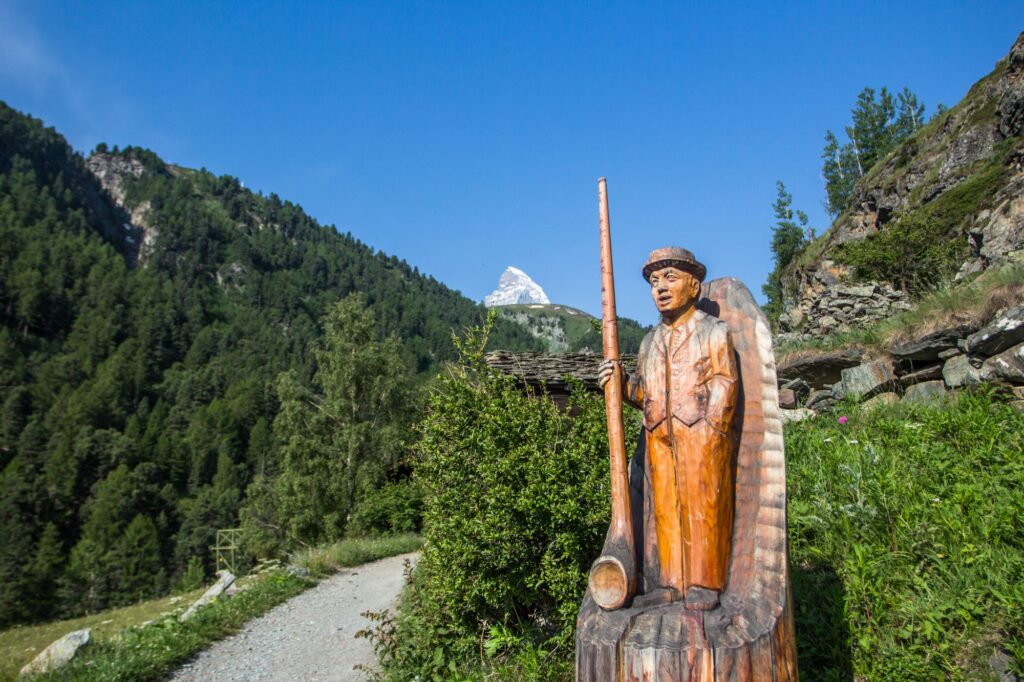
- In the evenings by the town hall, local musicians play the alpine horn – wooden five-meter-long horns.
- In Zermatt there is a daily ritual: a herd of alpine goats with bells on their necks pass through the town, accompanied by young shepherd boys in national costumes.
Routes near Matterhorn

There are a large number of hiking routes near Zermatt – all of them are marked on Google Maps and Maps.me maps, and well marked on the ground, so it’s impossible to get lost. But I’ll tell you about the routes we took near Matterhorn.
The special feature of hiking near Zermatt – you can hike up and down, and you can also use mountain trains or lifts for part of the route. If you like more difficult sections, there are routes leading to glaciers and rocks. On mountain trails you’ll often find benches for resting, placed in especially beautiful spots, offering wonderful views of the valley or the peaks. In Zermatt you can hire a guide if you decide to climb to the top of Matterhorn.
Route to the Matterhorn Glacier
The route is about 16 km and takes the whole day.

We started it right from Zermatt: walked to the end of the town, then continued along the Edelweissweg trail to the neighboring village of Z’Mutt.

Next, we walked along the Staudamm Zmuttbach reservoir and climbed up to Lake Schwarzsee following the Weisse Perle trail. We rested here a bit and then headed towards the glacier and its huge moraine. This route is marked on the map and on signposts as the Matterhorn Glacier Trail.

In fact, the Matterhorn glacier and its moraine are a huge trench carved out by thousands of years of glacial movement, which have now almost melted away. Underfoot is a mix of gravel, snow, clay, and sand. And something keeps cracking and crunching towards the summit.

Be prepared that even in July there is a lot of snow here, but part of the route is already thawing and this is soft soil mixed with stones. You need waterproof footwear with Vibram soles that do not slip on slippery rocks.
The route passes by lakes that form from melting glacial waters. But in July they were still covered with ice and snow. So we barely saw them.

We walked along the Matterhorn Glacier Trail almost the whole day, so we decided to finish it at the Trockener Steg lift station. Then we went down to Zermatt in about five minutes.
Route to Gornergrat and Lake Riffelsee
As I mentioned above, a mountain train goes up to the Gornergrat observatory. But we wanted to hike up there and see Lake Riffelsee on the way, in which the Matterhorn’s summit reflects.

But if you are not interested in constantly trudging uphill, seeing waterfalls, mountain chapels, helipads and so on, of course you can take the train. The starting point for the Gornergrat is in Zermatt almost opposite the train station square. The mountain train runs about three times an hour in high season, once an hour in low season.
We started our hiking route almost at the same place – from the campsite where we stayed for three days. Climbing up, we left Zermatt’s residential area on a trail that goes through a gorge spanned by a railway bridge. And next to it we saw a huge waterfall – as soon as you leave the town, you are already surrounded by beautiful nature.

Next, the trail took us to the Riffelalp Resort 2222 – a hotel located at 2222 meters above sea level, next to which the mountain train to Gornergrat passes by. Here we rested, drank tea, watched people arrive on holiday in private helicopters, and continued on.

The next stop on this route is Lake Riffelsee, in which the Matterhorn peak is reflected. I really wanted to see this sight and we were lucky the clouds did not completely cover the mountain.

Then we walked along the moraine of the Gornergrat glacier and climbed up to the observatory. On the way we saw mountain goats hanging out by a water source. They were almost three meters away from us.

From Gornergrat we returned to Zermatt by mountain train, because we were very tired and I had a bit of altitude sickness. In the evening the price of the train is lower than during the day – the discount was very timely.
Accommodation in Zermatt – hotels and campsites

Zermatt has a huge selection of hotels located both in the center and on the outskirts of the town. Renting apartments will cost a bit less – this is especially beneficial for a large family with children.
Budget hotels in Zermatt on Booking.com:
- Hotel Bahnhof – a beautiful hotel, clean room, cozy, great view, you can see the Matterhorn from the terrace. Close to the railway station, shops.
- Hotel Cheminee – superb location, very clean and cozy place, close to the city center and the main lifts.
- Hotel Alphubel – conveniently located hotel not far from the station. The hotel is clean and cleaning is done every day. Breakfast – buffet, small selection but all the essentials and very tasty. Nice view from the balcony
Transport – how to travel in Switzerland?

A branched network of railways runs across all of Switzerland, serviced by environmentally friendly electric trains. There are high-speed expresses that can get you to any point in Switzerland within a few hours. And small mountain trains, equipped with a cogwheel drive, that take you up to high peaks, remote settlements, and even glaciers. Switzerland is also famous for its panoramic trains, whose glass windows and roofs allow you to admire the mountains right above your head.
By car to Zermatt
You can travel Switzerland by train (that’s what we did), or rent a car. If your plans include more than just hiking, a car will be more convenient than a train. But you should know one thing about Zermatt and cars:
You cannot get to Zermatt by car – this town is one of the most environmentally friendly on the planet. Only electric cars and trains run here. You’ll have to leave your car in the neighboring village of Täsch, which is 5 km from Zermatt. After that, take a train or arrange a hotel transfer to Zermatt.
Trains in Switzerland

Trains in Switzerland are a separate topic. There are plenty of ways to save. For example, you can buy a Swiss Pass, which allows you to ride all days on trains and save on lifts. With the Swiss Pass you can use any type of transport, united in the Swiss transport system, getting a 15% discount on trams and trains, buses and steamers, ride panoramic trains such as the Glacier Express, Bernina Express, Golden Pass, and also numerous excursions, mountain railways and lifts.
Saving with the Swiss Pass
Swiss Passes come in standard and Flexi versions. The difference is that the standard pass is valid for consecutive days starting from a certain date, while with Flexi, you can choose the days yourself. For example, buying a four-day pass, you can use any four days within a month. You can choose the one that suits you best from several types of Swiss Pass subscriptions. Swiss Pass subscriptions are sold for 4, 8, 15, 22 days or for 1 month. The more days you use it, the cheaper the cost of one day of travel.
Swiss Half Fare Card – a card that gives you a 50% discount on most routes. It costs 100 euros and is valid for one month. The Swiss Youth Pass allows young people under 26 to travel on any Swiss transport with a 25% discount. Children up to six, accompanied by adults, travel for free. The Swiss Pass is a universal key that opens up many opportunities for you to truly enjoy Switzerland. Full information about passes can be found on the website www.swisstravelsystem.com
Prices in restaurants start from 15-20 euros per dish, a cup of coffee from 3 euros. But in Zermatt there are several supermarkets where you can buy all the necessary products. And if you stay in a pension with self-catering, this will also save your budget.
Websites I used to plan the route
- Swiss Railways – www.sbb.ch
- Zermatt website – lots of useful information www.zermatt.ch
- Swiss mountain sports website – map.wanderland.ch
- All about Swisspass and how to save on transport in Switzerland – www.swisstravelsystem.com
- Train to Gornergrat – www.gornergratbahn.ch
Logistics – how to get to Zermatt?
To get to Zermatt, you need to take a train to the town of Visp, from where there is a train to Zermatt every hour. We took the international train Milan-Geneva-Visp.
Useful articles and links:
- Chamonix – summer holidays with a view of Mont Blanc
- PR1 Vereda do Areeiro – a walking route in Madeira to reopen after two years of closure
- My Camino Primitivo – way from Oviedo to Santiago de Compostela
Travel insurance – online at HotlineFinance
Booking hotels and apartments – Booking.com