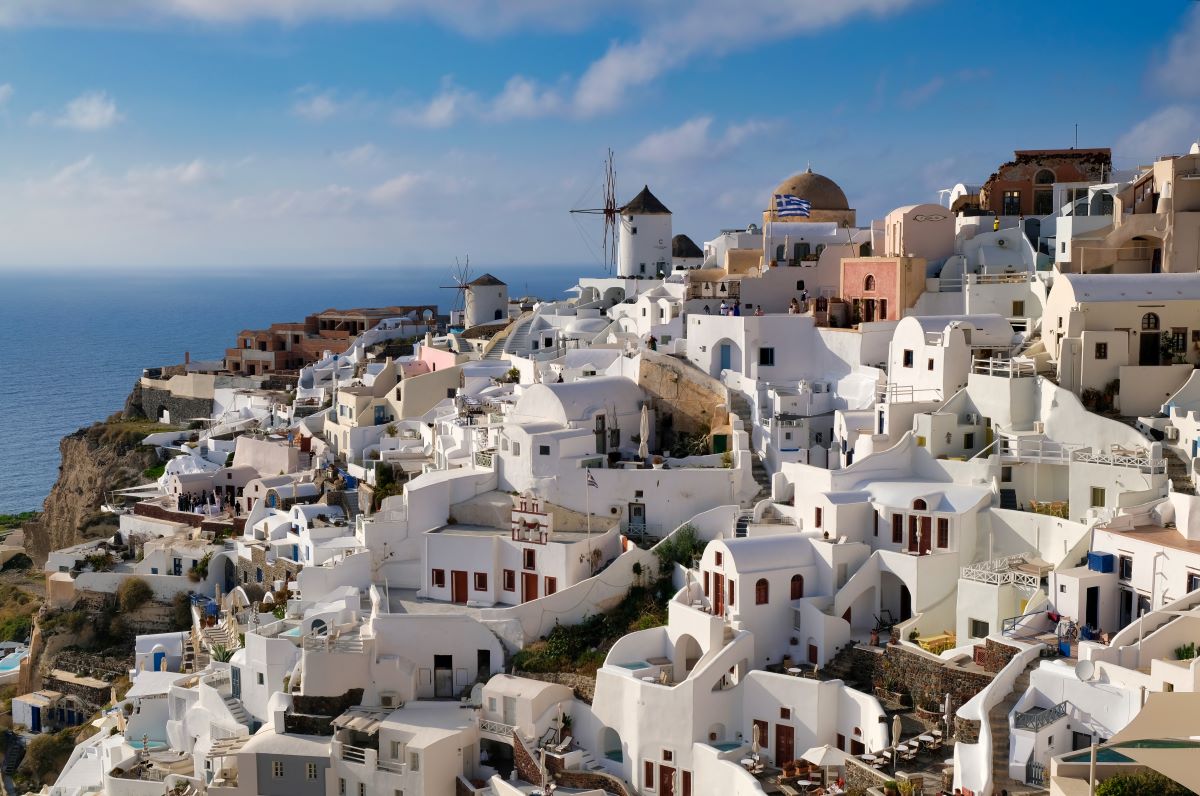
The volcanic island of Santorini is unlike other Greek islands. There is almost no greenery here, but the bizarre rock formations and multicolored beaches leave unforgettable impressions. The sunset against the background of the white village of Oia and boat rides along the rocky shores – Instagram-style romance can be found in every location. If you want to avoid queues for stylish photos with the sea and rocks in the background, you should go to Santorini in April, before the tourists arrive.
Speaking from personal experience – what to do in Santorini if you decide to spend 5–7 days here in spring.
A bit of history and geography – to understand what the marvel of Santorini is
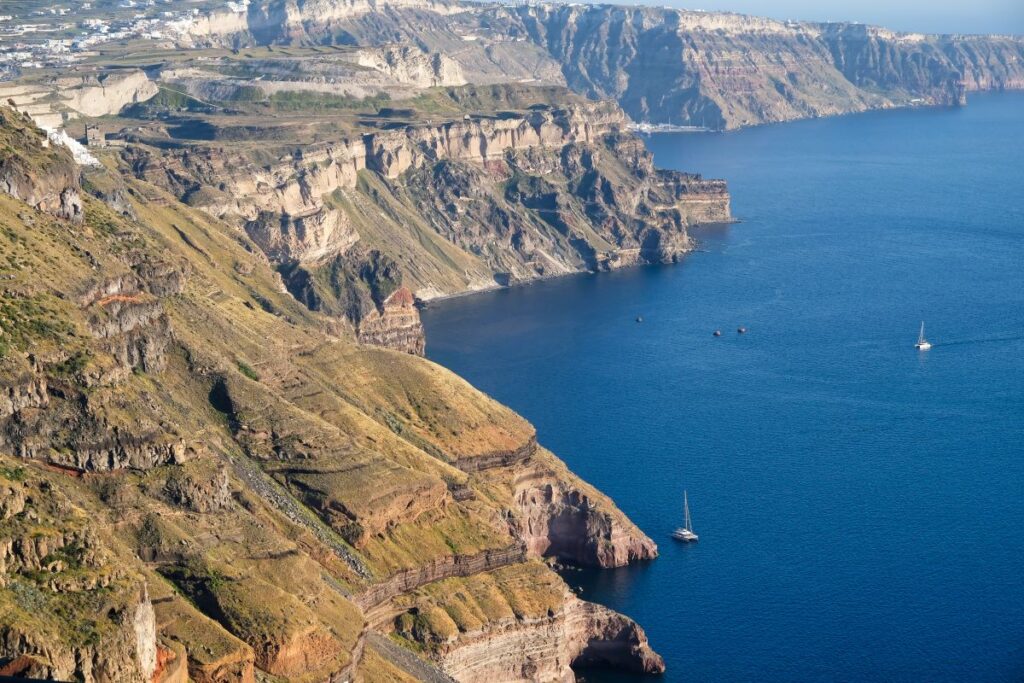
Five thousand years ago, in the place of Santorini was the large island of Thera, which was the cradle of the Minoan civilization. Santorini is a volcanic island formed by an eruption in the 15th century BC. And it was precisely this terrible catastrophe, which destroyed the Minoan culture and civilization, that gave it its crescent shape.
A large section of land went underwater – a volcanic caldera formed in the center, which was filled with seawater. Later, people settled the volcanic island again, naming it after Saint Irene — Santorini.
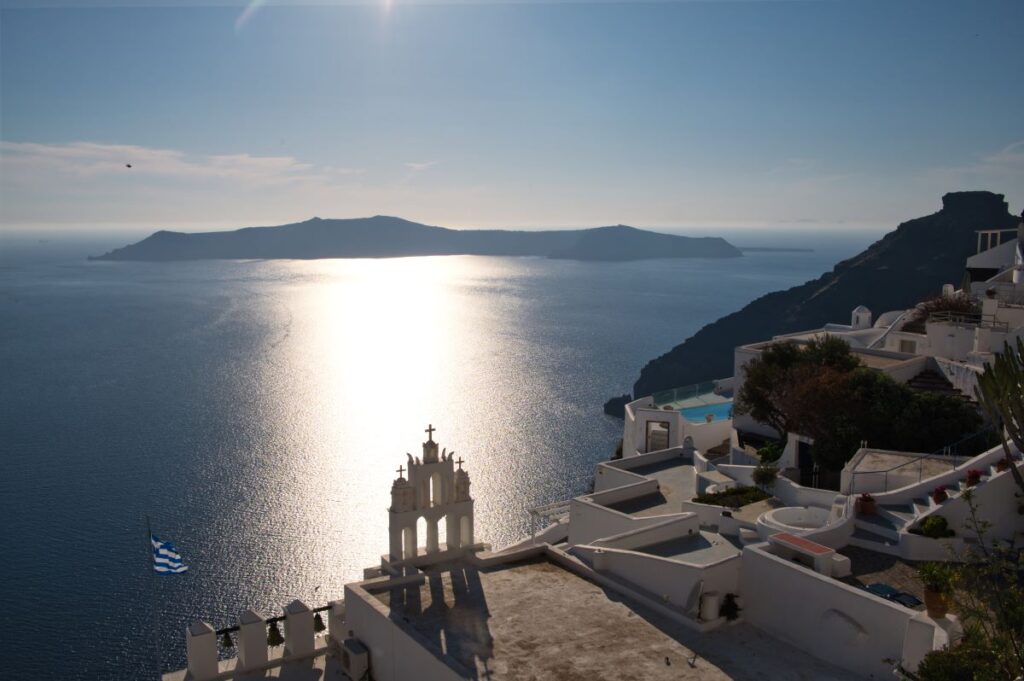
Opposite the main island of Santorini are four small islets: Hea-Kameni, Palea-Kameni, Thirassia, and Aspronisi. Today, Santorini and the caldera with its neighboring islands is one of the most popular Greek resorts in Greece. In summer, thousands of tourists come here, and cruise ships dock at Santorini’s shores—many want to see the wonderful island, its beaches, and its white villages with their own eyes.
When to go to Santorini
It’s warm all year round in Santorini – there are no frosts here. The tourist season lasts eight months – from the end of March until November.
In winter, fewer tourists come here (mainly Greeks and neighboring Turks), and therefore many taverns and cafes are closed, buses run less frequently, and life slows down a bit. Also, in winter, the cable car from the Old Port to Fira does not operate.
But in the spring, from April, everything gets lively again as the weather becomes cloudless, the sea gets a little warmer, and the towns gradually begin to fill up with tourists. Air temperature by late April reaches 20–23 degrees, and the water warms up to 18–19 degrees (checked myself). Cafes and restaurants are already open, excursions as well, but, for example, there are no crowds on boats, or at the volcano – everything is very relaxed and pleasant.
In summer, in July–August and even in September – it is peak, high season with correspondingly high prices and large numbers of people on the island. There are incredibly many people – crowds everywhere, especially at viewpoints for the sunset. You have to book tables in restaurants, and everything in that spirit.
Autumn – from mid-September through October – is the ideal time for a vacation, with everything still open. And the water is warm like just-milked milk. But the crowds can also be quite large.
How to get to Santorini
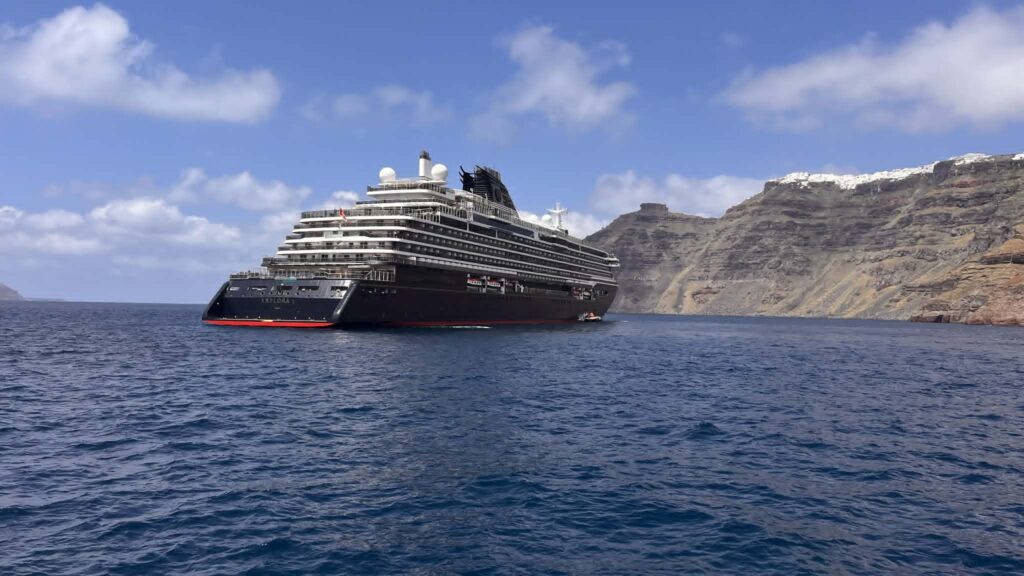
There are several options for getting to the island: by plane, by ferry, by plane to Crete or Athens + ferry.
Fly by plane, for example, from Athens or Thessaloniki with Ryanair – from €25 round trip with hand luggage (ticket prices mid-April).
Getting to the island by ferry – from €20 to €100 (depending on the type of ferry, the journey will take from 1.5 to 7 hours). Ferries to Santorini operate from different directions, it’s most convenient to get there from Crete. The high-speed ferry costs about €100 – it takes 1.5 hours. A slow ferry, which carries cars, trucks, and passengers, takes about 5.5 hours in calm, windless weather, and costs from €20 per ticket.
You can search for ferries on the aggregator site Ferries.gr, but buy your ticket directly from the chosen ferry company’s website.
My experience getting to Santorini
I flew to Crete from Bucharest (you can fly from Chisinau or another European city), and from there I reached Santorini by ferry. This option is considered the fastest and most popular. Especially for those vacationing on Crete’s beaches and wanting to visit Santorini for a few days.
I could have chosen the high-speed ferry Seajets and reached Santorini in 1.5 hours. But I was afraid of storms, which can cause the high-speed ferry to be canceled, so I chose the slower Blue Star Ferries – bought a ticket for €20 without a seat, and slept in the common lounge on a sofa.
How much time to spend on Santorini
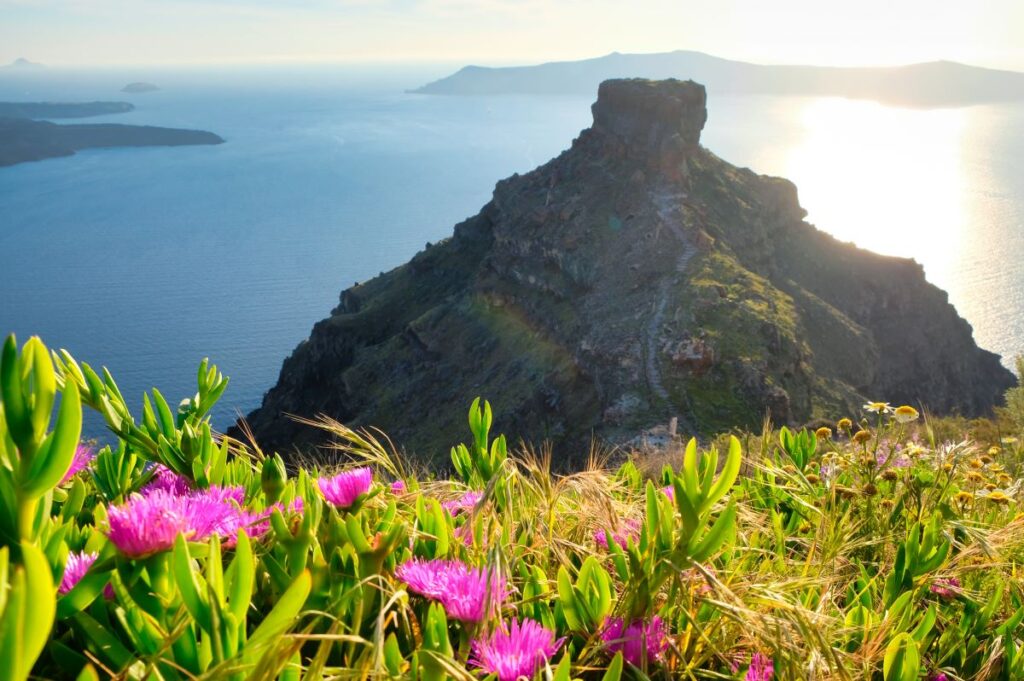
Santorini is considered a one-day island – I think this is a huge mistake.
Why do people think this about the island? Because many tourists visit it as a day trip from Crete, or as cruise ship passengers, who dock near Santorini for a day.
I believe that the island deserves to be seen from different sides, not just Oia or Fira; you should see the volcano islet, the multicolored beaches, the small villages far from the caldera, and view the world-famous Santorini sunset. But this can’t be done on a one-day tour.
In 3–5–7 days you can really explore the island, depending on which means of transport you use. By car it’s faster, by bus it’s slower, with time relaxing at the beach – you can easily allocate a week for Santorini.
So, the towns Oia (or Ia), Fira (the capital), the villages of Firostefani, Imerovigli, and the Skaros rock, the towns of Perissa, Akrotiri, Pyrgos, the Akrotiri archaeological area, Ancient Thira – all of this you need to find time to see with your own eyes.
And also Thirassia – the second largest island of the Santorini archipelago, to which the fast Seajets ferries run 4 times a day. And the Santo Wines winery and the Wine Museum. And you also need to make time to spend at sea in summer or (preferably) in the velvet season.
I spent 6 nights and full days on Santorini, getting around by bus. And I still didn’t manage to see everything I had planned.
How to get around Santorini
You can get around the island in different ways. Some people, like me, use buses, which are quite convenient, clean, and air-conditioned. Others rent a car – also not expensive, but it comes with the hassle of looking for parking spaces. There are many tourists who order a private transfer or taxi – this is expensive, but Santorini is not a cheap island.
Public buses in Santorini
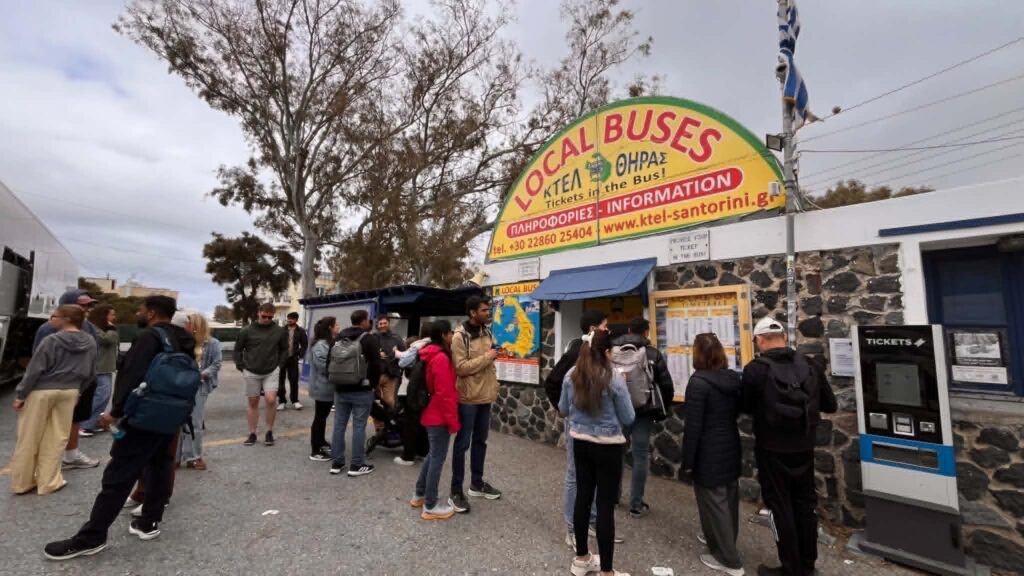
Buses of the company KTEL Santorini Buses run across the island. Many tourists prefer this form of transport, because it’s convenient and inexpensive. The central point from which buses set out and return from all over the island is the bus station in the capital Fira (Thira).
You should note that all villages and towns are connected to each other via Fira – if you want to travel around the island, you’ll have to change buses in Fira. If you plan to get around the island exclusively by bus, it’s best to stay in Fira, so you can do one-day radial routes.
Note that the schedule isn’t very well-coordinated for connections between lines. Therefore, you’ll have to spend some time waiting for your bus. But it’s no more than 30–40 minutes during high season (less buses in winter).
The bus schedule in summer and winter is different. You can find it out on the bus company’s website. Exception — the bus schedule to the port depends on the arrival time of each ferry and changes every day. You can also check the schedule at the bus station – next to the ticket counter.
Bus tickets can only be bought from the conductor on the bus — cash only, ideally with coins or small bills. In summer and in warm periods, buses run on the island from 7:00 to 23:00. Ticket price: from €2.2 to €2.7 — depending on the route and distance.
From Fira, buses go to the villages and towns: Akrotiri, Baxedes, Exo Gonia, Kamari, Monolithos, Ia, Perissa, Vlychada, and Vourvoulos. Buses also go to Santorini airport and to Fira port – this is where ferries from various Greek cities and islands arrive. Each bus displays a sign (or has an electronic board) at the front with the names of the final destinations in English. But sometimes they just shout the name of the direction – it’s a bit of a mess, but it works.
Car rental in Santorini
In Santorini, you can rent a car – rental companies are available both at the port and airport and in every more or less large town. However, the island is quite small, and rental prices start at €40 per day.
It’s best value to rent a moped or a quad bike – price from €15 to €20 per day. There are also many offers for transfers from taxi drivers, and you can haggle – the average price per trip is from €30 to €50.
Economybookings.com – this is an online aggregator that includes offers from all major international rental companies, as well as many smaller local agencies, which often have much better prices. If you plan to rent a car, I always recommend checking prices on it, as you can often find great deals there.
Where to stay in Santorini
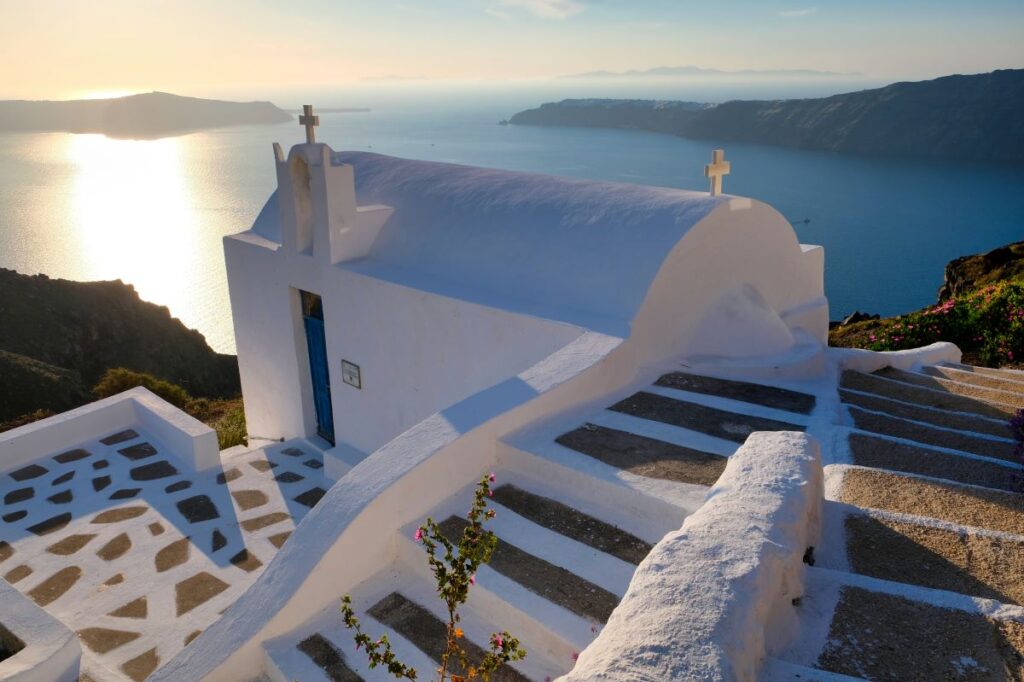
The cost of accommodation in Santorini depends on the hotel’s location. And especially on the view from the window and how developed the surrounding infrastructure is.
The most expensive hotels are in Oia with a view of the famous sunset – prices can start from €200 per night in low season and go up without limit. But the sunset is no less beautiful in the island capital Fira – from €150 per night for two. Or in the quieter Firostefani and Oia) also with a view of the caldera.
Fira – the logistic hub of the island, buses go in all directions from here. If you’re not planning to rent a car and want to explore the island a lot, this is the most convenient place to look for a hotel.
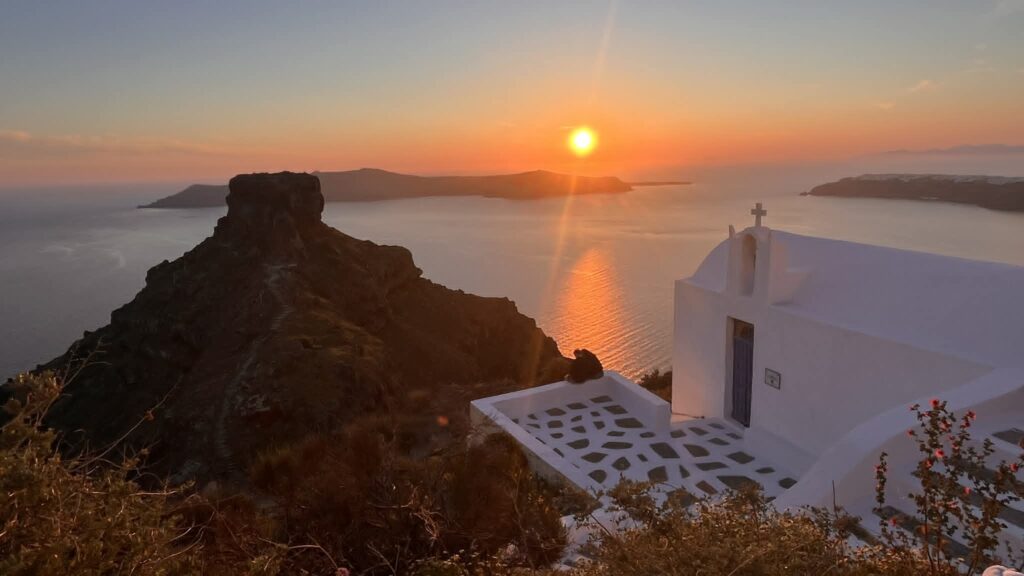
If you’re not too picky and don’t mind walking to see the sunset show each evening for 5–7 minutes, you can stay at a hotel with no view of the caldera. In which case, the prices become quite affordable — from €50 a night for a clean, white Cycladic-style room in a central Fira hotel. There are even hostels for young people and backpackers in Fira and Oia – these cost even less.
For a beach holiday, you can choose the towns of Perissa or Kamari – here the beaches are long but very different. In Perissa, there’s a black volcanic beach – partly pebbles, partly fine sand. In Kamari – light pebbles and a pleasant seafront. There is a wide selection of affordable hotels here, so you can stay for a summer beach vacation. And in the evening explore the island, without overheating under the harsh sun.
Find a hotel or apartment in Kamari≫
Santorini cuisine
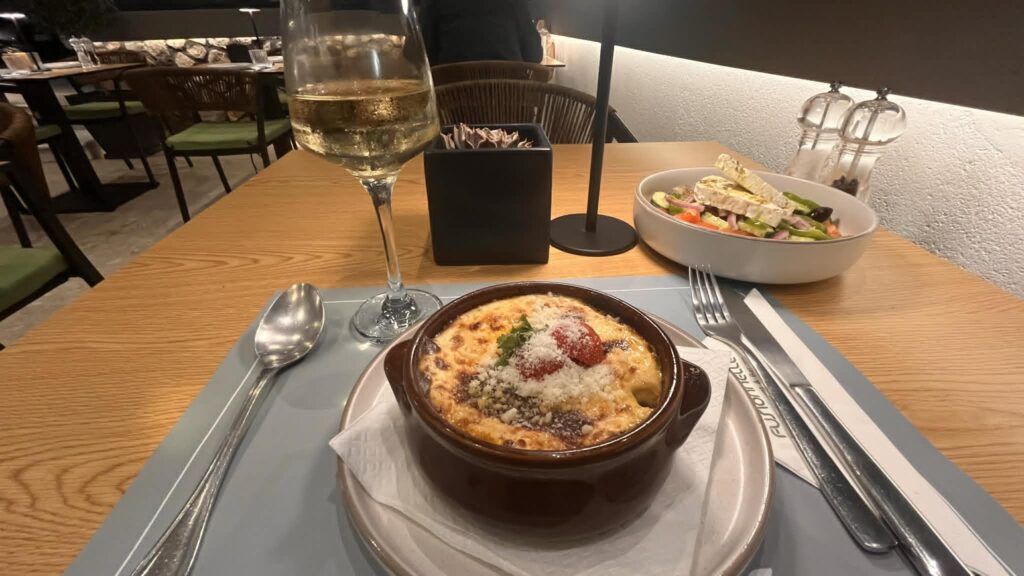
Greek cuisine spread from the mainland to the islands – and Santorini is no exception. Moussaka, pastitsio, fasolada (Greek bean soup), souvlaki, Greek salad, gyros, dolma – this is only a part of the famous Greek dishes you can try on Santorini.
- Moussaka — the most tender casserole of minced meat, eggplants, and béchamel sauce.
- Pastitsio — pasta baked with meat and creamy sauce.
- Pita gyros — the local equivalent of shawarma + fries, meat and vegetables wrapped in a soft flatbread, spread inside with tzatziki sauce.
- Souvlaki – skewers with chicken, or lamb, or cheese, or even squid.
- Fasolada – a lean soup with beans and vegetables, horiatiki or Greek salad with vegetables and feta cheese.
- Dolma — traditionally, as in other cuisines, grape leaves stuffed with rice and meat.
They cook very well on the island. And in principle, it doesn’t really matter which restaurant you choose – a fancy one with a caldera view in Oia or a small tavern in the village of Perissa: everywhere will be very tasty, and you’ll be greeted warmly.
The prices, though, will vary a lot – for the same dishes in Oia you’ll pay 30–50% more than in Perissa or Kamari, where dishes in taverns range from 10 to 25 euros. And don’t forget Santorini wines – they are sold literally everywhere. Especially valued are the Vinsanto and Mezzo wines – very sweet wines, dry white – Assyrtiko and Nykteri.
Beaches in Santorini
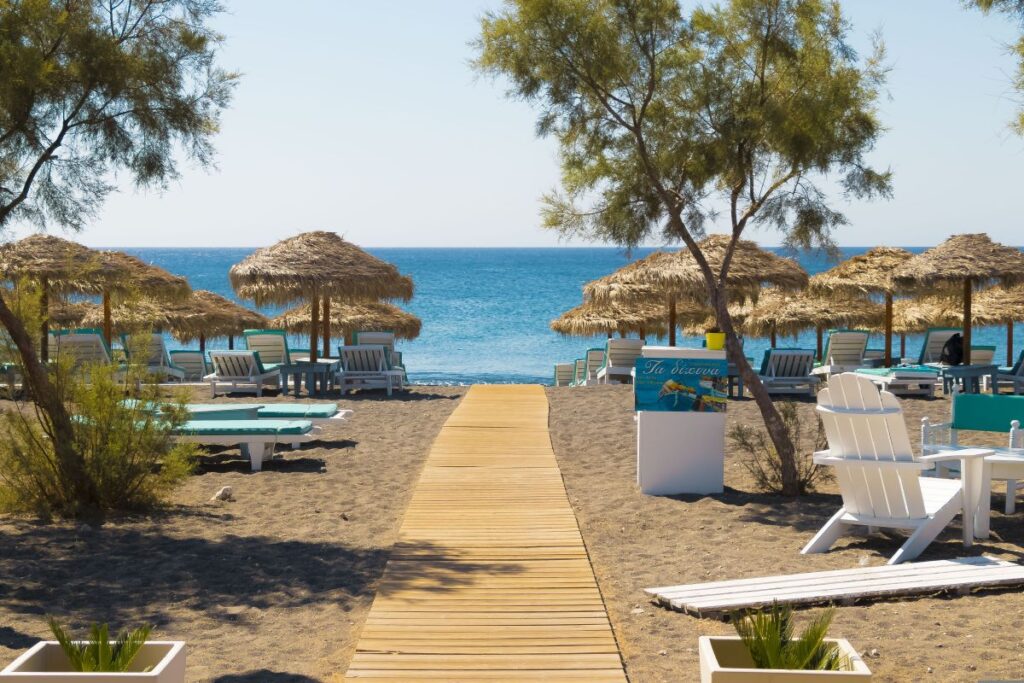
Let’s start with the fact that a beach vacation in Santorini isn’t the main reason to come here. The other beaches on Greek islands and the mainland are much better. But if you end up here in summer, or better yet in autumn when the water is warm and the sun is still pleasant, you can combine exploring the island with some beach time.
All the beaches in Santorini are different, it’s difficult to compare them to beaches on other islands, as they are uniquely beautiful in their own way. The multicolored shorelines of strange shapes are covered with sand or pebbles of unusual colors. Here you won’t see the usual yellow sand – the beaches are covered with gray and red volcanic sand, black pebbles, and white stones. And all of this is set against the blue sea, bright orange sunsets, and rocky shores.
Perissa Beach
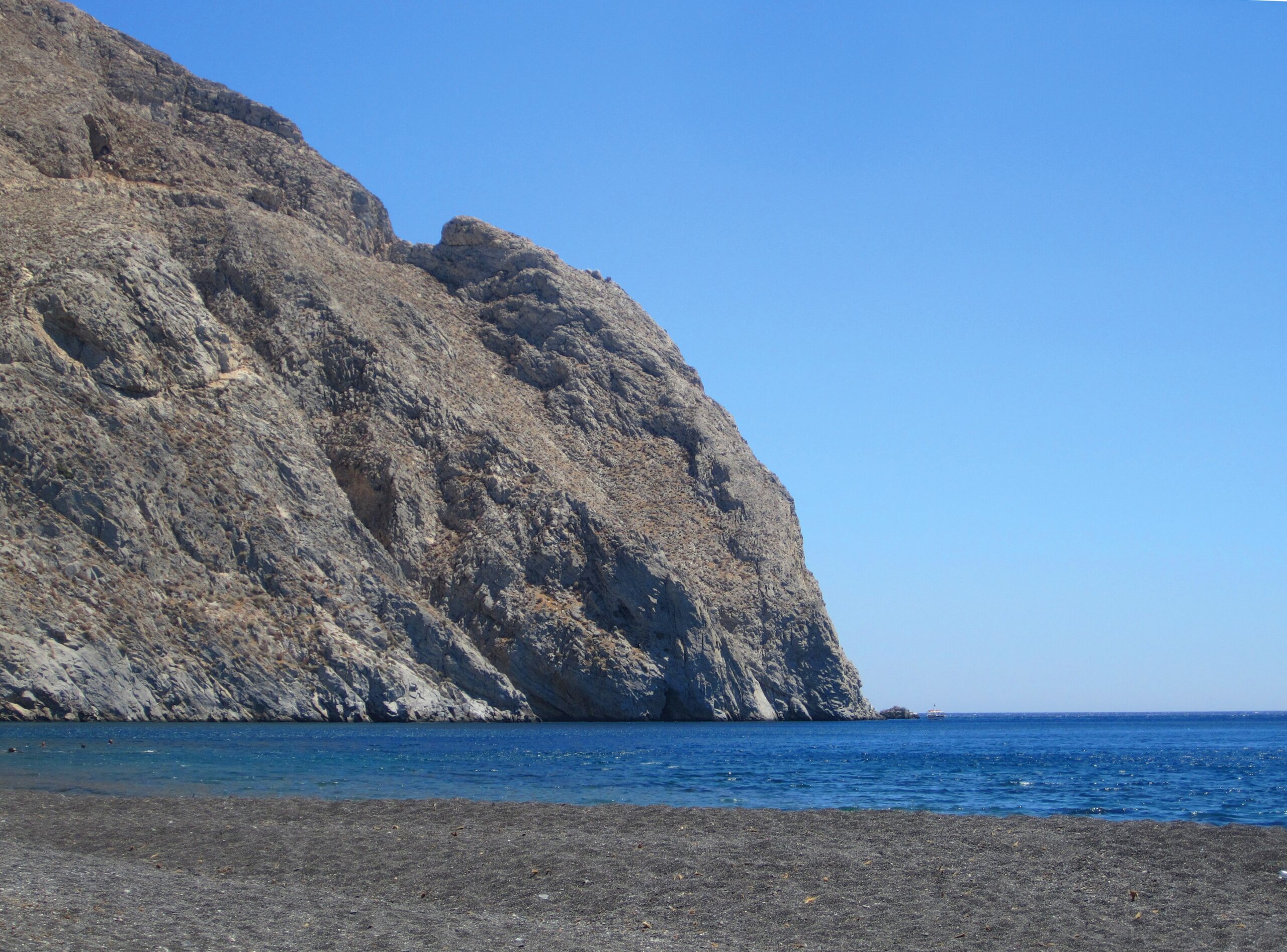
Perissa Beach is located on the southern shore of Santorini, in the shadow of Mesa Vouno mountain. It is the longest beach on the island – about 7 km long, covered with black volcanic sand.
It is divided into two parts: the western part is called Perivolos, and the eastern part – Piralia. The beach has an unusual entrance to the water: almost the entire shoreline is lined with stone slabs at the junction of the sea and sand, left here by nature – this is frozen lava, covered with the velvety vegetation of tiny marine algae.
Warning: it’s best not to run and dive into the water, as you can slip.
There are practically no winds in Perissa, so the sea is calm. The beach is most suitable for adults, as the water gets deep right away at the shore, but thanks to this, the water is very clean.
Perissa is one of the island’s most affordable beaches. There are plenty of hotels, cafes, and restaurants. All sunbeds belong to restaurants and cafes, and if you want to have lunch there, order coffee or cold drinks, you can use the sunbed and umbrella for free. Perissa is also a party place: there are many nightclubs and bars. And the fact that Perissa is 15 km from the capital doesn’t deter tourists at all. You can get here by car, taxi, or bus.
Vlychada Beach
This beach evokes thoughts of romance. Vlychada is located near the village of the same name and is surrounded by high white and beige volcanic tuff cliffs that completely enclose it from the land side. These rock formations were created after the eruption. The ash was compressed, and, as a result of thousands of years of weathering and water erosion, the cliffs took on bizarre shapes reminiscent of lunar landscapes.
Nature has worked its magic on Vlychada beach, creating true sculptures out of stone waves. In the morning the stone walls of Vlychada are lit with pink, and at sunset they take on an orange tint. The beach is not sheltered from winds, so keep in mind the sea can be rough.
The two-kilometer beach is covered with grayish sand, there are umbrellas and sunbeds, and you can buy drinks at the bars – here you can order the famous Theros cocktail. Due to its relative remoteness from tourist towns, Vlychada beach is not crowded. You can get here by taxi, public bus, or rented scooter.
Red Beach
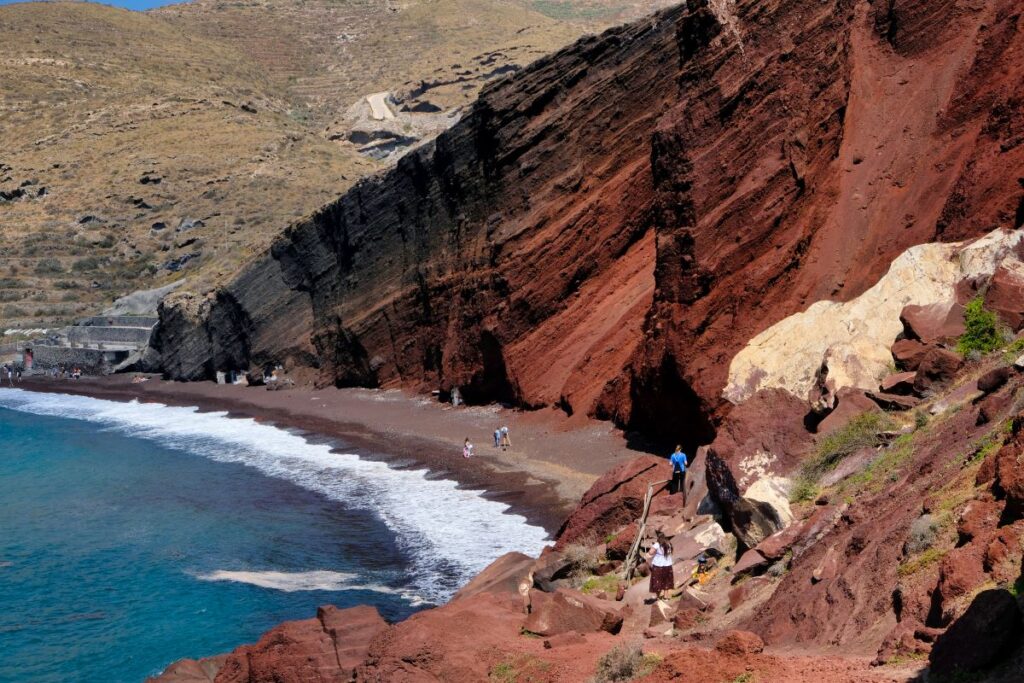
It’s really more of a deep brick red, and combined with the turquoise-emerald sea, it looks fantastically beautiful. If there was water on Mars, this is what a Martian beach would look like. But unlike the red planet, this place is crowded in summer – it’s a very popular spot.
The beach is hidden from the wind by sheer cliffs and boulders, which makes access to the water challenging. The sand and fine pebbles on the beach are red mixed with black, and the entrance to the water is rocky. You can rent an umbrella and sunbed. Otherwise, there aren’t many entertainments here aside from the sea and sun.
Red Beach is located in the south of Santorini, near the town of Akrotiri. The local buses stop nearby, coming from Fira bus station, or you can get there by rental car – there’s a parking lot nearby.
Hiking in Santorini – the best routes and useful tips
Kamari Beach
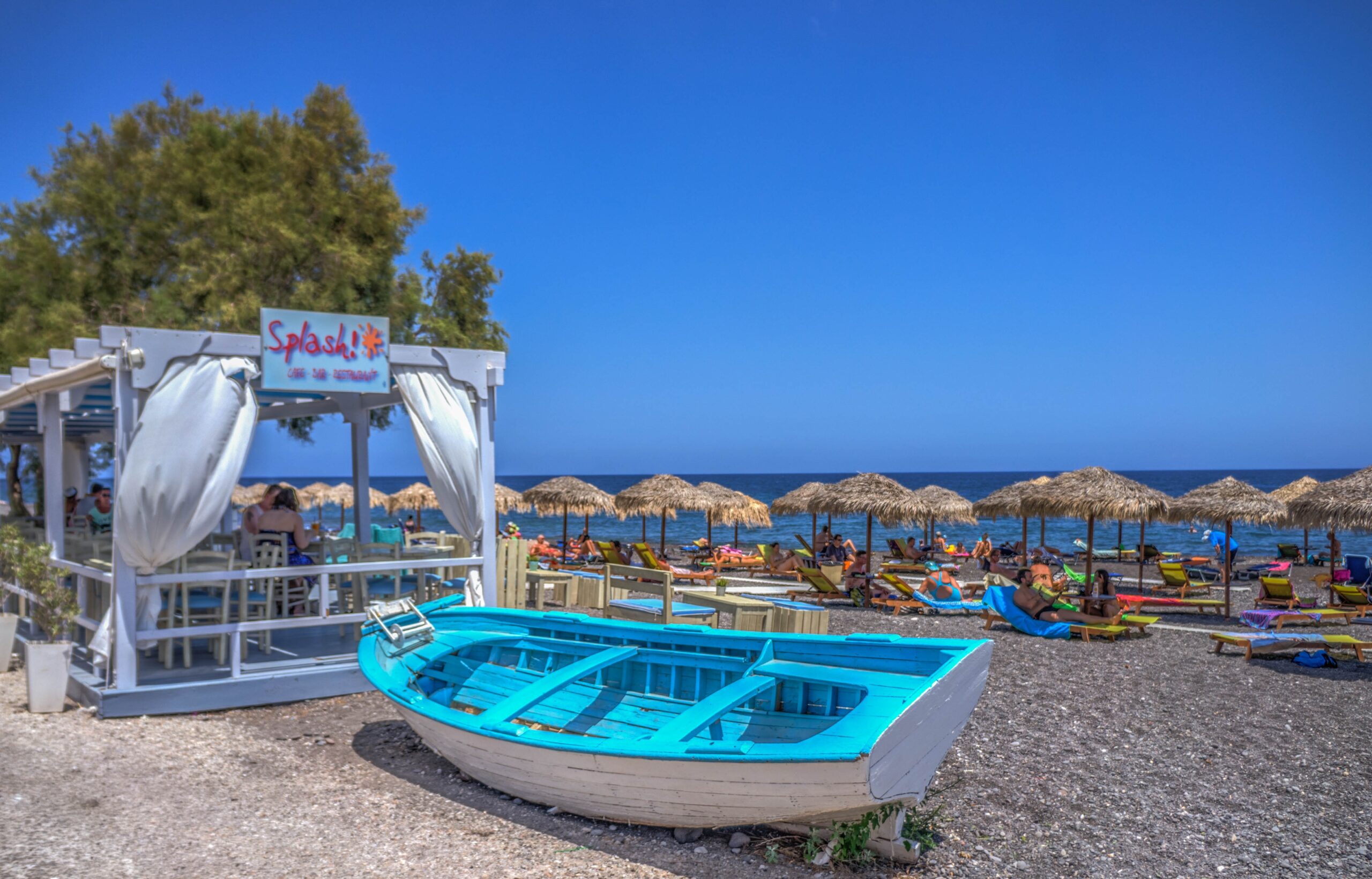
One of the most popular beaches on Santorini is located on the island’s southeast coast – Kamari. Along five kilometers of shoreline there is black sand and pebbles of the same color. Kamari is good for both relaxing and active vacations. The water here is clear, sometimes there are waves.
Along Kamari Beach there’s a wide walkway, perfect for an evening stroll. Taverns, cafes, and bars are lined along the shore. Sunbed and umbrella rentals are available.
Monolithos Beach
Monolithos Beach is perfect for families with children. It is located on the southeast of the island near Santorini airport. Monolithos is probably the only beach with a long, gently sloping sandy entrance to the water. Even with toddlers it will be comfortable here. Part of the beach is equipped with umbrellas and sunbeds, part is devoted to playgrounds, cafes, and taverns where you can have lunch during the day. As with the other beaches, public transport goes here.
Santorini Beaches: The Best Places for Swimming and Relaxation
White Beach
Aspiri Beach is also called the White Beach, for the white cliffs surrounding this small bay, covered with white fine and coarse pebbles and some sand. White cliffs arch over the beach, and turquoise sea splashes around. You can only reach this beach by water – from the village of Akrotiri, a boat will take you here for €105.
There is no pier on the beach – tourists disembark right into the water by the shore. The secluded beach is loved by couples – it’s very romantic and hidden from prying eyes. Still, there are umbrellas and sunbeds, and a bar selling cold drinks. In general, this place is for those who love adventure, not just to step from the hotel directly onto the beach.
What to see and do in Santorini
Here are the main spots to visit in Santorini and things you can do on the island.
Oia (Ia) – the most beautiful sunsets in Santorini
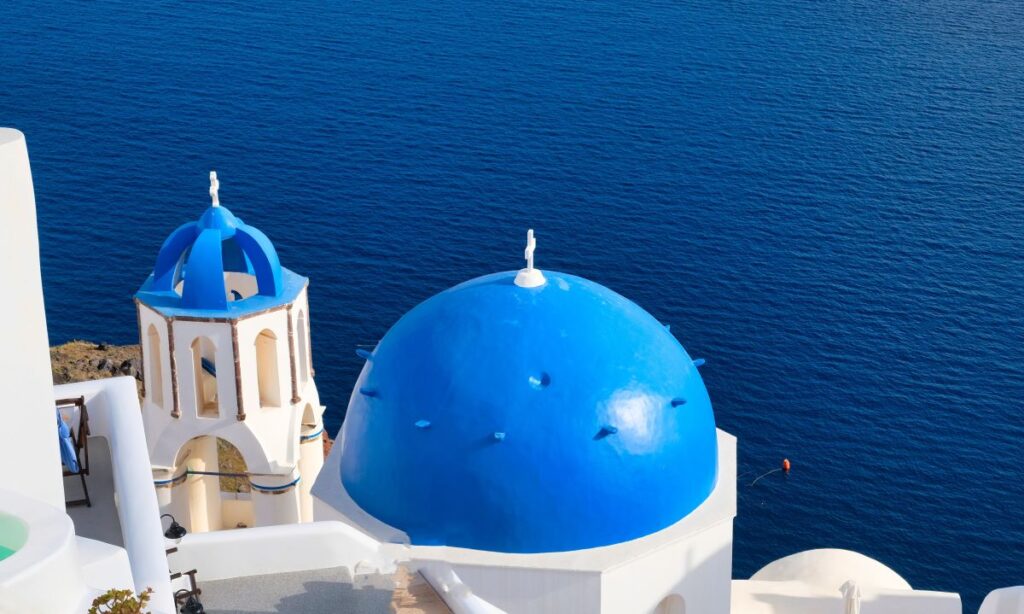
And of course, you must visit the city of Ia (Oia or Oya) – the most famous, beautiful, and widely photographed spot in Santorini. White houses and churches perched on a steep cliff on the northwest part of the island, 100 meters above sea level.
The architecture of Oia leaves no one indifferent: picturesque sunset vistas, white walls, blue doors, window shutters and bell domes, arches and mills. The town is simply and elegantly Greek, a must-visit for any self-respecting photographer and Instagram blogger. There are just no bad photos here! In summer it’s packed, but in spring you can quietly walk the small streets and stairways of white Oia.
While strolling the town, you can visit sights such as the Church of Panagia Akathi. From the ruins of the ancient fortress, a magnificent panorama of the town opens up.
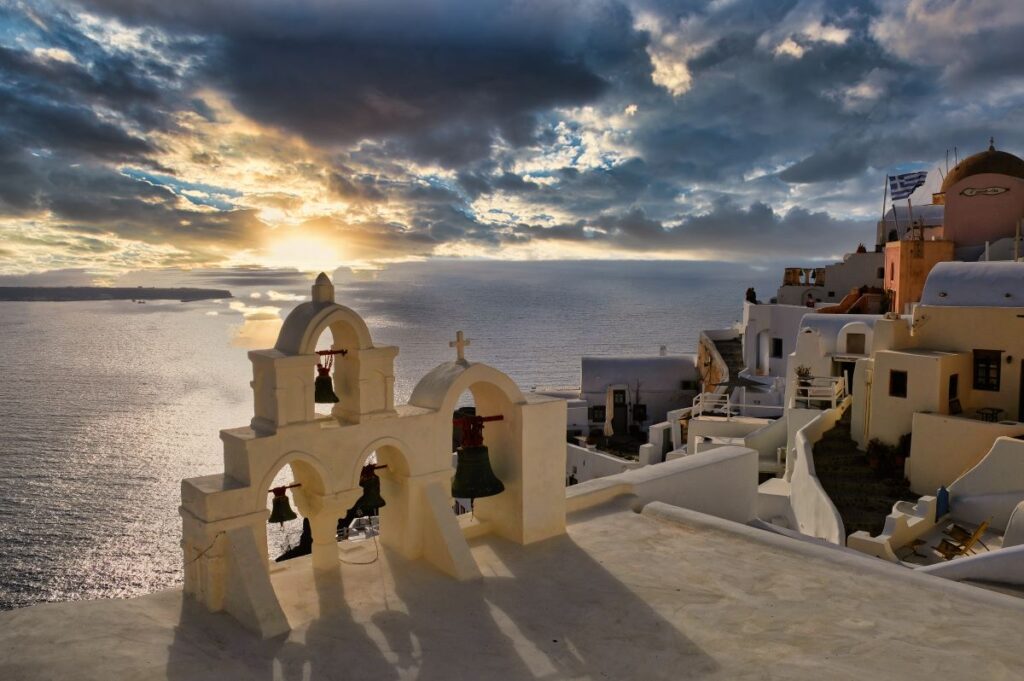
And, of course, the sunset is Santorini’s famous feature: when the sun sizzles into the sea, white Oia turns wild shades of yellow, orange, pink, and red. Don’t forget to choose a place in advance to watch this fantastic sight: book a table in a cafe, or grab a spot on a terrace near the mills. Wait until the first lights come on, and Oia turns into a glowing doll town hanging over the endless sea waters.
Fira and its old port
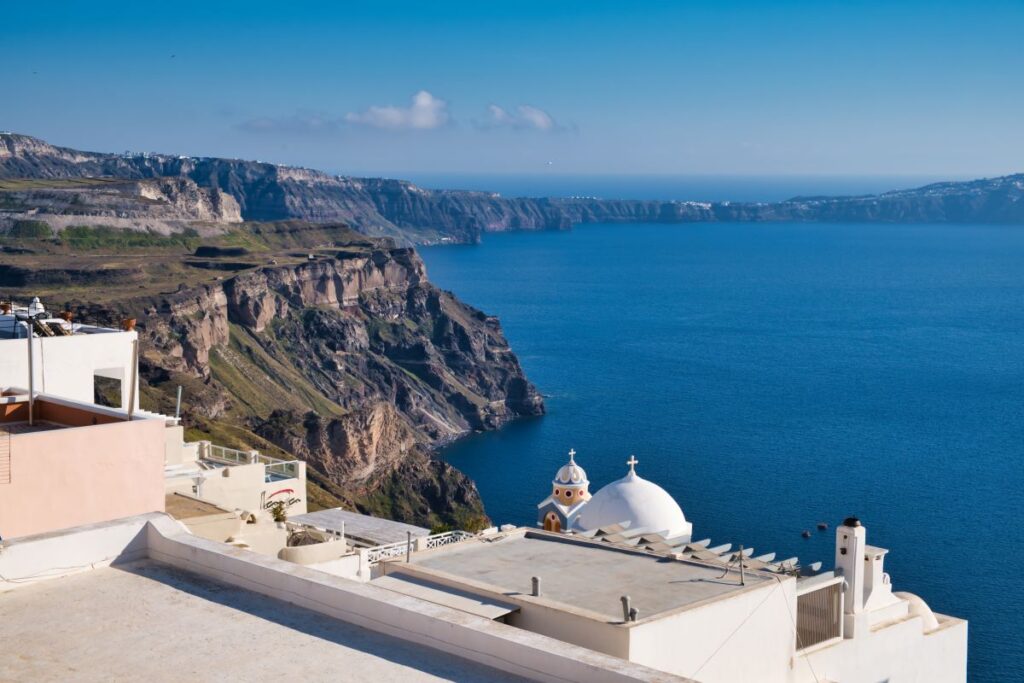
The island’s capital – Fira (or Thira) – is the administrative and tourist center, located almost in the island’s center. Fira also offers enchanting views of the sea and sunset. Although the capital of Santorini doesn’t have its own beach, tourists and locals use it as a hub to travel the island by bus.
If you plan to use public transport and visit different beaches and sights every day, Fira is the ideal base for this kind of trip. Fira also has an old port where boats with excursions to the caldera and neighboring islands dock.
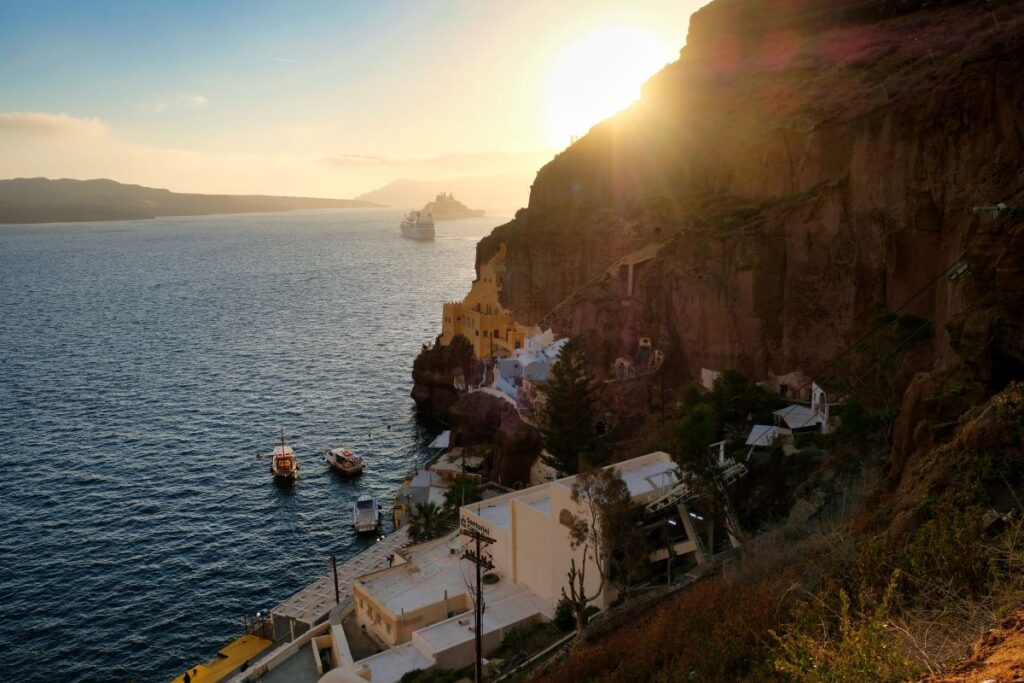
The port is reached by a very picturesque staircase, and tourists are carried up and down by donkeys (€10). Walking down the 600 steps before sunset is a special pleasure: the views are very beautiful. Though, one nuance – it smells of donkey manure )) You can get back up by funicular – €10 one way, tickets are bought at the lower station if you’re going up (or vice versa, if going down).
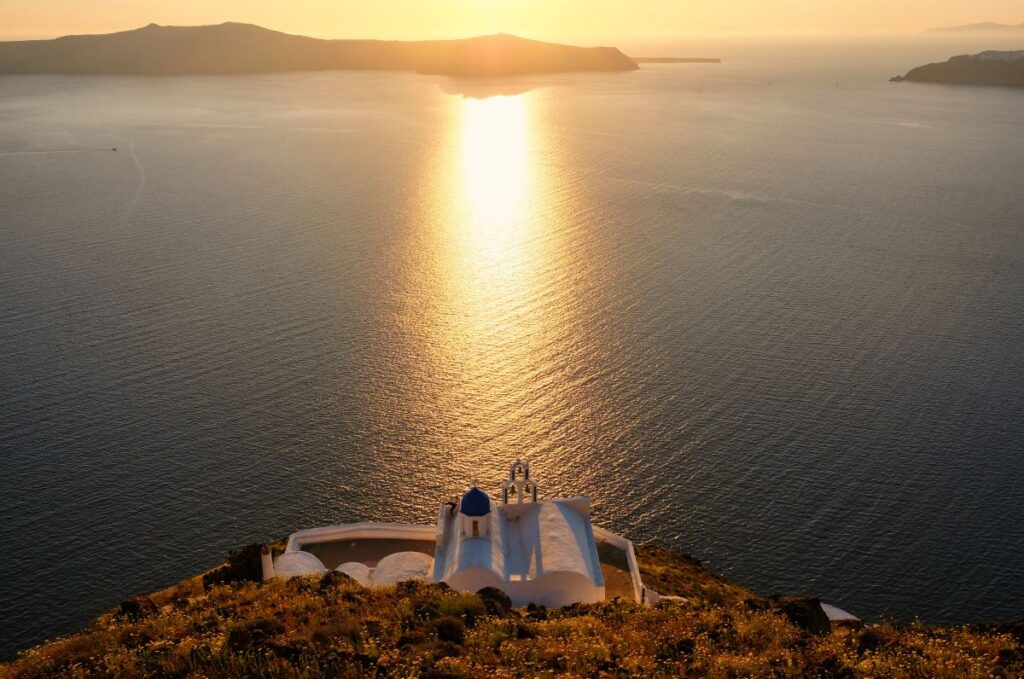
And for sunset, head to the famous photo spot – the Three Bells of Fira. This church has a beautiful bell tower with three bells, a blue dome, and magnificent views of the caldera.
Caldera cruise and volcano trip

From the old port of Fira, you can set out by boat, catamaran, or chartered yacht on a one-day or 4–6 hour caldera cruise of Santorini. I bought a tour to the islands of Nea Kameni and Palea Kameni. During such a trip, you can visit the volcano and hot springs.
Nea Kameni island is a volcano covered in black ash and lava, last erupted in 1956. I thought there was no vegetation at all, just craters – it feels like being on the moon here. But it was really strange to see wheat growing and chamomile blooming on the craters in spring.
The volcano offers incredible views of Fira and Oia. The volcano is still active, and one of the craters has warm rocks and a sulfur smell. The hot sulfur springs located near Palea Kameni island are also a result of volcanic activity. At its foot, tourists can stop and swim in the hot sulfur springs.
How does it cost
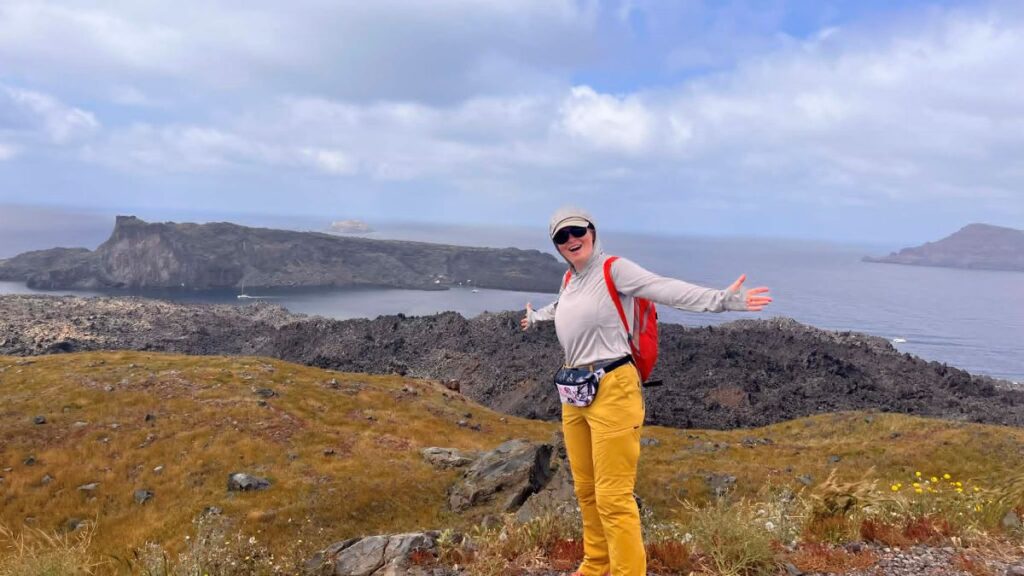
A volcano island tour plus bathing in the hot springs by boat costs from €35, in addition to a separate entrance fee to the island. This is a 3-hour tour, and it was more than enough for me. I recommend this tour because there are fewer people and a smaller boat. There is also a 6-hour tour with a stop at Thirassia island – costs from €55. But to float around at sea for 6 hours would be boring for me (I have similar experience with a tour in Fethiye, where I got tired of hanging out with so many people).
One small nuance – to swim in the hot springs, you have to swim about 30–40 meters from the boat. This was April: the sea water was 18 degrees. I swam very fast to warm up. And the springs turned out to not be that hot. But in summer the sea water is warm, so you won’t feel the same contrast as I did )))
I liked the tour, the captain didn’t play loud music, and the playlist was nice.
Tip: I highly recommend buying tickets in advance for the Greek Wedding Show, which takes place every evening in Santorini. It’s a great opportunity to immerse yourself in Greek traditions, taste local dishes, and dance your heart out with the actors and other visitors.
Hiking in Santorini
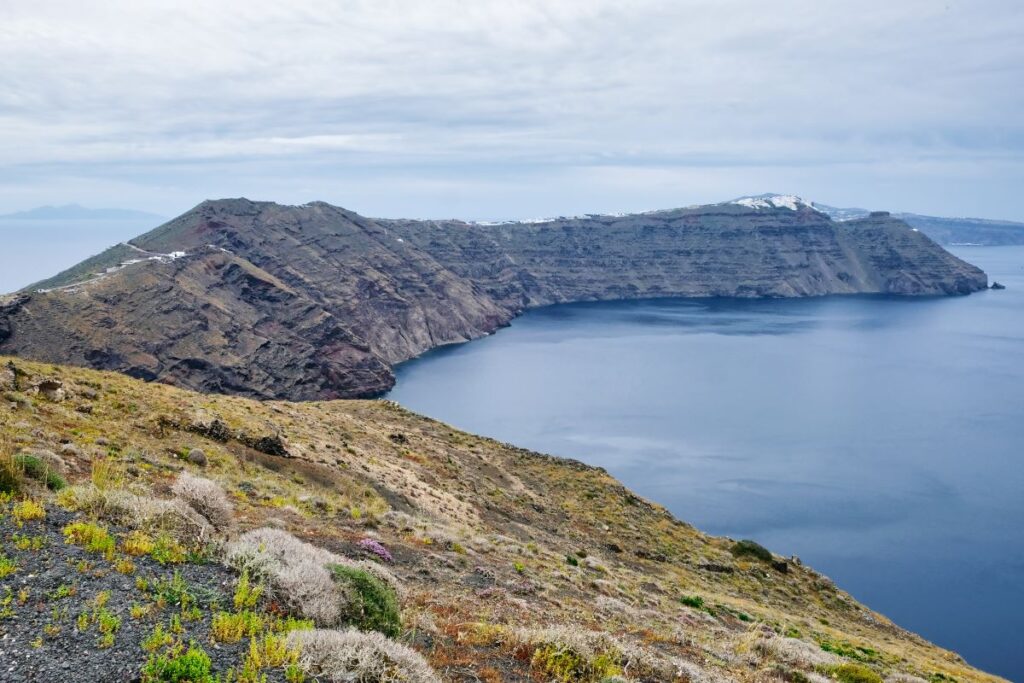
For those who like to be active, there’s a hiking route from Fira to Oia. The route goes along a winding path with very beautiful views of the sea and the steep shores of Santorini. The walk takes only 2.5–3 hours; if you make frequent stops to enjoy the views, it might take about 4 hours. It’s a great stroll before the sunset, which every day awaits on Oia’s white terraces.
This 10-km path runs along the caldera, and it’s amazingly beautiful! The island in April is all covered in daisies, yellow poppies, and fragrant thyme in bloom. I walked the route slowly – wear sneakers suitable for hiking, there are some rocky, scree spots, but for the most part the path is paved with volcanic stones and there are stairs. I really, really liked it – I stopped often just to gaze at the caldera; the views are gorgeous! Honestly, this is why I came to Santorini.
To the ruins of Thira
There are other hiking trails as well. For example, a route to the ruins of Thira, which starts in Kamari. It’s a tough climb, so be prepared – hiking shoes, lots of water, and a hat will come in handy. And don’t do it in intense heat – it’s dangerous, you could get heatstroke.
Ancient Thira is located on top of Mesa Vouno mountain. It was inhabited from the 9th century BC to 726 AD and was named after the mythical ruler of the island, Theras.
In the ancient city, there are artifacts dating to the geometric period (900 BC). It is especially impressive that some ceramics have survived in excellent condition thanks to the burial traditions of that era. In addition to ceramics, different sculptures have also been found. The settlement itself has a wide boulevard over 800 meters long, with various significant buildings such as the Roman forum, the old theatre with a view of the Aegean Sea, the gymnasium, public parks, and Roman baths.
Red Beach and Akrotiri
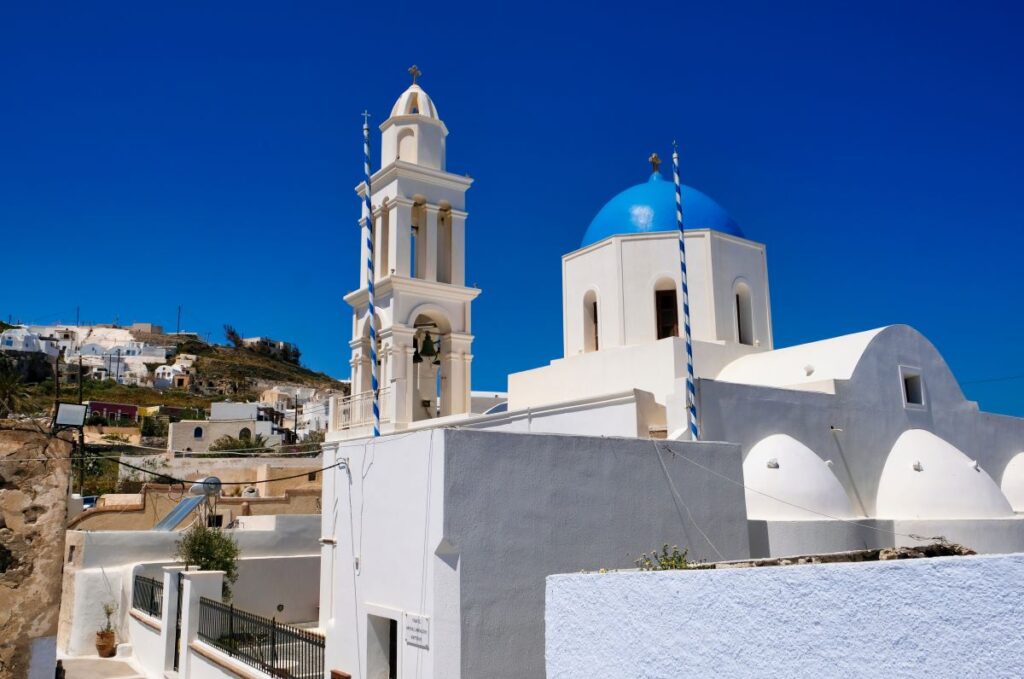
Buses run from Fira to Akrotiri and the last stop – Red Beach. Head to this beach to see the marvel of red sand created from layers of volcanic lava. The beach is wild, but in summer you can rent a sunbed for lounging. From the bus stop it’s a 10-minute walk.
Returning to the bus stop, you’ll find the Akrotiri archaeological site and museum, where there is an amazing prehistoric settlement, which is one of the most significant archaeological sites in Greece and the Mediterranean.
Akrotiri – these are the Pompeii of Greece, once a Minoan port town with connections to mainland Greece, Egypt, and even Syria. Although the town was covered in ash after the eruption of the island’s volcano in the 16th century BC, the preservation of the settlement is exceptional.
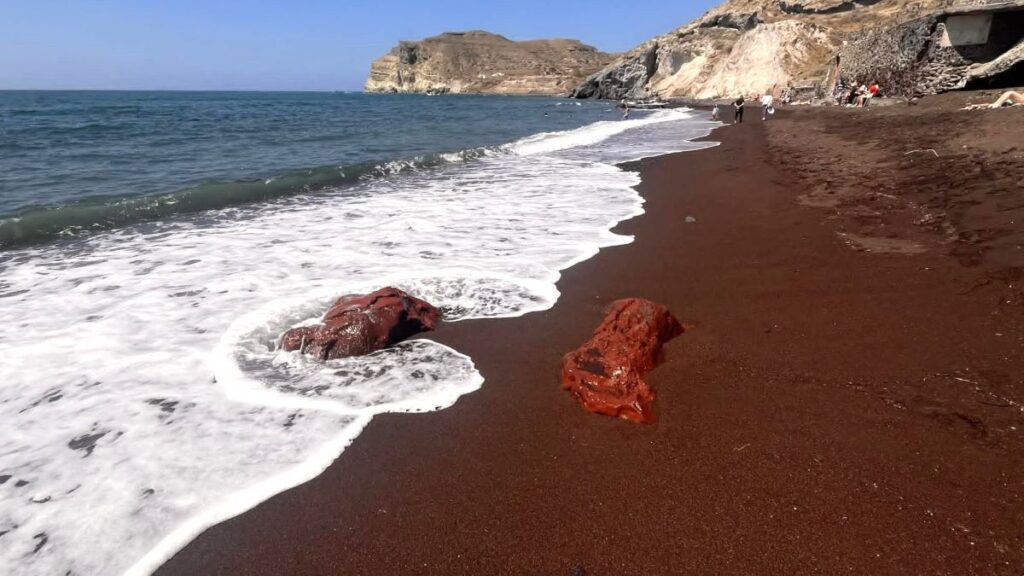
Today, this area is carefully preserved and protected, covered with a bioclimatic roof and with walkways suspended above the archaeological remains. In some places, paths lead between two- and three-storey buildings.
Akrotiri is also a small village, which I explored, strolling through its narrow lanes. There aren’t as many hotels here as in Oia and Fira, it’s more peaceful, and you can see how the locals live. You can also stay here if you like tranquility and rent a car so you’re not tied to bus schedules to explore the island.
Visit Pyrgos
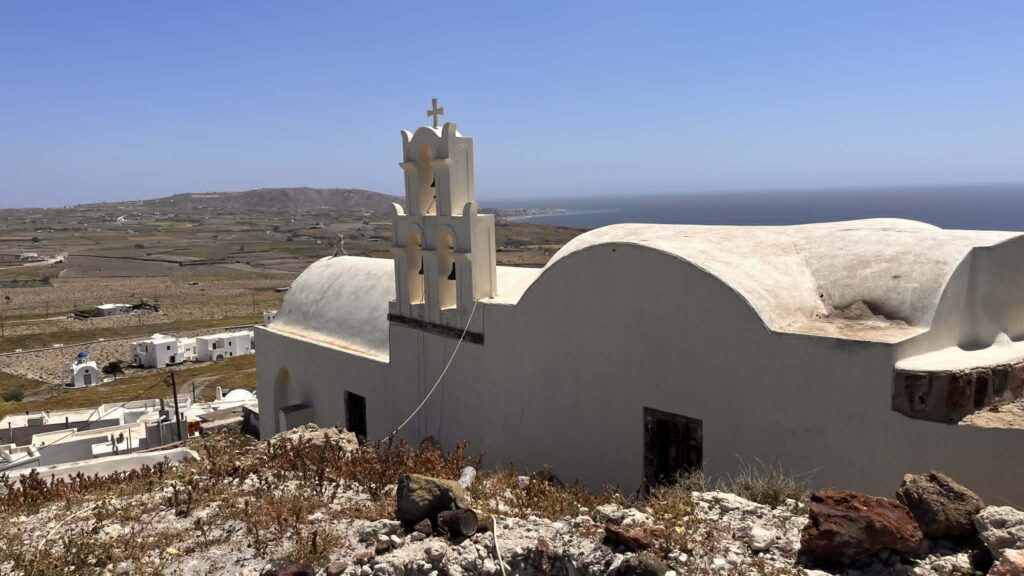
Pyrgos is a beautiful village on a hilltop, the highest on this little island. It’s a fine example of Cycladic architecture and a contrast to the crowded streets of Oia.
Its advantages are linked, in particular, to its drawbacks: the town is not on the caldera or by the beach, so fewer people want to stay here. Pyrgos doesn’t have a glitzy, glamorous atmosphere, but rather quiet streets, steps, and viewpoints from which the whole island can be seen in good weather.
I recommend Pyrgos for panoramic views and great food at Pyrgos Restaurant. For peace and quiet without the hustle, this is the perfect place to relax and enjoy the tastes of the island.
Wine tastings in Santorini
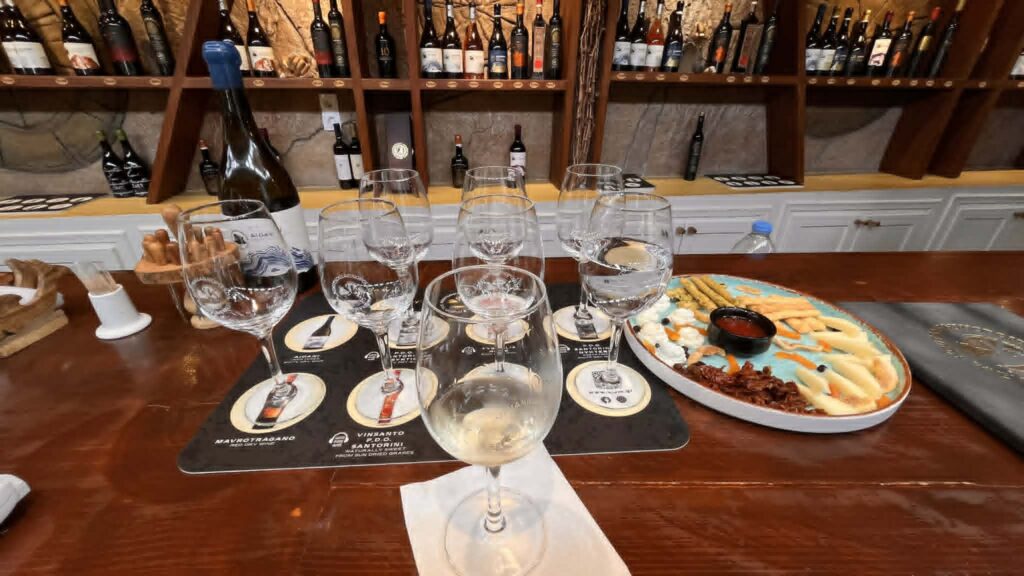
Despite the sparse vegetation, wine is grown and excellent wines are made here in Santorini. The vineyards of Santorini have been producing wine for 4000 years. There was only a three hundred year break – right after the volcanic eruption, when all life was destroyed by volcanic ash (known as “aspa”) and lava, which completely covered the island.
Today, the vineyards of Santorini make up about 1200 hectares of family estates. They are part of Greece’s intangible cultural heritage thanks to the unique geographical conditions and production methods.
There are so many wineries in Santorini worth visiting that it is almost impossible to recommend just one. For those who appreciate the beverage of the sun, I recommend visiting the Wine Museum – Cave Wine Museum – Winery Koutsogiannopoulos, which is located at a local winery that has been based on the island since the 19th century.
What’s interesting is that the museum is inside a cave, eight meters underground. The cave is a real 300-meter labyrinth. Underground, the temperature remains constant at 14 degrees. The natural cave is a kind of wine cellar, where bottles of wine are stored. If you buy a ticket to the museum, the price includes a wine tasting.
There are several ticket options – €35 with a tasting of 4 wines. I bought a ticket for €55 – tried 7 wines and rakia. The tasting included dry white Nichteri, rosé Lava, aged red Ampelones, and semi-sweet Mezzo.
What to bring from Santorini
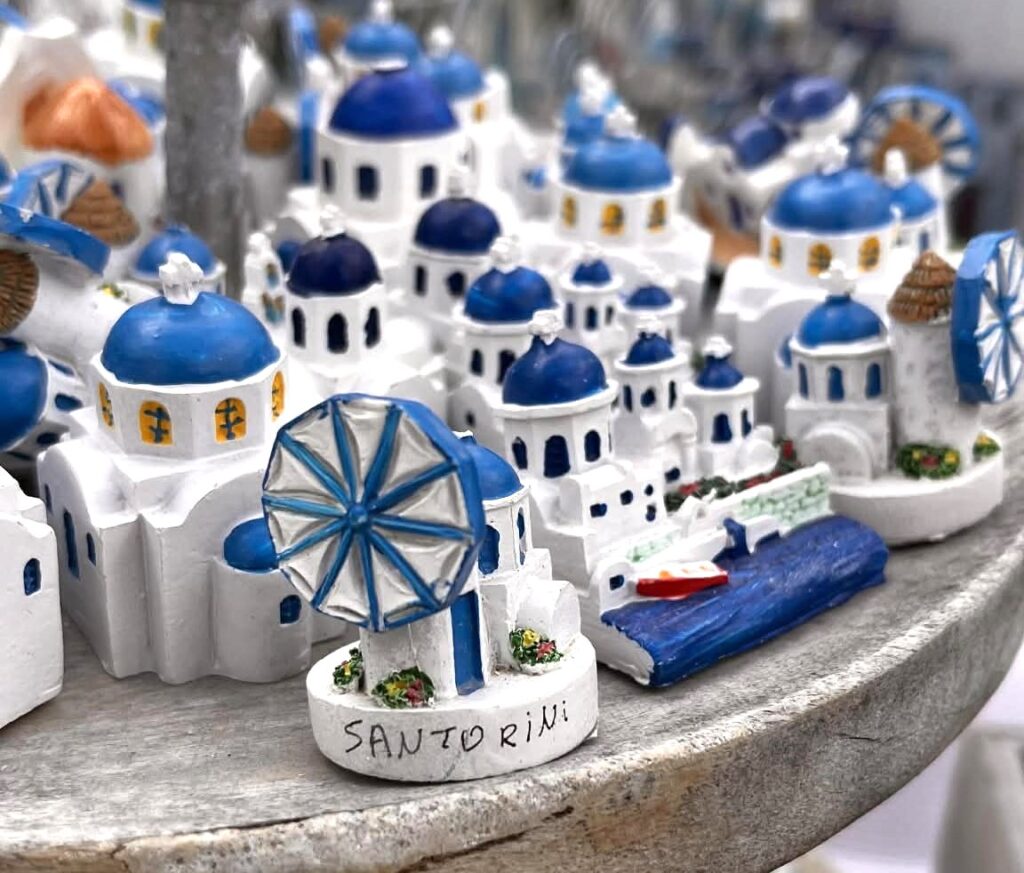
A bottle of island wine will help ease the separation from the romantic island, which will long be dreamed of and make you want to return.
For an inexpensive but beautiful souvenir, bring ceramics. Cute plates and vases can literally be bought for €10, but this will be a pleasant gift from a Greek island.
Paintings on wooden surfaces with classic Santorini views start from €15 and up, depending on the size of the plaque and artwork.
Souvenirs made from solidified lava – various figurines and candle holders made from solid volcanic rock.
Greek sweets – a win-win gift option. Honey from Santorini has a unique intense flavor and will delight anyone with a sweet tooth. The Greek dessert Loukoumades – little balls of yeast dough that taste like donuts, topped with sweet syrup, honey, and powder sugar with cinnamon.
In Santorini, natural cosmetics are sold, made from olive oil, sea salt, and various extracts and components.
Useful articles and links:
- Two-week Andalusia itinerary – how to see almost everything
- Provence itinerary – a road trip through wineries and lavender fields
- Portugal road trip itinerary – from Lisbon to Porto
Car rental – DiscoverCars
Timetables and tickets for buses – at InfoBus.ua
Green Card, Compulsory car insurance and travel medical insurance – online at the portal HotlineFinance
Hotel and apartment bookings – Booking.com