
If you have already walked the Jacobean routes in Portugal and Spain, and are looking for similar trails in new countries—I have good news. In Croatia and Bosnia, a new Camino de Santiago route has been created: Camino Dubrovnik – Medjugorje.
This route consists of seven stages, starting in front of the Church of St. James in Dubrovnik and stretching 145 km to the northwest, crossing the border with Bosnia and Herzegovina and ending at the Church of St. James in Medjugorje—one of the most important pilgrimage sites in the Balkans.
What is Camino Dubrovnik?

Camino Dubrovnik is a historical, cultural, tourist, and pilgrimage route connecting Croatian Dubrovnik and Medjugorje in Bosnia and Herzegovina.
Medjugorje, along with Lourdes and Fatima, is the most visited religious site in Europe. This cultural route—like other world-famous trails under the “Camino” brand—offers a unique challenge and unforgettable experience.
People who seek active recreation and adventure, wish to get to know new cultures and traditions, or classic pilgrims—everyone will find something special for themselves on Camino Dubrovnik. From natural landmarks to historical trails and cultural/religious events spanning four thousand years. And they will also get acquainted with the gastronomic and wine traditions of this region.
The route has become an official part of the European network of the Ways of St. James (Camino de Santiago), passing through the territory of the Republic of Croatia and Bosnia and Herzegovina—from the Church of St. James in Dubrovnik to the Church of St. James in Medjugorje.
The Croatian Brotherhood of St. James, as a member of the Archconfraternity of St. James in Santiago de Compostela, helps and supports pilgrims on this route. The path from Dubrovnik to Medjugorje joins the network, which through the project Camino Croatia aims to connect this part of Europe with the Camino networks leading to Santiago de Compostela.
How long does this walking journey take?

The journey from Dubrovnik to Medjugorje is planned for seven days. Each day you walk one segment, after which you can find accommodation, meals, and supplies for the rest of the journey.
The average length of the seven segments is 25 kilometers.
Three segments are on the territory of the Republic of Croatia, and four—on the territory of Bosnia and Herzegovina.
Entry to Bosnia and Herzegovina is through a border crossing located about an hour’s walk from the tourist village of Slano, the center of Dubrovnik’s coast, which is also the final destination of the second day of the journey.
For the journey, as on other Caminos, there is a Credential—Pilgrim’s Passport that can be purchased at Narodne novine Dubrovnik. During the journey, pilgrims collect stamps to confirm passing each part of the Camino Dubrovnik.
Locations for stamps are marked in the app, and you can also collect other stamps along the route (for example, stamps from Camino trails in Portugal and Spain).
After arriving in Medjugorje, pilgrims can receive a Compostela—a certificate confirming they have completed the Camino Dubrovnik.
Camino Dubrovnik – Medjugorje Route
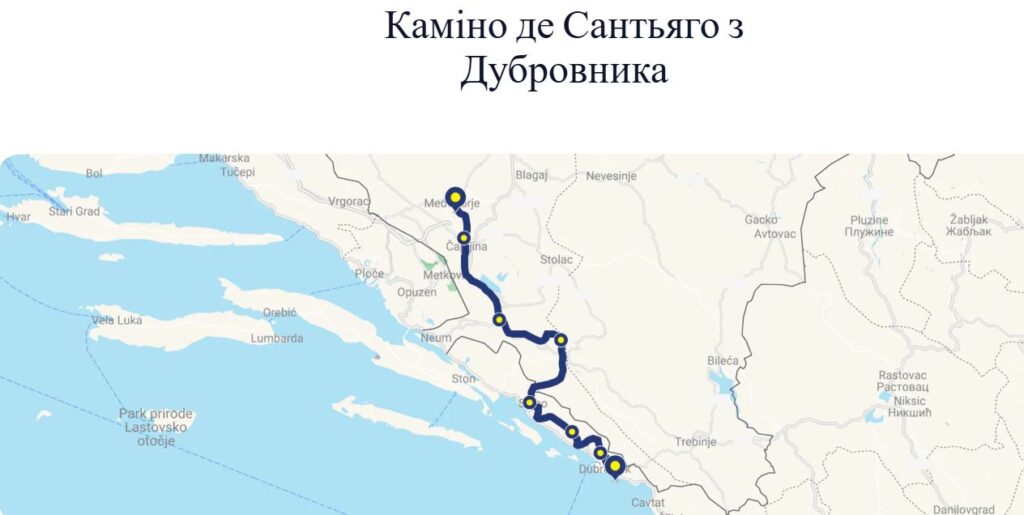
To learn all the information about each stage—I recommend going to the Camino Croatia website. Here you will find complete information about altitudes, towns for stops, accommodation, shops, etc. A full-fledged guide to this path, with which you can plan your own route.
This trail involves constant ascents and descents, starting with the climb to Mount Srđ, which towers above Dubrovnik.
Accommodation on the Croatian Camino Trail
Unlike the routes in Portugal and Spain, Croatia and Bosnia do not have a wide choice of pilgrim hostels. Mostly, walkers and pilgrims stay in hotels and rural guesthouses. This is, of course, more expensive than hostels. But offers a different level of rest and the opportunity to experience local traditions and gastronomy.
So, you should budget more money for this route—accommodation from 50 euros per person.
You can look for accommodation either on Booking.com or on the route’s website.
Cheapest accommodation on the route:
- Dubrovnik – HI Hostel Dubrovnik – from 24 euros, Love Dubrovnik Hostel – 44 euros, Old Town Hostel – 50 euros.
- Mokošica – Marin San – 45 euros, Rose Garden – 53 euros,
- Zaton – MALFI – your best choice – 80 m from beach – 90 euros, Soko Apartments & Rooms – 73 euros
- Orašac – Cozy Apartmant with a sea view in Orašac – 95 euros
- Slano – Apartments Vila Riva – 87 euros, Guest House Pavkovic – 51 euros, Guest House Franica & Pero Lobrovic – 48 euros
- Zavala – Apartments Zavala – 66 euros
- Ravno – Hotel Stanica Ravno – 85 euros
- Hutovo – there is nothing except KUĆERICA – Čarolija u kamenu, which is located off the trail.
- Gabela – Apartman ODISEJ – 65 euros, Kamena Kuca Family Rodin – 52 euros
- Čapljina – N&N Apartment – 40 euros, Apartman Tea – 36 euros, Apartment Neretva – 36 euros
- Medjugorje – Mica Medjugorje – 27 euros, Apartments Kruno – 36 euros, Irish House Međugorje – 45 euros.
Keep in mind that in October and March not all apartments have started or finished working yet. Check availability at the provided links.
When to walk Camino Dubrovnik—the best seasons
In summer, Croatia is very hot, so the best time to go is spring and autumn.
Plan your journey from March to May and from mid-September to late October. It will not be hot and dry enough for such a walk. It’s especially beautiful in autumn. You can catch a warm sea, a few rains. There are many delicious local products, see the grape harvest, and eat ripe figs from the trees.
What can you see during the journey?
On the Camino Dubrovnik path there are a number of cultural monuments and protected natural landmarks.
Pilgrims will have the opportunity to experience and see at least four thousand years of historical heritage of this region. It is the largest part of the cultural heritage on the trail dates to the Illyrian era.
Most of the hillforts, towns, and tombs of Illyrian origin were built up to 2,000 years BC. The roads and routes used by the Illyrians were also used by later inhabitants of these regions, from the Greek and Roman periods to the Slavic era.
Of course, there are also remnants of roads dating back to the days of Napoleon Bonaparte, and the railway (known in these areas as “Ćiro“), built during the Austrian occupation of this region. In addition to roads, Illyrian hillforts and tombs, on the trail you can also see “stećci“—unique 13th and 14th-century tombstones attributed to the Christian sect of the Bogomils. The Camino also passes the 16th-century Orthodox monastery in Zavala and crosses the Most Mustaj-beg, which was built during the Ottoman Empire on the Bregava River near the village of Klepci. Along the trail there are also numerous Catholic churches and monasteries built from the 9th to the 20th century.
As for natural and protected landmarks, on the Camino route there is the Kočišta reservoir in Orašac. And almost seven-hundred-year-old oak and the protected turtles in the village of Maikovi. The Vjetrenica cave near Zavala, and the Hutovo Blato Nature Park, which is also the endpoint of the fifth stage of the journey to Medjugorje. The trail passes through Popovo polje, along the Trebišnjica River. As well as the Vrutak and Svitavsko Lake reservoirs and the Krupa, Bregava, and Neretva rivers.
Useful articles and links:
- Path of the Gods – where to go hiking on the Amalfi Coast in Italy
- Active travel instead of the beach: why I choose long routes and mountain hikes
- Hiking in the Albanian Alps: route from Valbona to Theth through Valbona Pass
Travel health insurance – HotlineFinance
Hotel bookings and apartments – Booking.com
Car rental – Economybooking