Total solar eclipse is one of the most breathtaking phenomena of nature; there is even a whole branch of tourism dedicated to it – chasing total eclipses.
Spain is lucky to be a place where this event can be observed consecutively in 2026, 2027, and 2028. Don’t miss this unique astronomical event, known as the “Iberian Trio”.
The total solar eclipse on August 12, 2026, will cross northern Spain at sunset, making it a major tourist event in Europe. High demand is expected in Galicia, Asturias, Cantabria, Castile and León, Aragon, and the Balearic Islands, where hotel bookings and searches for rural accommodation through home exchanges are projected to grow by 830%. Specialized astro-tours are available with the best viewing spots in cities like Burgos, Palma, and coastal areas.
Key tourist details of the 2026 solar eclipse:
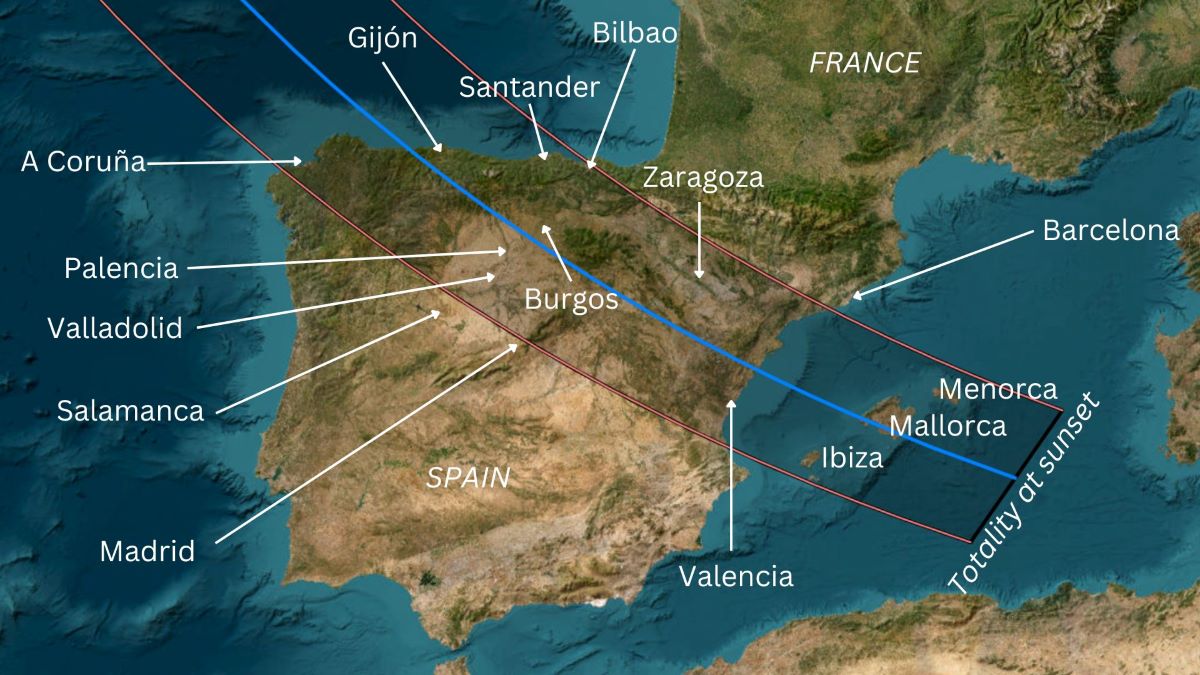
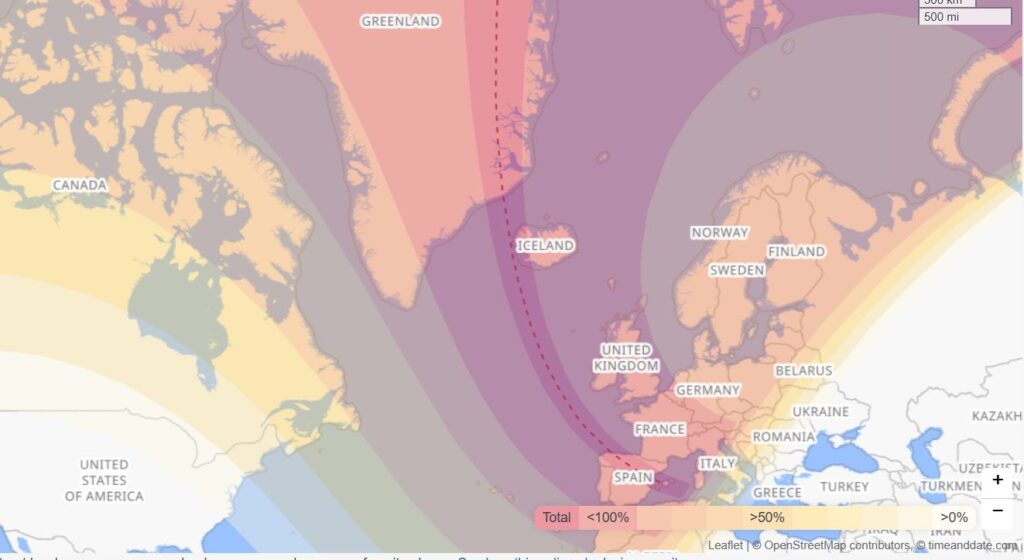
Path of totality: The eclipse will reach Spain in the evening (around 8:30 pm local time). It will move from northwest to east, passing through A Coruña, Oviedo, Santander, Burgos, Zaragoza, and ending over the Balearic Islands.
The best places to watch the 2026 eclipse in Spain
- Balearic Islands (Mallorca, Menorca, Ibiza): offer a rare and stunning view of the eclipsed sun setting over the Mediterranean Sea.
- Inland regions (Castile and León/Aragon): drier regions with a high probability of clear skies (for example, Burgos, Zaragoza).
- Galicia/Coast: A Coruña has a favorable location, but coastal areas have a higher chance of cloudiness.
When choosing a viewing location, it’s important to consider the westerly position of the Sun. Since the eclipse will occur near sunset, look for an open western horizon without buildings or trees. The coast or elevated observation points ensure the best viewing conditions.
Santiago de Compostela, Spain – a mini-guide to the capital of Galicia
Demand for accommodation during the eclipse
A “tourist boom” is already being observed around the 2026 eclipse in Spain. The Airbnb platform records that bookings of rural accommodation along the path have increased on average threefold compared to last summer season. In some inland provinces (Aragon, Navarre, La Rioja, Castile-León) demand has increased fivefold to tenfold.
Representatives of the Spanish authorities are confident: “Millions of people will come to Spain to see the total eclipse in 2026”. Travel agencies call Spain “the astronomical hub” for the coming years because of this and the next series of eclipses (2027–2028).
For comparison: in a similar case in the USA (the total eclipse of 2024), about 20 million travelers attended, which corresponds to the scale of the upcoming European event. All these factors indicate a significant increase in tourist flow and prices for August holidays in 2026.
Events and activities:
- Astrotourism: Specialized astronomy tours are organized, such as Astro Trails and Wilderness Travels.
- Cultural events: Locals plan scientific lectures, themed routes, and festivals.
- Sunset solar picnic: Many visitors plan to watch the event from picturesque rural spots during “solar picnics”.
Tips for tourists: how to avoid crowds and not overpay
Consider organized tours or cruises: for convenience, you can join a tour or book a cruise specially planned for the eclipse. This will solve many logistical issues and guarantee you a spot in a convenient location.
Plan your trip ahead of time: book tickets and accommodation now, especially if you’ve chosen large cities (Valencia, Mallorca) or eclipse centers. Closer to the date, availability will drop and prices will skyrocket. Early booking will help you avoid the “rush” and prevent a surge in prices.
Choose alternative locations: instead of crowded resorts, consider smaller towns or villages near the eclipse path. For example, agrotourism, guesthouses, or paradores (hotels in old buildings) outside the big centers are usually cheaper. Such places offer freer horizons and more space for viewing.
Arrive earlier, leave later: on the day of the eclipse, roads and transport may be heavily congested. It’s better to arrive in the chosen region 1–2 days before the event and not rush your departure, as traffic jams will form on the highways.
Seek a clear western horizon: since the eclipse will occur before sunset, choose places with an unobstructed view to the west. Observation decks on hills or on the coast are ideal, where there are no buildings or trees blocking the view.
Prepare for observation: don’t forget special solar eclipse glasses and bring water and sunscreen (heat is typical for August). Check the weather forecast a few days before the event and plan a backup option in case of clouds.
Avoiding crowds and hype: If observing the eclipse is not a priority for you but you still want to vacation in Spain—plan to relax in places where the eclipse will not be visible. Most likely, hotel and accommodation prices will be lower and there will be fewer crowds.
Location comparison
| Location | Accessibility (transport) | Cloudiness probability | Infrastructure | Expected accommodation prices |
|---|---|---|---|---|
| A Coruña (Galicia) | medium (airport, trains from Madrid) | medium (Atlantic) | good (hotels, roads) | medium (100–200 €) |
| Gijón/Oviedo (Asturias) | medium (airport, highway) | medium | standard (beds, car) | medium (≈100 €) |
| Bilbao (Basque Country) | high (international airport, highways) | medium | excellent (hotels, roads) | medium–high (120–220 €) |
| Zaragoza (Aragon) | high (railway, autobahn) | low | good (hotels, road) | medium (100–200 €) |
| Valencia | very high (airport, highways) | low | excellent (tourism) | medium–high (100–200 €) |
| Palma (Mallorca) | very high (airport, ports) | low | excellent (popular resorts) | high (150–300 €) |
If you can’t make it in 2026, where can you watch the total eclipse in 2027?
While the total solar eclipse on August 12, 2026, will be special, longtime eclipse watchers are already looking forward to next year. That’s because August 2, 2027, will be the “eclipse of the century,” the longest total solar eclipse that will be easily visible.
Major cities that will be in the path of the total eclipse include Cadiz and Malaga in Spain, Tangier in Morocco, and Luxor in Egypt. These locations should be among the most popular places to watch the eclipse, as the maximum duration of the total eclipse – six minutes and 23 seconds – will occur just 60 kilometers southeast of the city.
So, you can prepare for next year if you’re confident that this world will remain the way we’ve come to expect it…
How to Watch an Eclipse Safely
Proper eye protection is a key aspect of safe eclipse viewing. Outside of the total eclipse period, when the sun is completely blocked by the moon, you’ll need special sunglasses.
Sunglasses should meet the international standard ISO 12312-2, which is thousands of times darker than sunglasses.
Or you can use a pinhole projector, which can be made as simple as clasping your hands together and shining a light through it, to watch the eclipse from the ground.
In which other countries can you observe the eclipse
In addition to Spain, the total eclipse can be observed in some parts of Greenland and Iceland.
If you want to organize your own trip to observe the eclipse, there are several websites that can help you with this.
For Iceland, on the Eclipse 2026 website you can see where in the country the eclipse will be visible, as well as the duration of totality in each location.
In addition, some tourist boards specializing in certain regions of Iceland have also suggested viewing locations, including the Westfjords, Reykjavik, and Reykjanes.
As for Spain, the National Geographic Institute has created a website, where you can check when totality will begin at your chosen location and where the sun will be.
As in Iceland, tourist boards such as Visit Palma, share information about where the eclipse will be visible.
Conclusion
The total solar eclipse of August 12, 2026, is a unique astronomical event that will significantly affect Spain’s tourism.
The best places to watch are the coast of Galicia and Asturias, northern areas of Cantabria and the Basque Country, and the coast of Valencia and the Balearic Islands.
Tourist demand will multiply: tripled bookings in villages along the path and the country’s authorities are preparing to welcome “millions of visitors”. To enjoy the eclipse hassle-free, book your trip in advance, choose a location with an open western horizon, check the weather, and have a backup plan in case of clouds.
Also expect high prices for accommodation and transport – at peak dates, they could be twice as high as usual. Thanks to these recommendations, you can comfortably plan your journey and avoid typical mistakes related to the eclipse.
What you need for traveling in Spain
- If you plan to travel the country – rent a car, which will allow you to visit many interesting places and locations in a week. Rent a car right after arrival and travel the beautiful roads of this country. By the way, highways are toll roads, and the payment system is the same as in Italy. That is, before entering a toll road, you take a ticket at the barrier, and at the exit – pay for the kilometers you have traveled. I recommend looking for a car on Rentalcars.com – here you can find budget and more comfortable car options.
- Don’t save on medical insurance – it’s convenient to buy it online on the HotlineFinance portal. Healthcare in Spain is not cheap, but for a small price you can get insurance covering 30,000 euros.
- Book accommodation in advance – prices in Spain, as in other countries, rise during the high season. Booking.com allows you to find discounted options, as well as book accommodation with free cancellation.
- To get to Spain I recommend looking for airline tickets on Ryanair or Wizz Air websites. The cheapest low-cost flights in the winter period – to Madrid and Barcelona.
- Bus tickets around Spain I buy on the website of the Spanish carrier Alsa.
- Train tickets in Spain – on the website of the Spanish railway company Renfe.
Useful articles and links:
- Mallorca beaches – the most beautiful bays and beaches with blue water
- Palma de Mallorca – what to do in one or two days
- Where to stay in Mallorca – beaches and active adventures
- Galicia – guide to the green province of Spain