
Santiago de Compostela is probably the only place in the world where most people arrive on foot, rather than by plane or bus. According to the statistics of Santiago de Compostela Airport, there are more departing passengers in the warm season than arriving ones. This is not surprising, since it is at this time that most people come here, finishing one of the pilgrimage routes of St. James.
This city is the quintessence of the Way of St. James, this is where the routes end. And this is the moment when you no longer need to walk with a heavy backpack, you can relax and for a couple of days transform from a pilgrim into a regular tourist. What else is there to do here besides attending the pilgrim mass?
Santiago de Compostela is also a tourist city – there are a huge number of bars and restaurants with wonderful Galician and Spanish cuisine. There are many interesting museums, as well as great places outside the city that are also worth seeing with your own eyes, but already as part of an excursion, not on foot.
I have been to Santiago de Compostela five times, after completing the Camino. And each time I have something to keep myself busy for a couple of days. Here I share about my favorite restaurants, parks, and what to do in Santiago from personal experience.
A little history of Santiago de Compostela

Anyone interested in history and hiking has probably heard of the Camino de Santiago. In fact, there are many of these routes, but all of them, one way or another, lead to the same place – Santiago de Compostela. It is the third most important city on Earth for Catholics – after Rome and Jerusalem.
Until the 9th century, the territory where Santiago is located was just a small, isolated, and forgotten crossroads in northwestern Spain. But around 820 AD, news reached the Christian kingdoms that the tomb of St. James (one of Christ’s apostles) had been found there. This greatly increased the importance of the place, leading to the development of the city.


The tomb of St. James is located in the Cathedral of Santiago. It is believed that the relics of Saint James rest here. At least, Christian rulers and politicians of that time preferred to believe it, as this gave them the perfect opportunity to fight Moorish rule in what is now Spain and made Santiago de Compostela one of the historically important European cities.
The historic center is a perfectly preserved reflection of the city’s deep history, and a walk through its narrow streets truly makes you feel as if you have travelled back in time to the Middle Ages. Especially early in the morning or late at night. Because during the day, there are thousands of other tourists and pilgrims here besides you. There are also lots of young people, as Santiago is quite a big university city.
So yes, the squares and streets are ancient and historical, but the atmosphere here is lively and cheerful, full of many young people and tourists from all over the world (not necessarily pilgrims and Catholics – now the Way of St. James is a very touristy route).
How to get to Santiago de Compostela
Again, I’ll repeat – you can arrive here on foot. As I have repeatedly done while walking one of the Camino de Santiago routes.
Recommended reading: Camino de Santiago – which route to choose
By Plane
If you are coming from another part of Europe, Santiago has an international airport located just outside the city. You’ll find many daily connections with other Western European countries, as well as major Spanish cities. Check tickets on the airline websites Ryanair, Vueling and others. At least I flew with them after the Camino to Madrid and Barcelona, and from there home on other flights.
From the airport to the city, bus 6A runs – its schedule can be checked on the bus company website. It operates daily every 20-30 minutes from 6:00 am to 11:00 pm. The price is 1 euro. The journey from the airport to the city center takes 25 minutes.
The stop from Santiago to the airport is located here.
By Train
Santiago is well connected by train with Madrid, with several arrivals to the city daily. The journey takes from 3 to 4 hours and will cost about 80 euros. You also have frequent local trains connecting Santiago with other major cities of Galicia, such as A Coruña, Vigo, and Pontevedra. These trips take no more than 1.5 hours and cost from 5 to 15 euros. Renfe is the national rail carrier, and trains go to different parts of Spain. Unfortunately, the Renfe website is not working, so it’s convenient to check timetables and buy tickets on the European rail website – Trainline.
By Bus
From other places in northern Spain, the best option is the bus, and you’ll find regular connections with Bilbao, San Sebastián, Gijón, Oviedo, and Santander. ALSA is the main Spanish intercity bus company, and this site is almost always the best option for checking schedules and routes.
You can also get to Santiago from Lisbon and Porto. The bus is the easiest option, as there are no direct trains. Check departure times and prices for both cities on the Alsa website.
If you plan to travel outside the city – around Galicia, check the bus schedules (and bus company strikes – this happens very often in Spain) on the website monbus.es.
If you are looking for local companies – I recommend using Omio – it will show suburban buses, their schedule, and ticket prices. You can also check the schedule and cost of suburban trains here.
Car Rental
And finally, if you are traveling Spain and renting a car, Santiago is easily accessible by any well-maintained local road, as well as the national highway. If you are still planning your trip and route – I recommend checking prices and booking cars on Rentalcars.com.
This is a car rental website that features offers from all major international car rental companies. As well as from many small local agencies, which often offer attractive deals. I use it myself and have had a good experience.
When is the best time to visit Santiago de Compostela?
The summer months, from June to August, are when the weather in Galicia is at its best: warm, sunny, and minimal rain. Unlike Madrid, Barcelona, or southern Spain, it never gets very hot here, and rain is frequent even in summer.
June, July, August, and the first half of September are the busiest months because of the Camino de Santiago. At this time thousands of pilgrims arrive in the city daily. If you decide to come at this time, book accommodation in advance.
Shoulder season in April–May and in the second half of September–October is much less busy than summer, although it can be quite cool and rainy.
The winter months, from November to March, are the coldest and wettest months in Galicia. This is not the best time to visit Santiago de Compostela if you are not a pilgrim but a tourist who doesn’t like crowds. However, because of the bad weather, some types of activities in Santiago, mainly outdoor activities, may be unavailable.
Where to stay in Santiago de Compostela
As I mentioned above – you should spend at least two days in the city. It’s best to stay overnight, because if you arrived on foot, you’ll have time to attend the pilgrim mass, as well as spend time with friends in numerous bars. And the next day, you can see the city during the day. So, plan at least two nights in the city.
Now – where exactly is the best place to stay – recommended albergues (hostels) and hotels where I stayed during my visit to the city.
Albergue Seminario Menor

Albergue Seminario Menor, Santiago de Compostela≫ – this is probably the most popular and famous albergue in Santiago among pilgrims who have walked the way of St. James. There are many reasons to stay here.
First, if you arrived in Santiago but still want to soak up the Camino atmosphere with your Camino friends. Second, this is an old building of the theological university, part of which is a hostel for pilgrims. Staying in it is a unique experience, although it has all the modern amenities for a comfortable stay: showers, elevators for those with limited mobility, a kitchen, washing machines, etc.
In addition to large dormitory-style rooms, there are single and double rooms (cells), and the price for staying in them is not much different from the dormitory. So I highly recommend that, if you have finished the Camino, you stay at Seminario Menor.
Hospedería San Martín Pinario≫ – This guest house is located in a former monastery building, opposite Santiago de Compostela Cathedral. Although the building is old and historic, the hotel amenities are very modern, including an elevator. Breakfast is served in a beautiful 16th-century vaulted hall.
Pensión Casa Douro≫ – Very nice hostel, conveniently located relative to the old town and the train station. Also nearby (literally across the street) is the city market. Friendly and pleasant staff; comfortable room.
What to see and do in Santiago
Santiago Cathedral
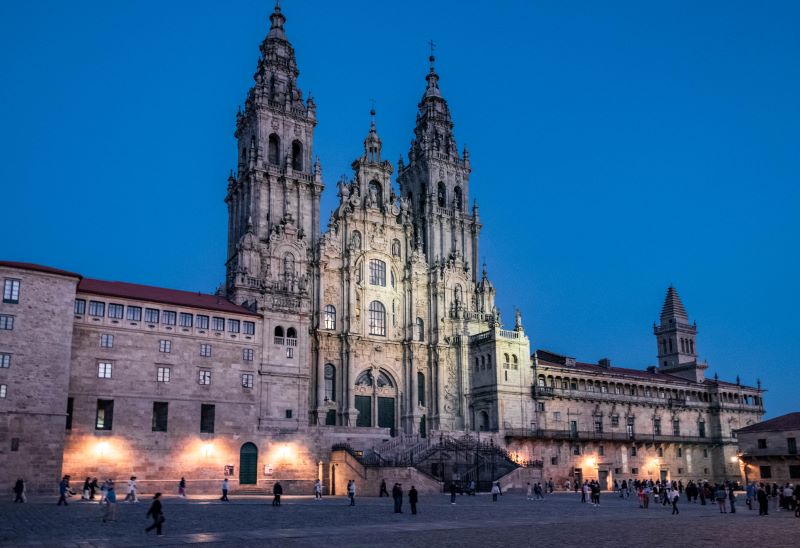
Santiago Cathedral is a symbol of what this city means today not only for Galicia or Spain but for the entire Christian world. The first cathedral, built at the beginning of the 9th century by order of King Alfonso II of Asturias, was later conquered and destroyed by the Moors, and the current cathedral was rebuilt on these ruins in the 11th century. It was expanded and changed over the centuries. The last changes were made to the cathedral in the 18th century. Both the exterior and interior are impressive.
No other cathedral on the Iberian Peninsula has such symbolic significance and none can compete with its grandeur. You can spend hours admiring its intricate details, its baroque façade, the famous Romanesque Portico of Glory, and its rooftops. And that’s even before you go inside!
Inside, the cathedral is just as impressive. The richly decorated baroque altar is an exquisite work of art. You can visit the crypt under the altar with the relics of Saint James. Entrance to the cathedral is free, but walking around and taking photos during mass is not allowed. You can take a tour of the cathedral and museum to learn more about its history.
Attend a pilgrim mass at Santiago Cathedral


Even if you’re not a pilgrim, it’s interesting to visit the cathedral during mass, which occurs several times a day. The mass lasts 30–45 minutes. If you’re lucky, you might witness the Botafumeiro ceremony, when six specially trained monks swing a giant silver censer attached by a thick rope to the ceiling.
This does not happen every day, only during special religious holidays such as Christmas, Easter, Saint James’ Day, etc. During the height of Camino season (August – September) you have a better chance to see the Botafumeiro. Because groups of pilgrims book and pay for the ceremony of their arrival in Santiago for a solid sum of about 450 euros.
Plaza Obradoiro

The best view of the front façade opens from Plaza Obradoiro, the beautiful square in front of the cathedral. Every Camino ends right here – thousands of pilgrims come here, hug, cry with happiness, and take photos to remember. They spend some time here – sitting, lying, strolling around the square, not believing that their long, hard journey is finally over.
For tourists who have not walked the Way of St. James, such a number of people with backpacks might seem strange. But if you read the history of the city and about the huge popularity of the Camino routes, everything falls into place. I recommend coming to Praza Obradoiro late in the evening when the lanterns light up. You can also hear concerts by a local musical ensemble here, playing Spanish tunes to which tourists and pilgrims dance.

The square also houses, first of all, the Hostal dos Reis Católicos or Parador de Santiago – the building of the old pilgrim shelter, which is now a Parador hotel. The building was constructed in the 1400s as a dwelling and hospital for pilgrims. This hotel is one of a network of hotels that in Spain are opened in ancient palaces, monasteries, and other historic buildings. Also on the square are the Pazo de Raxoi (now city hall), Pazo de Xelmírez, and Colexio de San Xerome.
Take a tour of the cathedral roof

To make your visit to the cathedral complete, take a roof tour. On this tour, you will get a unique opportunity to see the upper part of the cathedral up close and enjoy a bird’s-eye view of Santiago de Compostela. The tour with a guide lasts about 1 hour, during which you can explore the roof, enjoy a 360-degree view of the city, and see the squares and streets around the cathedral from above.
Mercado de Abastos
Like every Spanish city, Santiago de Compostela has its own beautiful market. That’s Mercado de Abastos, a lively place operating since the 17th century. You’ll find many vendors selling local products, as well as several stalls where food is prepared to order. For example, you can buy fresh seafood and have it cooked and enjoy it right at the market.
Opening hours – Mon-Sat from 7 am to 3 pm
Explore the Old Town on foot

Walking the Old Town of Santiago on foot is a great way to immerse yourself in its medieval charm. Its narrow cobbled streets with beautiful old buildings, churches, squares, fountains, and parks are made for strolling.
Santiago has many interesting buildings; don’t miss the main attractions: San Martín Pinario Abbey, Plaza Quintana, Pazo da Fonseca, Pazo de Raxoi (city hall), Colegiata de Santa María, University of Santiago de Compostela, the San Francisco Monastery and Church, and many more.

Tip: You can combine your walk with shopping. I really like bringing back silver jewelry related to the Camino and delicious gifts from Santiago. About the latter – I recommend buying the Tarta de Santiago, which is baked from almond flour, it’s very tasty and your family will definitely love it. You can buy it at any souvenir shop, but it’s cheaper in a regular supermarket – here it costs from 6 euros. Also very tasty are chocolate-covered almonds and Galician wines – they make great delicious gifts.
Bar Street in Santiago

Santiago de Compostela is one of those Galician cities where a lot of tourists just go crazy (in a good way). Because the local bars offer a large number of free tapas with every beer, cocktail, or glass of wine.
There is even a whole bar street here – Rúa do Franco, where the best bars and restaurants in the city are located. It’s also known as Paris–Dakar because at the start of the street there is the bar Dakar, and at the end – café Paris. Until you visit every place, you haven’t reached the finish line of the race.


It’s a joke, but with some truth. Every time I go to one of the tapas bars, I can’t stop – I eat tapas and pintxos – sandwiches with incredibly varied fillings. Delicious, noisy, fun, and very colorful.
So, here’s one of my favorite tapas-eating routes through the old town:

- El Papatorio – excellent tapas and pintxos, you can go inside to the restaurant or sit at the bar and enjoy pintxos with wine.
- A Taberna do Bispo – also a nice tapas bar where you can try a variety of tapas or local cuisine dishes.
- A Noiesa Casa de Comidas – excellent restaurant with seafood and Galician cuisine.
Tip: If you are in Santiago on the weekend – always book a table before you go for dinner.
Friday night is the best time to go out, when the streets are filled with people and music. Be sure to rest well before you go out, and don’t start too early as you may be full and tired before the party even begins. My favorite part of outings in Santiago is the parties with Camino friends with whom I finished the Santiago route, and it’s a great occasion to celebrate this event.
Alameda Park

Alameda Park, the green lungs of Santiago, is the most favorite place for leisure in the city. A huge green park, it’s ideal for long walks when you want to escape from the narrow streets of the old town. Be sure to visit the Mirador de Alameda with its impressive staircase, and visit the church on the highest point, from where there is a wonderful view of the cathedral and the Old Town.
The park is a kind of barrier between the Old Town, the university area, and the new town, so this is an ideal starting point to move on to the new part of the city: either to explore the new Ensanche neighborhood or stroll around the university and see all the students.

Also, in the busiest part of the garden, you can see the famous monument to the “Two Marías” – these are two famous old ladies from Santiago who were activists and, so to speak, socialites. In their honor, two statues were erected – every 5 years they are updated and painted with new dresses and outfits.
Recommended reading on what to see in Galicia and around Santiago de Compostela:
Galicia – a guide to Spain’s green province
Monte do Gozo

I have been here three times: the first time when I finished my first Camino Francés, second time – when I finished Camino del Norte, and third time – when I finished Camino Primitivo in 2024. Why so often? Because Monte do Gozo is located on the last stage before the end of all these three pilgrimage routes.
Just 5 kilometers from the city, it was at the top of this hilly cape that historically pilgrims first saw the three spires of Santiago Cathedral after weeks of walking. And I too saw them for the first time from here.
And although you might think there’s no point in coming here if you’re also not walking the Way of St. James – I’ll be honest: this is an incredibly beautiful place from where you can see the whole city. Especially stunning at sunset.
Cidade da Cultura (City of Culture)


If you want to see something that completely contrasts with the classic architecture of the Old Town of Santiago de Compostela, you just need to plan a visit to the City of Culture – Cidade da Cultura.
It is located on the top of a hill southeast of the city. Here you can see a range of strange and fantastic modern buildings designed by the famous architect Peter Eisenman. The buildings themselves and their bizarre shapes are the main attraction, but here you can also find a museum, library, amphitheater, and skate park. High above the city, there is an incredible view of Santiago, especially at sunset. Be sure to check their website to find out what exhibitions and cultural events are taking place.
What you need for traveling in Spain
- If you plan to travel the country – rent a car, which will allow you to visit many interesting places and locations in a week. Rent a car right after arrival and travel the beautiful roads of this country. By the way, highways are toll roads, and the payment system is the same as in Italy. That is, before entering a toll road, you take a ticket at the barrier, and at the exit – pay for the kilometers you have traveled. I recommend looking for a car on Rentalcars.com – here you can find budget and more comfortable car options.
- Don’t save on medical insurance – it’s convenient to buy it online on the HotlineFinance portal. Healthcare in Spain is not cheap, but for a small price you can get insurance covering 30,000 euros.
- Book accommodation in advance – prices in Spain, as in other countries, rise during the high season. Booking.com allows you to find discounted options, as well as book accommodation with free cancellation.
- To get to Spain I recommend looking for airline tickets on Ryanair or Wizz Air websites. The cheapest low-cost flights in the winter period – to Madrid and Barcelona.
- Bus tickets around Spain I buy on the website of the Spanish carrier Alsa.
- Train tickets in Spain – on the website of the Spanish railway company Renfe.
Useful articles and links:
- Ruta-del-Cares – the most beautiful hike in the Picos de Europa mountains
- Where to watch the 2026 total eclipse in Spain
- Hotels in Barcelona – which district is best to stay