
Galicia – what to see and try in the green part of Spain: ancient cathedrals, Celtic settlements, beaches, mountains and forests, Galician cuisine.
Hot Spain, from which the only escape is the sea. This is not about Galicia. It is here that people come in the summer to cool off from the hot sun, wander the Galician hills, eat delicious seafood, and pray for sins at St. James. Galicia is a vast province in western Spain where you can see how tourist attraction can be made up of more than just a vacation by the sea, combining man-made beauty, spiritual values and nature.

I walked through Galicia four times: first from east to west to cape Cabo Finistierra, and then from north and south, from the very Portugal. And all those times, Galicia roasted me mercilessly with the sun, poured rain on me, and blew bad thoughts and feelings out of my heart and soul. Despite such different weather, it has managed to occupy a special place in my soul and it looks like it will last for a long time – I am going on the road again and again to go some more Camino de Santiago.
Where exactly is Galicia located?
Galicia is the extreme northwestern region of Spain. It is also part of the Cantabrian coast, which stretches from the northern border with Portugal to the border with France. Galicia has landscapes closer to the Irish, thanks to its humid climate and green grass. It is not at all like the arid plains of southern Spain.

The Galician coast is washed by the Atlantic on both sides, bringing coolness, its evergreen mountains covered with eucalyptus forests keep rain clouds on the treetops. But if they are blown away by a hot wind coming from the central part, you can get burnt to a crisp here too.

Thanks to this luscious climate, you will find some of the most scenic and longest hiking trails in the country. This is where the different trails come together Camino de Santiago ancient paths that traditionally lead pilgrims from Spain and France to the Cathedral of Santiago de Compostela, the famous burial place of St. James, one of the 12 apostles of Jesus Christ.
Season – when is the best time to go to Galicia

Galicia is best in the summer because it’s cool and not as hot as in the south or in the central part of the country. When the temperature in Madrid exceeds +40℃, in Galicia you can safely put on a fleece or walk through the picturesque hills for fear of sunstroke. In summer, temperatures in Galicia can jump from +12 to +30 ℃.
It all depends on the clouds, which can come and pour rain on everything. Or dry, sunny and sometimes very warm weather will set in. But still, summer here is very comfortable for traveling both by car and on foot.
But there are exceptions to this. The heat sometimes comes to the forests of Galicia, which also burn due to extremely high temperatures in summer. Large-scale fires are affecting even the green part of Spain, so you need to be careful if hot weather comes to the north of the country.

It often rains in spring in Galicia, although it is the rainiest part of Spain in any season. The best month is May. On the contrary, in the fall, especially in September and October, it doesn’t rain much, and it’s often sunny and warm.
Winter in Galicia is the same as, for example, in the UK or Ireland. The temperature ranges from +5 to +15 ℃ and is very humid. But it can snow in the mountains.
What is interesting in Galicia

Galicia is home to culinary and religious treasures, vast expanses of ocean, accessible only to fearless surfers, and a place where you want to breathe at the top of your lungs, walk on foot, and watch the riot of nature for hours.
The most beautiful and dangerous beaches
The Galician coast is especially rich in rugged but beautiful beaches. They often don’t look like the usual picture with golden sand, but rather resemble works of art by Mother Nature.

On the border of Galicia and Asturias is one of the most beautiful beaches in the world – the beach of the Cathedrals. Natural stone arches formed by water and wind. At low tide, these arches expose their bases for several hours, and then hide again under the thickness of high water.

Cathedral Beach is officially called Praia de Augas Santas, which means “Beach of the Holy Waters”. Thousands of tourists come here (during the peak season, pre-registration is even organized on the official website). The best time to get here is at dawn, to walk along the clean sand that has been exposed after hours of being underwater, becoming a pioneer among the thirty-meter stone arches.

To visit this place from July to September and during Holy Week, you must book in advance on the beach’s website a free ticket online. The number of visitors is limited to 5000 per day, so plan your visit in advance. But in other months, you can freely come to the beach, as I did in June 2017. It is best to do this early in the morning, at low tide (check the tide schedule in advance) to walk under the stone arches of the cathedrals.

Muxia
Also, take time to hang out in a small village called Muxia, where the natural elements and human belief in a higher power merge into one. The Church of the Virgin Mary on a Boat stands on a rocky shore dotted with boulders.

This church was built on the site where, according to legend, the Virgin Mary came ashore in Spain and then helped St. James preach Christianity on the Iberian Peninsula.

The beaches near Moushia are quite rugged on cloudy days, and bright white with blue water in sunny weather. You can swim here in the summer, but don’t expect warm water – the Atlantic in this part is warmed by the Gulf Stream, but the water temperature does not exceed +14 degrees.
Lighthouses on the ocean coast

Faro is another feature of the Galician coast of Spain. The word means a lighthouse, and as a rule, they are located in very advantageous and romantic places, especially loved by couples in love and lovers of cool selfies.

There are a lot of them on the Atlantic coast of Spain. But there are especially many on the Costa de la Muerte, or “Coast of Death,” which stretches from the villages of Muros and Malpica. It got its name because there were many shipwrecks along its rocky Atlantic coast. Because of this, there are a lot of lighthouses here, and some of them are very old. There is even a hiking route – the Lighthouse Trail, or Camino dos Faros. It is not an official pilgrimage route, but it is very picturesque and beautiful to put on your bucket list, as I did.

This shore is also called Fisterra in the Galician language. According to Roman legend, this area was the end of the world (Finis-terrae). Cape Fisterra also has a lighthouse and a post with a zero-kilometer marker. It is here that the pilgrims end their long journey, having traveled great distances to the Cathedral of Santiago de Compostela and further, to the ocean.

Only 75 km north of the capital of the region of Galicia, there is the city of La Coruña, built in the Romanesque style. And its Old Town is home to an exquisite collection of squares and medieval churches. At the northern tip of the La Coruña peninsula is its national symbol, the Tower of Hercules, which dates back to the second century AD. It is the oldest Roman lighthouse in use today.
The capital of Galicia is Santiago de Compostela
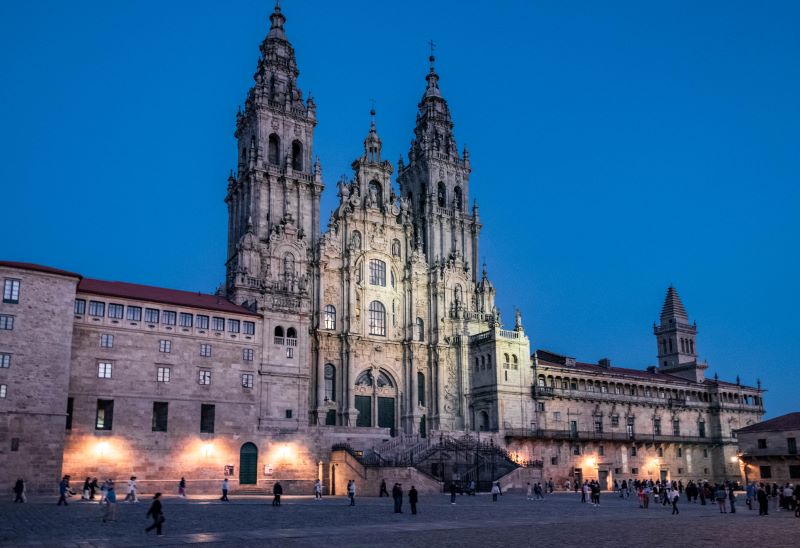
Santiago de Compostela is a tourist and pilgrimage center that receives hundreds of pilgrims every day and thousands of pilgrims from all over the world in the summer season. And busloads of tourists come to see the Cathedral of St. James, where the relics of the saint are kept. Not only the pilgrims, but believers from all over the world come to bow to the silver coffin.

The world’s largest censer is here
Three times a day, the cathedral hosts a mass, during which (if you’re lucky) you can see the world’s largest censer, the Botafumeiro, flying. The censer is launched only when a group of pilgrims or a wealthy believer pays for it (from 200 euros). So, if you see it, the impression will last a lifetime (I promise, because I must be a very lucky person – I have seen this miracle six times already). At the end of the mass, everyone can hug the golden statue of St. James, on whose back an unearthly light burns a comb shell, a symbol of the Camino de Santiago.

But there are many places in Santiago de Compostela worth visiting besides the tomb of St. James. The old town is a UNESCO World Heritage Site and there are many historic buildings worth exploring. However, one of the best ways to see the city is from above. For example, from the Monte da Gozo hill, where there is a monument to the pilgrims. Or from the roof of the Santiago de Compostela Cathedral , you can enjoy a spectacular view of the city below. To get there, you need to buy a ticket to the cathedral museum and go on a tour. The historic quarter, full of monasteries and churches, is also a must-see, especially if you’re a fan of religious architecture.

Alameda Park and Botanical Garden
Santiago de Compostela has a quiet and cozyAlamedaBotanical Garden, located in the heart of the city, next to Carbalheira de Santa Susana. Here, in the shade of palm trees and bananas, majestic camellias, locally called “hacobea,” grow. The garden also has a very nice observation deck overlooking the cathedral.

Also in the most popular place of the garden you can see the famous monument to the“Two Marias” – two well-known grandmothers in Santiago who were activists and, so to speak, socialites. Two statues are erected in their honor – every 5 years they are renewed and new dresses and outfits are painted for them.

Tapas and pinochos bars
If you’re more interested in a bustling evening life, head to Rúa do Franco after 8pm, where the best bars and restaurants in the city are located. It is also nicknamed Paris-Dakar because there is a Dakar bar at the beginning of the street and a Paris cafe at the end. You won’t reach the finish line of the race until you’ve passed all the establishments. It’s a joke, but it’s true. Every time I go to one of the tapas bars, I can’t stop eating tapas and pinchos, sandwiches with incredibly varied fillings. It’s tasty, noisy, fun and very colorful.

But the real beauty of Galicia can be found outside the cities of the region.
The nature of Galicia

You can’t miss the Galician forests and hills. I have walked many times in the Galician forests – there are many trails where you can feel like you are in the locations from The Lord of the Rings. Forests filled with oaks and chestnuts can be very dense, but they are full of natural wonders. And in the eucalyptus groves, it is impossible to be inspired by the aromas of the trees, the smell is a bit like in a pharmacy, but fresh and uniquely natural.
Where you should definitely visit:
Serra do Curel is a UNESCO World Geopark. Deer, wild boars, and even wolves inhabit this dense, wild landscape. There are many hiking trails here. But to get through them, just make sure you’re well equipped to tackle the steep slopes of the forested terrain.
There are also many interesting places in the mountains of Galicia. For example, the Cañón del Sil, a canyon of the Salt River, along which you can see numerous terraces with vineyards. The observation decks offer stunning views of the canyon and grape terraces.
If you have a desire to sit in thermal springs, they are also available in Galicia. They are located in the town of Caldas de Reis, where hot water with a temperature of +42+48 °C flows from the ground and enters the pools. Also, the water is mineral – it is safe to drink. If possible, stay in one of the spa hotels with a thermal pool. For example,
Or come to the city center, where you will find a small old laundry – it also has a thermal spring, where pilgrims love to put their tired legs after many kilometers.
Historical sights and places

There are many historical monuments in Galicia, including fortresses, monasteries, and the remains of Celtic settlements. Here you can even see the Holy Grail (at least one of them – there are three cups in the world that compete for the title of the same cup from which Jesus took communion during the Last Supper).

Where to find the holy grail
In a small village at the top, O’Cebrero, lost among the Galician mountains and fogs, the Holy Grail cup is kept. And this is no joke – this artifact is recognized by a good half of the Catholic world. According to a local legend, in the thirteenth century, a peasant from a neighboring village made it to church for mass despite the storm that had broken out, trudging through the storm and gale-force winds.
The priest was not expecting anyone in this weather, and so he was angry that the zealous parishioner prevented him from warming himself by the fire. And at that moment in this church, the wine in the communion cup turned into real blood. The miracle beset the unrighteous priest, and the vessel was recognized as the Holy Grail.

Where did the Celts live?
Ancient Celts lived in Galicia, and the remains of their settlements have been preserved here. One of the largest is located in A Guarda on the border with Portugal, which is served by the Minho furnace. The Celtic settlement of Santa Trega in A Guarda is one of the best preserved in all of Galicia. It is located on top of a mountain, offering breathtaking views of the mouth of the Minho River. Here you will not only see the remains of Celtic settlements, but also get acquainted with the life of its inhabitants, different types of houses and see ancient petroglyphs.
25 km from A-Guarda is the city of Baiona, which has a very colorful old town and a fortress on the coast. You can also see a copy of the Pinta caravel here. This ship arrived here in 1493, bringing news of the discovery of America.
What are these houses on chicken legs?

Also in Galicia, you can see very unusual old structures – Hórreos. This is the name of the houses on “chicken legs” that are considered one of the symbols of Galicia. A few centuries ago, they were in every yard and served to store grain or corn. Now they stand along the roads-sometimes with the doors open, sometimes carefully locked, and they are still in use.
The unusual design with built-in round stone millstones prevents rats and mice from getting inside the orreo. And a large number of holes allow the grain to ventilate. For example, the town of A Merca has the largest number of such barns – 34.
Galicia’s cuisine

Galicia is known worldwide for its seafood. And for good reason – Galicia, unlike other parts of Spain, has the longest oceanic coastline. That’s why there are so many fishermen who go out to sea every morning and evening to catch local catches: velvet crab, scallops, langoustines, and exotic persebes, or rocking crayfish, which can be found on many restaurants’ menus. In addition to the variety of seafood, it is very cheap in Galicia. For example, this plate costs 24 euros, and it was enough for two people.

Octopus – Pulpo
But the most important sea creature in Galicia is the Galician octopus, or Pulpo. Its boiled tentacles are served on a bed of boiled potatoes, generously seasoned with paprika and olive oil. This octopus doesn’t even need to be chewed – it melts in your mouth. It is very tasty and you can go to any pulperia (a cafe where this dish is prepared) and taste the famous dish.
In Galicia, there is even a festival dedicated to Pulpo– Festa do Pulpo de O Carballino. It is held annually on the second Sunday of August in the municipal park of O Carballino to enjoy pulpo a gallega – octopus in Galician.

Padron peppers
Seafood is certainly an important part of Galician cuisine. But there are also vegetables, the main one being Padron peppers (Pimientos de padrón). The green pods, five to ten centimeters in size, are fried with olive oil and sprinkled with coarse rock salt. They all look the same, but for every ten sweet peppers, there are one or two unbearably bitter ones. This savory dish is known all over the world, and in Spain it can be found in every corner and ordered as an appetizer (tapas).
Galician soup
They also serve the Galician soup Caldo. The main ingredient is the Galician cabbage couceiro, which grows in every garden or yard. This cabbage does not have a head of cabbage, or rather, it looks like a bush pole along which cabbage leaves grow. Tacos contain chorizo sausages, ham, potatoes, and sometimes turnips. It’s very tasty and warms up nicely in cool weather.

Galicia’s wines are another topic not to be missed if you drink alcohol. It is interesting that traditionally Galicians did not drink wine from glasses but from bowls, which are very similar to those used in the East. In addition, in Galicia, they make moonshine, or Orujo, a Galician alcoholic beverage with a strength of 30-60%, which is made by distilling the fermented grape residues. The drink is then aged in barrels and infused with herbs, honey, and spices. Orujo is used to make the hot Galician punch Queimada. This drink came from the Celts, who used it to ward off evil spirits, which was a good reason for a fun party.
Getting around Galicia

All the times I’ve been to Galicia, I’ve come there on foot during the Camino de Santiago. And then I either took a train to Madrid or flew from Santiago airport. By the way, in summer, more passengers depart from this airport than arrive. Cheap airlines fly here Ryanair – of course, if you buy tickets in advance and not on weekends.
Trains from Santiago de Comostela to Madrid run quite frequently. There are fast trains, which can be reached in 2.5 hours, and there are transfers, which take 4-6 hours (the second option is cheaper).
It is convenient to travel around Galicia by car – car rental prices in Spain (except in summer) are very affordable – from 15 euros per day. It is convenient to search for a car on Rentalcars.com but if the search engine offers you a cheap car from the Spanish rental company GoldCar, try to avoid this choice. I really didn’t like my experience with GoldCar – huge queues at the counter (they are very popular for some reason), they cheat with the fuel policy, require you to buy other types of insurance, etc.). It’s better to choose someone else – in general, carefully study the reviews of a particular rental company.
If you plan to travel by public transport, look for bus tickets on the website of the national bus carrier ALSA. Or by city trains – on the website of the railway company Renfe.
I always look for hotels on Booking.com – Santiago de Compostela⋙. – here are the best prices, you can see reviews from other guests. Very fast and convenient.
If you need to find an affordable hostel or pilgrimage albergue, it is better to look on Hostelworld⋙
Travel Medical Insurance – online on the EKTA
Useful articles and links:
- Barcelona – what to do in three days
- The 7-day route in Andalusia – what to see in the south of Spain
- What to see for one or two days in Granada, Spain