

Via Francigena is the Italian Camino from Lucca to Rome. What is the infrastructure on Via Francigena, when is the best time to go, how much does accommodation and food cost on the route?
The Via Francigena is a unique pedestrian path that runs from Canterbury in the United Kingdom through France and Switzerland and Italy to Rome. The section of Via Francigena from Lucca to Rome is one of the most popular and spectacular.
This part of the Via Francigena way has Tuscan vineyards, great Italian food, incredible views and hospitable towns and villages of Lazio area. A walk from Lucca to Rome along the Via Francigena is a truly unique experience in life.
Below you can learn more about my experience – how I walked from Lucca to Rome along the Via Francigena.
More information: Via Francigena – my experience of walking from Lucca to Rome
What is Via Francigena?

Via Francigena translates directly as “the way of the Franks“. It is a path or connection of paths that runs over 2000 km from Canterbury in the UK through France, Switzerland, and Italy and eventually ends up in Rome. Over the years, it has undergone a transformation from a strategically important road to an important religious pilgrimage route. Along with Santiago de Compostela and Jerusalem, Rome is also a holy place and has been a center of pilgrimage for centuries.
Sigerick, who was the Archbishop of Canterbury, is most associated with Via Francigena. He walked to Rome and back to Canterbury after receiving a religious honor from Pope John XV in 990 AD and planned his journey. Sigerick was the first who write about this way.

Today, just like on the Camino de Santiago in Spain, many people walk along Via Francigena. And people do it for different reasons: some are interested in the cultural component, some go for religious reasons. Some challenge themselves physically, and some seek spiritual issues by walking 20-30 km a day, overcoming hills, plains, and mountains on foot.
I walked from Lucca to Rome at the end of September to 10 October 2023. It was the wonderful walking journey and I was happy have did it.
How long does it take to get from Lucca to Rome?

The total length of the Via Francigena from Canterbury in the UK to Rome is over 2000 km. The section from Lucca to Rome is 420 km. You can walk this part in 18 or 20 days, depending on your walking pace. I went through the guidebook in 18 days.
Many pilgrims start from Siena. The walk from Siena to Rome along the Via Francigena is approximately 290 km. This stage will take about 10 days, depending on your walking health.
The best time to walk the Via Francigena

In principle, you can walk the stretch from Lucca to Rome in any month of the year. At least I read reviews of those who went in winter. Many people also go in summer when the weather is very hot (in the summer of 2023, the temperature in Italy rose to +40℃).
However, it is still better to go in the most pleasant weather, which in this part of Italy is set in spring and autumn.
- In spring, it’s April-May. It’s warm, the temperature is very comfortable at +20-25℃. There are rains, morning fogs, but the sun does not burn.
- In the fall – September-October. It’s very warm, and sometimes even hot – I went from September 23 to October 10, and it didn’t rain, but it was hot for me. On some days, the temperature reached up to +32℃. They say the fall of 2023 was abnormally hot.
Remember: the most budget housing closes in the fall on October 1 and opens its doors to pilgrims in May. So in the low season, you have to sleep in hotels and guesthouses, which are much more expensive than hostels in churches or monasteries.
Is it difficult to walk from Lucca to Rome?

If you decide to walk from Lucca or Siena to Rome, be prepared to encounter steep climbs, uneven terrain, and several small river crossings. In the spring, you have to wade through these rivers. But in the fall, when I walked this route, they were very shallow, it was enough to walk on stones and not get your feet wet.
Get ready for some serious challenges: for example, a particularly steep climb to a town called Radicofani, which is located on the border of Tuscany and Lazio. For me and the other pilgrims, it was the hardest day, as the climb (up to 800 meters) came at the end of a 32-kilometer day. And I was also “lucky” – it was the hottest day of 32℃. Plus I had three blisters on my left foot.

If you look closely at the number of kilometers per day and the terrain, it becomes clear that even in 20 kilometers you can get tired. Because you will find quite undulating terrain with hills and traditionally steep climbs into cities at the end of each day.
In the past time cities were built on hilltops. Because it was a guarantee of safety for local residents. And for the pilgrims who were tired during the day, it was a good test at first. And then, after rest and a shower in the hostel, beautiful sunsets and views of the valleys around them.
If compare to Camino the Sanriago
Most of the pilgrims I met along the way were retired people who had overcome it and were able to go through all the difficult stages. So you can do it too, if you’ve already been to other Camino and know how your body works over long distances or in the mountains.
If I compare the difficulty with other Caminos I’ve walked in previous years, Via Francigena is closest to the northern route, the Camino del Norte, which leads from Irun to Santiago de Compostela, in terms of difficulty and complexity of the route.
Documents for pilgrim on Via Francigena

Credentials are also available on Via Francigena, and it is impossible to stay in monasteries and ostellos at churches or those belonging to religious associations without them.
If you start in Lucca, buy a credential in the museum of the Lucca Cathedral. I bought mine for 5 euros. If you start in Siena, there are six different locations where you can get a credential – all of them can be found here.
Just like in Spain, every day you put your stamp in a credencial, a place to sleep, and optionally in other places where pilgrims put their stamps: bars, museums, tourist centers, etc.
How did I get a pilgrim certificate for Via Francigena?
If you have walked the Camino de Santiago, you know that at the end of the route you will receive a Compostela. It’s a certificate of completion of the route to Santiago de Compostelo. This is a certificate that is given to you by the Pilgrimage Office in Santiago when you complete the pilgrimage to Santiago.
The Via Francigena has an analogue of the Compostela – the Testimonium. It’s a similar certificate issued to pilgrims who have walked at least the last 100 km of the Via Francigena.
At the end of the route, in St. Peter’s Basilica in the Vatican, you have to show your credentials and can receive a Testimonium. But the process of obtaining it is much simpler, than in Spain. No one takes into account the number of pilgrims in Rome, because there are very few of them compared to the Camino de Santiago.
Keep in mind: To get the Testimonium, you need to go inside St. Peter’s Basilica, which is always crowded. But the pilgrims do not have to stand in line with the tourists; they are allowed to enter without a queue.
Infrastructure on Via Francigena

The markings on the route from Lucca to Rome are excellent – you can follow the arrows and stickers located on the poles or on stone pillars (there are many of them in Tuscany).
Accommodation on Via Francigena
Accommodation on the route is a very important thing, so, firstly, it is a significant budget item, and secondly, it is a unique experience of this particular Camino.
Via Francigena has a variety of accommodation options: hostels, monasteries, hotels, campsites and guesthouses.

Staying in a monastery or a parish church on Via Francigena is a special experience. Even if you’re not religious, the warm welcome you get when you arrive is still really impressive. After a long day of exploring, a clean and welcoming environment awaits you.
There are not many times when you will be invited to a monastery or church to spend the night, which makes it even more a unique experience on Via Francigena. You should not expect hotel service here, but you will have everything you need for the night: a bed in a dormitory or even in a separate room, a toilet and shower, a place to wash your clothes, and sometimes dinner prepared by nuns or volunteers. In any case, the apartment will always be clean and warm.
Important: You don’t have to be religious to stay in the monasteries and churches on Via Francigena. During my stay in the monastery, I was never forced to attend prayer time. I was invited, but it was of my own free will. But they checked for a credential, which confirms that you are not a tourist who wants to save money, but a real pilgrim on Via Francigena.
What you have to know when planning to stay in a monastery or church hostel:
- In monasteries and churches, there is often a curfew that must be observed. For example, the doors may close at 21:00 or a little later, and you won’t be able to return to the building after that. Therefore, it is necessary to check with the owners whether there is a curfew and whether they will give you a key or access code to return to the building.
- You can get a bed in a dormitory or your own room – it all depends on the conditions provided by the monastery or church.
- You can be offered dinner and breakfast – at your choice, it is not obligatory.
- Payment for an overnight stay in a monastery or church can be fixed (for the night + dinner + breakfast), or donated – as much as you think it is possible to leave for the night + dinner + breakfast, if any.
- Prices for such accommodation range from donativo (I left from 10 to 30 euros depending on the conditions, whether there is dinner – I never ordered breakfast because it is often not tasty, I prefer to have coffee with a croissant in a cafe). There is also accommodation in monasteries and churches with a fixed rate – from 10 to 20 euros for an overnight stay, from 15 euros for dinner, 5 euros for breakfast (sometimes more expensive).
- However, some hostels cannot be booked, and there are those that adhere to the tradition of first come, first served. If you run out of places, go look for another place to spend the night.
What other options did I have for where to stay for the night?
- Camping – there was a big discount for pilgrims, so for 22 euros I got my own room with a shower and toilet and a small terrace.
- Apartments – I made arrangements with other pilgrims, and we stayed in an apartment with 4 beds. It was much cheaper than a hotel, and we had our own kitchen where we could cook a delicious dinner with food we bought in the supermarket.
- A private hostel – I spent the night there because I couldn’t find any other places, but the price was nice – 20 euros.
- A hotel for pilgrims – I stayed in such a place several times because it was also much cheaper than in ordinary hotels (30-35 euros instead of hotels for 70-80 euros).
- It is possible and best to book accommodation almost everywhere. I did it in the evening the next day. I would call (or ask Italians to help me book a bed), or write an e-mail, but most often no one answered. In my experience, booking by phone is much more efficient.
Unlike the albergues on the Camino de Santiago, hostels and monasteries on Franceschina open after 3 p.m. (in Spain, you can check in after 1 p.m.). Also, if you do not book your accommodation in Italy in advance, you may not be accepted after 18:00, even if there are vacancies. The albergues on the Camino generally allow pilgrims to sleep on the floor or camp in the garden if all the beds are full. This is unlikely to happen on Via Francigena.
Where exactly can I find information about accommodation, where can I track the stages of the route?

First of all, on the official Via Francegina website has a complete list of all types of accommodation along the route. I saw a lot of people either looking at the contacts of the accommodation in the Via Francegina app or even making paper printouts and carrying them with them. You’ll also need this site and app if you want to see your route and location on a map. The app is connected to GPS, so you can see whether you are on the route or lost.
Secondly, the same information about housing is available on the already familiar website for supporters of the Camino de Santiago – Gronze.com. I used it because I was already used to it when I was walking around Spain, and it has all the information I need.
There is also always a backup option – the Booking.com where you can find accommodation in any city in Italy if you decide to stay in a hotel, B&B, or agriturismo, of which there are many on the way.
Many of the pilgrims also used paper guides, such as the Walking the Via Francigena Pilgrim Route which is available on Amazon. But there is no Ukrainian-language edition.
Food on Via Francegina


Unfortunately, there is no where to cook in hostels, there are almost no kitchens. And even if they did, there was not a single store in the village where the hostel with a kitchen was located. And carrying food on your person is not an option.
Monasteries often offer breakfast and dinner – on average, it costs 15 euros if the price is fixed, or donations (as much as you give). 15 euros for the first, second and wine is a good price. Because in a restaurant, a plate of pasta costs from 12 euros and a glass of wine from 5 euros.
Some bars and restaurants offer a pilgrim’s menu, which also includes pasta and salad, or some other hot dish plus a drink (wine or beer), sometimes sweets and coffee. The price of this menu starts from 10 Euros (without meat), 12-18 Euros with meat and wine.
Breakfasts in monasteries or churches are very nominal: cookies, toast, jam, a store-bought croissant, coffee, an apple, and sometimes yogurt. I didn’t like it, so in the morning I would buy coffee and a croissant (3 euros) in a cafe or bar, and I always had fruit for the daytime transition (I don’t eat heavy food on the road – only fruit and water).
Markings on Via Francigena

The markings from Lucca to Rome are almost perfect. Instead of the yellow arrows that we used to see on the Camino de Santiago, there are white and red stickers with the symbol of this path, the pilgrim, on almost every pillar. Additionally, there are large brown arrows at intersections. Tuscany also had stone pillars (milestones) with the letters VF.
Via Francigena is laid out on dirt paths as much as possible, going through fields, forests, and hills. But of course, it’s not always possible, so some sections along the road are unpleasant because of the way Italians drive, and most of them have no space for pedestrians. Also, don’t expect Italians to stop at a pedestrian crossing on their own – they almost never do. But, for example, when a car is driving on a dirt road, when it sees a person on foot, drivers slow down and walk very slowly so as not to kick up dust (unfortunately, not all, but most).
I also liked the benches and resting tables that often come along the way. In Tuscany, especially, they are installed in beautiful places, either on observation decks or just near drinking water taps.
Water on the route
In almost every site has water taps. In general, the water in Italy is potable. Only a couple of stages I had to carry a liter and a half of water because there were no springs along the way.
Most of the stretches have towns in the middle where you can stop at a bar, drink coffee, take a break, and get some drinking water at a bar or at drinking water taps.
How much does it cost to stay for a day at Via Francigena?

At the Spanish Camino I spent 25-30 euros a day (accommodation + food). The Italian route is more expensive. Count on at least 50 euros per day.
Of course, you can save money on food and not go to a restaurant. You can not buy the offered dinner at the monastery. But this means that you will have to eat only supermarket sandwiches and fruits and vegetables.
Attention: it is wrong to save money on paying for donated housing. Not paying at all is very ugly. Because you are given a roof over your head, the opportunity to wash after the trip and wash your own clothes. We should leave a thank you note for this, at least a minimum of 10-15 euros.
Are there many pilgrims on Via Francigena?
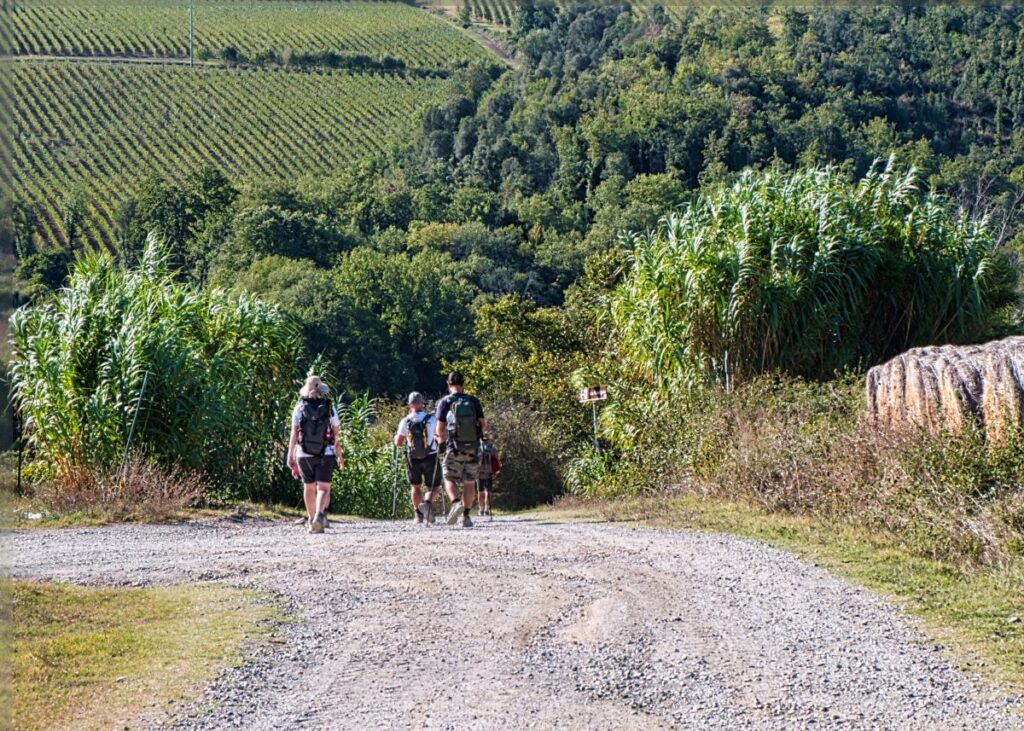
No, not many. And because of this, there are few cheap places to stay. There were about 15-20 people walking along with me. But because of this, there is a very warm, almost family like atmosphere in the evenings by the fireplace. Because you constantly spend the night with the same pilgrims, go to dinner with them, and talk to them. And then it is very difficult to say goodbye to these people who have become fellow travelers on the road.
The last 100 kilometers are just as quiet and peaceful as the rest. No crowds, groups or schoolchildren. Only the penultimate 19 km, when you are already entering Rome, are difficult, because you have to walk along the highway with terrible traffic, near garbage dumps, until you reach Monte Mario Hill (a park with a great view of the Vatican). That is, it was a joy to walk the last 100 km, although I was a little sad because the miracle of the Camino was ending with every step.
Atmosphere on Via Francigena

I have already walked 7 Caminos, but this route was special. Maybe because there are not many people there yet, or maybe because there are almost no private hostels.
It was here that I immersed myself in the tradition of pilgrimage, spending the night in monasteries, churches, and hotels for pilgrims. The nuns met us and cooked for us, it was very nice and hospitable. In the Roman Ostello, I went through the ritual of washing the feet of pilgrims, a very touching tradition.
From the very beginning, I had the feeling that someone took me by the hand and led me down Via Francigena. This has not happened on other routes.
And Rome, of course, is not Santiago de Compostela; tourists are more important here, than a handful of pilgrims. But spending the night in the ostello Spedale della Providenza di San Giacomo was the best decision. I was happy to stay overnight under the protection of St. James, who awaits the pilgrims even in the eternal city.
I highly recommend this route before it becomes more popular. Because there is more to it than tourist wineries, restaurants, and cities. In 5-10 years, everything will change, become different, and I don’t know if it will be for the better. But now Via Francigena is only gaining popularity. Hurry up!
I’ll write about the details of the route, what I saw on Via Francigena from Lucca to Rome, what my logistics were, and how much money I spent on this Camino later.
Useful articles and links:
- Venice – a small trip for three days
- Tropea – complete guide about the rest on the best beaches of Calabria, Italy
- Rome in winter – what to see in three days
Bus schedule and bus tickets are available at InfoBus.ua
Booking of hotels and apartments – Booking.com
Rent a car – on DiscoverCars

Very interesting, I’m inspired to go..
You’ve inspired me!