
Via Francigena – the walking way from Lucca to Rome. My diary of a 420 km walk in 17 days through Tuscany and Lazio in the Italian Camino.
I recommend you to read: 15 the most beautiful places in Tuscany
How hard is it to walk from Lucca to Rome along the Via Francigena?
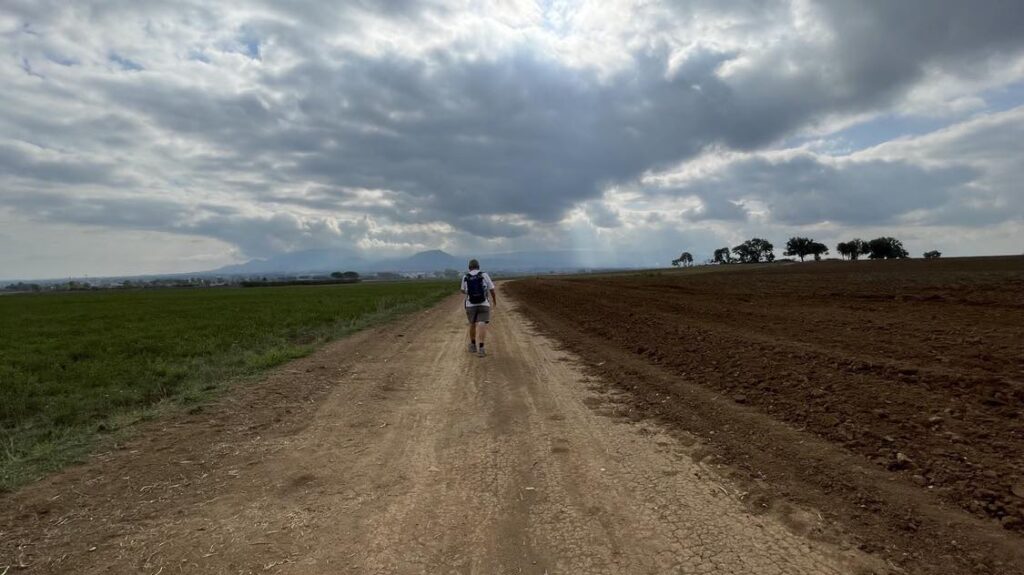
Compared to other long routes I’ve walked before, Via Francigena is harder than Camino Portuguese but not as difficult as the northern route of the Camino de Santiago del Norte.
What is the complexity of Via Francigena? Tuscany is a land of rolling hills with fields, vineyards, and olive groves. It is crossed by several rivers – the Arno, Orcha, and Arabia– that form valleys. So you have to spend a lot of time going up and down. If you’re lucky enough to have cool weather, it’s much better than in the heat of the day, as was the case in my case. Although I was expecting a cool autumn, the temperature rose to +27-32 ℃ almost every day.
Also, the peculiarity of the route from Lucca to Rome is that almost every city is located on top of a hill. You have already walked 20-25 km and at the end you have to go up. The stage from San Quirco to Radicofani, which is located on the border of Tuscany and Lazio, is particularly difficult. You will have to climb with an altitude difference of up to 800 meters – and this is at the end of a 32-kilometer day of hiking.
But the views, delicious cuisine and wines, and the wonderful atmosphere on Via Francigena make up for it. The atmosphere of the Camino, which has not yet been promoted as much as in Spain on the French or Portuguese Route. Overnight stays in hostels at churches or monasteries are a special pleasure and a good experience that brings us closer to the times when the pilgrims did not have the opportunity to book hotels on Booking.com )))
If you are preparing to take the route from Lucca to Rome, I advise you to read my diary. I hope you will find this information and my experience useful.
Day 0: Lucca

When planning a trip along Via Francigena, I booked an ostello in Lutsk for the first night. I could have found a hotel for a little money, but I wanted to immerse myself in the Camino atmosphere right away.
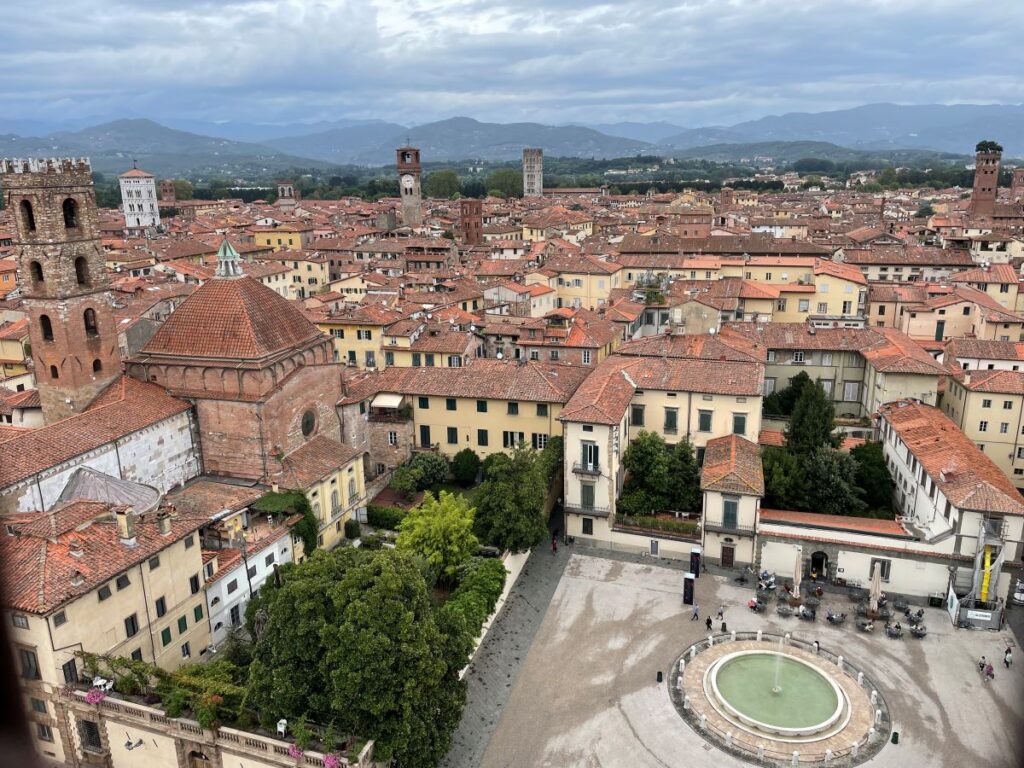
Of course, I spent the whole day in the city – it’s worth staying here for two days. Compared to the neighboring Pisa, where I arrived the day before arriving in Lucca, I liked it much more. In Lucca you feel the spirit of artisanal Tuscany. But Pisa – is a tourist anthill where there is nothing to do except for a tower and a couple of museums and cathedrals.
I bought a credence in the museum of the Cathedral of Lucca. I bought mine for 5 euros. If you start in Siena, there are six different points where you can get credencsal – all of them can be found here. Every evening I stamped the places I was staying so that at the end of the journey in St. Peter’s Basilica I could get Testimonium is a certificate issued to pilgrims who have walked at least the entire or only the last 100 km of the Via Francigena (similar to the Compostela on the Santiago de Compostela way).
More details: Via Francigena – Italian Camino, details of the route from Lucca to Rome
Where to stay in Lucca:
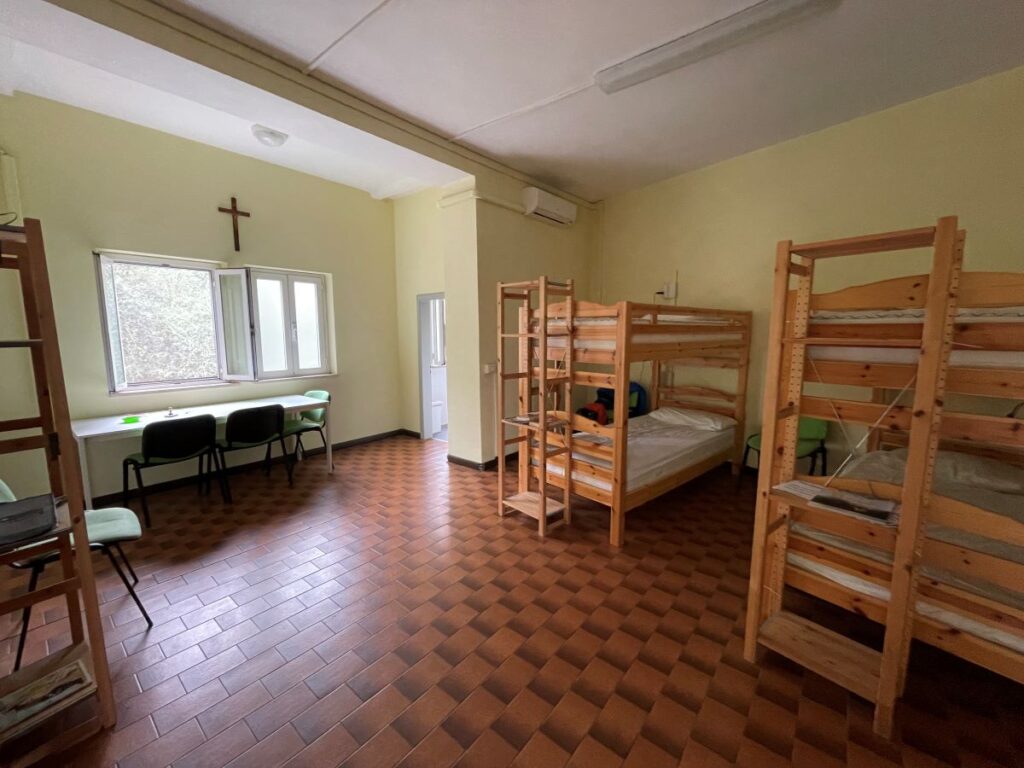
I did not want to call from Ukraine to Italy to make a reservation. So I wrote letters in two ostellos and quickly received a response of approval from the Pellegrinaio di San Davino (sandavino@luccatranoi.it, Phone: 366 1062641). Payment is in kind. Ostello offers 12 beds, has 4 bathrooms and 3 showers. Even pilgrims with disabilities traveling on the Via Francigena will be able to stay at the Pellegrinaio: they have a room on the ground floor and a bathroom. Check-in is until 7 pm.
Day 1: Lucca – Altopashio
Distance: 18.5 km
Difficulty of the stage: *
There are shops, bars, cafes and restaurants on the route, water can be asked for in cafes and bars, I met one water tap near Chiesa Romanica di Badia Pozzeveri and Ostello San Pietro(3 km to Altopaschio).

The first day of my Italian Camino. I got up in the morning, but I was almost the last one to leave – all the other pilgrims blew up at six and ran away before morning. I was in no hurry, because sleeping peacefully all night is now a luxury for me. That’s why I enjoyed sleeping every night. And then I paid for it in the hot sun. I knew what I was paying for, and I was quite happy with it.
The first day is quite simple and straightforward. You walk from Lucca to Altopashio most of the time along the road for the cars. It’s not a very interesting stage, but it allows you to calmly tune in to a new route.
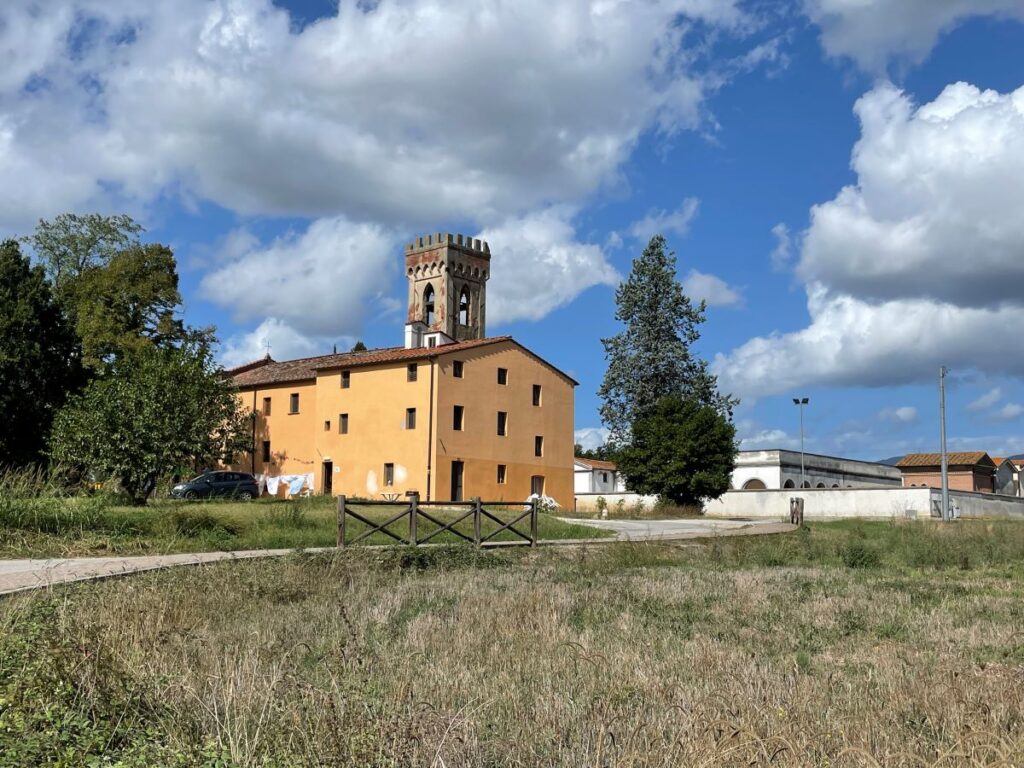
Most of the walk on the first day is along the side of the road. But there is also a short trail at the end when the first vineyards begin. It’s not a stressful day, at the end of which you start to see stunning scenery.
Altopashio
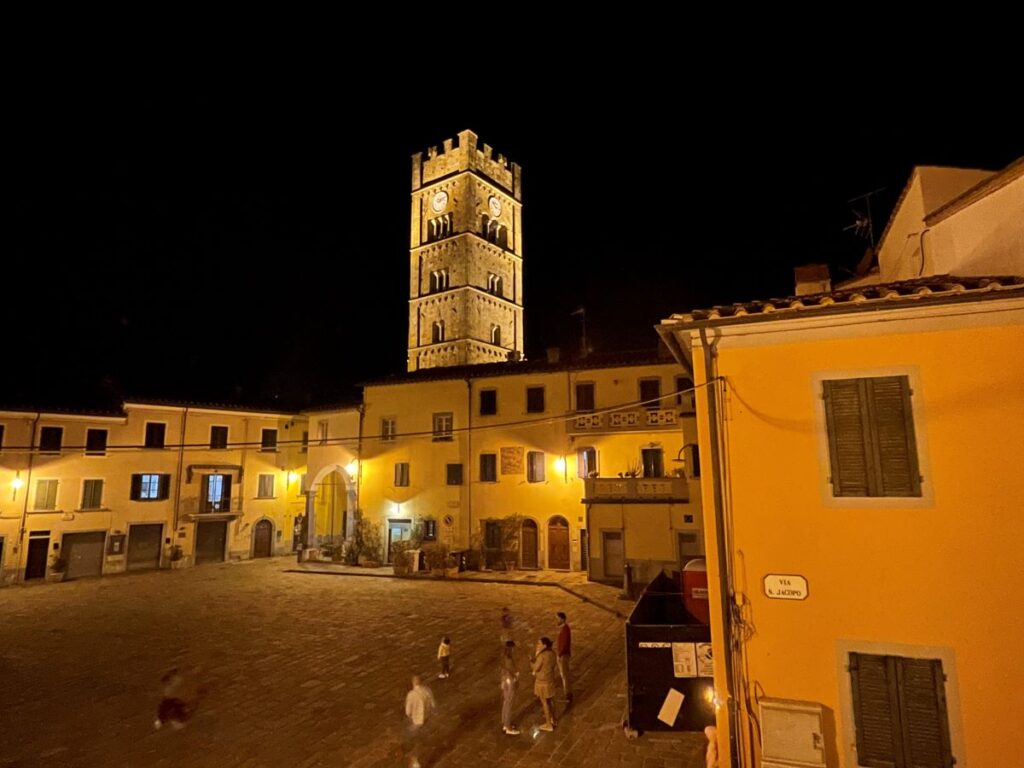
It’s a nice little town with several restaurants. I came here at about one o’clock, and the ostello (pilgrim hostel) where I planned to stay was still closed. So I decided to have lunch at osteria La Dispensa. They offered dishes with wild mushrooms – porcini. I ordered pasta with porcini mushrooms, a salad, and white wine, and sat outside at a table and enjoyed the flavors and aromas, the sun, and the cold wine.
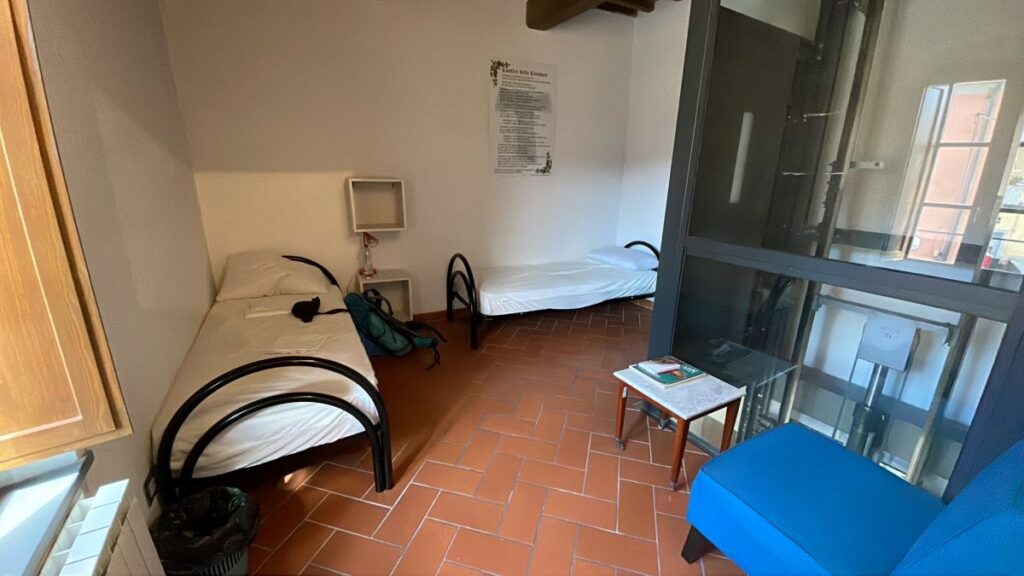
After 3 p.m., I checked into the Ostello Donativo, a room with two beds and an elevator (!). I was joined by Monserrat from Barcelona, with whom we became very good friends. We spent the evening together, drinking beer, talking, walking around the Altopashio, which is a very small but pretty town.
Keep in mind that if you come later, between 15:00 and 19:00, the restaurants will be closed. Lunch from 13:00 to 15:00, dinner after 19:00. But you can also order a drink at the bar and have an aperitif (nuts, chips, snacks, etc.) to accompany your beer or glass of wine.
Accommodation in Altopashio:
- Magione Cavalieri del Tau (turismo@comune.altopascio.lu.it +39583 216280 -366 5708802).
- I spent the night at the Ostello del Pellegrino, which I booked a day in advance by phone +393384957991 (they speak a little English there).
- Il Picchio Verde – can be booked on Booking.com.
Day 2: Altopashio – San Miniato
Distance: 29 km
Difficulty of the stage:**
On the route: there are shops, bars and restaurants in Galleno, Ponte E Capianno and Fuccecchio. There are also two water taps.
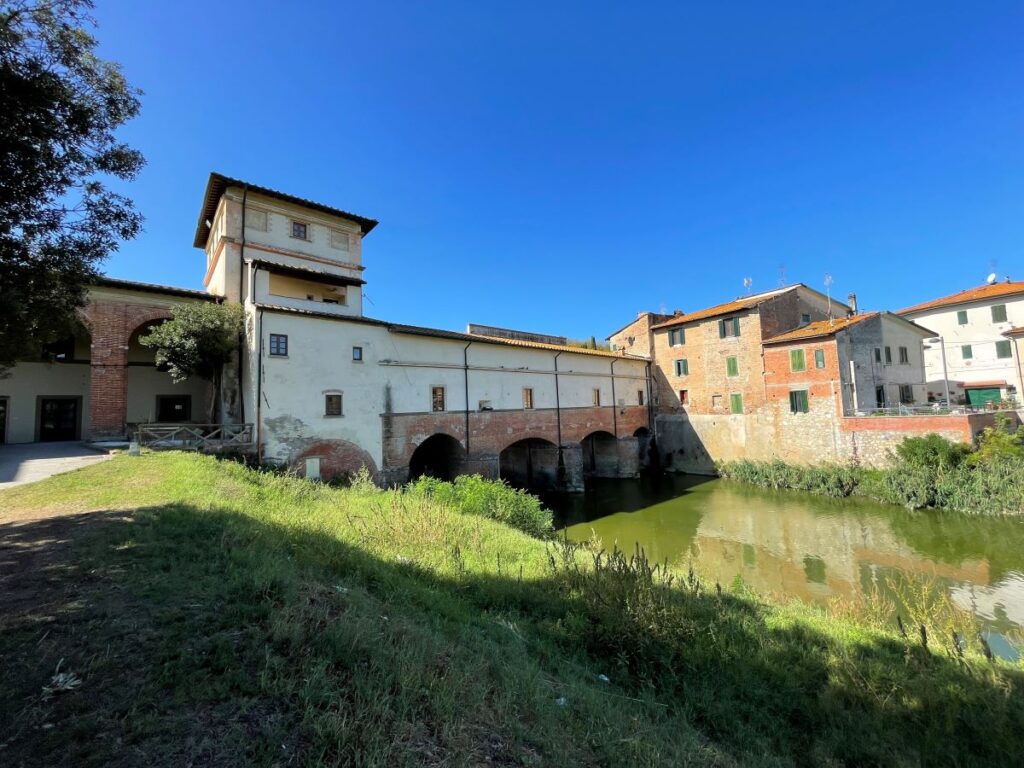
Today, most of the route goes either through the forest or through the countryside. It was a bit of a hard day, because the path circled between fields and then along the river dam. The route is mostly flat, but that day a strong warm wind was blowing, and the path along the dam did not end. At the end of the route, when I was already quite exhausted, I saw that I had to go uphill – San Miniato stood on a large hill.
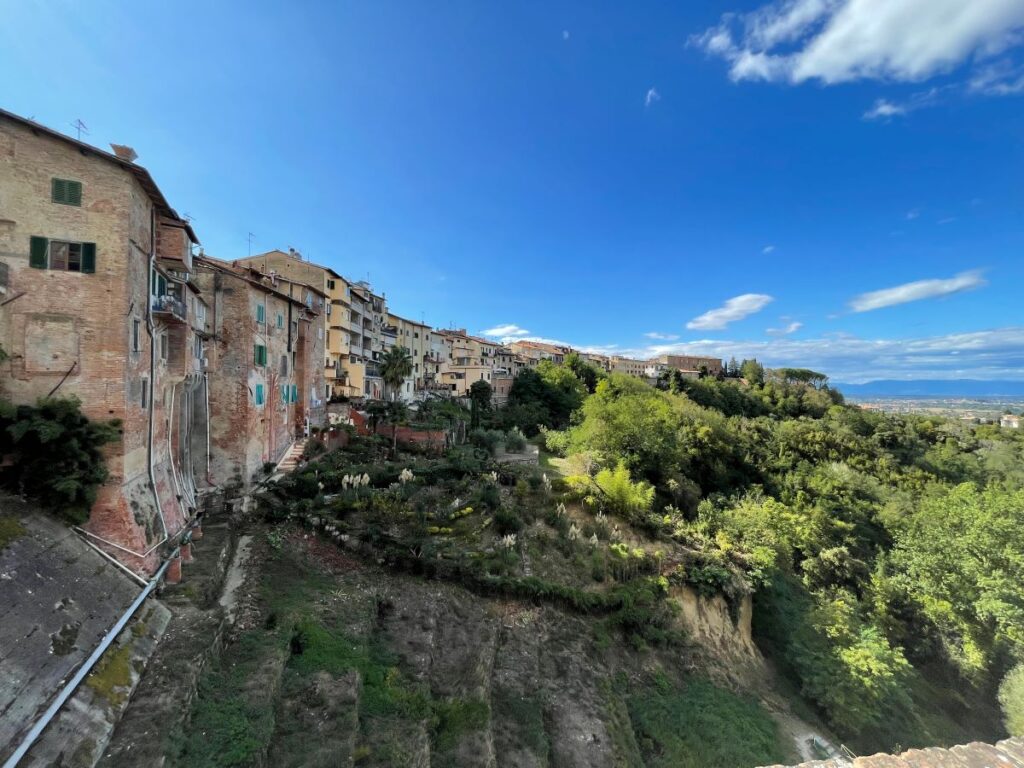
The climb was not easy, but I was very happy when I saw the elevator after crawling like a snail up to the old part of San Miniato. The elevator was very much in keeping with the theme, and I took it up about 50 meters, got off and found myself in a wonderful old town.
From the hill on which the old San Miniato is located (there is a new town of San Miniato Basso below), a stunning view of the Arno River valley opens up.
San Miniato and small towns along the way
- First, there is a nice cafe in Galleno with a pilgrimage menu and coffee for 1 euro.
- Ponte E Capianno has a magnificent medieval bridge, above which is an ostello for pilgrims.
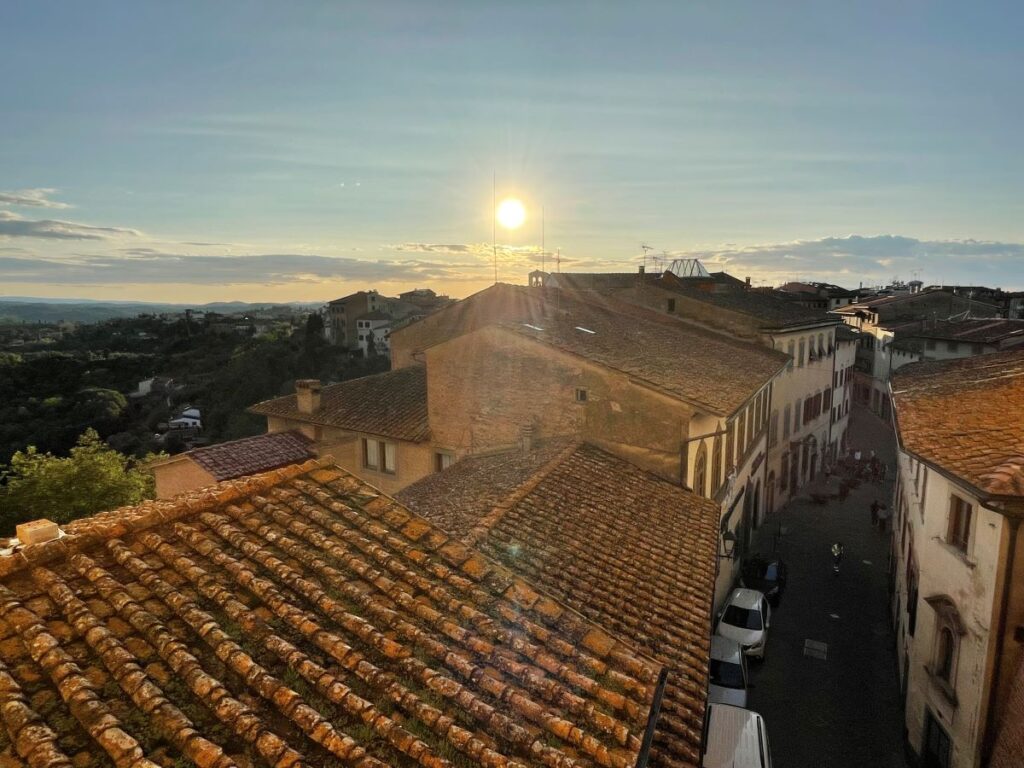
- In Fucecchio, you have to climb a mountain to see a beautiful view of the Arno River Valley. But it’s worth it!
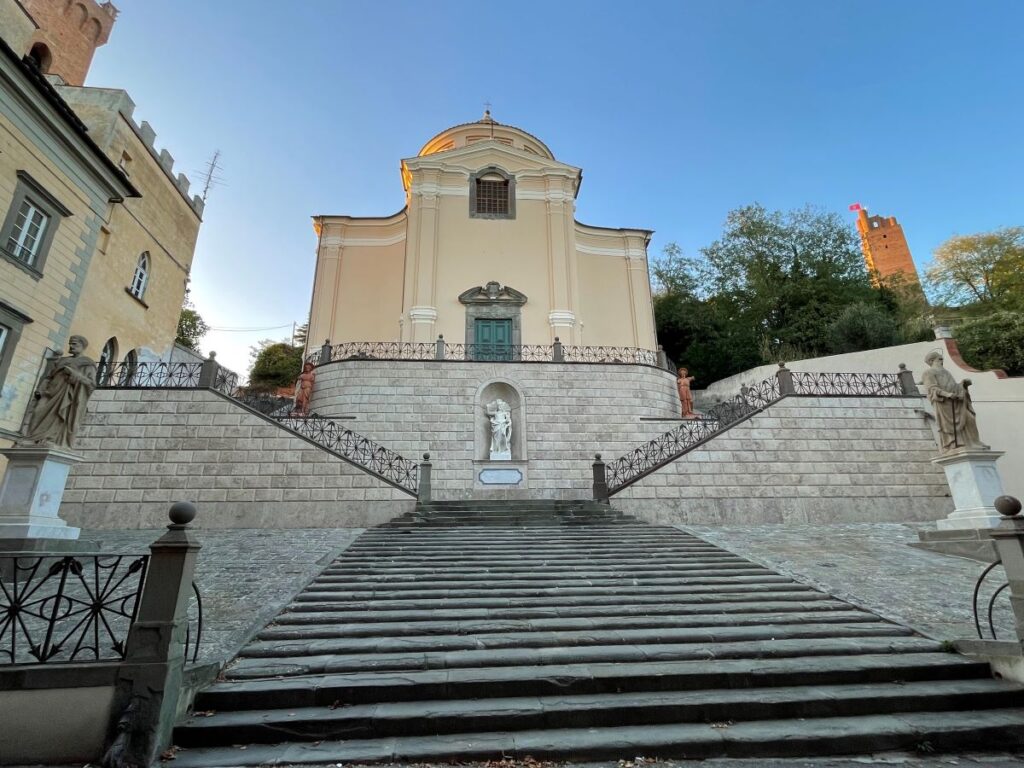
San Miniato is a wonderful ancient city, the Tuscan capital of white truffles. Try the truffle pasta or sandwiches served at the Birra e Acciughe bar (Via Augusto Conti, 29). And Caffè Bistrot Bonaparte (13 Piazza Buonaparte) offers a pilgrim’s menu for 18 euros.
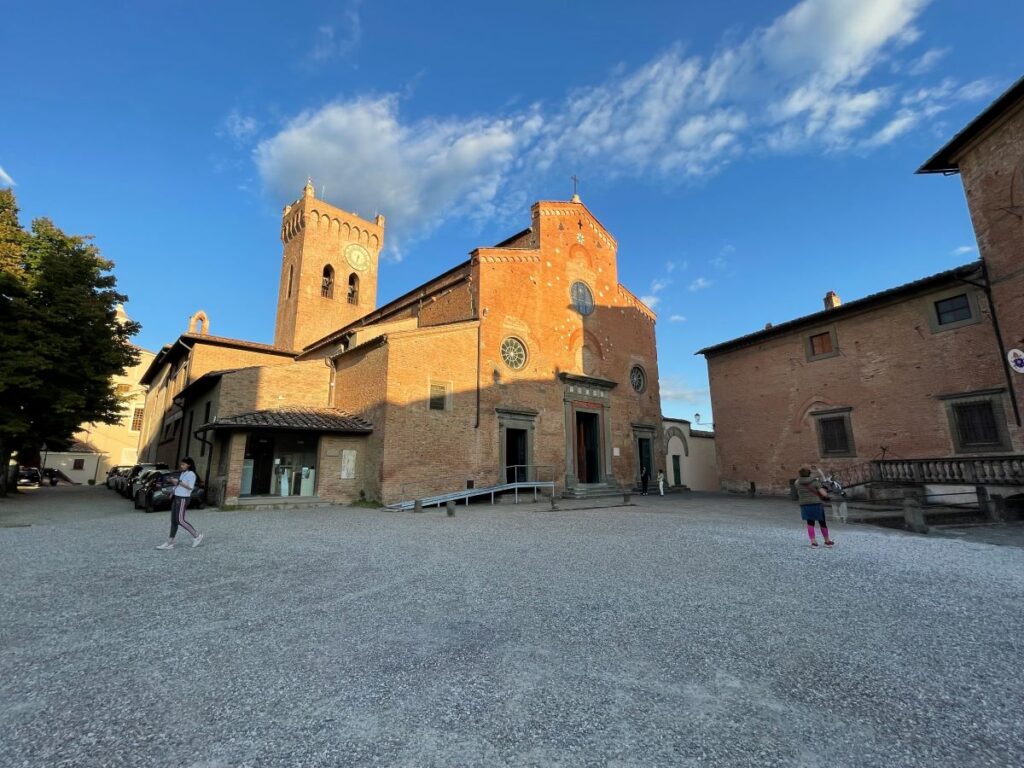
Near this restaurant there is an interesting church Oratorio dei Santi Sebastiano e Rocco with unexpectedly modern frescoes and a huge figure of a pilgrim. And above the city rises the magnificent Romanesque-style Cathedral of Santa Maria Assunta and Jenesien with a Baroque ceiling. Go inside if it is open. Better yet, go to Mass and listen to the organ. If you still have the strength, climb to the top of the San Miniato hill to the Torre of Federico II tower, where pilgrims have a discounted entrance fee (5 euros).
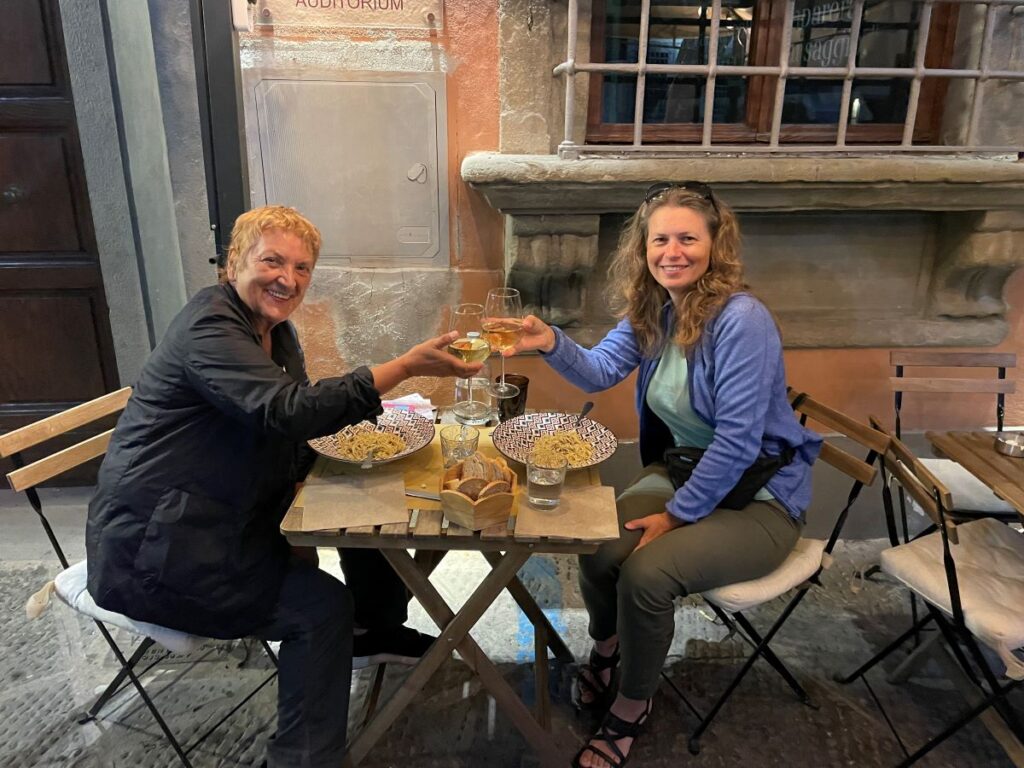
By the way, there are no usual supermarkets in San Miniato (there are some downstairs, but you’re unlikely to go to a new city to buy food). But in the old town there is a nice shop called Cosi’ E’ Se Vi Piace with homemade products. Here you can buy whatever your heart desires for dinner. Or bread, prosciutto, cheese, fruit and vegetables for the next day for a snack on the go.
It’s also a great place for breakfast before leaving San Miniato, as it opens early. We couldn’t find any supermarkets in San Miniato, so keep that in mind if you plan to cook.
Accommodation in San Miniato:

- There is a hostel for pilgrims here, it is called L’hospitale del Pellegrino San Miniato. You can contact them on Facebook or by phone +39at 3934995126 – lhospitaledelpellegrino@gmail.com. This hostel should be booked in advance and note that it usually does not open until Easter.
- There is also a hostel that can be booked on booking.com, it is called Ostello San Miniato. It was here that I booked a bed for 20 euros because I wasn’t sure if I would have enough space in other hostels. I liked the hostel – it was clean, there was a kitchen, towels were provided, and there was a washing machine for extra money.
- Another option is the monastery in San Miniato – Convento San Francesco. It’s a small property with only about 10 beds and must be booked in advance (sanminiato@nuoviorizzonti.org).
In addition, on Booking.com you can find several options for private accommodation:
- Affitta camere San Miniato≫ – single room in a guesthouse, 40 Euros.
- Camere Montalbano≫ – apartments with a private bathroom, for 50 euros.
Day 3: San Miniato – Gambassi Terme
Distance: 24.5 km
Difficulty: **.
On the route: there are no cafes or bars on the road, so take food for a snack. Water is available only closer to Gambasi-Terme, and you have to carry 1-1.5 liters with you.
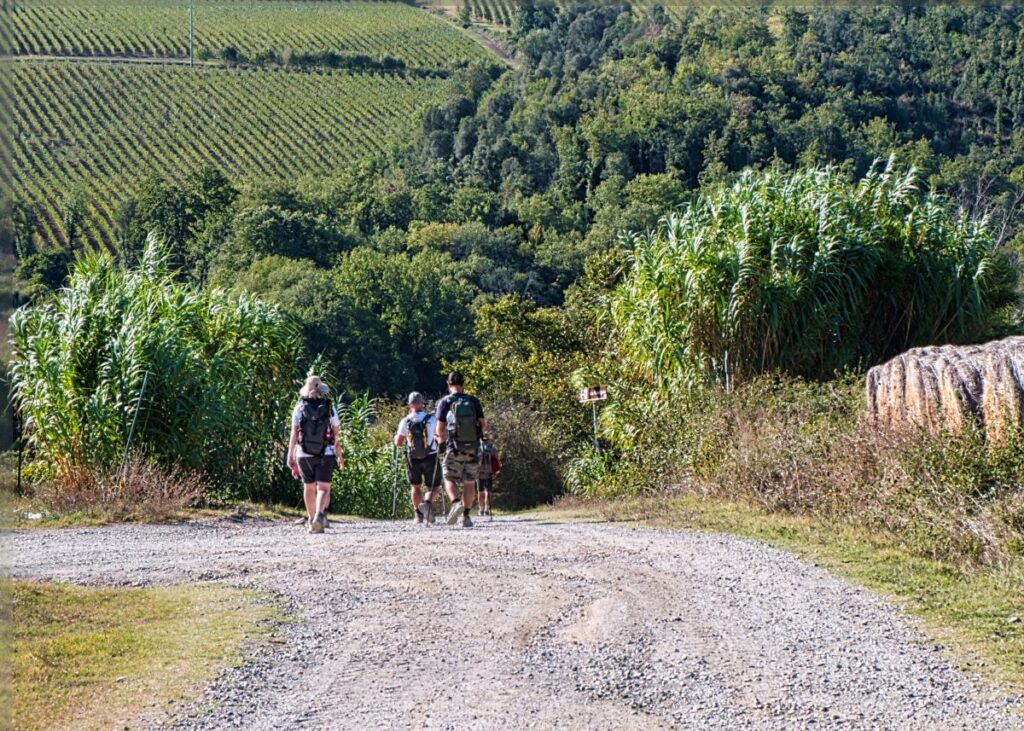
The walk from San Miniato to Gambaci Terme was stunning. It is after San Miniato that the classic hills of Tuscany begin, which I fell in love with 6 years ago. After you leave the city, after about an hour you will hit a trail that winds through vineyards and open countryside.
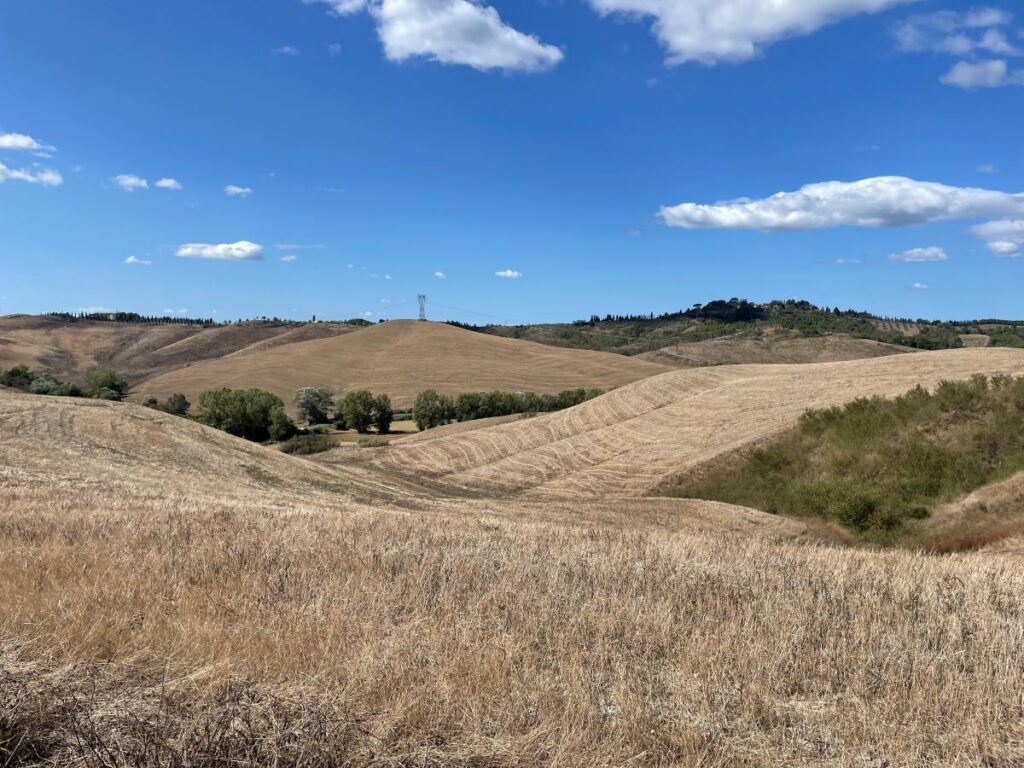
I enjoyed the scenery that opened up around me: the hills from which the wheat had just been harvested and the vineyards where the harvest was underway.

There is a large bench on the route that was built on top of one of the hills. I got there by following the arrows I saw on the way. At the time, the builders of this tourist attraction were there-they were finishing up the barrel stairs. So I asked to take a picture of me on the bench – I liked it because of the colors it was painted with))
The trail runs mostly over hills, through private fields, vineyards and olive groves, past old houses with tall cypress trees. Everything looks very Tuscan, I like this picture very much.
Gambassi-Terme
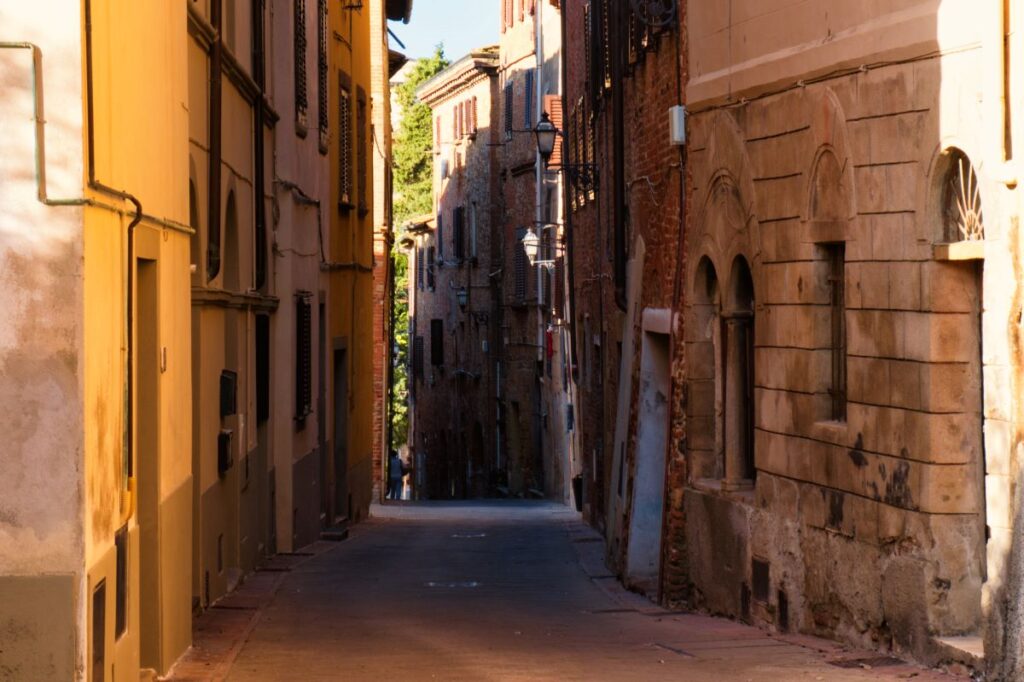
That day, I was only one kilometer short of reaching Gambassi Terme. Because I stayed at Ostello Sigerico in the suburbs. A very good place for pilgrims to spend the night, offering dinner and breakfast. There is also a wonderful garden where it was nice to watch the sunset in the evening overlooking the ancient Gambassi Terme.

Gambasi-Terme is very small, with only one cafe in the city center (I had a delicious coffee with a homemade cupcake here) and a couple of restaurants. There are also no supermarkets – I found one small shop on the road in the morning and bought fruit and water for a snack.
Accommodation in Gambassi Terme:
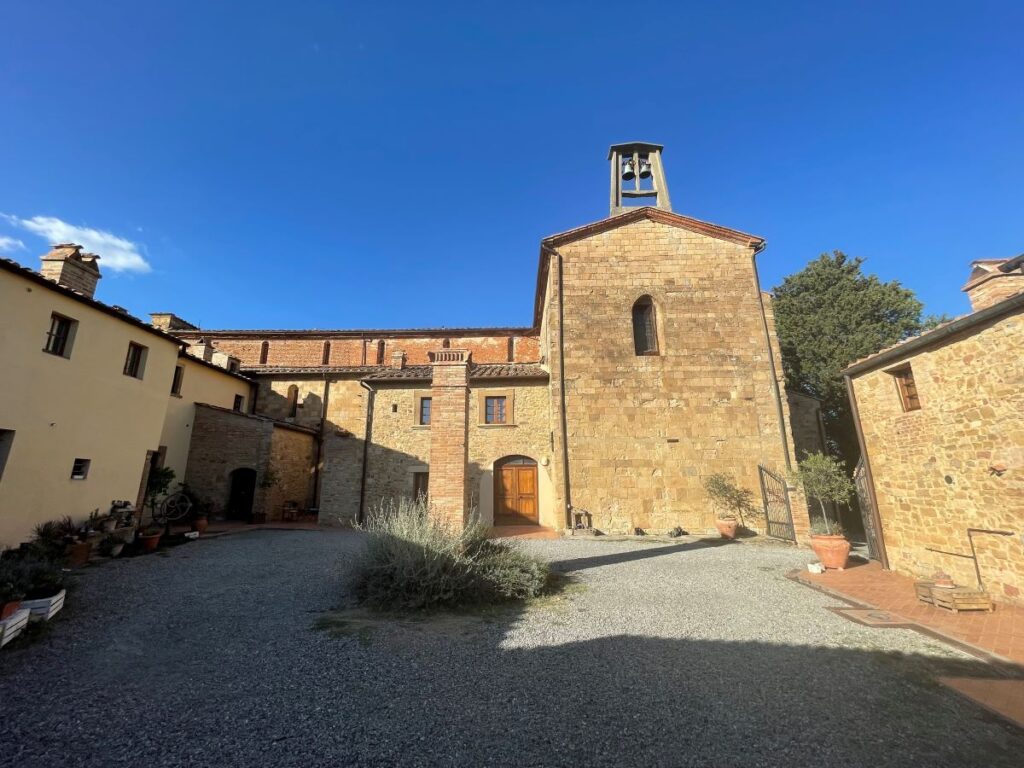
- In Gambassi Terme, I stayed at Ostello Sigerico – a private hostel open all year round, located 1 km from the city center. It is a former monastery that offers dormitories or private rooms for 16/20/35 euros per person.
- There are only hotels in Gambassi Terme – you can book a double room in Casa il Castello for 85 euros.
Day 4: Gambassi Terme – San Gimignano
Distance: 13.5 km (walked 15.5 km)
Weight:*
On the route: there are no cafes and bars, but there are wineries where you can order a tasting, a small shop with honey and jam in the Monastero di Cellole. There is enough water – there are several taps on the way.

It was a very beautiful and short stage, during which I enjoyed the Tuscany vibe – wineries were at every turn. Some of the pilgrims did not stop in San Gimignano and went on. But it was nice not to be in a hurry. In the morning, I first met hunters hunting hares with their dogs. It was a little strange to go up the hill and see people with guns. But at the end of September, the time when hunting is allowed, I saw hunters on my way every day.
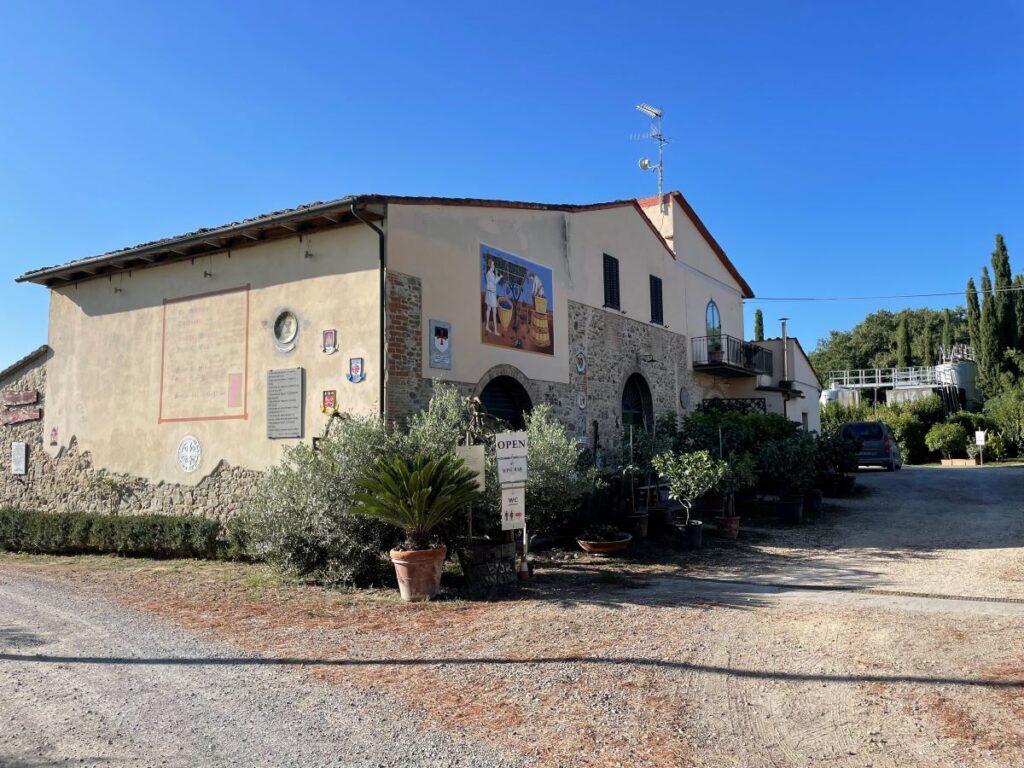
I’m very interested in the topic of winemaking and wine, and I saw the Azienda Agricola Casanuova winery, which produces Chianti wine. The door to the winery was open, so I went in to breathe in the fresh grape must. The owner came up to me and offered to put a seal on it, and I agreed with pleasure. I didn’t drink the wine – it was 9 a.m., too early for wine.
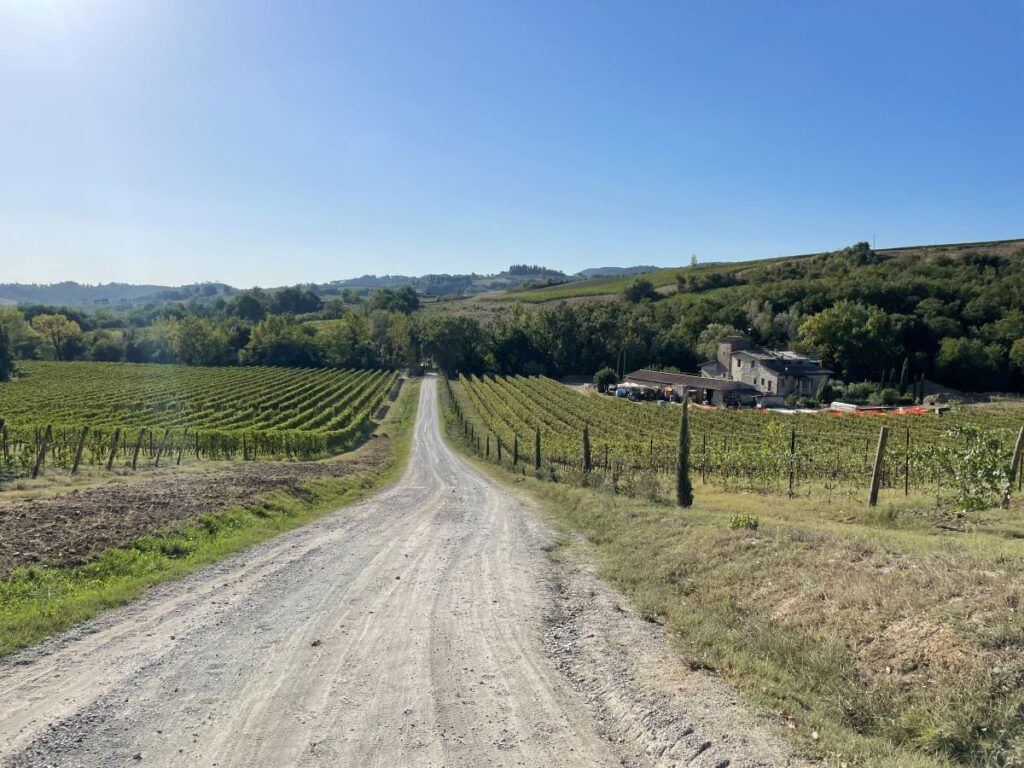
I saw a church in the village of Pankole Santuario Maria SS. Madre della Divina Providenzaunder which there is a grotto free for visitors. The grotto is decorated with figures of various biblical characters – it looks a bit childish, but it’s also interesting. There is a tap with delicious water near the church.
Then I walked for several kilometers along the wineries – it was beautiful! I came to the Monastero di Cellole – the church was closed, but the shop was open. You can buy yourself some honey or jam and leave the money in the drawer – complete trust!
San Gimignano
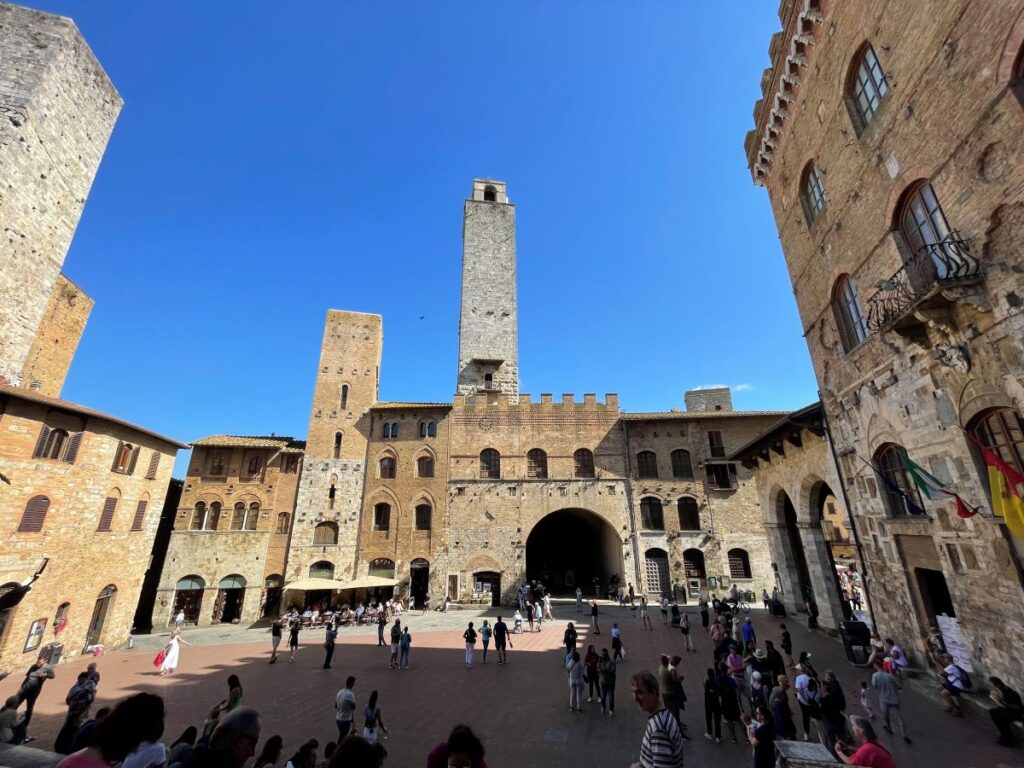
I didn’t plan to stay in this very touristy city because I was afraid that I wouldn’t have room in the ostello. It was impossible to book accommodation there, so I booked a place at a campsite outside the city. But the campsite check-in was after 3 p.m., so I decided to spend a few hours in San Gimignano like a real tourist. With a slight difference – I had to walk around this city with a 10 kg backpack behind me.
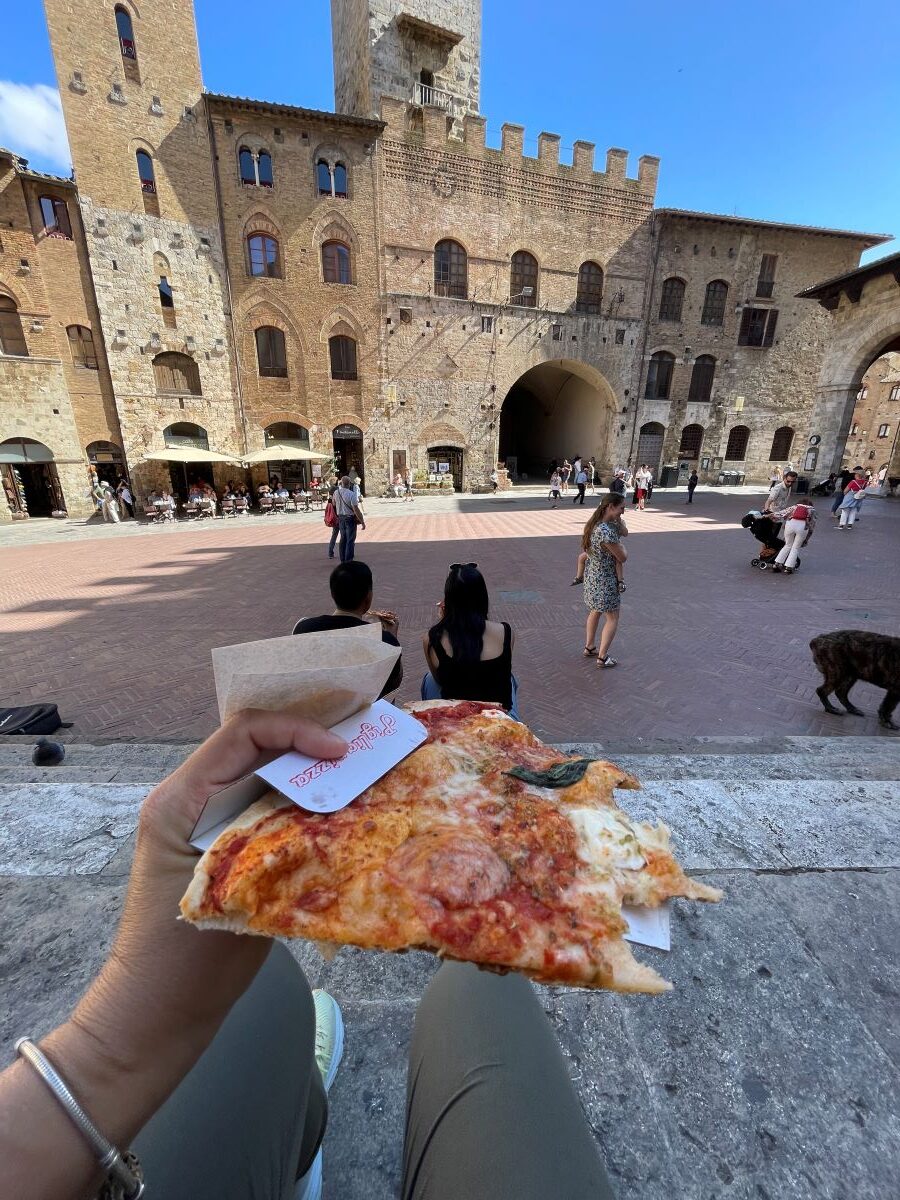
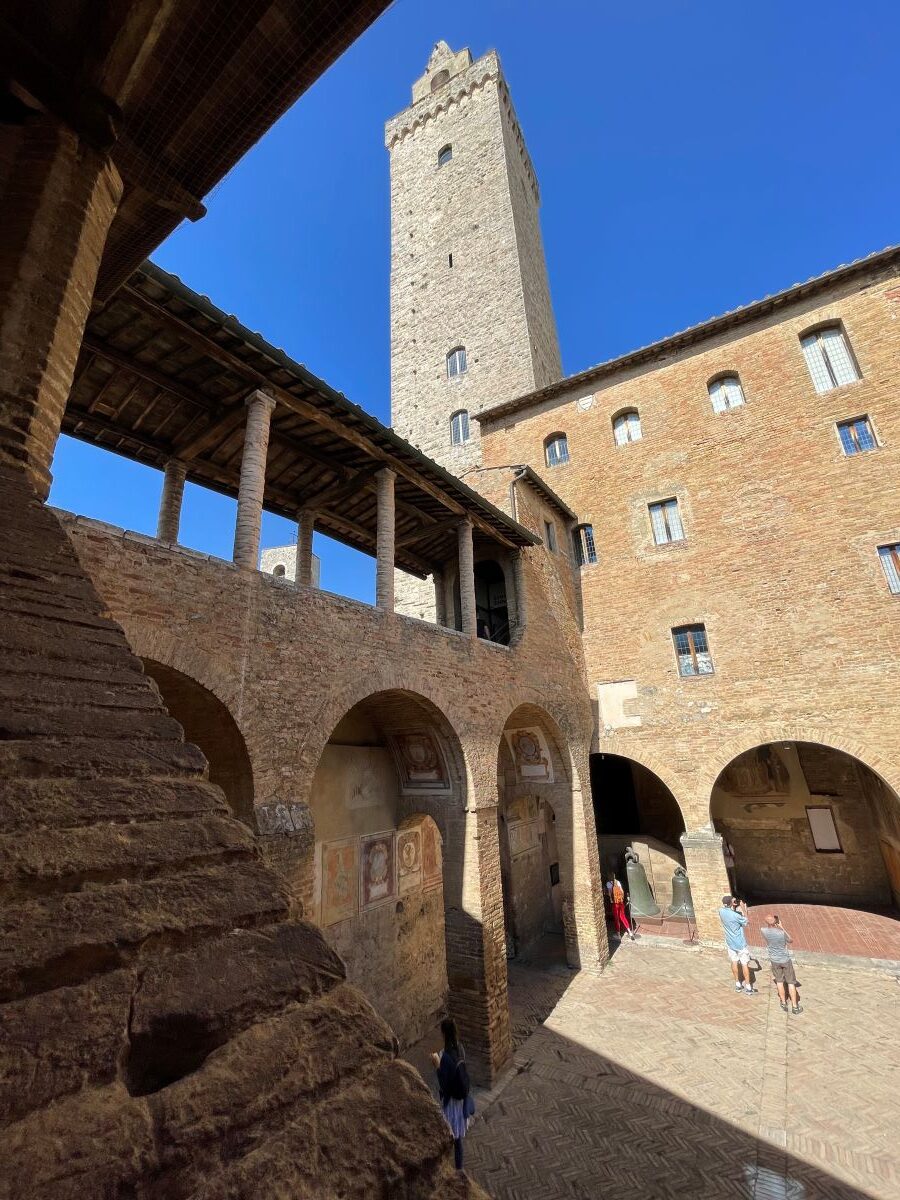
But it was still very interesting to see both the squares and observation decks filled with tourists and the narrow streets where there was no one. The line at Gelateria Dondoli for the world’s most expensive gelato was too long to stand in – it stretched across the entire square. So I ate a triangle of pizza, sat on the steps of the Duomo di Santa Maria Assunta, listened to my guitar, and left the city for the place to stay, which I had booked at Camping Il Boschetto di Piemma.
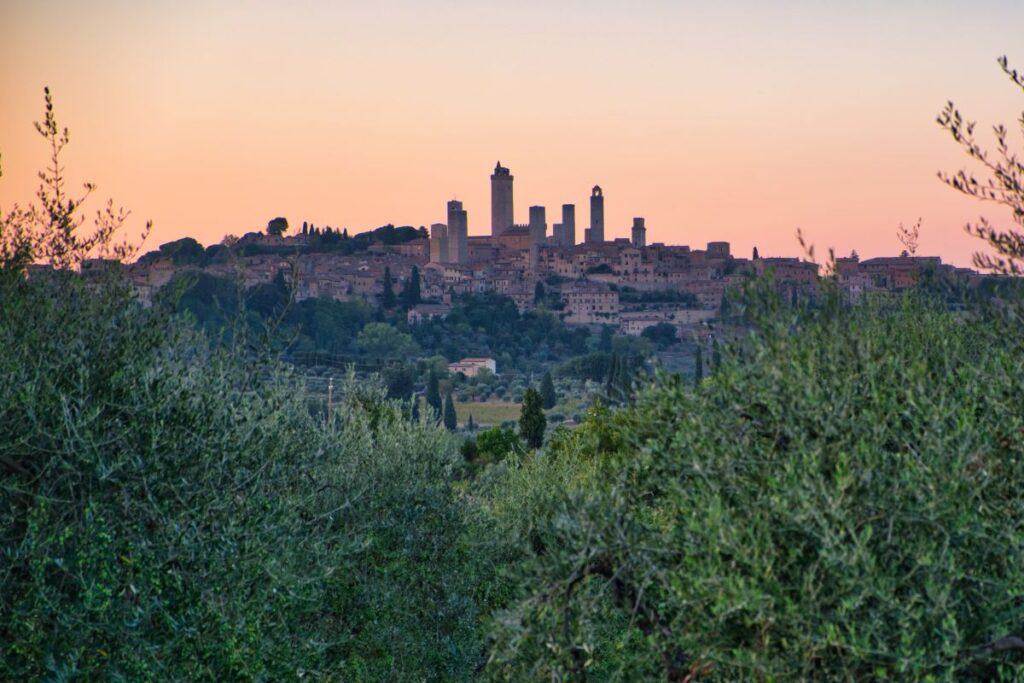
In the evening, I had a wonderful sunset over the towers of San Gimignano, delicious rabbit in the restaurant located on the campsite. And a boring conversation with a Frenchman who had been walking alongside me for several days and was also staying here.
Accommodation in San Gimignano:
San Gimignano is one of the most visited cities in Tuscany. Therefore, there are many private accommodation options that can be booked in advance. In the summer and during the high season for pilgrims, there is a monastery that also hosts pilgrims in a hostel.
- Ostello is called the Ospitale dei santi Agostino e Giacomo and can be reached at +39 3890271946 – segreteria@fraternitaospitalieri.it. But they don’t book accommodation – the principle of pilgrimage applies here: first come, first served.
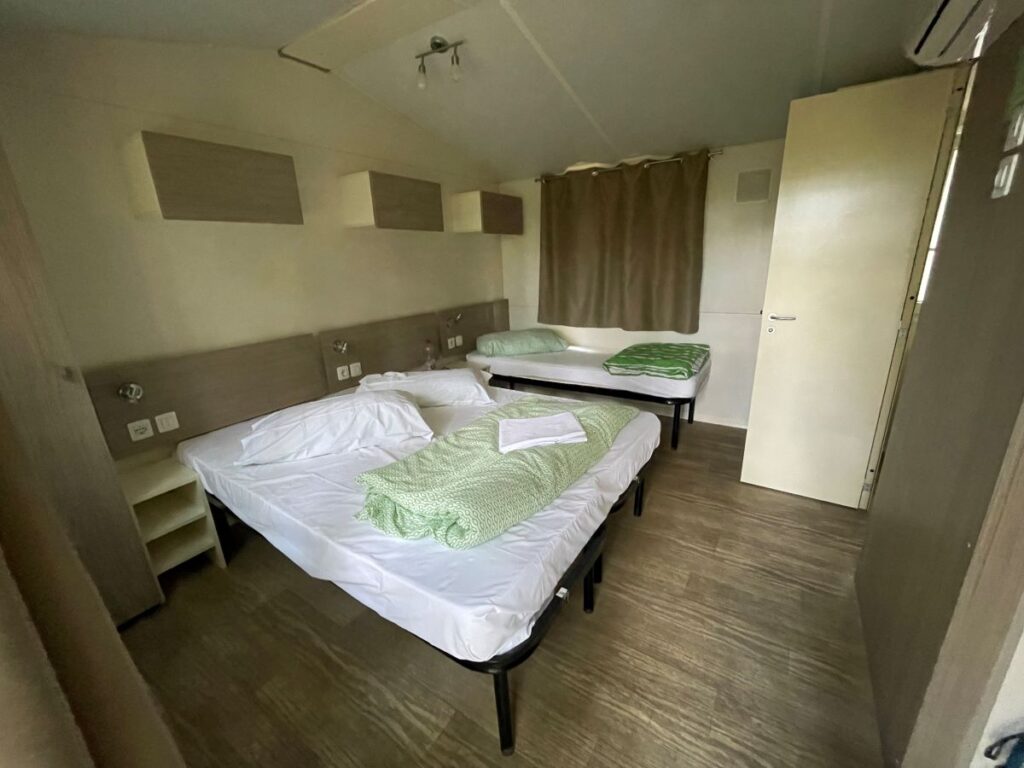
- 2 km from the city there is Camping Il Boschetto di Piemma – here, in the low season (I was there in October), you can book a private room with a private shower for only 21 euros.
Day 5: San Gimignano – Abadia Isola (or Monterriggioni)
Distance: 27 km (or 30 km)
Weight:**
On the route: cafes and bars, water should be collected in advance at the Colle di Val d’Elsa, as the next spring is only in Strovo.
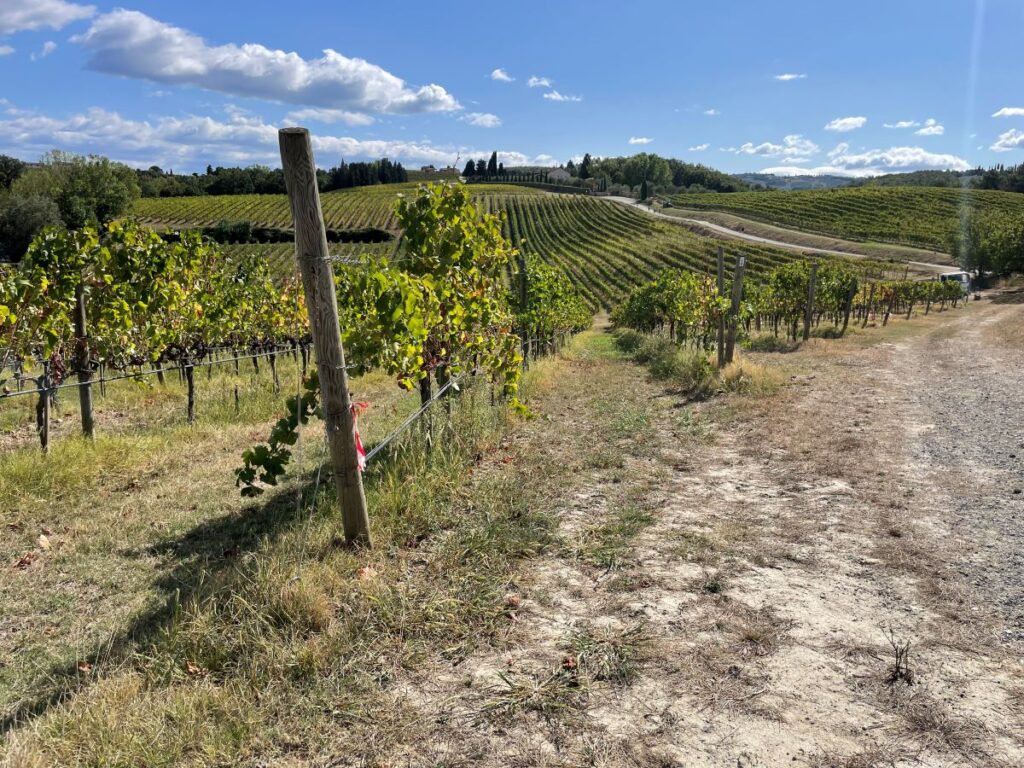
The walk from San Gimignano is mostly along the path between the hills and along the beautiful blue river. First, you will come to a fork in the route, where you can choose one of two paths. One is a shorter route to the city of Colle di Val d’Elsa, but it has several steep ascents. The other route is longer, about 4 km, but flatter.
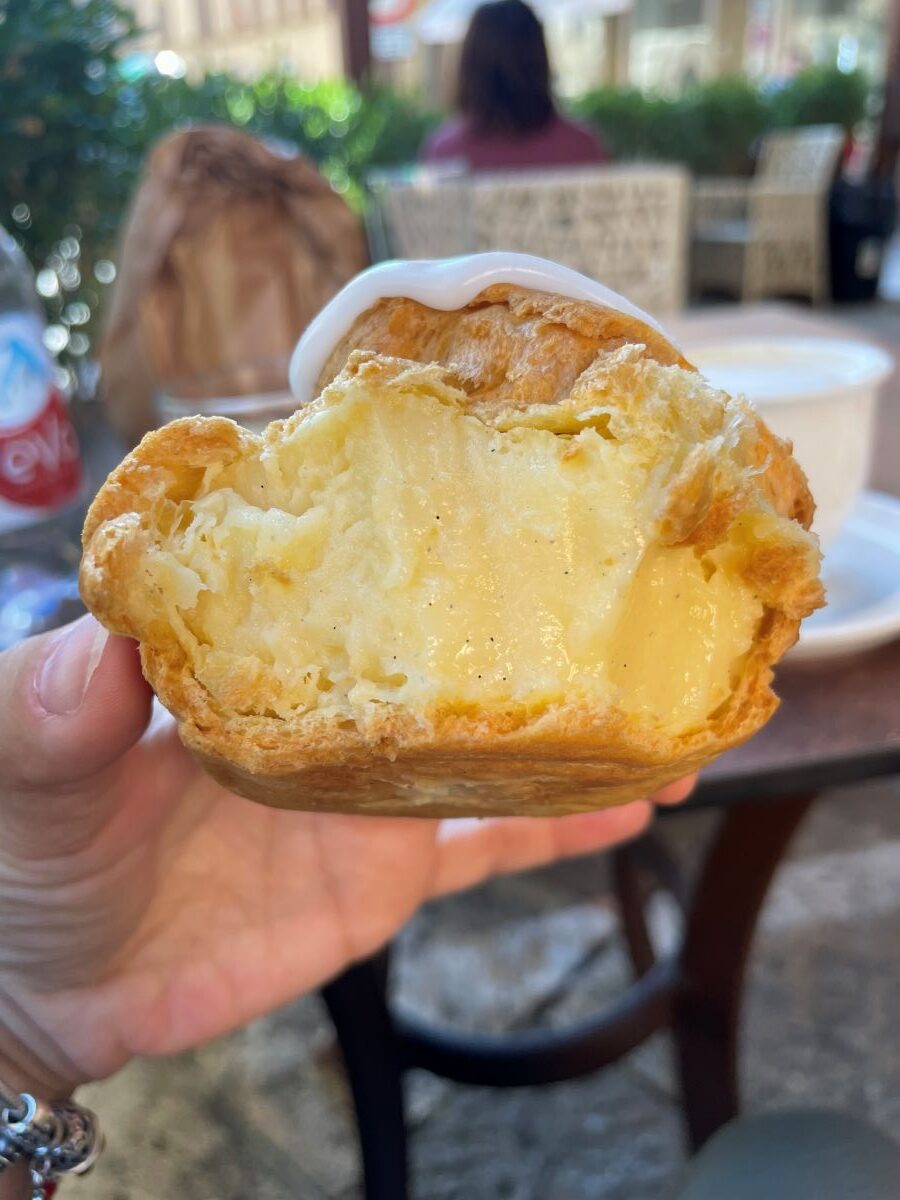
I chose a steeper climb to the wonderful town of Colle de Val d’Elsa, where I bought groceries and stopped for coffee with the most delicious eclair I’ve ever had during my entire trip to Italy. I got to the city at about 11 am, so I had time to order a cappuccino and no one looked at me funny.
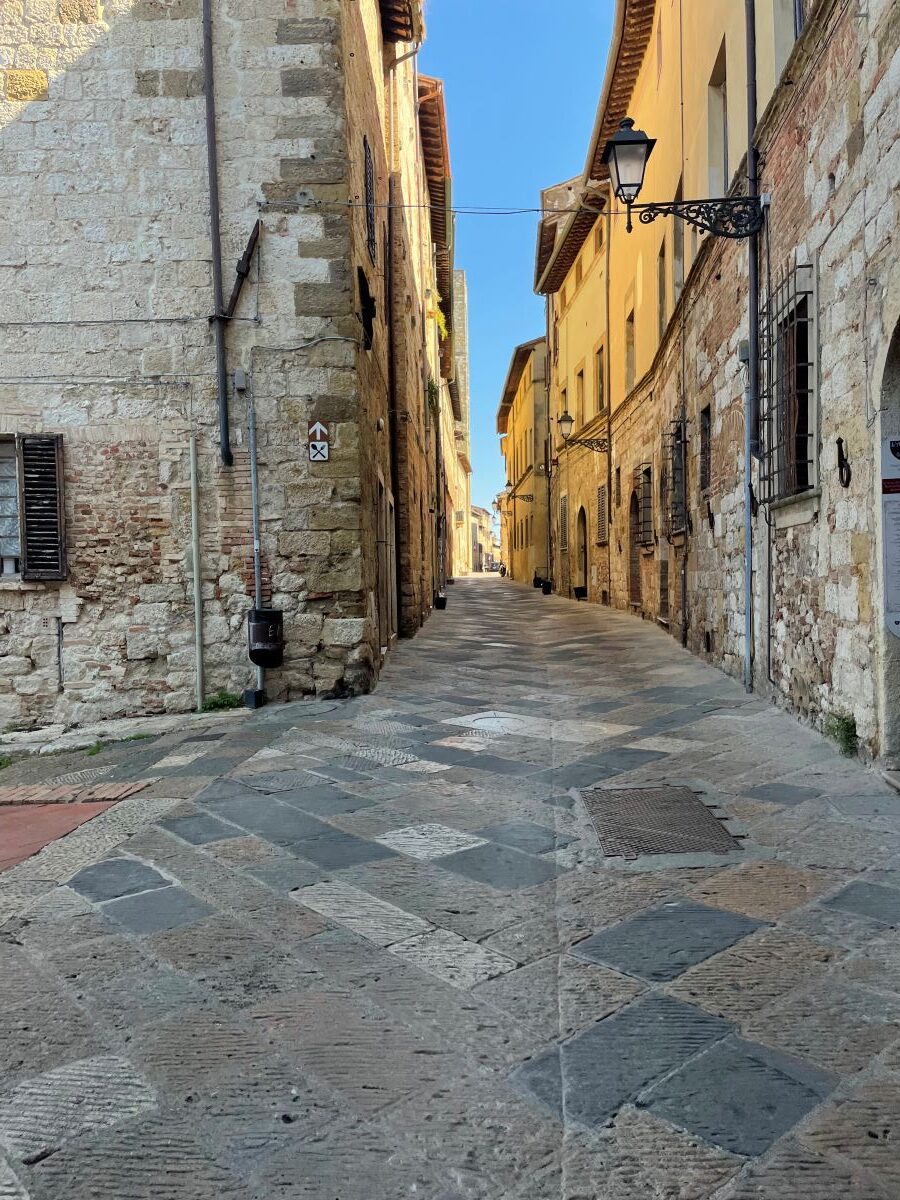
Leaving this city, I first got to a wonderful observation deck with an elevator that was not working – I had to go down on foot (I don’t like it because of the pain in my nails). And then the route led me to a stunning park with waterfalls and an incredibly blue river (Sentierelsa Trail). The river flows through a canyon and is a great place for a picnic or even a quick swim if the weather is warm. It was a rather hot day, a Sunday, so there were a lot of people on the trails along the river.

The route along the river ended on the outskirts of the city. After I left it, I came to the ancient Roman pools (Le Caldane – Terme Etrusche – Romane), where there were also many people on vacation. My dream to take off my sneakers and put on a swimsuit somewhere did not come true – there were too many people around and I did not dare to do it.
I regret this, because then there was a seemingly endless hot walk to the village of Strove, where I almost didn’t get sunstroke, and I was left almost without water.
Abadia Isola
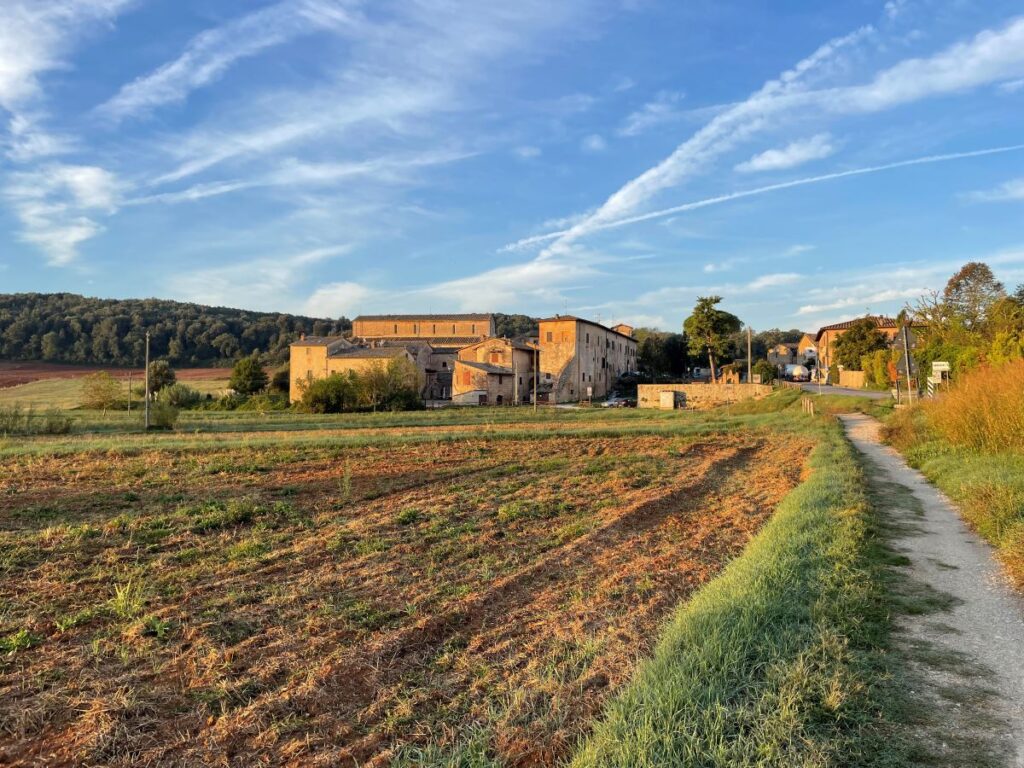
That’s why instead of going to Monteriggioni, I stopped at the small abbey of Abadia Isola. And it’s a good thing that happened, because it was here that I met the wonderful Cerezo family from California. Kathy retired from the US Navy at the age of 42. Her dad, brother, and mom were traveling along the Italian part of Via Francigena for the third week. Then I will meet them almost every day and these wonderful people will become an integral part of my Italian Camino.

So I saved Monteriggioni for my morning coffee. And the evening was spent in wonderful company at a common table in the albergue of the Ospitale dei Santi Cirino e Giacomo with other pilgrims. There were Italians, Americans, a German, and me, a Ukrainian. The owner of the albergo prepared so many delicious dishes for us that it was a real feast and a holiday. A celebration of socializing and Italian cuisine. It was wonderful – I felt like I was on a real Camino again.
Accommodation in Abadia Isola and Monteriggioni:
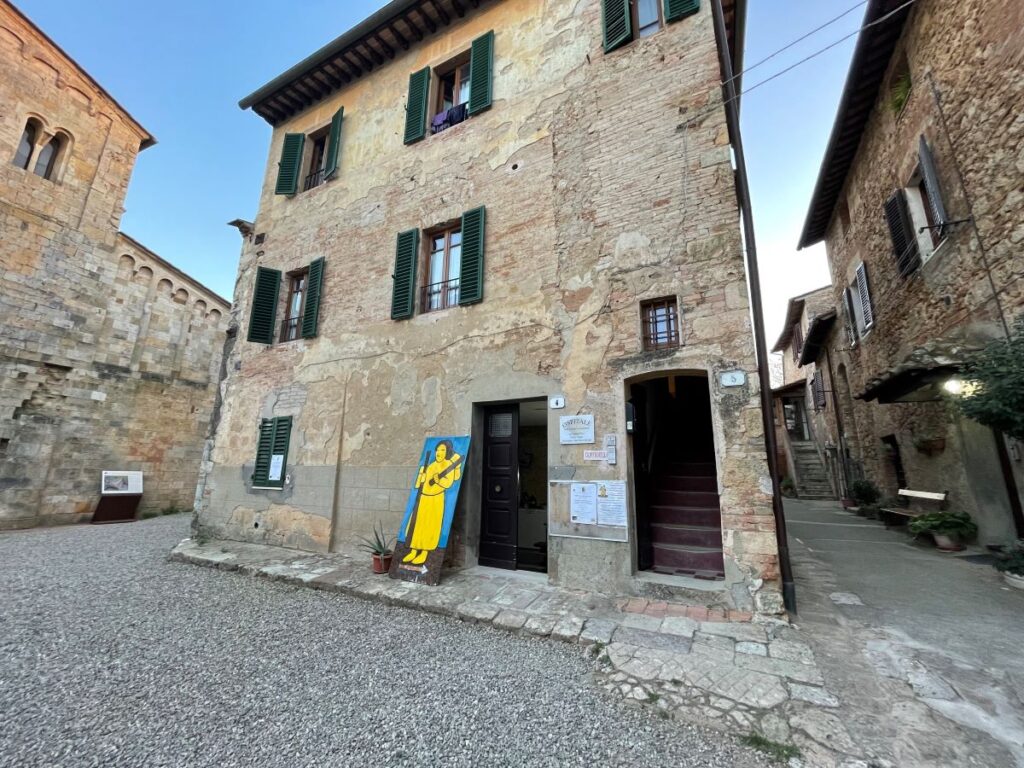
- Hostel Ospitale dei Santi Cirino e Giacomo – works in the tradition of St. James’s albergue. You can’t make reservations – you can come and stand in a live queue, if there are enough places, you will spend the night here. The price is quite inhumane – 18 euros per bed, but I felt very good here. Lunch from the owner cost another 20 euros, but it was very satisfying, varied and tasty.
- Nearby there is a private Ostello Contessa Ava dei Lambardi located in the abbey.
- In Monteriggioni itself, there is a small ostello at the church – Castello Casa per ferie Maria Assunta – (call +393714717079).
- Affittacamere la Casella Monteriggioni – rooms in Monteriggioni for two for 65 Euros.
Day 6: Abadia Isola – Siena
Distance: 25 km
Weight:*.
On the route: one nice donativo cafe, one water tap.
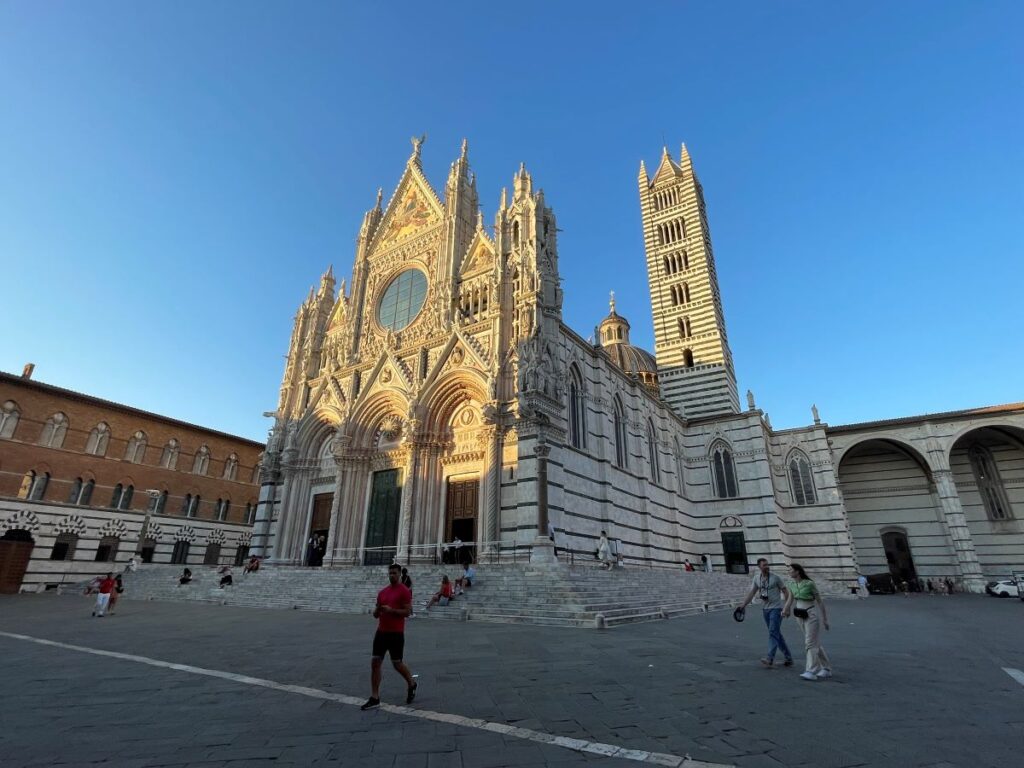
The first part of the trail from Abadia Isola to Monterriggioni was quite flat and easy to walk. I left early in the morning and was still the last one to leave-everyone got up at five and ran to Siena. I saw a German pilgrim, Johan, walking in front of me, so I quickly caught up with him and arranged to have coffee in a bar in Monteriggion.
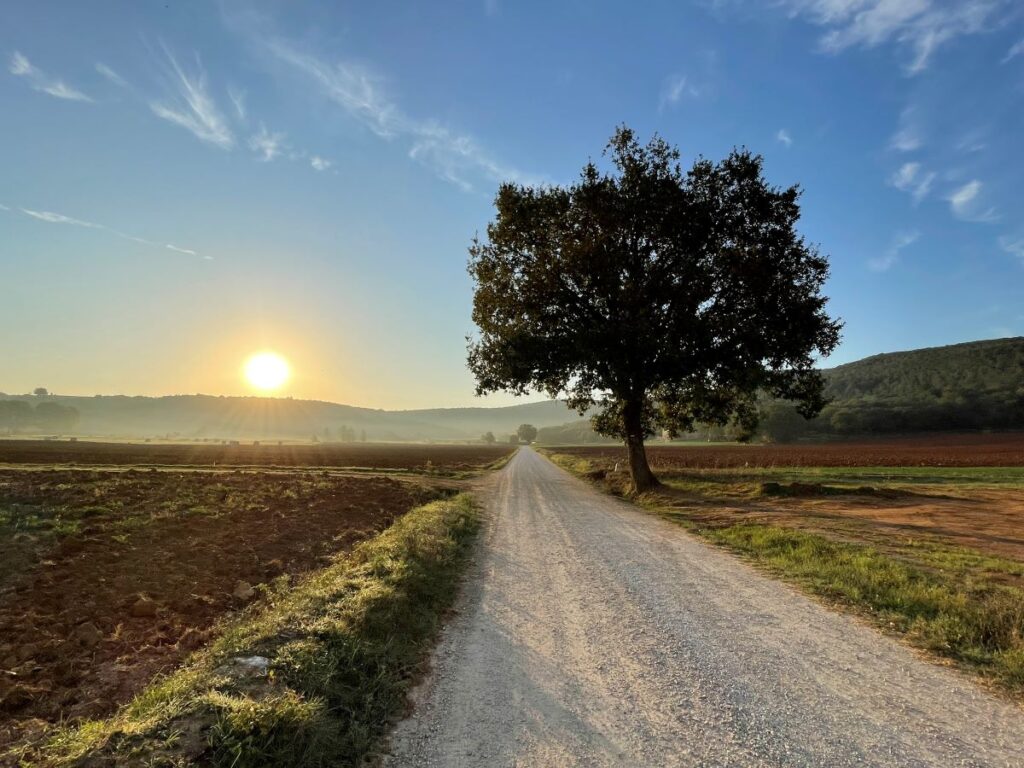
As I walked, I watched the sun rise and disperse the beautiful morning fog – a beautiful moment, and for some reason, I remember them for a long time. The last part of the way to Monterriggioni is a very steep hill, which I walked very slowly. But it was worth it – the round fortress on the hill, the Borgo Monteriggioni, is still impressive. Borgo is the name of a micro-authentic Italian settlement located on the top of a hill inside a fortress.
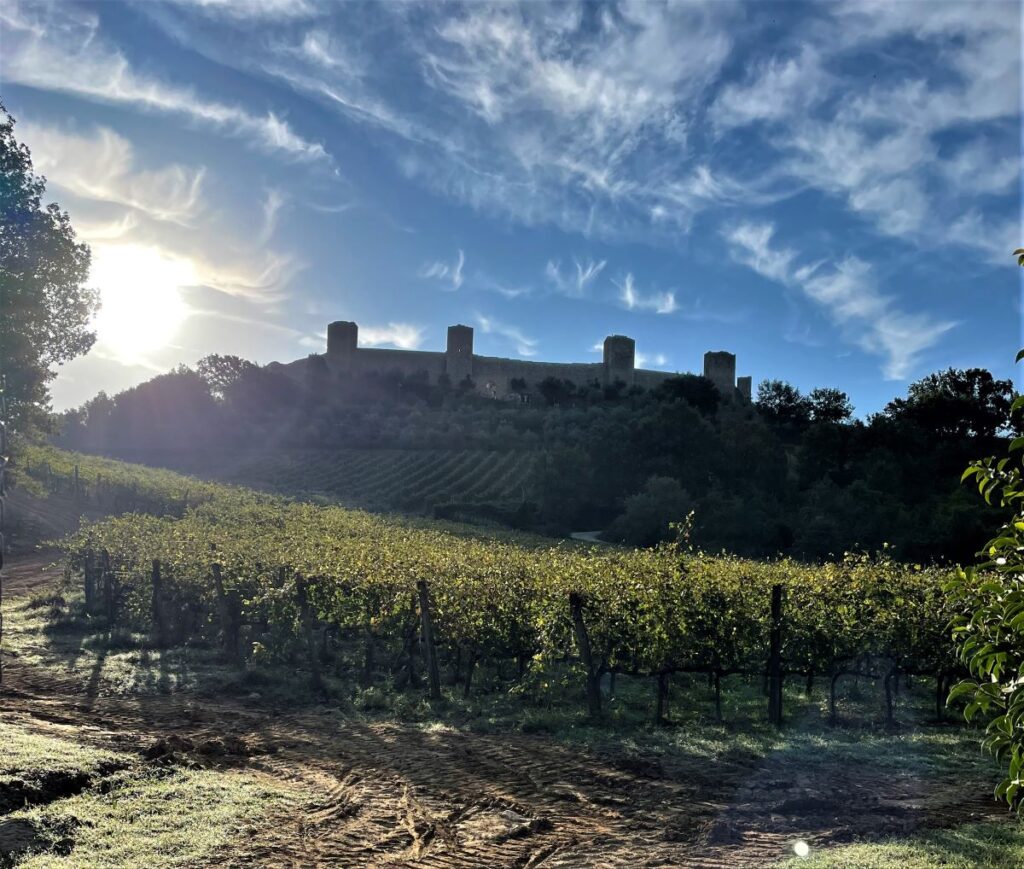
The coffee at Restaurant da Remo was not very good, but the conversation with Johan was pleasant and interesting. So we walked on together, looking at neighboring castles along the way. There is a very beautiful part of the road here – a castle with a tower, like in the fairy tale about Rapunzel, inspired me to take a photo. Besides, there was someone to ask to do it.
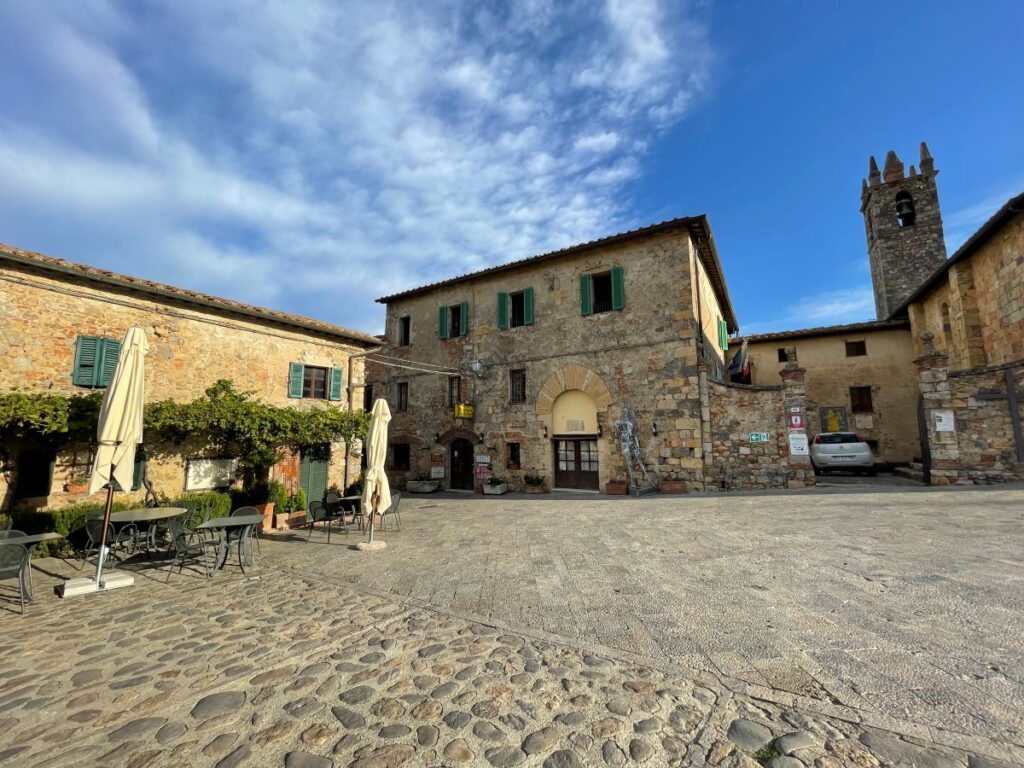
After Monteriggioni, the path turns into a trail and many wonderful shady paths. We again saw hunters hunting hares among fields of brick-red soil. Suddenly we came to a very pleasant place – about 3 km after Monterrigioni there is a donut bar. They serve coffee, make sandwiches for the pilgrims, and you leave as much as you think you can. Here we met up again with the Tsorizo family, who were resting after the morning’s trek. Kathy was very happy to see me and Johan again.

Then the path went along the suburban roads of Siena – we had to walk along the side of the asphalt. At times it seemed a bit dangerous, as drivers here drive quite fast. The last 5-6 km and I found myself on the outskirts of Siena, and then I was walking with the help of a navigator – tonight I planned to spend the night in a monastery in the city center.
Siena
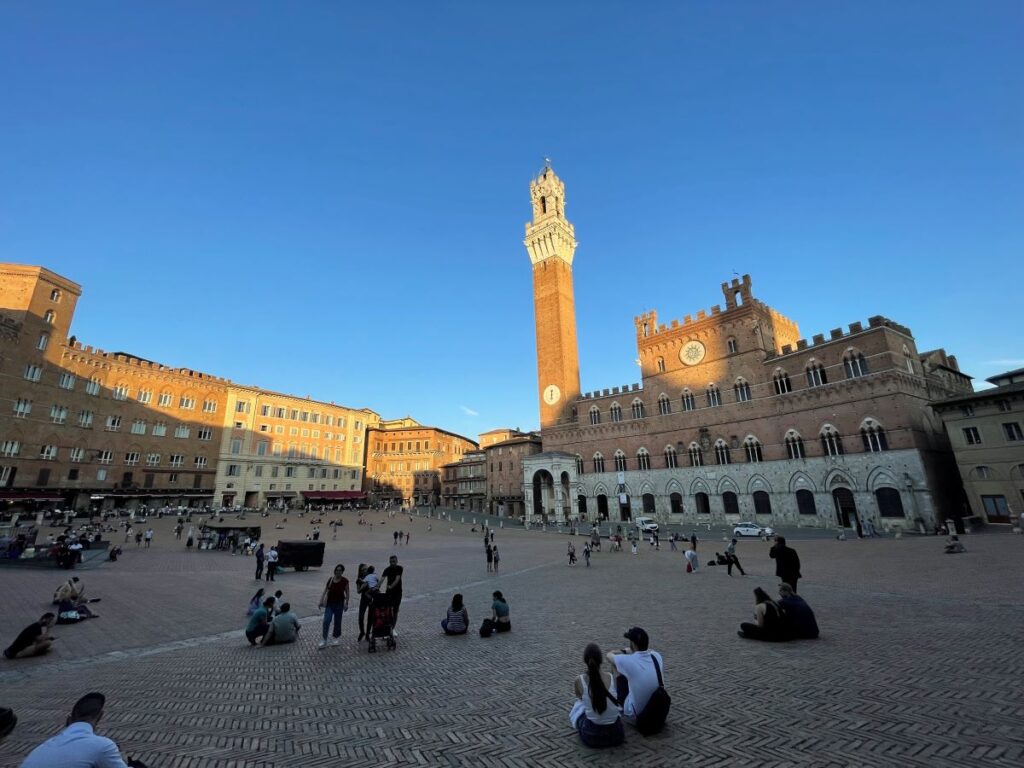
Siena is a stunning city and the highlight of the walk from Lucca to Rome. And it’s not the first time I’ve been here – we came here as a family during a on a road trip through Tuscany.
If you come to Siena for the first time, I recommend staying here for two days to enjoy the city. Also note that the Duomo closes at 17:00, so if you want to get a stamp, you’ll need to get there before closing time. I stamped it in the monastery where I spent the night.

It was a beautiful evening – I walked around the city, sat on the warm bricks of Piazza del Campo, and watched the sun paint the Duomo in pink color. I also ate gelato at a gelateria with Katie’s dad, whom I met while walking around the city.
Where to stay in Siena:
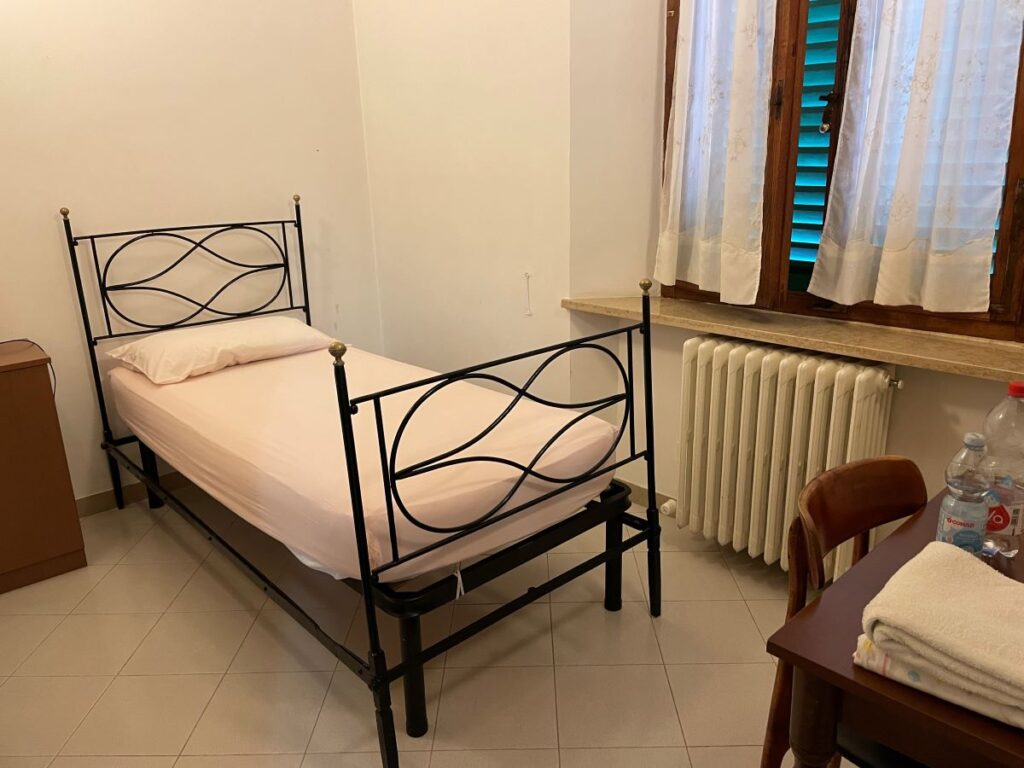
- If you are planning to stay in Siena for a couple of days, I advise you to book your accommodation in a hotel or private hostel in advance. Casa di Alfredo Affittacamere has a great view of the Tuscan hills.
- B&B Dei Rossi with double rooms for 80 euros has a great location – in the heart of Siena.
- If you’re like me and plan to spend only one night, I recommend booking a place a day in advance at Accoglienza Santa Luisa – Via San Girolamo, 8 -+39 057721271. Here I spent the night in a private room with my own shower and breakfast. Payment is made on a donation basis.
Day 7: Siena – Ponte d’Arabia
Distance: 27 km
Weight:*.
On the route: there are bars, cafes, wineries, and a single water tap among the hills.

For the first 10-15 km after you leave the outskirts of Siena, you will find a track with cars and garbage. And the urban landscape, which is not very pleasing when you walk on the road. The most exciting thing about this stretch was the stunning view of Siena as soon as I left the city.
When I was tired of walking between the wood processing plants and the warehouses with used cars, I stopped at a bar for a coffee and orange juice. Then, in the town of Ponte a Tressa, I finally turned onto the trail that winds through the picturesque Tuscan ridges. The views from both sides of this road were just incredible!

After Suvignano, where there is a single water tap, I walked along a flat path that ran along a field on one side and a railroad track on the other. It was quite boring to walk like that for about 7 km. But I finally made it to Ponte d’Arabia, a small village with two bars and a pizzeria that is closed on Thursdays. Fortunately, it seems that the two bars are always open and both accept credit cards (although there is also an ATM in the village). There is the only Centro Cresti ostello in the entire neighborhood, which I booked in advance, and it’s a good thing I did. Because I was the last to arrive and my bed was not given to another pilgrim.
There are also a couple of hotels in the village – the Tsorizo family stayed in one of them. I met Katie at a pizzeria where I went for dinner with a pilgrim from Canada (unfortunately, I don’t remember her name).
Where to stay in Ponte d’Arabia:
- I spent the night at the Ostello Centro Cresti , a donativo hostel for pilgrims. Book in advance +39 3277197439 – centrocresti@libero.it (responds to email inquiries).
- If you are traveling together and could not book beds in an ostello, book an apartment in Booking intero appartamento.
Day 8: Ponte d’Arabia – San Quirco
Distance: 28 km
Weight:**
On the route: there are bars, cafes, and a single water tap among the hills.
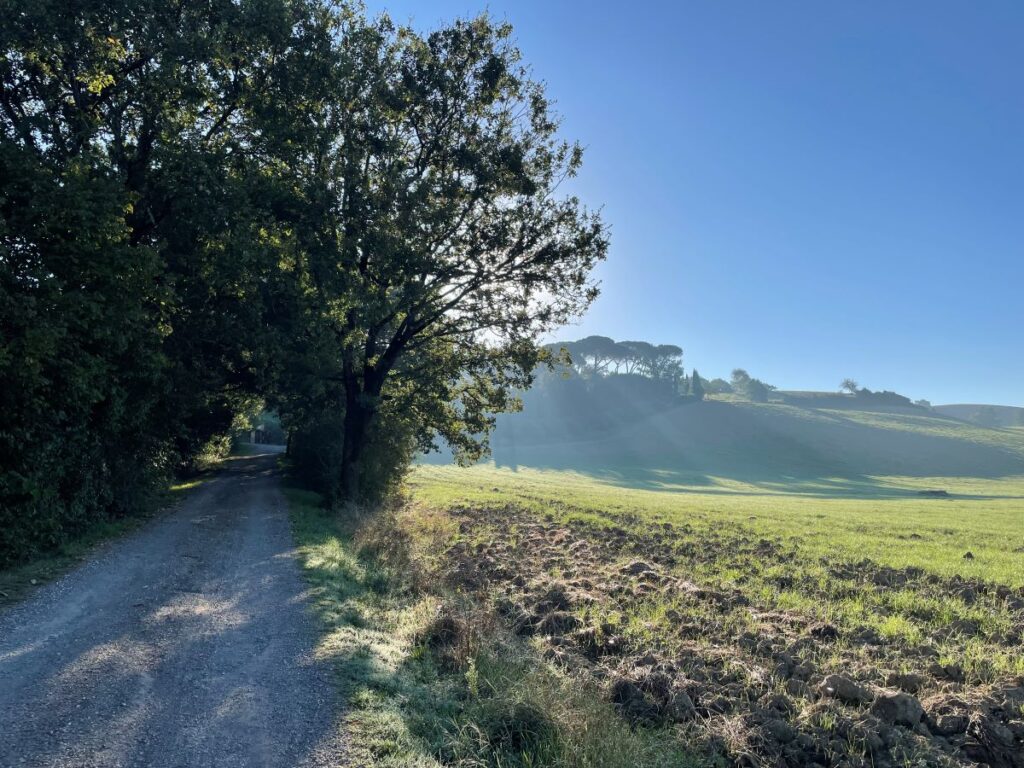
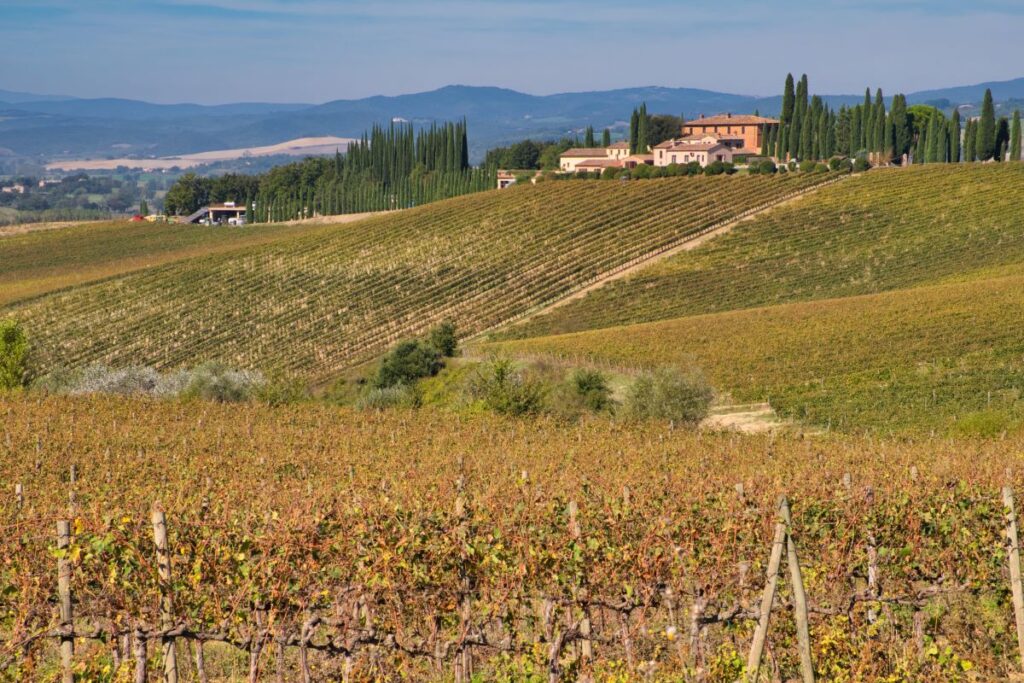
A very beautiful stage through the valley of the Arabia River, across which a wooden pedestrian bridge leads to Ponte d’Arabia (it was under repair when I was there). This is a real Tuscany with its classic landscapes, where you are accompanied by fields, olive groves, cypress trees and hilltop villas all day long. Such beauty accompanied me for 20 km of the journey.
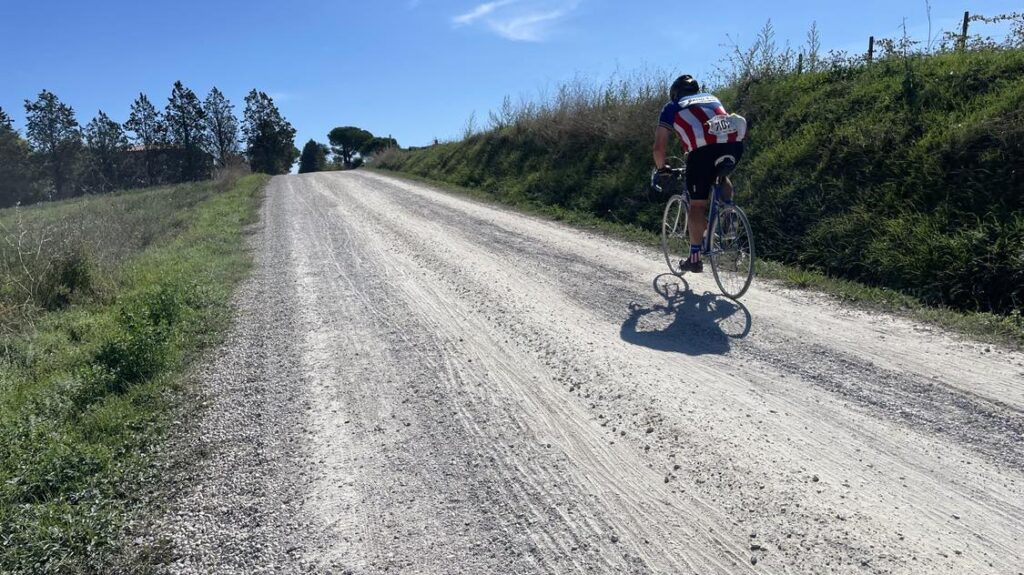
On the same day, the Nova Eroica cycling race was held on the Via Francigena trails. Cyclists on modern and retro bikes were constantly passing me. They greeted me, and I greeted them. In the town of Buonconvento, I stopped for coffee and bought delicious peaches and pears for the road at the Sunday market.
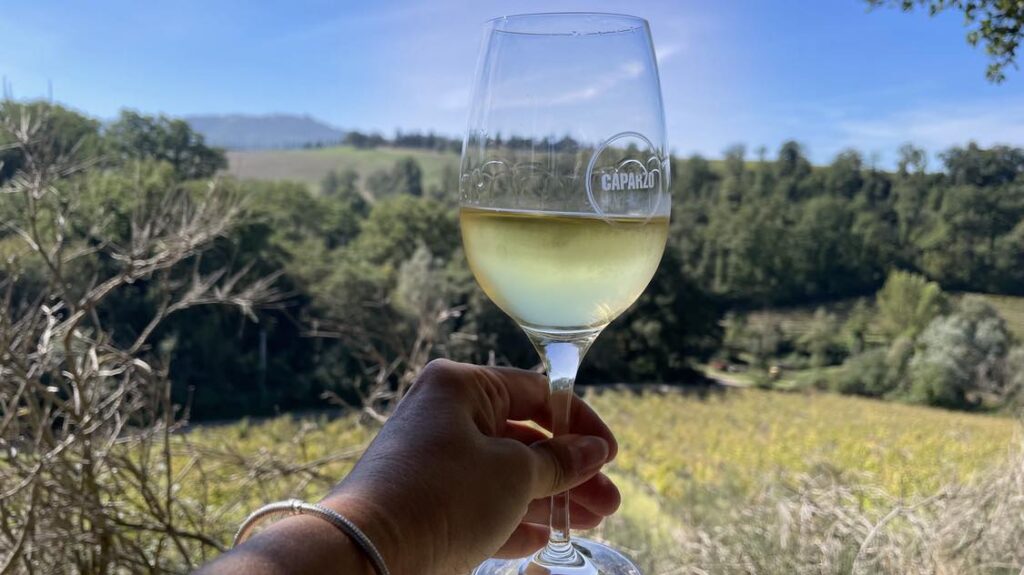
Then came the vineyards and wineries that offered to stop for a glass of wine. Winery Carpazo winery made a few advertisements on the way, and I couldn’t resist stopping by to try their wine. It was quite hot, but the cool white made me feel very comfortable.
And in the next town,Torrenieri, I was very hungry and stopped for lunch (which I almost never do when hiking) at La Panzerotta di Giordani Ambra pizzeria. It was good that I did, because I was a little tired after half a day of walking.
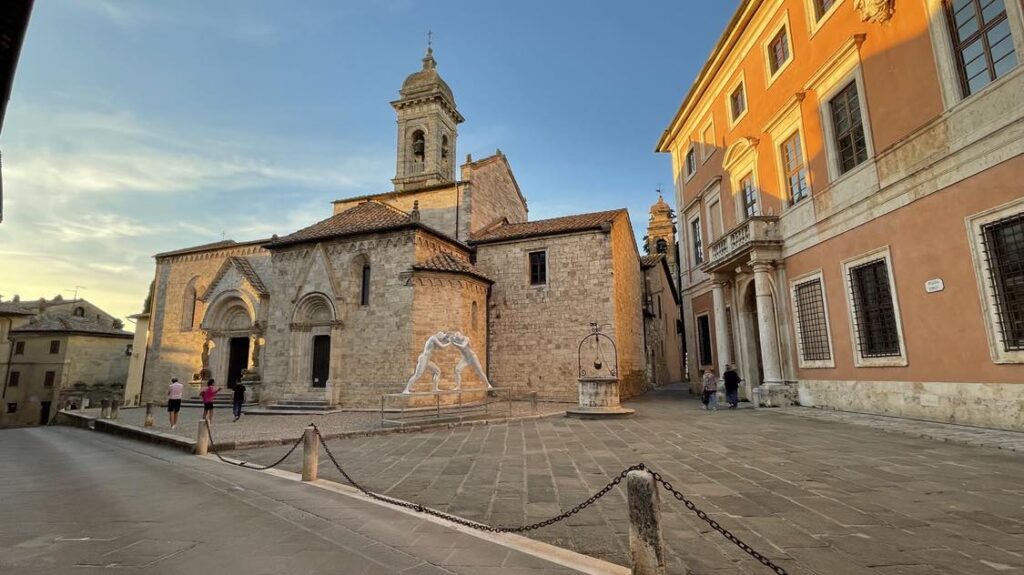
The last 7 km are on a road with hills. It was quite difficult to walk because of the blisters, although there were not many cars on the road. When I entered the city of San Quirco, I felt very tired. It was good that I had booked a room – I was the last one to arrive again, but they booked a bed downstairs for me – it was real happiness!
San Quirco d’Orcia
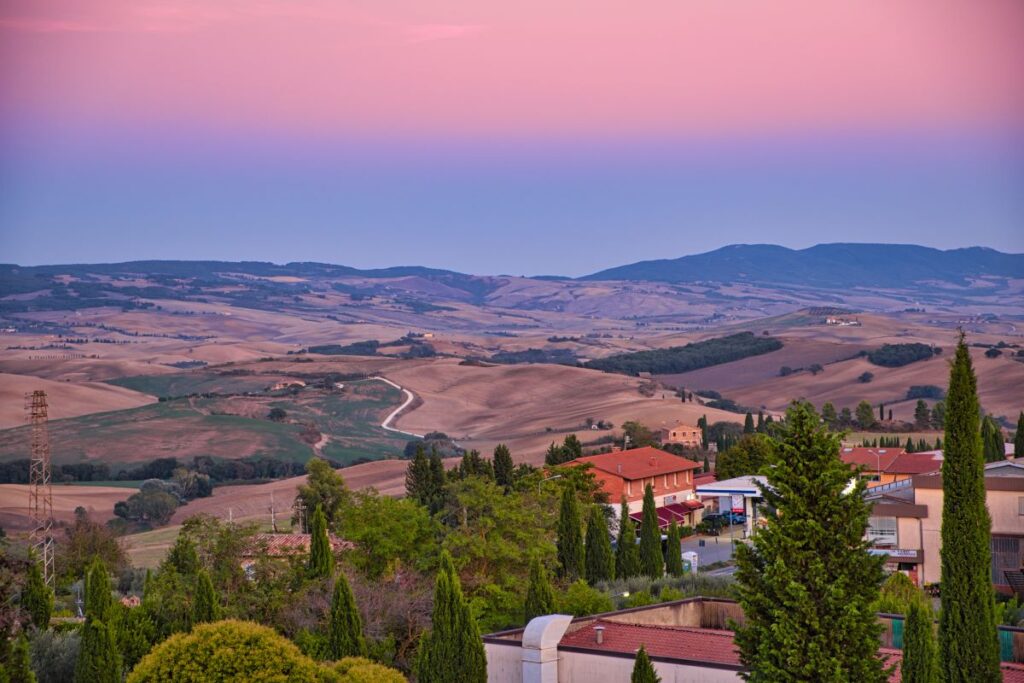
It is a beautiful and at the same time touristy city on a hill overlooking the Val d’Orcia valley. The sunset was just incredible – the red sky was playing with colors. I took a walk around the city, visited the Horti Leonini gardens, took pictures of the sunset and enjoyed pasta and a glass of wine at the InTralci trattoria. It would have been nice to stay here for a couple of days, but I’ve already been to the Valley and seen it in the spring. Now I was curious to walk it on foot, which I did the next day.
Where to stay in San Quirco d’Orcia:
- I spent the night at Il Palazzo del Pellegrino – the cost of a bed is 21 euros (contact details here palazzodelpellegrino@gmail.com).
- Ostello Parrocchia Collegiata is a slightly cheaper pilgrim hostel (aminchiarri@gmail.com).
- Antica Sosta – is a wonderful guesthouse with double rooms for a couple.
Day 8: San Quirco – Gallina (Radicofani)
Distance: 32 km
Weight:***
On the route: there are bars, cafes, thermal springs, but I saw only one water tap along the way.
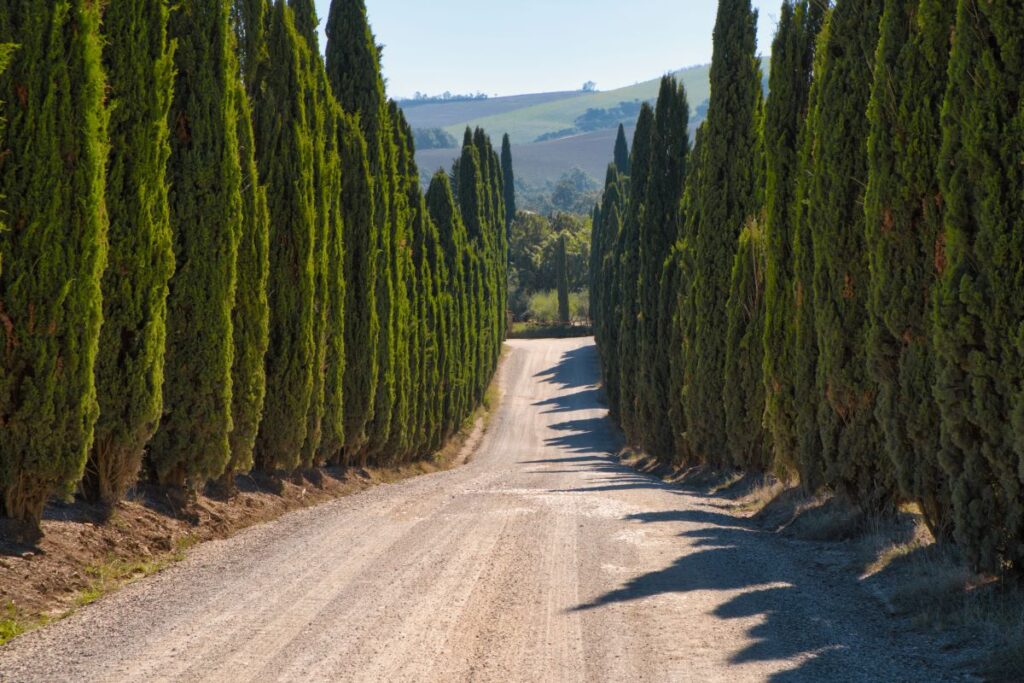
It was the hardest day on my Via Francigena journey and the last day in Tuscany. It must have been the same for everyone who walked the distance from Lucca to Rome. First, 32 km is quite a long way. Secondly, on the last stretch, there is a sharp uphill climb of almost 800 meters. And thirdly, on this day (October 1, 2023) it was incredibly hot – +32 ℃!!!
I should have gotten up as early as possible, but… But I was the last one to leave the hostel and went to look for coffee, which I didn’t find at 8 a.m. because it was Sunday and bars opened after ten. I had two pears, water, and a desire to walk 32 km, which I couldn’t do because of the heat, back pain, and hunger – you can’t go far on two pears.
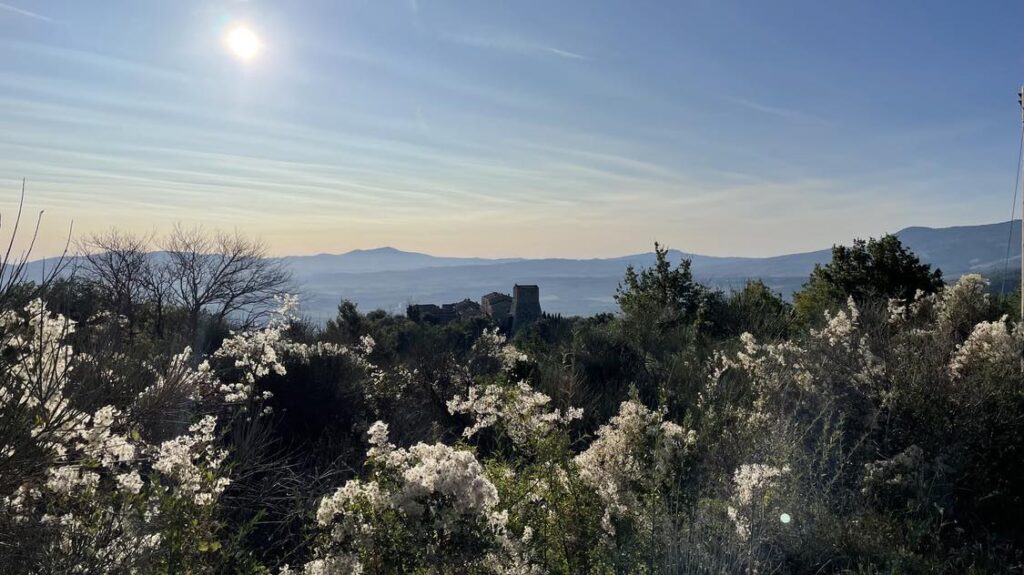
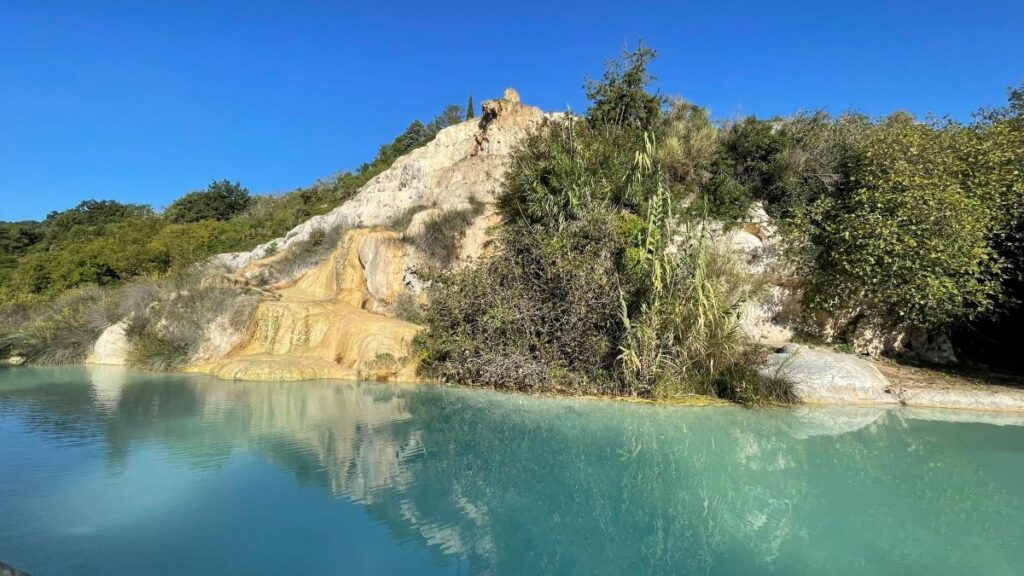
The initial part of the route goes to the small village of Vignoni Alto, and then you get to the larger city of Bagno Vignoni. The latter is particularly beautiful, with a large thermal pool in the city center. I decided to walk to it to bathe in the thermal baths. But I gave up on this idea because the water was cool and we had little time.
The views and landscapes today are stunning – I had to walk across the entire Val d’Orcia valley. I have been dreaming about this for 7 years since the first time I saw it and saw the Via Francegina signposts.
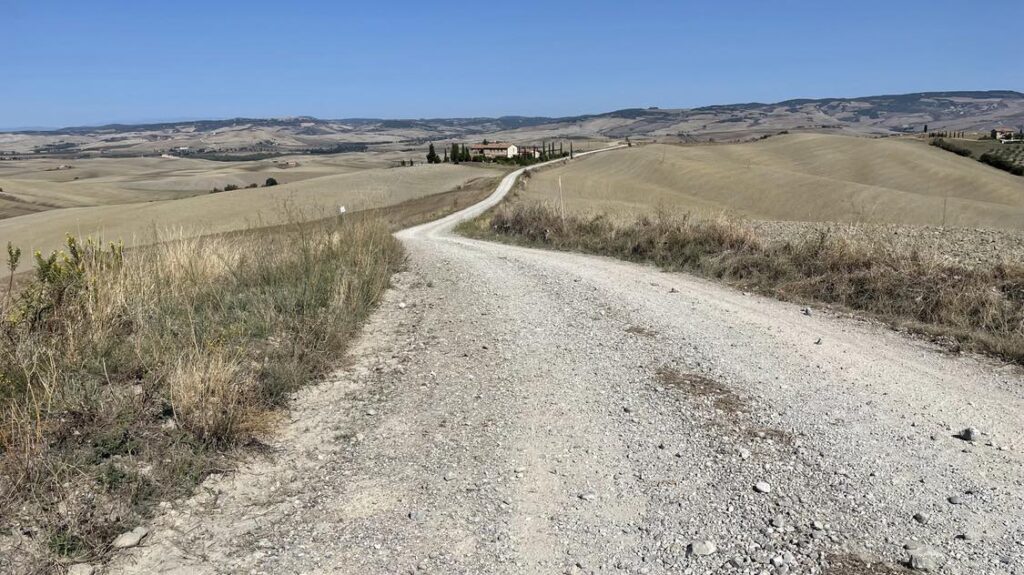
Along the way, the route approaches several towns, such as Castiglione d’Orcia, but does not actually come across them. This means you’ll either have to make a beeline for coffee and lunch or go on without food. I recommend buying lunch in San Quirico (there is a large Coop supermarket there). He doesn’t do it like I do – it’s very hard to go hungry and sometimes it seems like I have no strength anymore.
Therefore, I decided to stay in the valley for the night in the village of Gallina, which is located about 25 km after San Quirco. It was the right decision – my back was hurting badly, and three huge calluses prevented me from walking. And I was hungry.
So I looked at the list of accommodations in Gallina and found a great hostel where I could relax in the evening.
Gallina
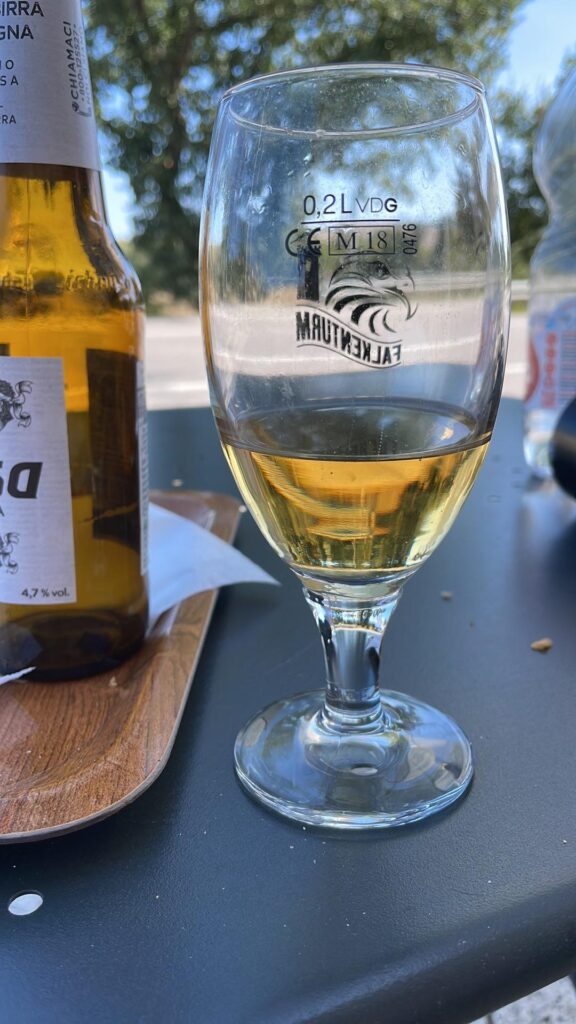
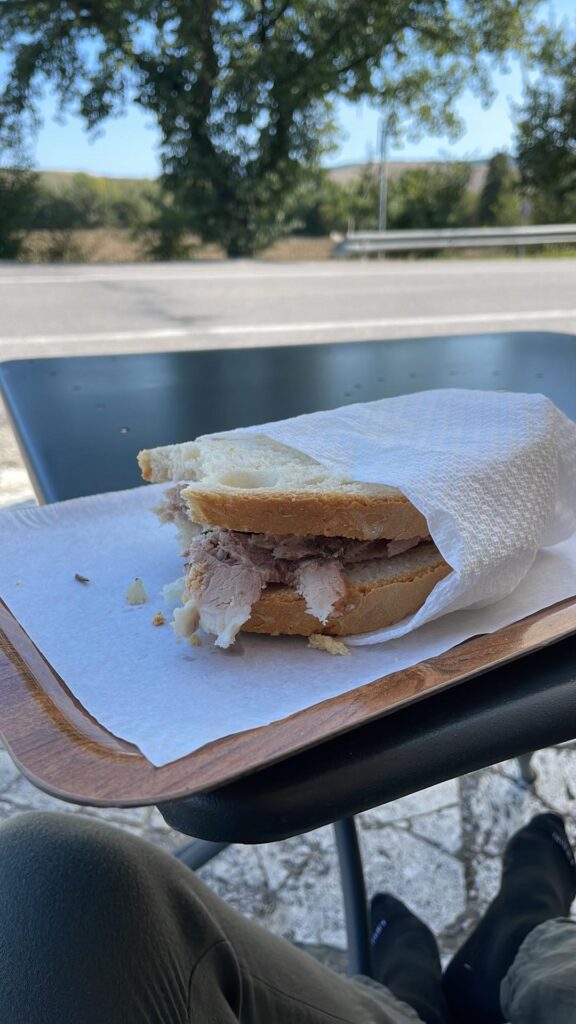
I remember this very small village in the middle of the Val d’Orcia valley from my last visit to this place. We were told about it by the owner of the agritourism where we stayed on our trip. He told me about a bar that serves the most delicious porchetta pannini in all of Tuscany. We tasted them that time – they were really very tasty and very cheap.
My hostel was still closed, and I remembered that bar and went to it. Mamma mia! The same owner worked there and made the same pannini-I ordered one with porchetta, one with salami, mozzarella, and tomatoes. I was so hungry – damn! I took a bottle of beer, took off my sneakers, and sat down to enjoy my meal outside at a table.
There were cyclists sitting next to me, resting, watching me rest, not hiding their pleasure. It was unbearably hot, but I felt good, because now I didn’t have to go far and high. My back and legs wouldn’t have been able to take it. There were hardly any buses in this place, so I did well to book a place in the middle of the valley.
Where to stay in Gallina or Radikofan:
- I spent the night in Gallina – in Ostello La Vecchia Posta- Via Cassia, 43/45 – +39 331 9972594 – lavecchiaposta@yahoo.com, for a bed in a shared room for 4 (I actually spent the night there alone) – 16 euros. There is a kitchen, but no shops, only one bar.
- In Radicofana, the Ospitale Santi Pietro e Giacomo (+39 3387982255, – +39 3389205540) is a donation-based hostel run by volunteers all year round. In the summer months, they organize dinner and breakfast and accept reservations. In winter, you need to call when you arrive to inform them of your arrival.
- Municipal hostel Radic Hostel (info@ostellifrancigena.it, +39 3760622460).
- Private accommodation is also available – Casa del Ciliegio and Albergo La Torre.
Day 9: Gallina – Aquapendente
Distance: 24 km
Weight:**
Along the route: there are bars, I drank water in a cafe, and there are several fountains and rest areas.
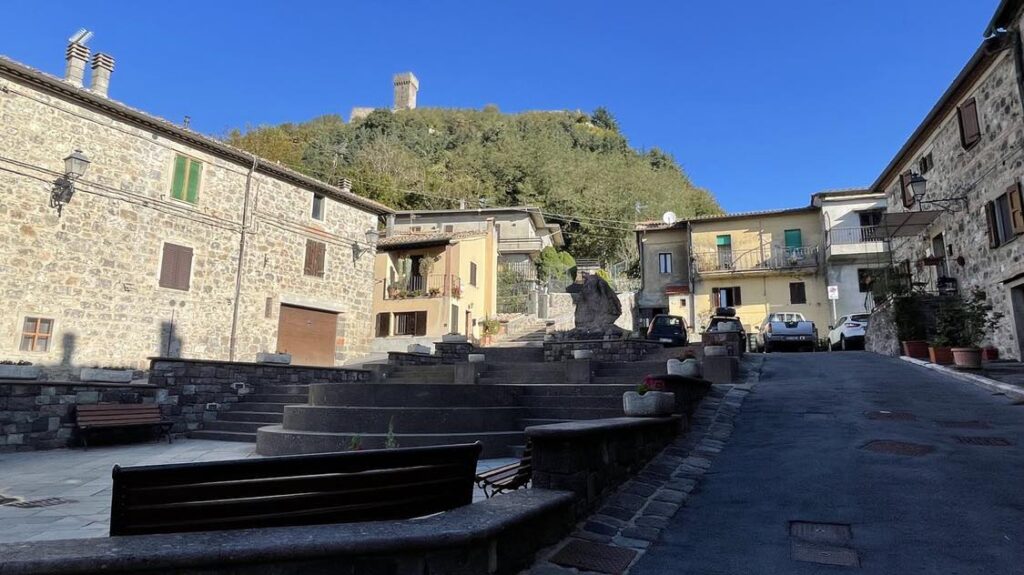
Radikofani is a beautiful town (also a classic example of a borgo) located high on a hill 800 meters high. If you go there on foot, expect a gradual ascent from 400 m to 800 m over the last 7 or 8 km. The last 3 km are especially hard, but the reward at the end is so worth it.
I woke up early in the morning to take the only bus that goes from Gallina to Radikofani. My back was still hurting, so I didn’t want to risk my own health.
At 7:40 a.m., I took bus #54A and got to the Bisarca-Bivio Bagni San Filippo stop (two stops). There I had to wait for the next bus (8:22) Bagni S. Filippo- Radicofani. Such a connection was possible only in the morning – buses do not connect in the afternoon.
Bus tickets can be bought only through the Tabnet app – The driver does not accept cash. When boarding, you need to show the ticket to the driver in the app. There are no other options to buy a ticket outside of cities (in cities at Tabacco shops). The fare is 1.7+1.7 euros.
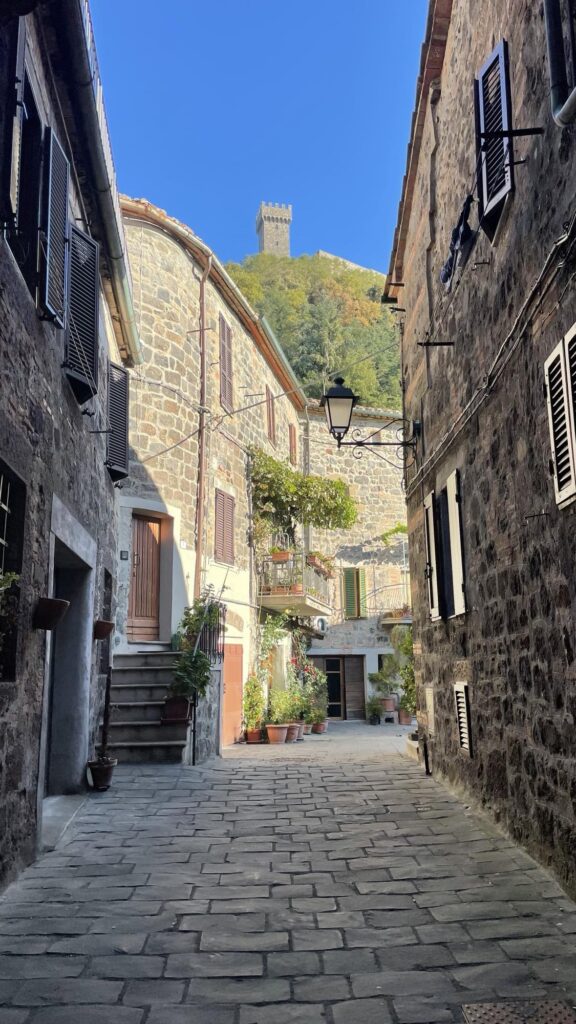
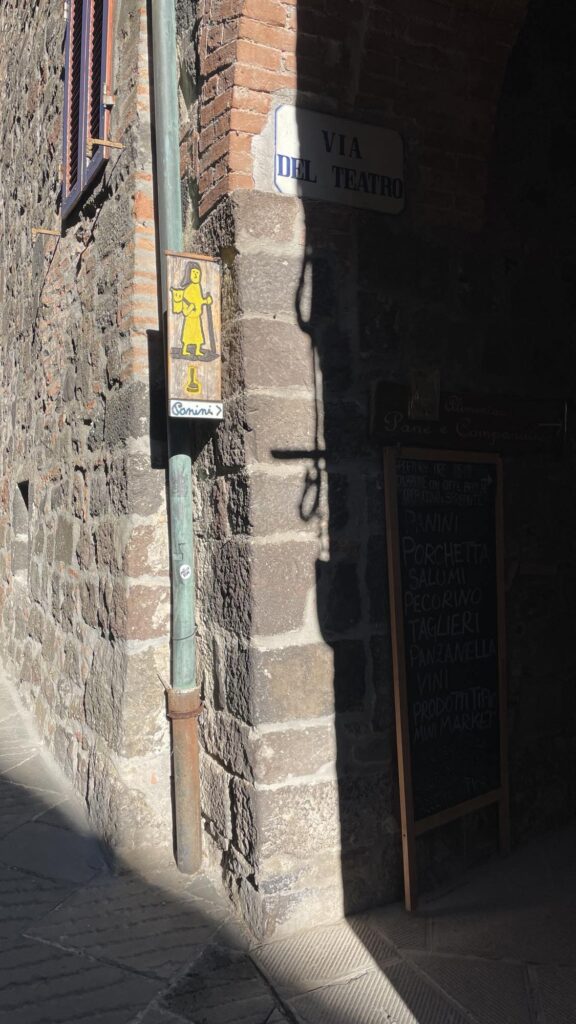
So, instead of a difficult climb to Radikofani, I reached this town in 30 minutes. The driver opened the door for me at the bus stop and I found myself at a small bar. My American friends were sitting in the sun at a chair. Chitter! – they said together out loud and we laughed together)))
I walked around Radikofani, looked down at its majestic fortress, drank coffee, and went on to the next stage.
Sometimes, when I feel bad, when I have health problems, it’s better to be a cheater than not to reach the goal of my journey at all.
When I returned home and was examined, I found out about the intervertebral hernia and other problems that may now prevent me from walking far. But I’m trying to cope, because I don’t plan to stop.
Radicofani is located on the border between Tuscany and Lazio. So I had a coffee, said goodbye to Tuscany! and went on to Rome.
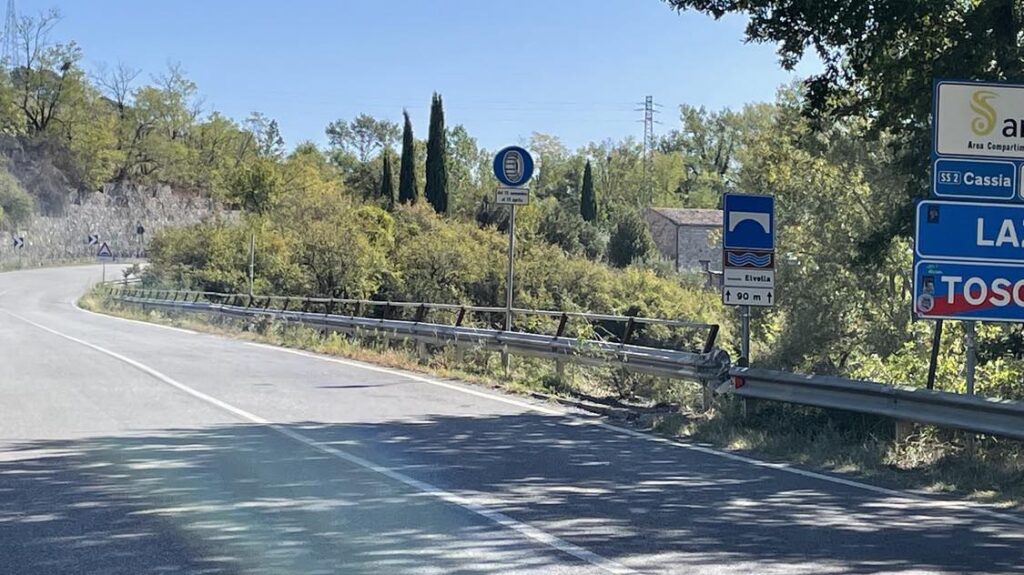
The walk from Radicofani to Aquapendente is much easier than the previous day. The first 10 km is a slow descent from the hill on which the city is built. Here I met two Americans of Indian descent, professors at a university, friends since childhood, who had been walking the entire Via Francigena for several years. And this was the last piece of their journey. Very nice and interesting uncles I talked to on the way. then in a cafe at the bus stop.
I had to walk the last 7 km on the road. It was quite dangerous in some places where there was no path along the road. There is a van with coffee and other drinks about 4 km to Aquapendente. You can also put stamps in the credentials there. At the crossroads before the Aquapendente, you turn towards the city and climb up again, but not for long and pleasantly, because the whole road is planted with trees and there is a lot of shade.
Aquapendente
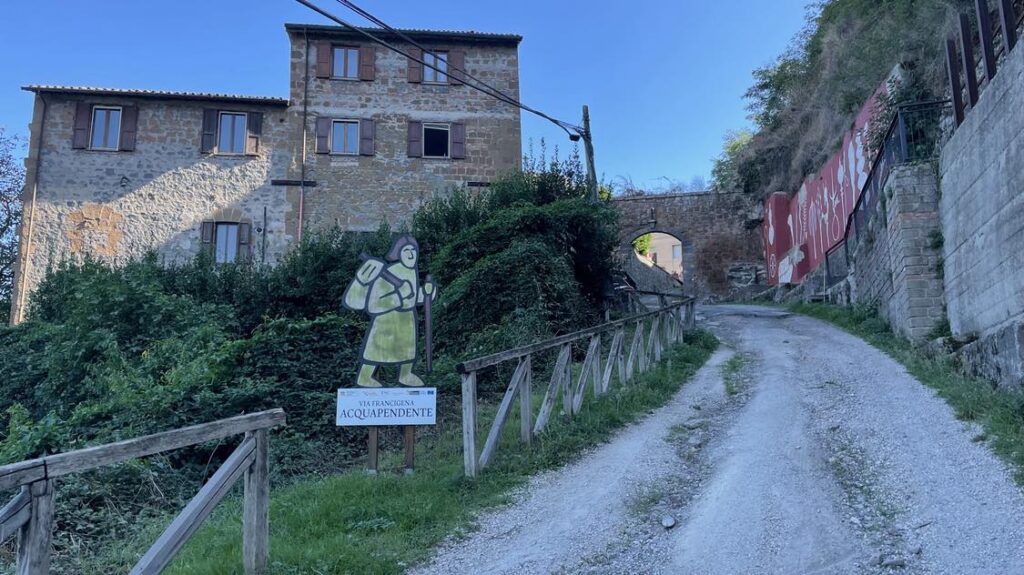
To be honest, I didn’t really like the city – it looks kind of neglected in the center. All the small towns here were built thousands of years ago. Most of them are kept in very good condition – they clean the walls, grow flowers in pots. But in some of them you can feel a certain indifference, and through this you understand the attitude of the locals to the place where they live. This was also the case in Aquapendente.
I booked a bed in a church hostel for 10 euros because there were no other cheap options. When I got to the hostel, I called to get an access code and room number. I checked in, and about 10 minutes later a huge Italian man burst into the room.
Stefano is now my fireplace friend, and then a big bear who barely spoke English. We got acquainted, took turns showering and doing laundry. About an hour later, the third man came, Claudio, a dry, tall Italian who smiled and didn’t know a single word of English except OK.
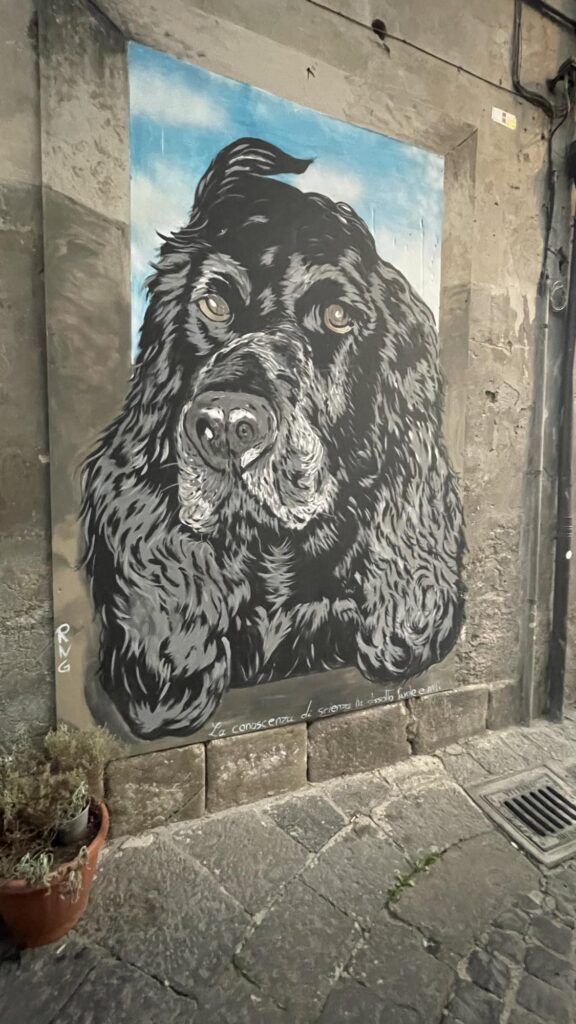
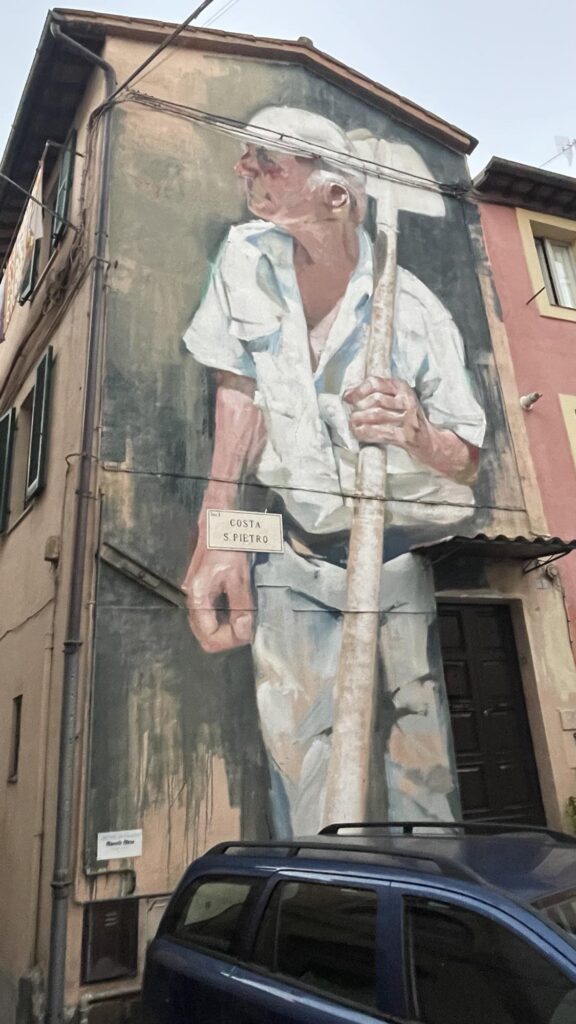
We agreed to go to dinner together. They were talking to each other, Stefano was translating something for Claudio and me into our respective languages. I understood something in Italian, because it’s not a difficult language to understand – Latin. From that day on, for the next 10 days, we will eat dinner together, sleep in the same ostellos, laugh, and talk about different topics despite the fact that we speak different languages.
I still smile happily when I remember our evenings, I cry when I remember how we said goodbye in Rome…
I had dinner at the Albergo Toscana restaurant , for the first time ordering the Pilgrim’s menu for 15 euros (there was also an option for 12 euros without meat). It’s hearty, tasty, even a lot of food for me.
Accommodation in Aquapendente:
- I booked the day before arrival at Casa del Pellegrino della confraternita di San Rocco (+39 3471662919). A bed in a 3-4-bed room costs 10 euros. There are two showers and toilets (only one was working during my stay). Everything is very ascetic, but clean.
- Associazione Casa di Lazzaro is a pilgrim hostel located on the outskirts of the city. (reservations by phone +39 0763730177, +39 3394327383).
- There are also private accommodations – guesthouses Casa Girolamo and Il Sogno.
Day 10: Aquapendente – Bolsena
Distance: 23 km
Weight:*.
On the route: there are bars, I got water in a cafe, there are no water taps.
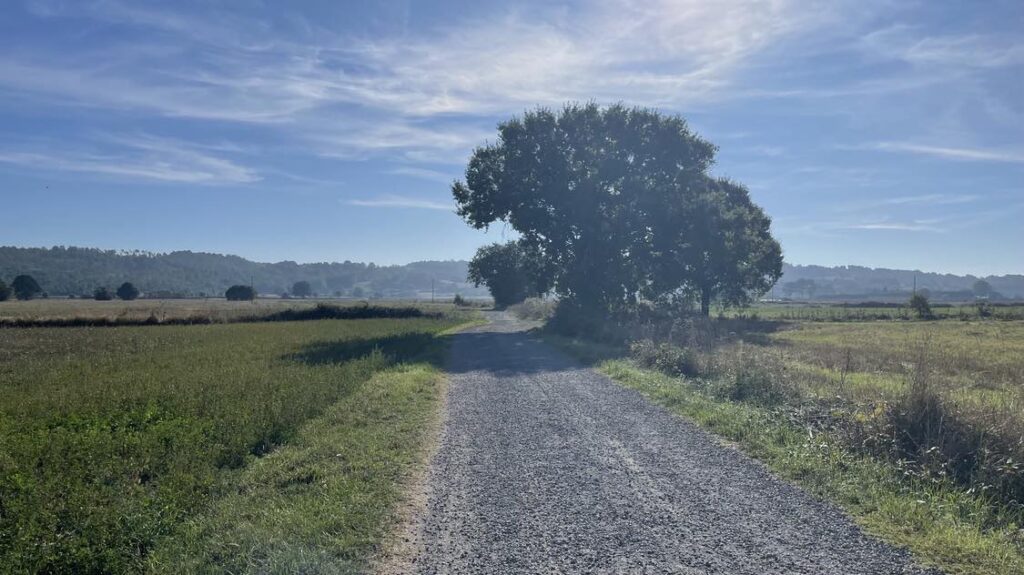
In the morning, my fellow travelers got up very early and left. And I laid around until seven because I didn’t want to stand in line for the toilet. When I realized that everyone had left, I got ready, decided to go in before going to the toilet and ran into a Frenchman who didn’t close the door. Is this what people think when they sit on the toilet and don’t close the door?
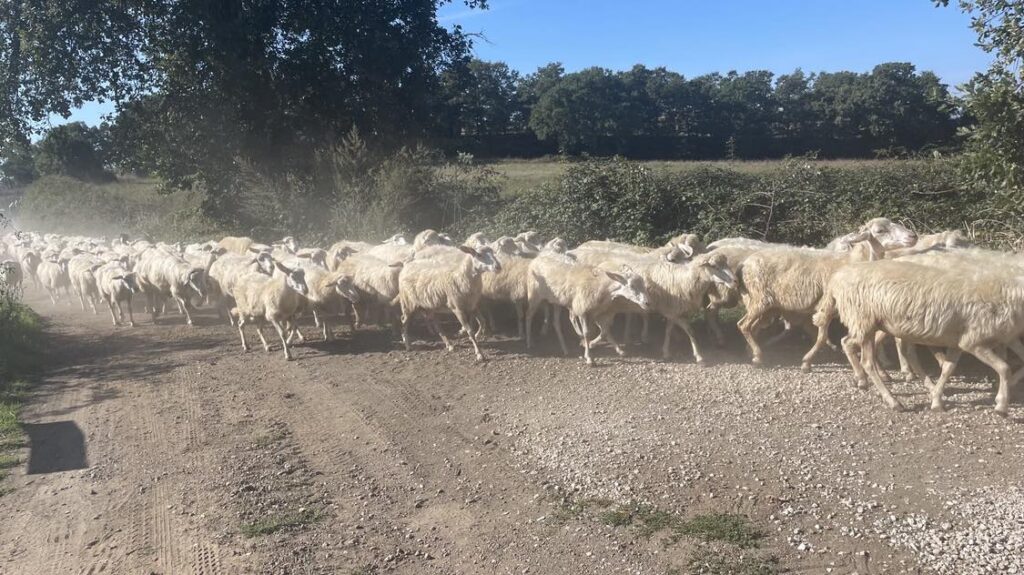
A relatively easy day of walking from Aquapendente to Bolsen, if not for my three large calluses that prevented me from walking normally. The beginning of today’s route along the highway past the industrial zone. After five kilometers of this path, we turned into the fields, where the trail went almost in a circle. And then she took me to the city of San Lorenzo, in the center of which there are some great bars for coffee.
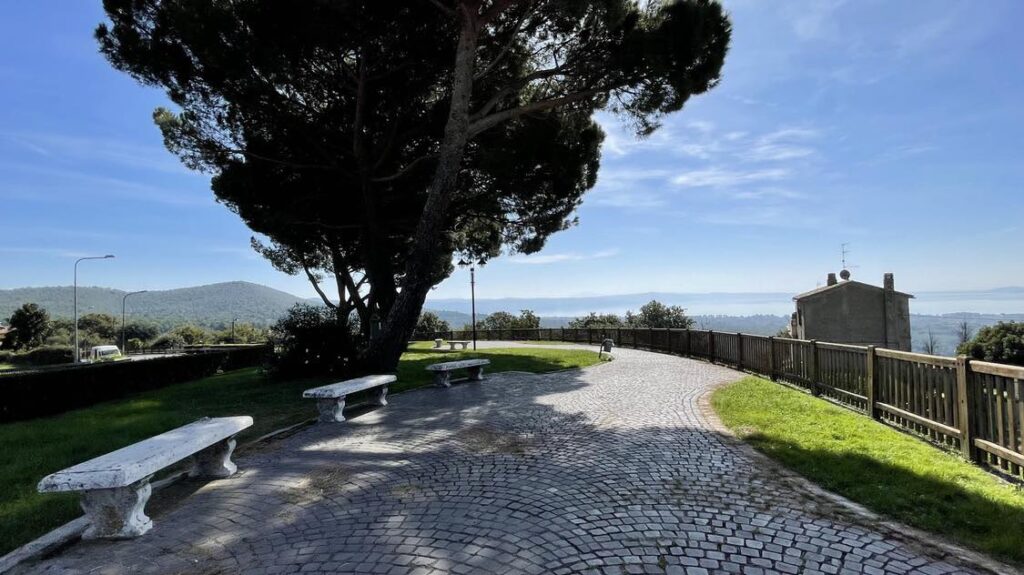
I drank coffee and went on – the next part of the route was very pleasant. It was a forest trail that offered magnificent views of Lake Bolsen. An easy winding path will lead you to the town of Bolsen.
Bolsena
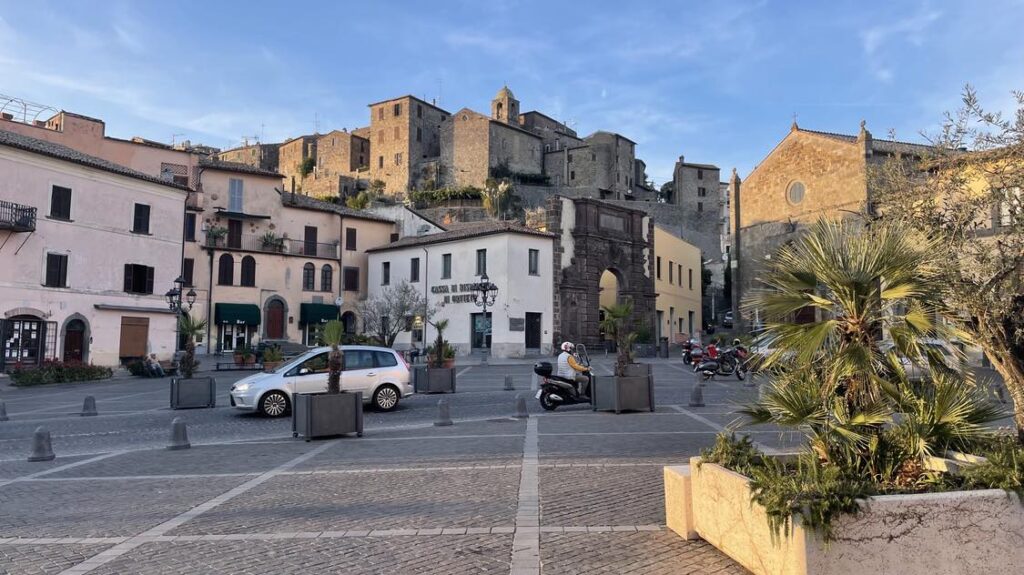
The first thing you’ll see in the city is a well-preserved fortress built on a hill. Below it is the old town with streets and alleys, restaurants in the evening. Then, if you walk along the street lined with old plane trees, you will come to the waterfront and the beach. In summer you can swim here, and in autumn too, but the water was very dirty and I didn’t want to go in. There’s a wonderful marina near the beach where I used to watch the sun go down.
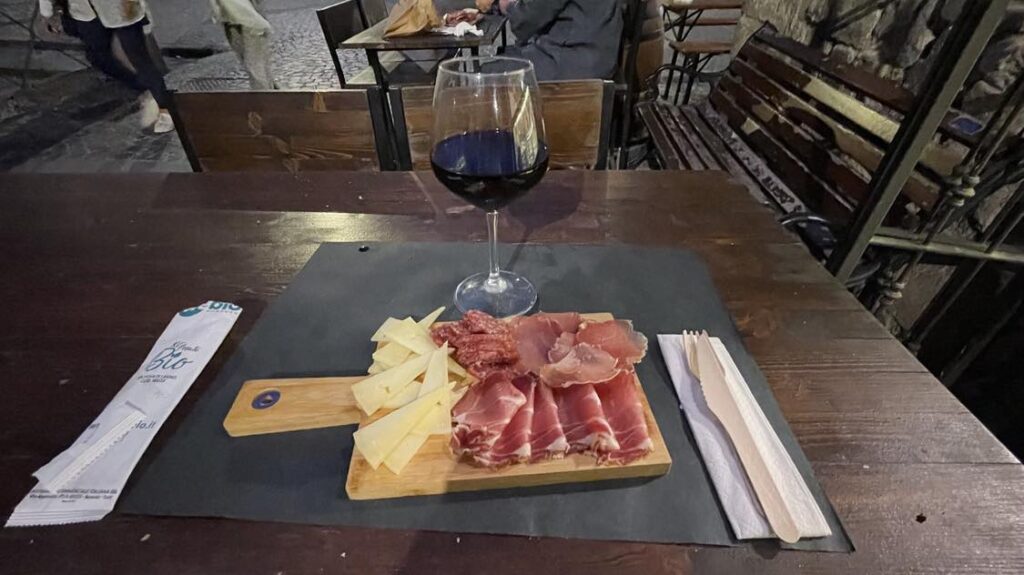
I settled in a monastery in the city center. When I had rested, washed my clothes and went for a walk around the city. There I met Kathy, had a glass of wine with meat and cheese, and chatted until it was time for me to run to the monastery (the doors closed at 9 o’clock).
Where to stay in Bolsena:

- Suore del SS Sacramento Monastery. It cost 15 euros per person per bed in a shared room for 8 people. I don’t know if there are any more places for pilgrims. I recommend booking in advance by calling 14 +39 – 0761586210. The nuns at the monastery are extremely friendly and the stay was wonderful.
- Hostel at the church Foresteria Santa Maria del Giglio (49- +39 0761 799066 – info@conventobolsena.org).
- Pilgrims’ hostel Casa di preghiera Santa Cristina (r70 -+39 3466044158 – info@casacamporitiro.it).
Day 11: Bolsena – Montefiascone
Distance: 17 km
Weight:*.
On the route: no bars or water taps.
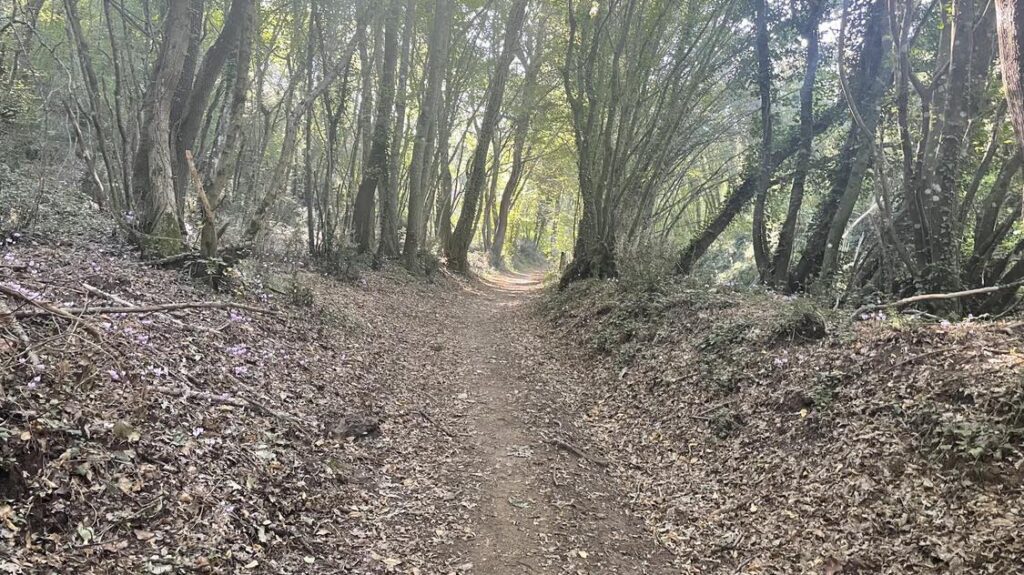
This day can be completed in two stages: 16.5 km from Bolsena to Montefiascone, and 17.5 km to Viterbo. Some of the people I met on the way did the same. But I was in no hurry and went to Montefiascone, and I didn’t regret it.
This route was very easy and pleasant – it went near the vineyards and through the forest on an uneven path. It was cool and very beautiful almost all the time. You have to go up a little bit, because Bolsena was near the lake, and Montefiascone is located on a hill above the lake and therefore has a great view of it.
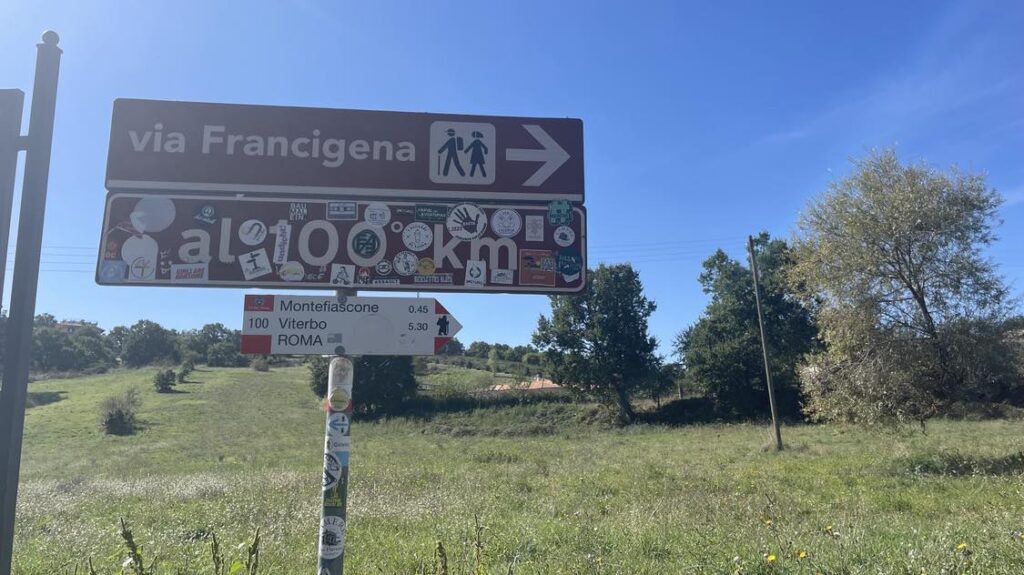
Before entering the city, you will see the Church of Corpus Christi, near which there is a metal pedestal with a marker 100 km to Rome. In fact, this is not true and 100 km is elsewhere, but Montefiascone decided to take such a beautiful figure for himself. This metal pedestal has a secret locker – if you open it, you will see a stamp with a 100 km mark. This is a mystery that I unfortunately did not know about, and only later did Stefano tell me about it. I didn’t go back for the stamp)))
Montefiascone
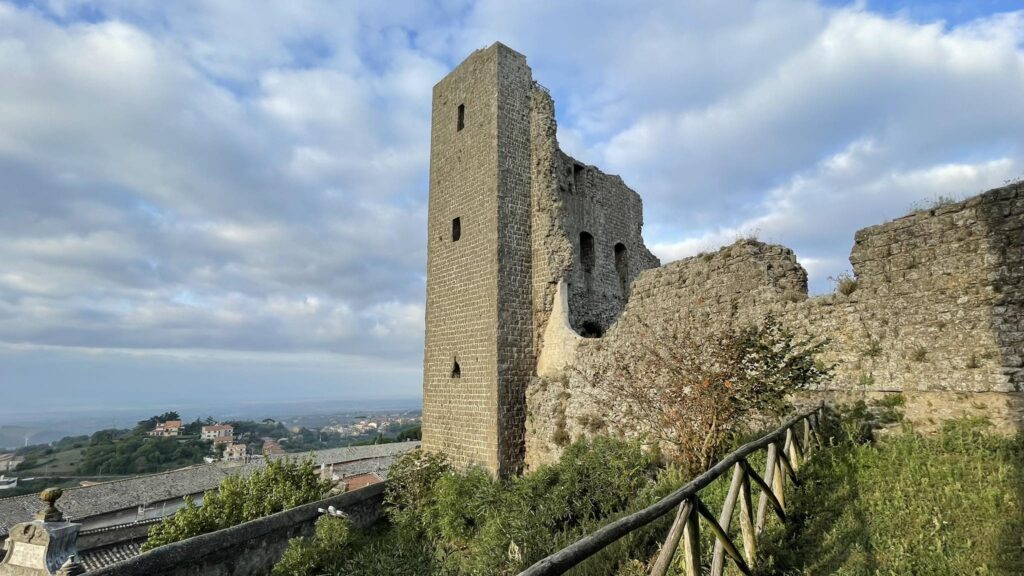
Montefiascone is located on a hill with an insanely beautiful view of the lake. There are many old churches here that can be visited for free. This is where the famous wine is made Est! Est!! Est!!!
Be sure to try the wine Est! Est!! Est!!! – This unusual name was given to white wine from Lazio in the XII century. According to legend, the Bavarian prelate, Bishop Giovanni Defuc, who accompanied Emperor Henry V on one of his trips to Italy, sent his servant Martino in the direction of Montefiascone ahead of the royal train to announce the arrival of the monarch and find a hotel serving good food. Martino had to mark all such places with the inscription “Est!” on the door. However, the wine in Montefiascone was so good that one “Est!” was clearly not enough for him, so the page wrote the word three times and put three exclamation points after the last one.
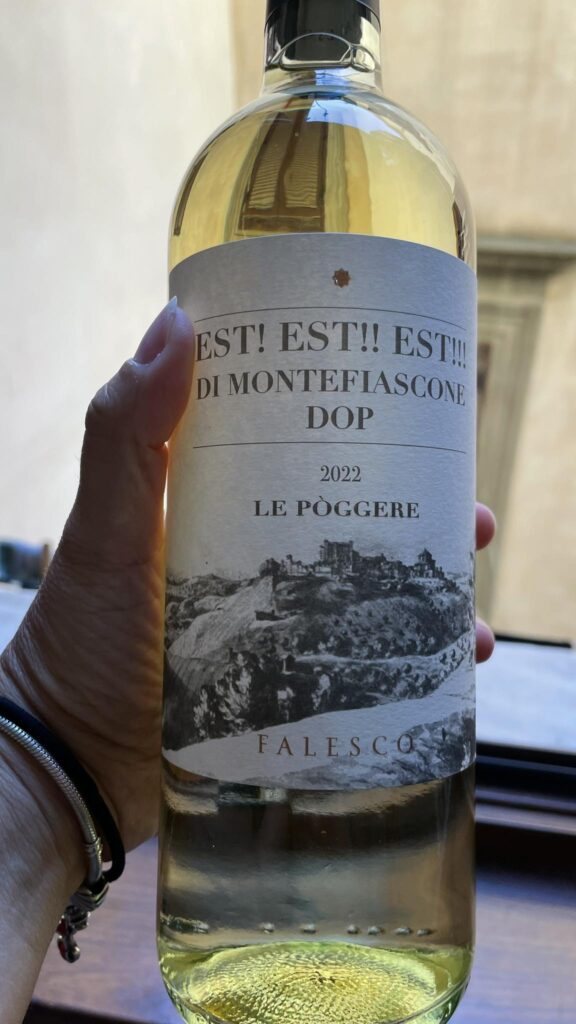
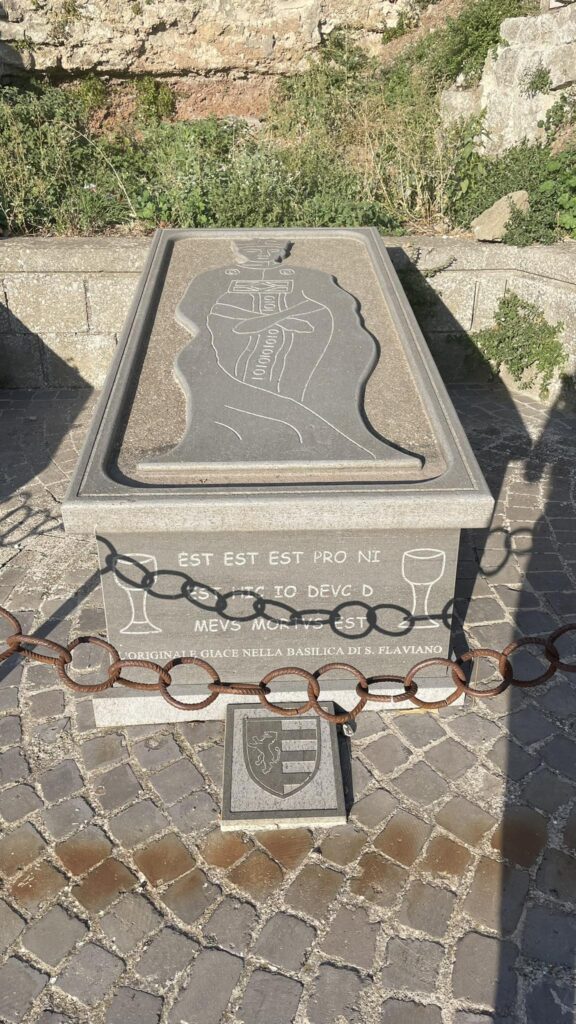
The legend of this wine says that Bishop Defuc fell in love with wine Est! Est!! Est!!!…so much so that he couldn’t stop tasting it in time, and that’s why he died. Local legends say that he took advantage of his gift of hospitality by drinking too much wine and was cursed by God for it. He is buried in the church of Chiesa di San Flaviano, which is free to enter.
The remains of the papal residence, the ruins of the Fortress of the Popes, which is located on a hill in the Old Town, rise on the hill. Tickets can be purchased in advance .
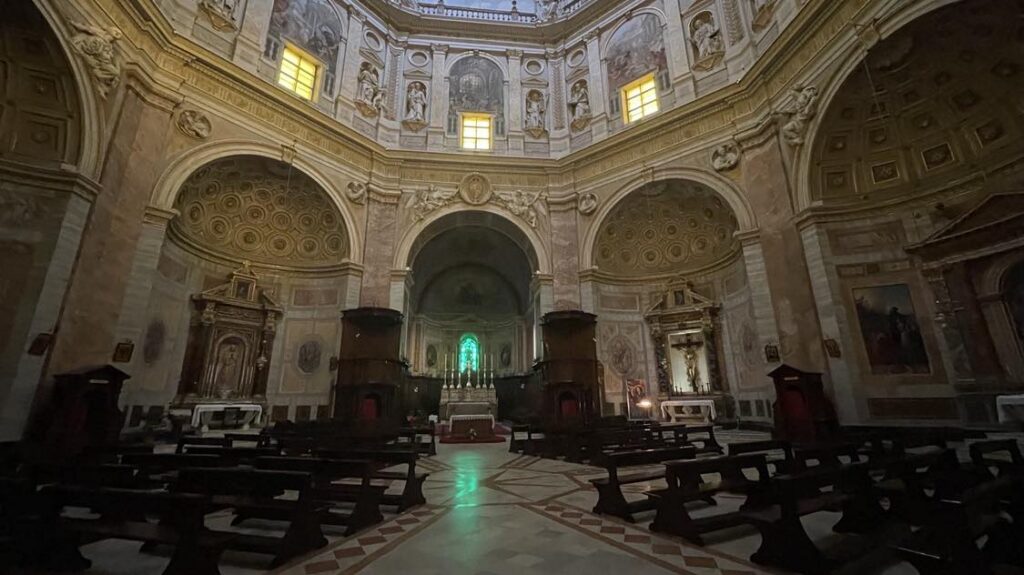
Also visit the Cathedral in honor of Margaret of Antioch – it is considered one of the largest on the entire Apennine Peninsula, second only to St. Peter’s Cathedral in Rome and Santa Maria del Fiore in Florence. By the way, under the cathedral there is a crypt where Margarita’s mummy lies in a crystal coffin (the place is incredibly impressive, I was there alone, and I couldn’t get over the experience for a long time).
Where to stay in Montefiascone:
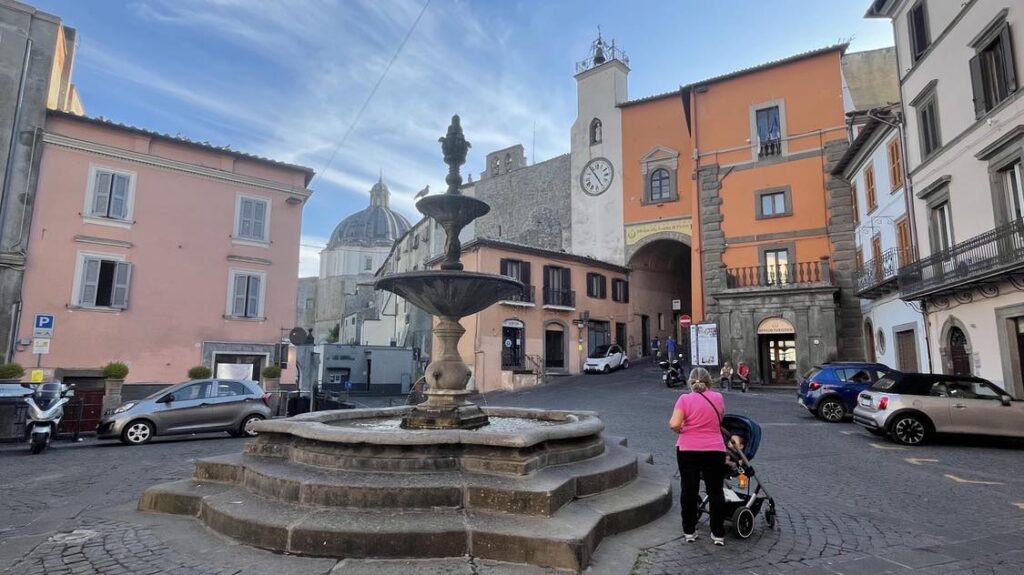
- I spent the night in the Monastery of Monastero San Pietro, located in the very center of the city – I booked a day in advance with Stefano by phone (31 – +39 0761826066). The accommodation cost 15 euros, and the same amount was spent on dinner prepared by the nuns. She was amazing! Delicious pasta, caprese salad and homemade cutlets in tomato sauce. As well as wine, fruit and juice. It was very heartwarming and pleasant to sit with the pilgrims at a big table. You can also order breakfast for 5 euros, but I like a good coffee with croissants in the morning. There are separate rooms for women and men – I was in the women’s room alone. If you are a couple, you can stay in a separate room (ask for the price for such accommodation separately). There are also women’s and men’s toilets and Wi-Fi!
- Pilgrims’ hostel Convento Cappuccini Raggio di Sole – on the outskirts of Montefiascone 3 – +39 3475900953 – edybertolo@libero.it.
- Cheap apartments in the city center Dimora dei Falisci.
Day 12: Montefiascone – Viterbo
Distance: 18 km
Weight:*
On the route: no bars or water taps.
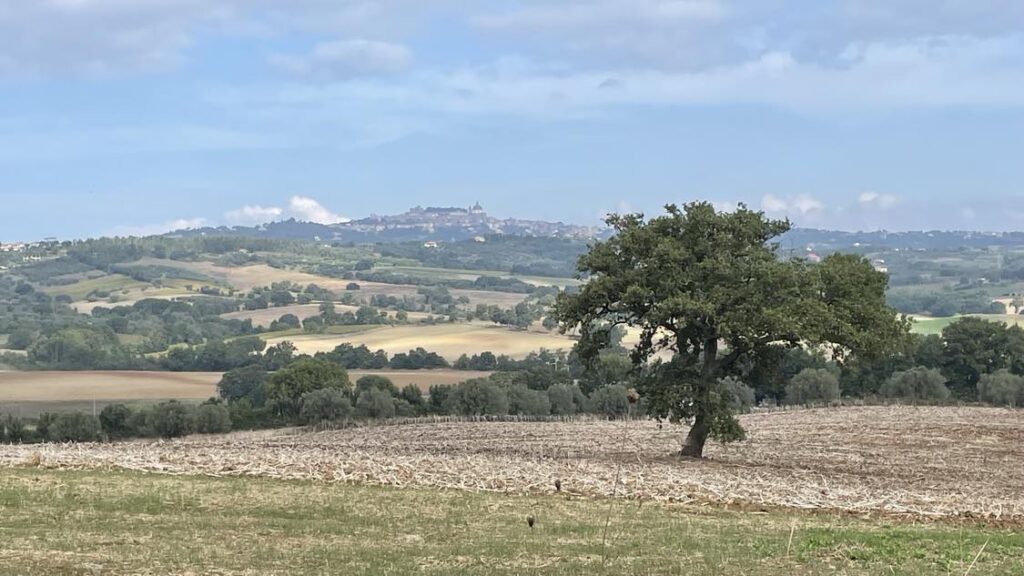
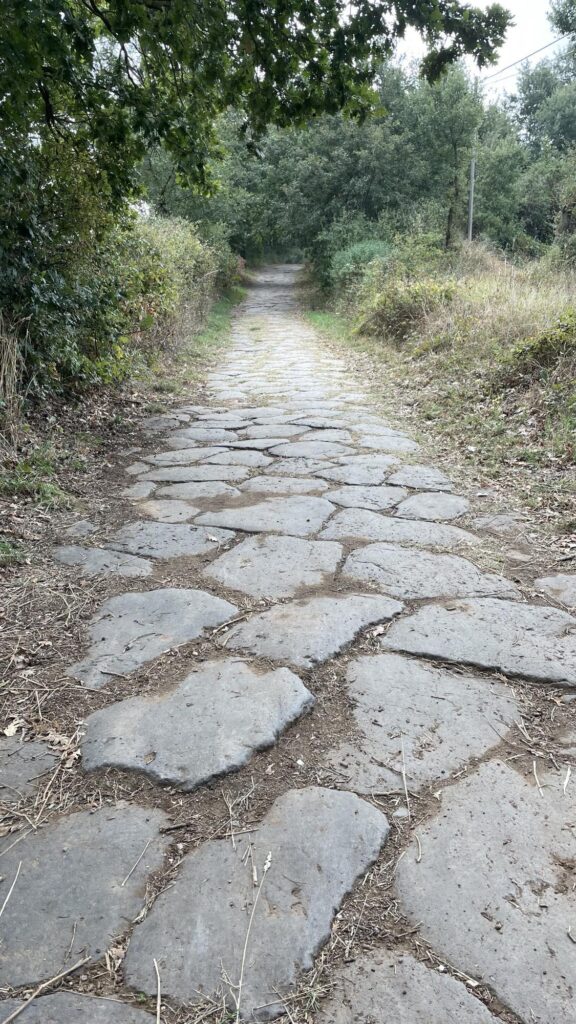
Nothing special happened that day. The whole day is basically a smooth descent from the Montefiascone hill through the fields. Along the way, you will walk along the ancient Roman road, which was built more than 2000 years ago. It’s very strange to walk on the stones where the sandals of Roman legionnaires used to walk.

I got to the city pretty quickly, but on the way I met a very nice couple, David and Anne from New Zealand, who had been traveling along the Via Francigena for several months. We talked for no more than 20 minutes, but I felt like we were soul mates – it was incredibly sincere and we still keep in touch on social media.
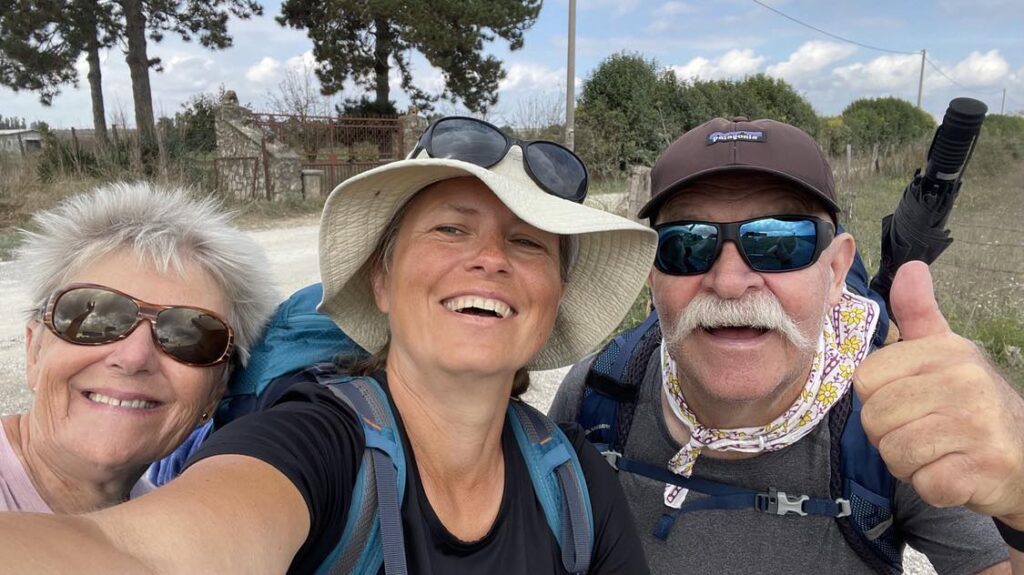
I reached the pilgrims’ hotel, where a private room for 35 euros was waiting for me. We moved in with Ste and Claudio in the neighboring rooms. We agreed that we would go to dinner together, but I ran to see the city while they were resting. I really liked the city where a lot of movies were filmed – I advise you to visit it if you want to go somewhere to get away from Rome for a day. .
Vitirbo is a large city, the second largest in the province of Lazio after Rome. I thought that’s why there were so many affordable places to live here. But Stefano had to make several phone calls to find us a place to stay, and we did.
Viterbo

The beautiful historic city of Viterbo is best known for its huge Papal Palace, which was the residence of the popes in the 13th century. Nowadays, the center of Viterbo is a museum city, where movies are filmed almost every year and there are many different historical monuments that you have definitely seen in feature films. With such fantastic architecture, just wandering around the city without a real plan is a great way to spend a few hours.
Viterbo’s historic center is one of the best preserved and largest in Europe, and its streets are filled with beautiful Gothic and Romanesque buildings that make you feel like you’re in the Middle Ages. The main square is Piazza San Lorenzo, surrounded by lively cafes and restaurants where you can enjoy a glass of prosecco or a good cup of coffee.
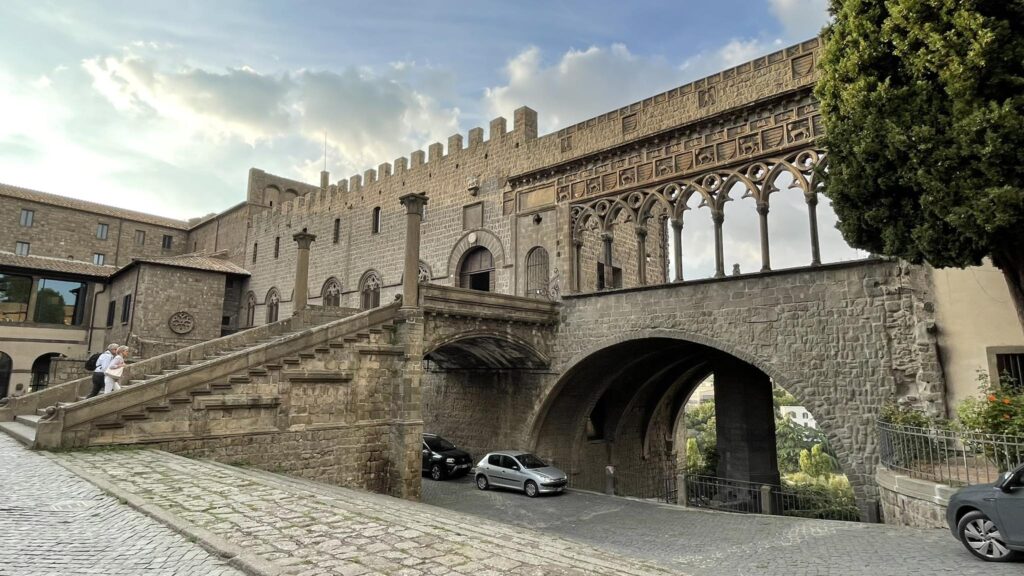
The Cathedral of San Lorenzo and the Papal Palace are not far away. Nearby are the gardens of Villa Lante in Bagnai and Palazzo Farnese in Caprarola. Here, Renaissance cardinals rested from their daily duties at the papal court. Admire theCathedral of Santa Maria della Quercia and see the Parco dei Mostri and its strange medieval sculptures.
Every year, on September 3, the streets of Viterbo host the Macchina di Santa Rosa procession, which takes place every September and is included in the UNESCO List of the Intangible Cultural Heritage of Humanity. A decorated bell tower weighing about 5 tons, made of iron, wood, and cardboard, is carried to Viterbo. At the top of the bell tower stands a statue of St. Lorenzo, the patron saint of Viterbo. The bell tower is illuminated, while during the procession all the lights are turned off along the main streets of Viterbo, through which it is being carried.
Accommodation in Viterbo:
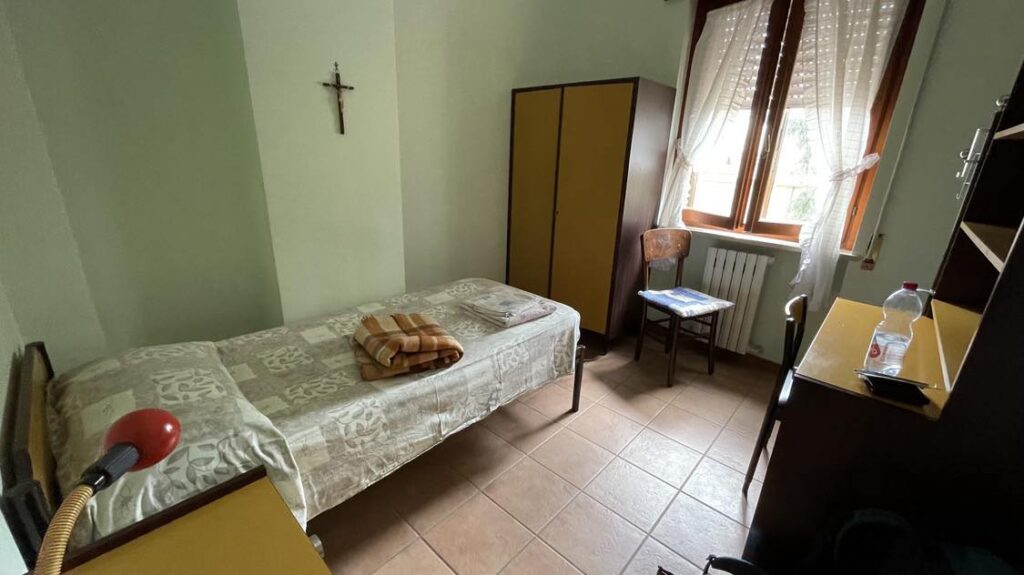
- We checked into a hotel that welcomes pilgrims who drive and walk to Viterbo – Casa Per Ferie IL Villino (+390761341900), where you can stay in a private room for 35 euros. The price includes a simple breakfast.
- A more traditional option is the Ospitale dei Pellegrini (+393346960175 – ospitaledelpellegrino@gmail.com or mirvin@virgilio.it) or Convento Cappuccini.
- Private rooms and hotels can be searched on Booking.com – Viterbo.
Day 13: Viterbo – Vetralla
Distance: 22 km
Weight:**
On the route: there are bars, cafes, and water taps.
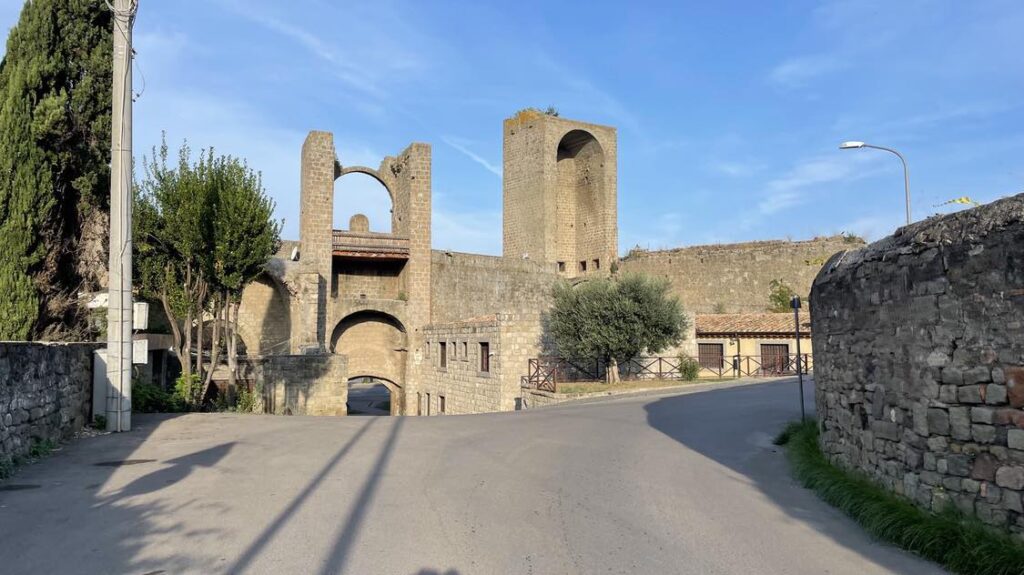
Usually, the walk from Vitirbo to Vetralla is about 22 km. However, there are two routes – a longer one and a shorter one – 17 km. During my walk (October 2023), the short route was closed. I didn’t know about it, started walking on it, and then had to switch to the regular one, so I covered even more than 22 km.
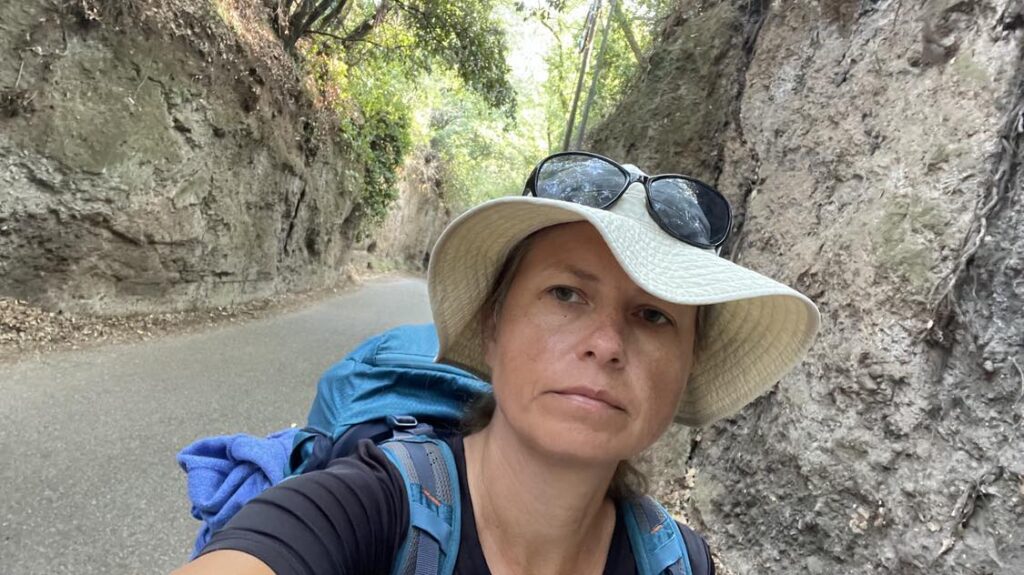
To get to the town of Vetralla, I started the journey by taking a short route, and when I saw that it was blocked by fences, I took the regular route, using Google maps to navigate the roads.
It was a bit unexpected, both for me and for the villagers I had to walk through. They looked at me in surprise. But when I got to the town of San Martino al Cimino, I was finally able to drink coffee and relax a bit.
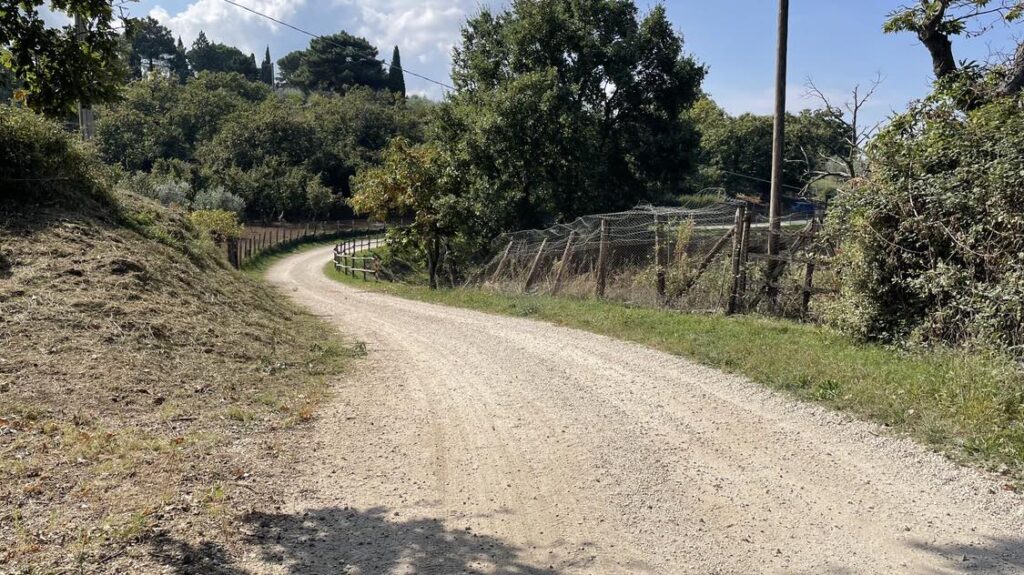
Then the route led me through beautiful forests on the hills, which are more like a forest park, where the trails were marked with different routes. And then I went to the village of Tre Croci, where I could buy coffee or fill a bottle with water. I didn’t stop and decided to go to Vetralla, because I was the last one to arrive at the ostello after wandering around in the morning.
Vetralla
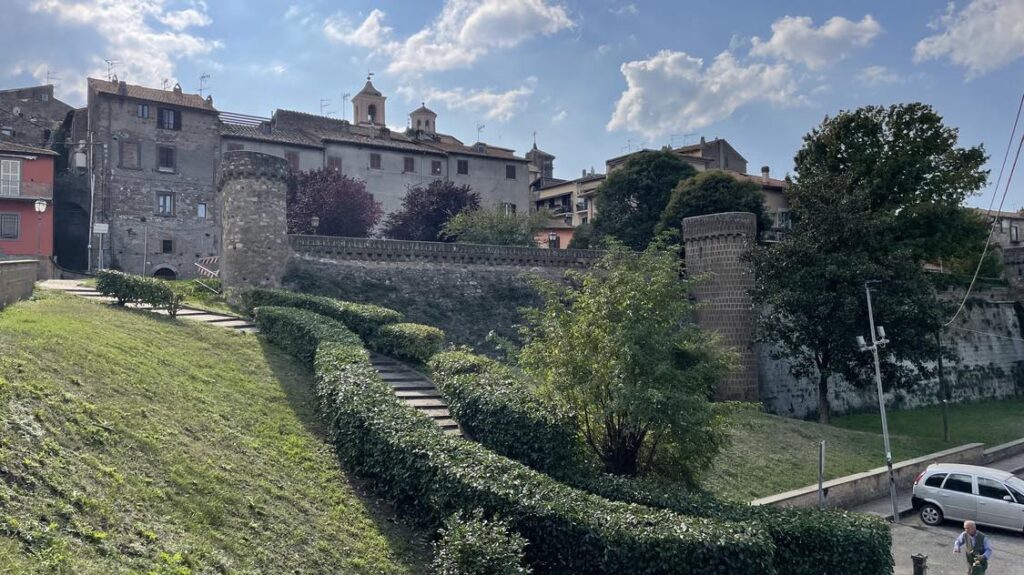
To me, it’s a very depressing and untidy city, which I would have gladly avoided if I had known about it. There was almost nothing I didn’t like about the place, except for the company of Stefano, Claudio, and the wonderful Eveliz from Colombia.
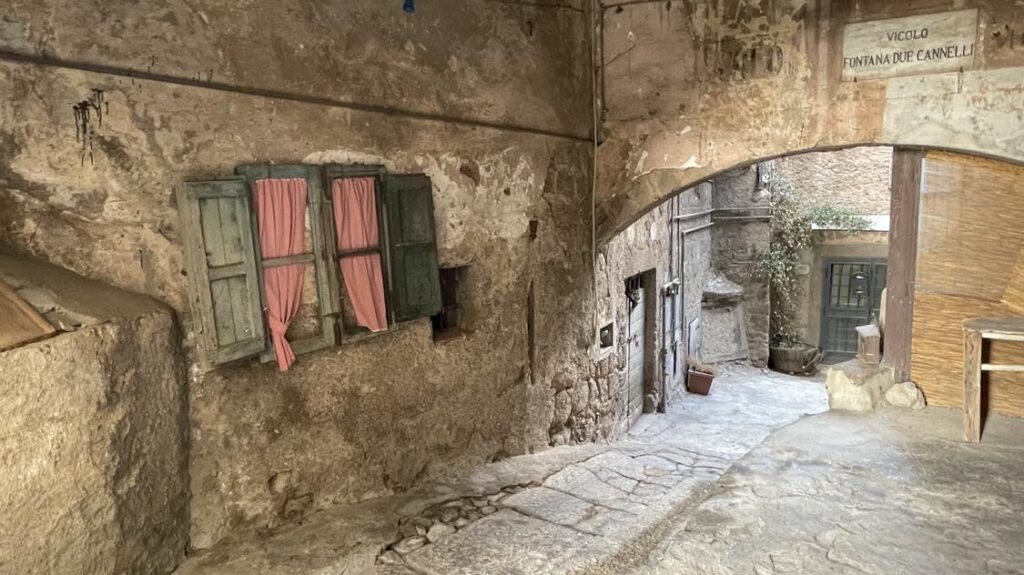
We spent the night in the most disgusting ostello on the entire route, and there is simply nothing to see in the city. The only exception is that I liked the food that Ste and Claudio and I ordered at Ristorante Da Benedetta. They serve delicious pasta with wild mushrooms. It was here that I learned that grated Parmesan is not added to this pasta – men looked at me like I was stupid when I reached for a bowl of grated cheese. Claudio screamed – NOOOOOO! and poured all the parmesan into his Carbonara (it was for him). So it’s strange – like cheese and porcini (porcini mushrooms) are not compatible. Italians!
Where to stay in Vetralla:
- I don’t recommend the ostello where I stayed (only as a last resort if there are no vacancies): Ostello/Parrocchia San Francesco – there are only two rooms for 4 and three places, one toilet-shower room, which has two showers, but they are next to each other. Everything is very tight and narrow, but clean. I slept on the top bunk because I was the last to arrive. The fee is 10 euros.
- There is also a shelter in the monastery outside the city Monastero Regina Pacis run by the Benedictine Sisters. They are located further away and for some reason were closed when I was walking along the path (they were open until September 31). It’s much better here – the nuns offer nice rooms with showers and toilets for several pilgrims. You can also book a private room for 30 Euros. The monastery has a beautiful garden, a stay in which in summer should be wonderful.
Day 14: Vetralla – Sutri
Distance: 25 km
Weight:*.
On the route: there are bars, a cafe at Kapranik, and several water taps.
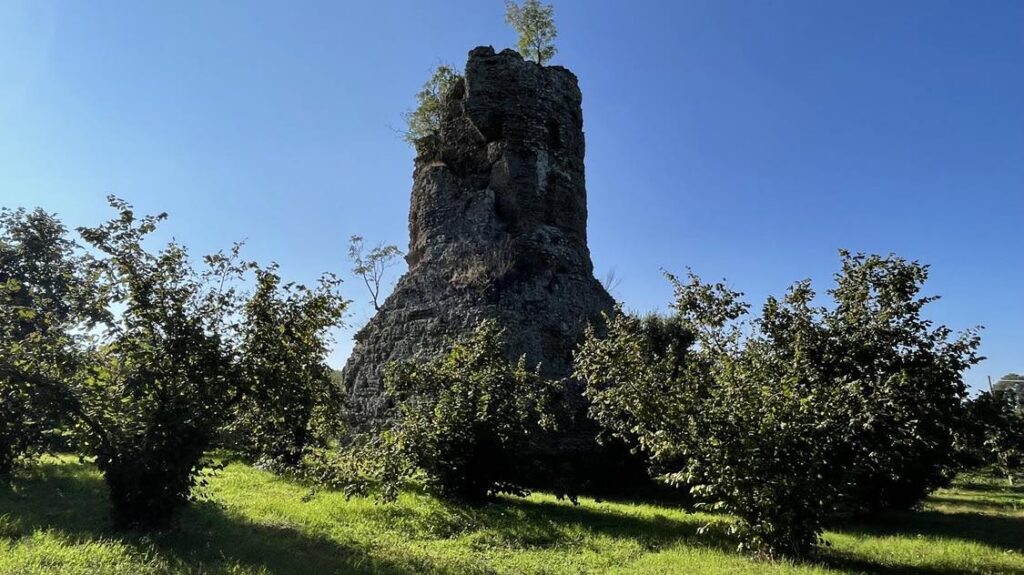
I liked this stage – very beautiful olive and walnut orchards. It was very pleasant to walk the last part – through a shallow canyon overgrown with trees along the river. I saw some interesting relics of historical buildings along the route – watchtowers standing in the middle of hazelnut groves. It is here that nuts for nutella are grown – I gave this stage the name Nutella Land.
It turned out that my fireplace friend Claudio is a nutella addict. He told us about it at one of the dinners. I was also shocked to find out how old he was – an athlete, climber, cyclist who couldn’t be older than 53 was already a pensioner (61 at the time). He is also a DJ at weddings and birthday.
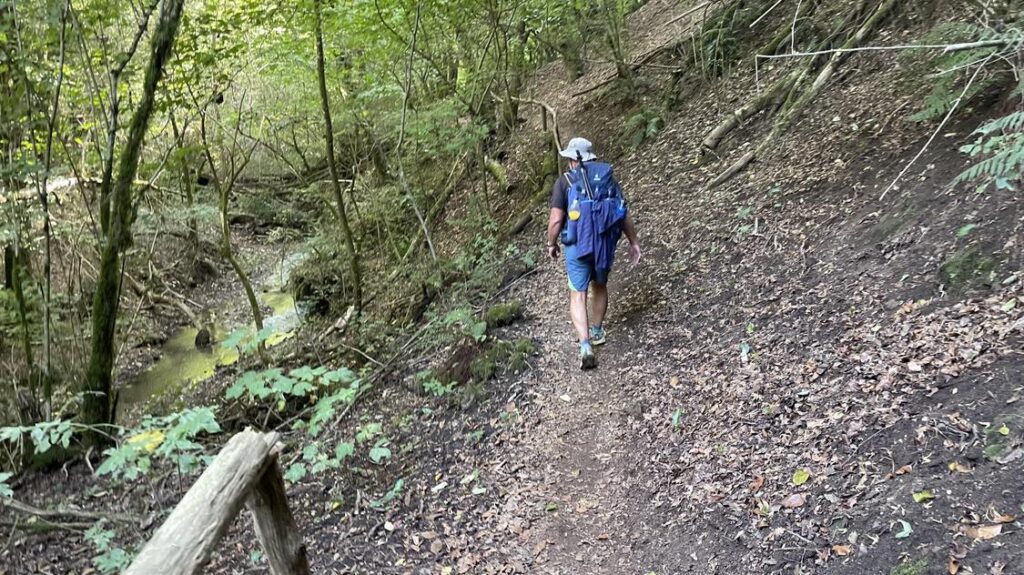
The last 5 km from Kapranik to Sutri are a forest in a canyon and a path along the river. I read that you can meet flocks of wild boars here. Not surprisingly, it’s quite wild here, although there are a lot of markings and even railings across the bridges. I was walking in the daytime, there were other pilgrims, so I didn’t meet anyone with heels and cliques)))
Sutri
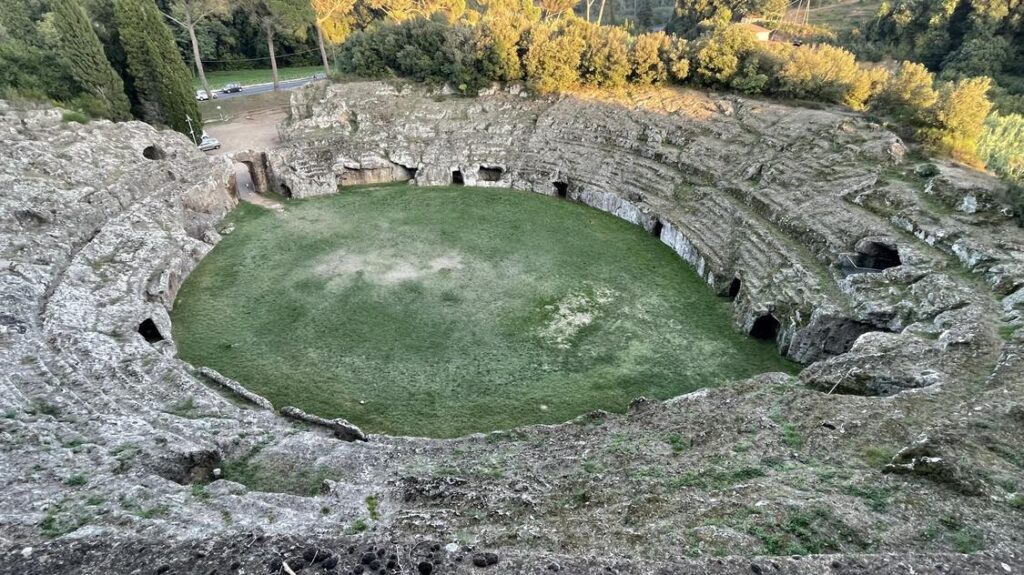
Sutri is an amazing city where the Etruscans lived three thousand years ago. Located among the jagged tuff cliffs of northern Lazio, about 50 km from Rome, the city is a top destination for magnificent Etruscan and ancient Roman monuments. Among other things, you can see an amphitheater from the second century BC, completely dug out of the local tuff rock – it’s something incredible, because I’ve never seen anything like it!
Not far away is the charming church of the Madonna del Parto, carved in a cave deep in the rock above the site of the ancient mitreum (temple of the cult of Mithras).
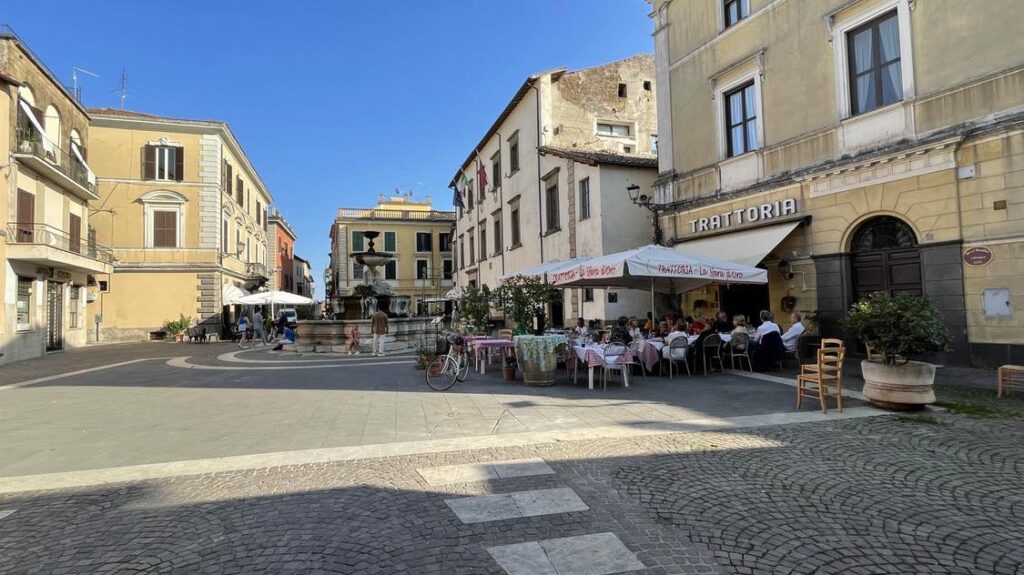
The city itself is located on a hill overlooking archaeological ruins. And it is a little gem in itself, with a wide central square, a beautifully decorated cathedral and a wonderful art gallery in the historic Palazzo Dobbing.
The old town is very neat and pleasant, with lots of flowers, and you can see that the locals are doing a lot to make it attractive to tourists.
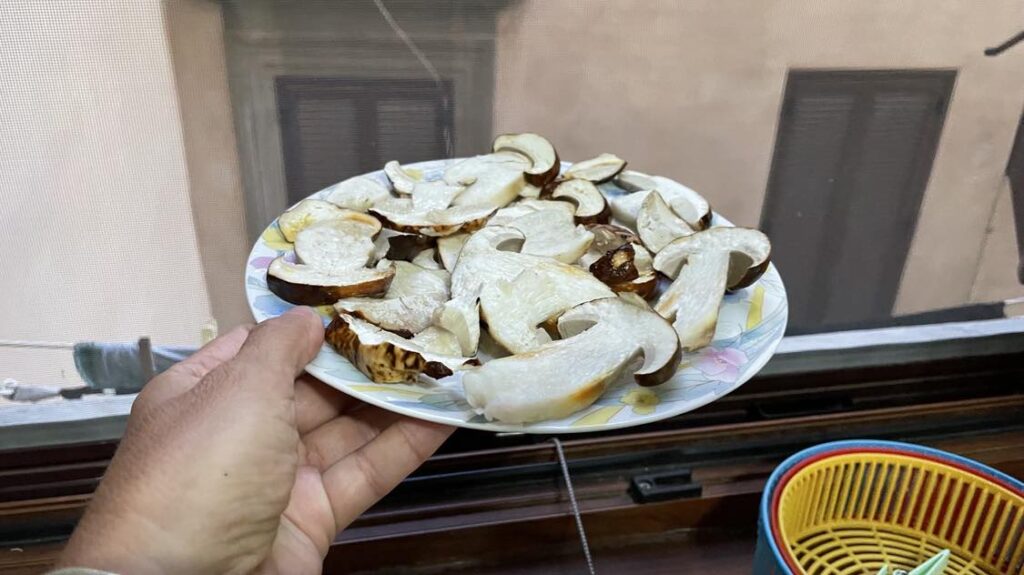
We booked an apartment with a kitchen, went to the supermarket and cooked delicious pasta with gorgonzola and nuts, salad, and roast beef. I also bought fresh porcini mushrooms and made a plate of mushroom carpaccio. Very tasty and cheap – we compensated for the cost of the apartment with this wonderful dinner.
Where to stay in Sutri:
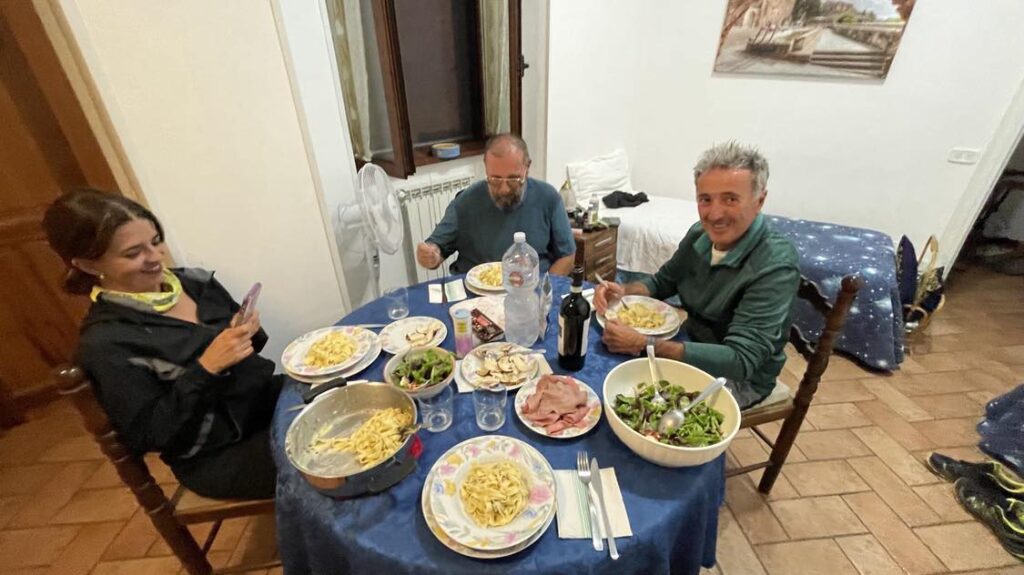
- There is no cheap accommodation in Sutr[ designed for pilgrims. Therefore, look for fellow travelers, as was the case in my case – the four of us booked an apartment with 4 separate beds. A bit expensive – 40 euros per person. But other options were even more expensive.
- CasaVacanze Salza nel Borgo and in Radici Etrusche Sutri – can accommodate three people.
- Nerone’s – Sutri Bed & Dinner – is a more or less affordable option for two.
Day 15: Sutri – Campagnano di Roma
Distance: 24 km
Weight:*
On the route: there are bars and cafes in Monteroga, and it’s better to take water with you.
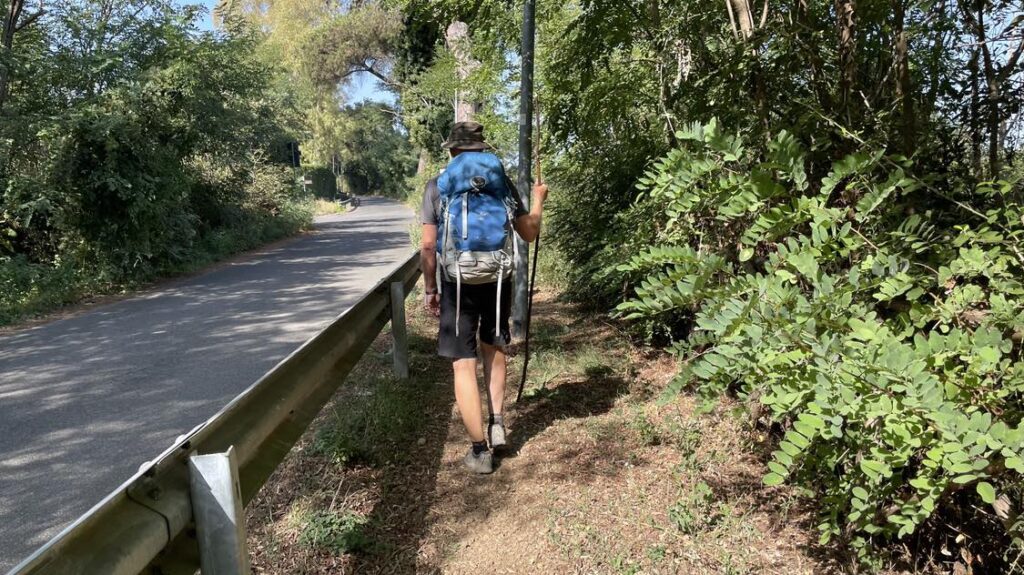
The morning began with several stretches of country road. It’s unpleasant to drive on them, to be honest – Italian drivers are driving fast. In addition, the roads are winding, they can’t see you from behind the curve, so I had to walk on the right side.
But after about 5-6 km, I moved on to trails that led through fields and farmland, which were more picturesque and peaceful. After about 10 km, I reached the small town of Monterosi. Here I met a Norwegian friend whom I had met in Vetralla at a hostel. He was walking the last kilometers of the entire 2000-kilometer Via Francigena. He’s a cool guy, we talked a lot about what happened yesterday in Israel (7/10) – it was a shock for me, he had already read the news.
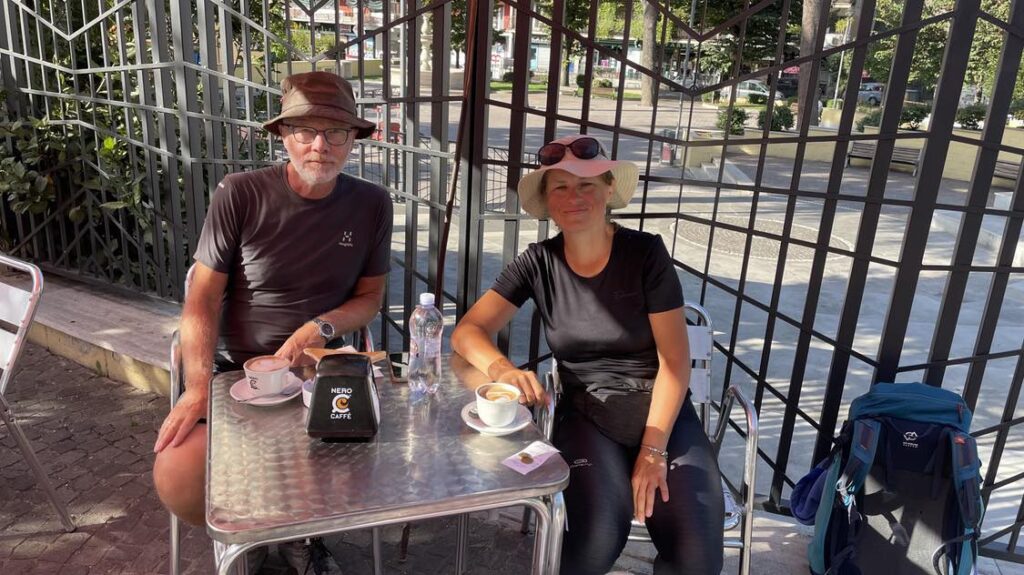
We stopped at one of the many cafes in Monterosa for a coffee and a break before heading back to the trails after the highway. It was a very hot day – October 8 felt like the middle of August. I filled a bottle with water in a cafe and we left separately – I had a lot to think about and long for.
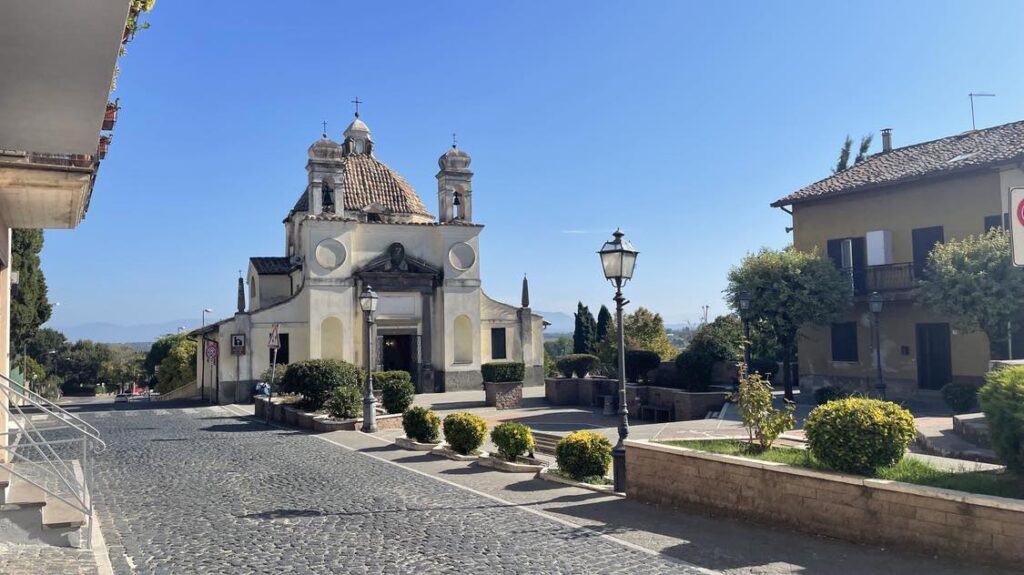
Then I had to walk along another winding and very narrow path that led through fields, past stables and some farms (you can’t call it a village, because there was nothing there except a few houses). And then I was quickly caught up by a tall man of about 65 with a sad face. We greeted each other and the vig moved on – I saw him for the first time in days. It’s strange, I’ve been walking for more than two weeks now, and still there are new people I haven’t seen since Lucca, and since Siena.
It was a Dutchman (unfortunately, I don’t remember his name) who would surprise me later. He looked like a classic Nordic man with almost no emotion on his face, even his smile, though rare, was very sad. For some reason, he reminded me of the donkey from Winnie the Pooh.
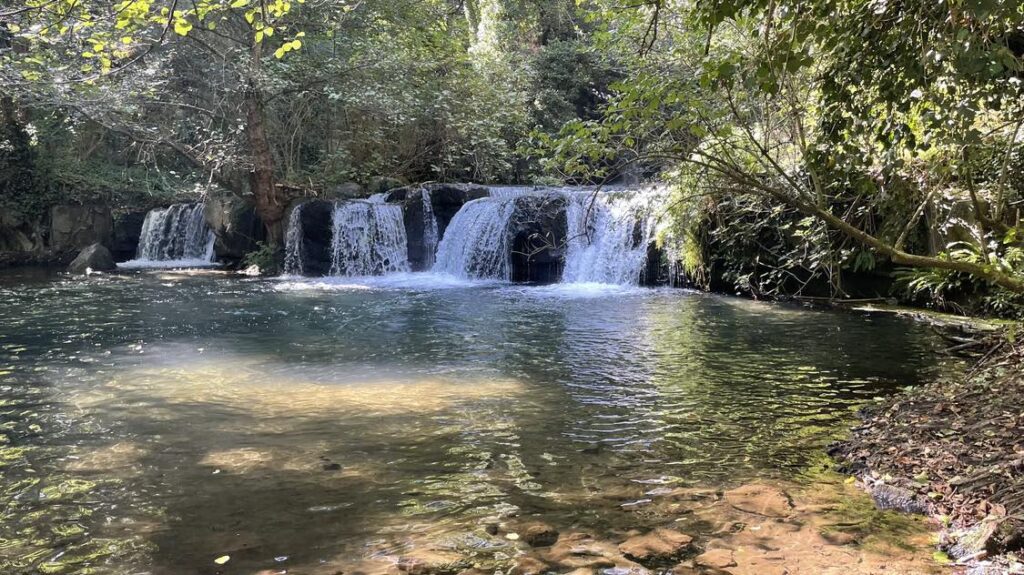
Eventually, the trail led me to a park with stunning waterfalls. The name of the park is Monte Gelato, in honor of the high hill that rises near the river with waterfalls. A great place for a picnic or relaxation – there were a lot of people who fled Rome to stay cool during the insanely hot October.
Campagnano di Roma
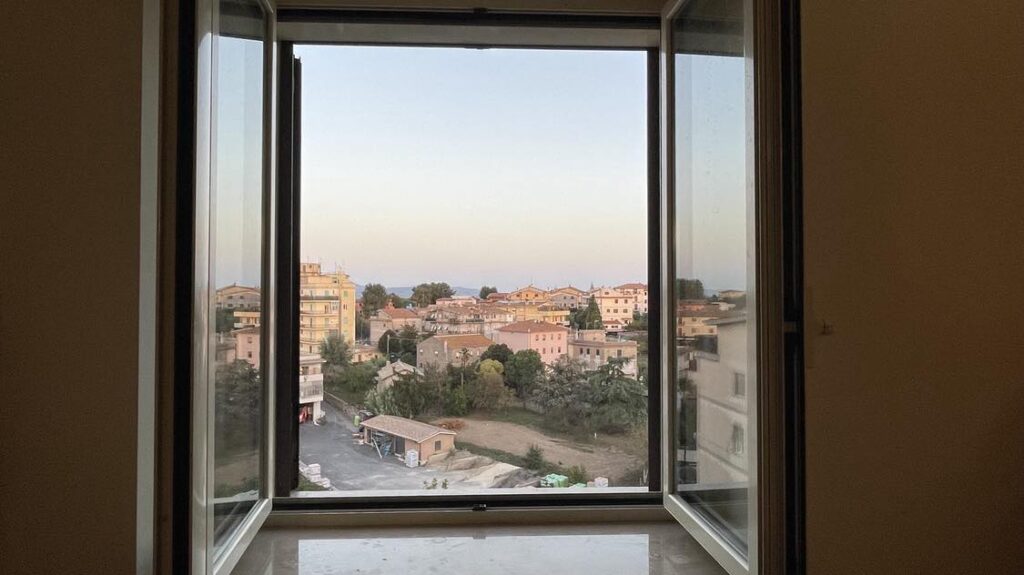
The city of Campagnano di Roma again required me and the other pilgrims to climb up to reach the Old Town first, and then down again to reach the shelter. The city can be called a bit shabby, and that evening I didn’t want to go for a walk because of the insane heat and fatigue.
I reached the place to spend the night – a shelter for pilgrims organized in a Christian school. There were classrooms on the first and second floors, and a nice hostel on the third floor (though the mattresses were not very clean). There was everything non-motorized for recreation, you can wash and dry things on the balcony. And all this for a donation.
By the way, it is in this city that two Camino’s – Via Francigena (the Way of the Franks) and Via di Francesco (the Way of St. Francis of Assisi) – are connected, leading from Florence to Rome via Assisi. And then I saw a bunch of strangers – Rome is just around the corner, my journey will soon end, and I will miss it.
Stefano went to a nearby bar and ordered a pilgrims’ dinner from the owner Mario. In a rather dilapidated bar, we found such a pleasant atmosphere that you don’t see in restaurants. For 12 euros, we had delicious pasta, salad and a large steak – Mario cooked it and it was delicious! Ste bought wine for everyone, and Claudio tasted some Nutella fake, which is why we called him Nutella (like a sommelier)))
Where to stay in Campagnano di Roma:
- I spent the night at the Parrocchia S. Giovanni Battista, a donatist shelter, ascetic but clean. There are 4 rooms with 6-8 bunk beds, two showers with toilets, laundry facilities and everything you need for this, even laundry detergent for hand washing.
- Ostello per pellegrini (+39 3316004982 – info@ostellocampagnano.it) is a small pilgrim hostel with a kitchen on the outskirts of the city. The price per bed is 25 euros.
- If you want to stay in the city center closer to all the restaurants and shops – Casa Simone Campagnano di Roma offers apartments with separate beds.
Day 16: Campagnano di Roma – La Storta
Distance: 20 km
Weight:*.
Along the route: there are bars and cafes, and it’s better to take water with you.
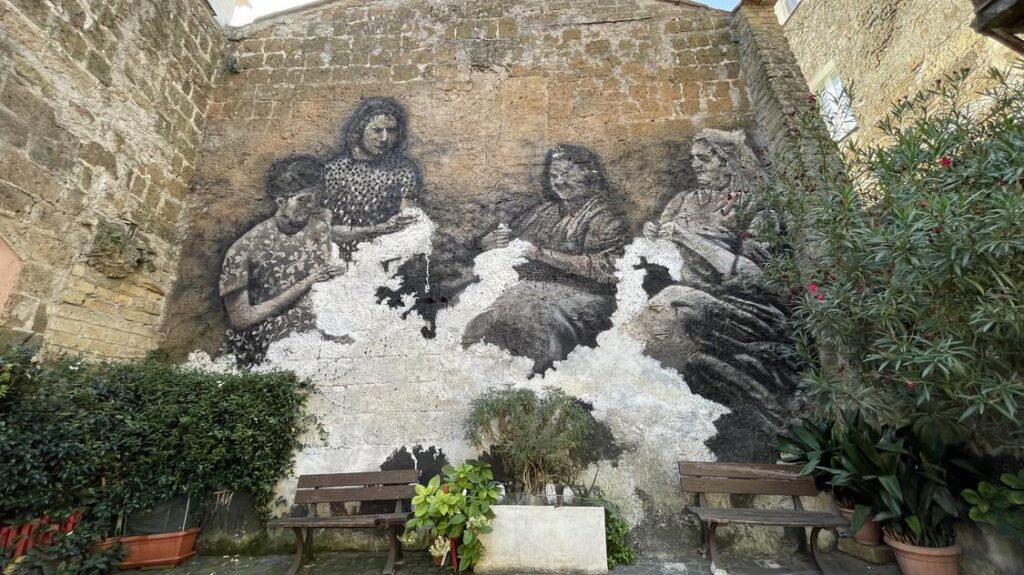
In the fall, the traditional route, which had been closed for several years due to the swine flu epidemic spread by local wild boars, reopened. The first 10 kilometers were along rural paths, where I met my Norwegian travel companion again. We decided to go together – we had the same comfortable pace and topics for conversation.
Unlike the last 50 kilometers of the Camino de Santiago, which are crowded with groups of schoolchildren and the like, Via Francigena is very quiet and peaceful. Despite the fact that there are already two paths ending here, there are still very few people. And only on the last day, walking through the streets of Rome, will you realize that your journey is coming to an end.
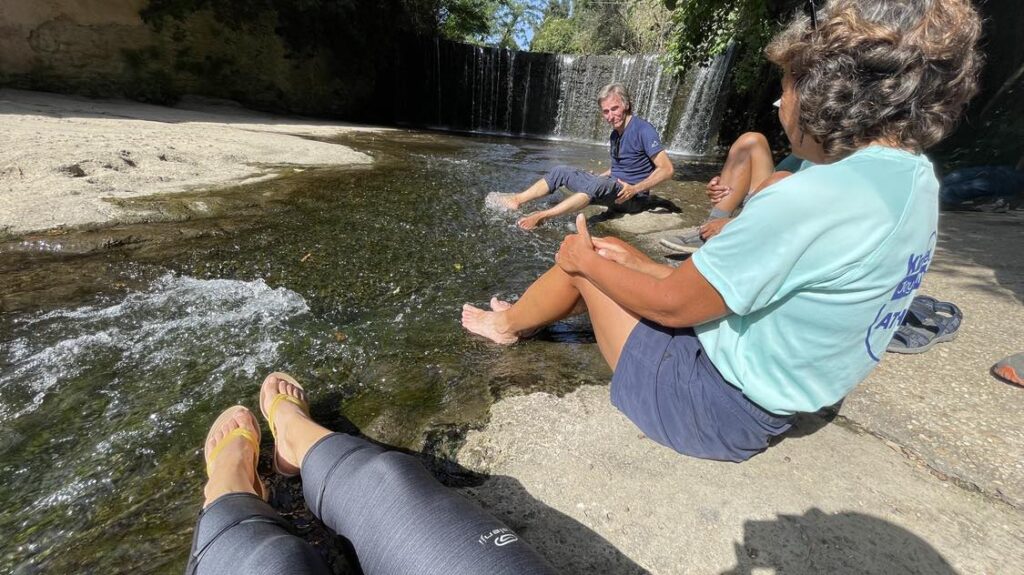
Somewhere in the middle of the journey, we came to a beautiful area – a river flows in a deep gorge, with trees growing along it and a path winding through it. Very pleasant places to walk, especially in those places where you can take off your shoes and put your tired feet in the cool water near a small waterfall.
It was along this path that we reached the city of La Storta, which is actually a suburb of Rome with nothing to see. The hotel for pilgrims was located on Via Cassia, a busy highway with a lot of cars.
When I checked in, I paid for a bed in a double room, which I shared with Eveliz, and for dinner and breakfast. We had a plan to get up as early as possible and reach Rome by 11. So the evening was uneventful, except for the fact that Claudio decided to run to the nearby Monte Mario station so as not to lose honest kilometers (in the morning, everyone else planned to ride the train).
Where to stay in La Storta:
- The Casa Nostra Signora Hotel for Pilgrims is more of a hotel-type shelter run by nuns. During the day, a kindergarten is open on the ground floor, so check-in is after 4 pm. The price was inhumane – 35 euros per person, but there was no choice.
- Hotel Cassia – is a rather expensive hotel, but even there there were no seats because the pilgrims had taken them all.
Day 17: La Storta – Rome
Distance: 29 km
Weight:*.
On the route: there are bars and cafes.
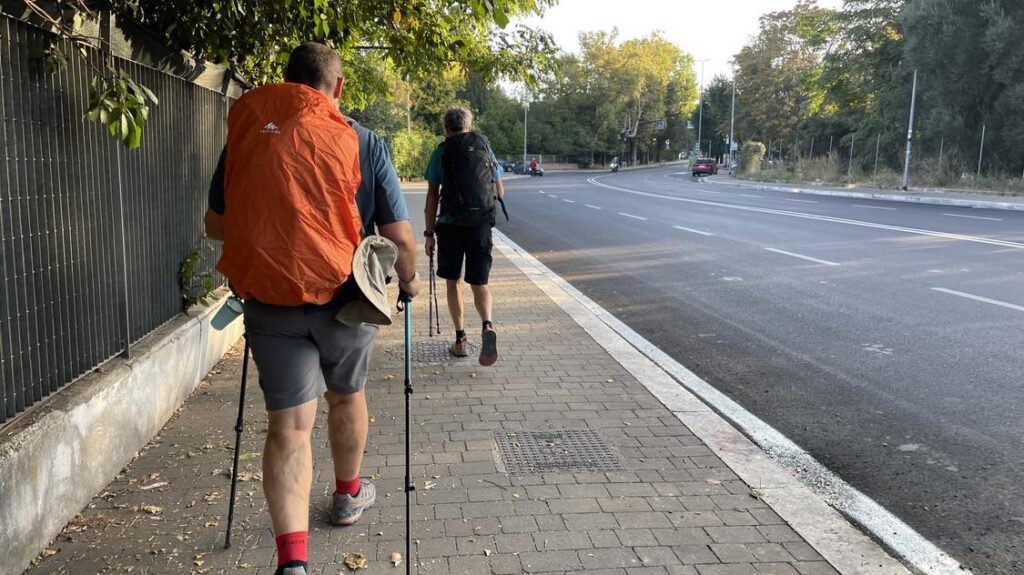
The walk from La Storta begins with a section along the busy Via Cassia road. This road is a very unpleasant moment that awaits the pilgrims on the last day. Mostly you have to walk along sidewalks with garbage cans along them, and in general, the outskirts of Rome are very dirty.
So all four of us decided to travel the unpleasant section by train. And I don’t regret doing it – a lot of mud and cars spoiled my last impressions of the trip. Ticket is 1 Euro through the Trenitalia app or at a vending machine.
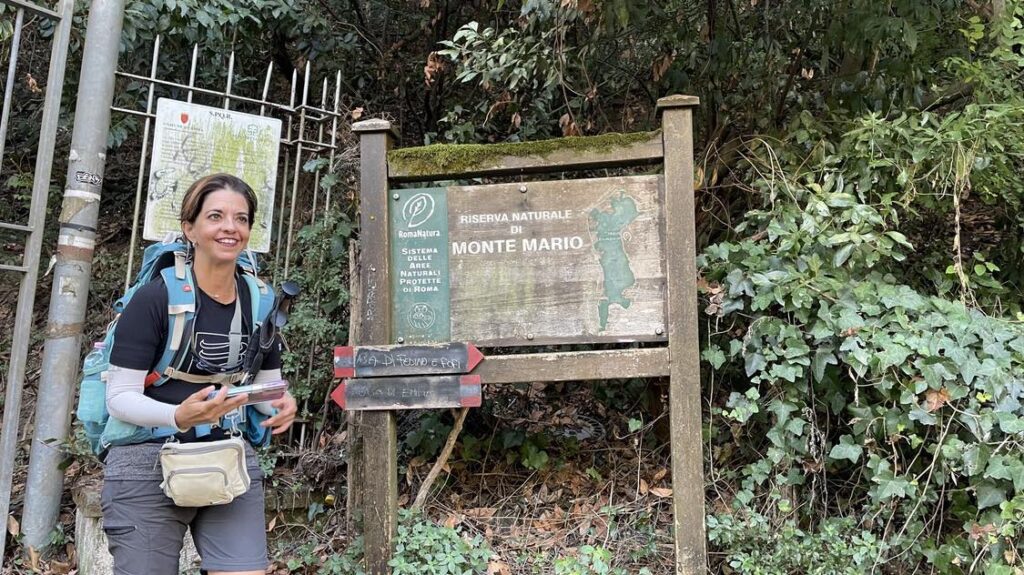
We got off at the Monte Mario station, walked the streets a bit and plunged into the wonderful Monte Mario Park. There was a sign on the gate to the park: Caution! Wild boars! And this was in Rome-I was shocked. We walked through this park for about 7 km, going uphill. Suddenly, we jumped up on a steep hill and a panorama of the eternal city opened up to us – Rome lay at our feet.
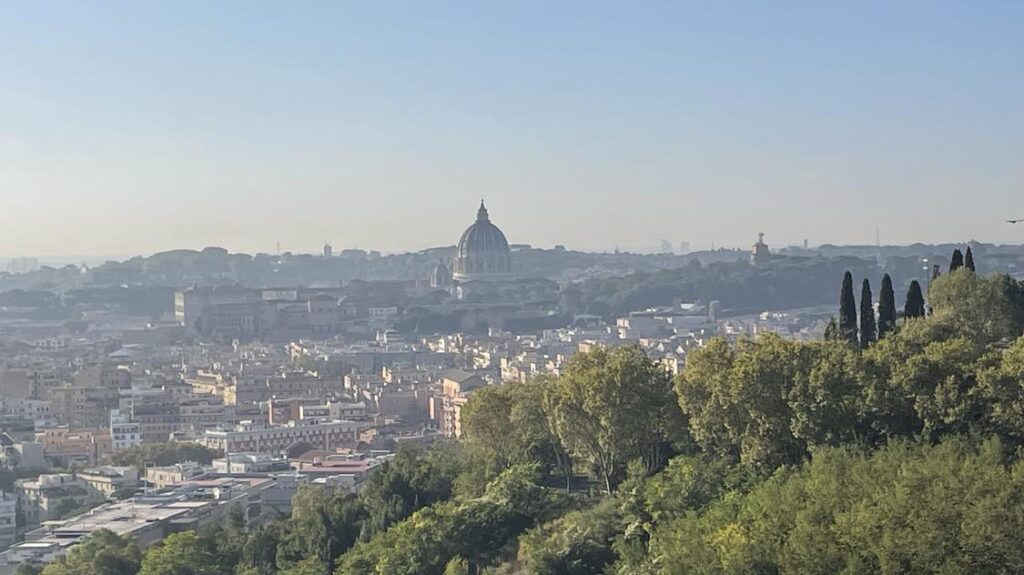
I stood on the observation deck, laughing and crying at the same time. I was happy that I was here and cried that it was all over. That the people with whom I shared dinners, laughed a lot, and was just a pilgrim – today they will go home and I will most likely not see them again. But it felt so nice to have a warm heart, as it does every time I finish the Camino. Because I know that the next one will be no less good.
Rome
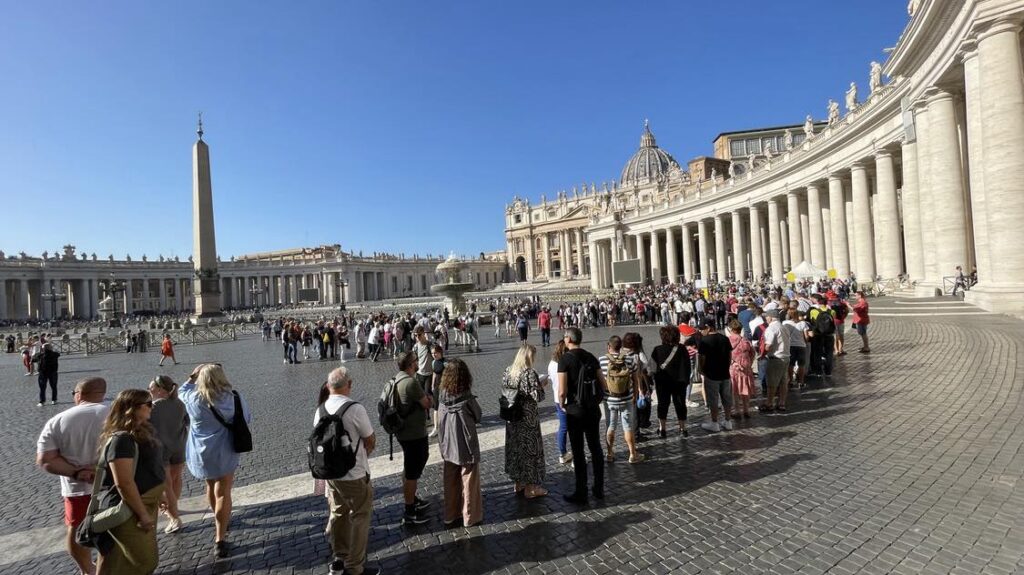
When we came down from Monte Mario Park, there was still time to have our morning coffee. There are many cafes on Via Ottaviano, which leads to the Vatican. I was walking down this street and remembering how I walked here with my husband two years ago, when the pandemic had just ended and the full-scale war had not yet begun.
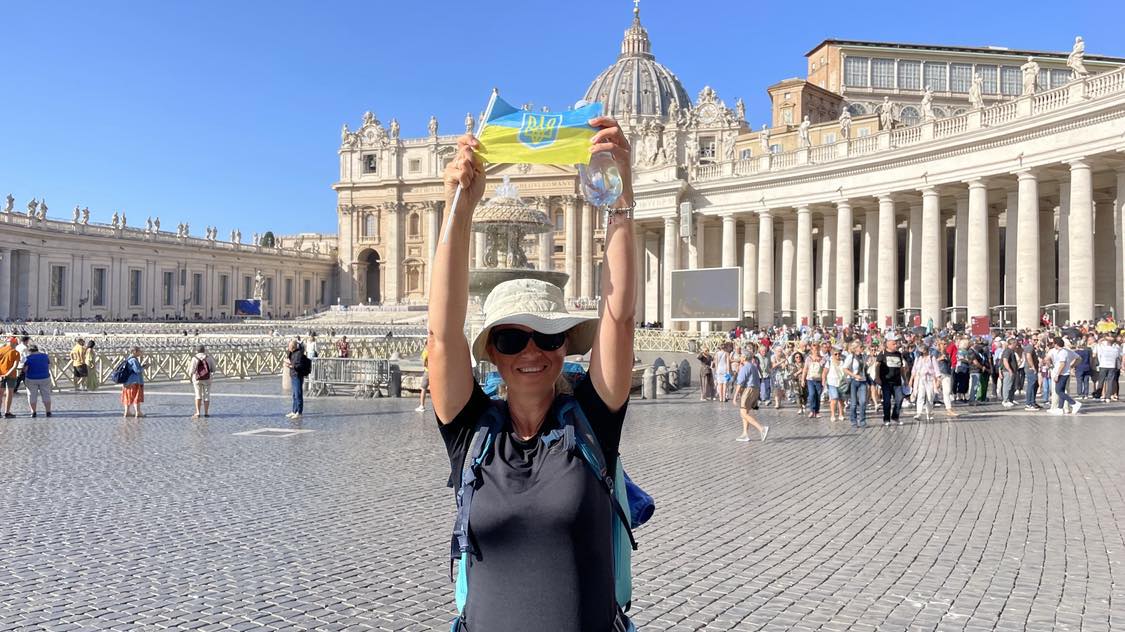
When I saw the walls of the Vatican and the square in front of St. Peter’s Basilica, I finally realized that I had arrived. The fireplace is over.
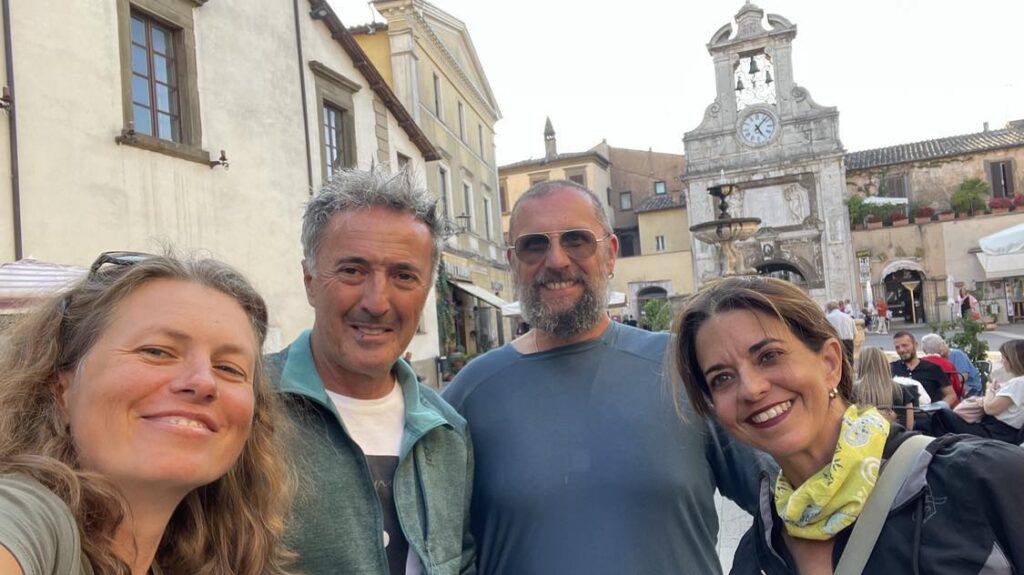
We gathered on the square, cried together with happiness, and took a bunch of photos. Then we saw a huge number of tourists who wanted to visit St. Peter’s Basilica (free of charge) and went to look for a line for pilgrims. It’s located at the entrance for groups – you have to show your credentials and go through a screening frame (you can’t bring knives, scissors, etc.).
When we entered the Basilica, we found ourselves at the entrance adjacent to the main entrance, where Testimoniums are given out. You need to show your credentials and fill out your own certificate.
We left our backpacks in the storage room, the same place where we filled out the Testimoniums, and went inside the Basilica.
It is stunning – it is an unsurpassed cathedral, of which there are very few in the world. The tomb of St. Peter is located here in the middle, and the walls are decorated with paintings by the greatest painters. It’s hard to recall such a scale as in the Vatican anywhere else.
We walked among the crowds of tourists like lost children, unable to believe that our journey was over.
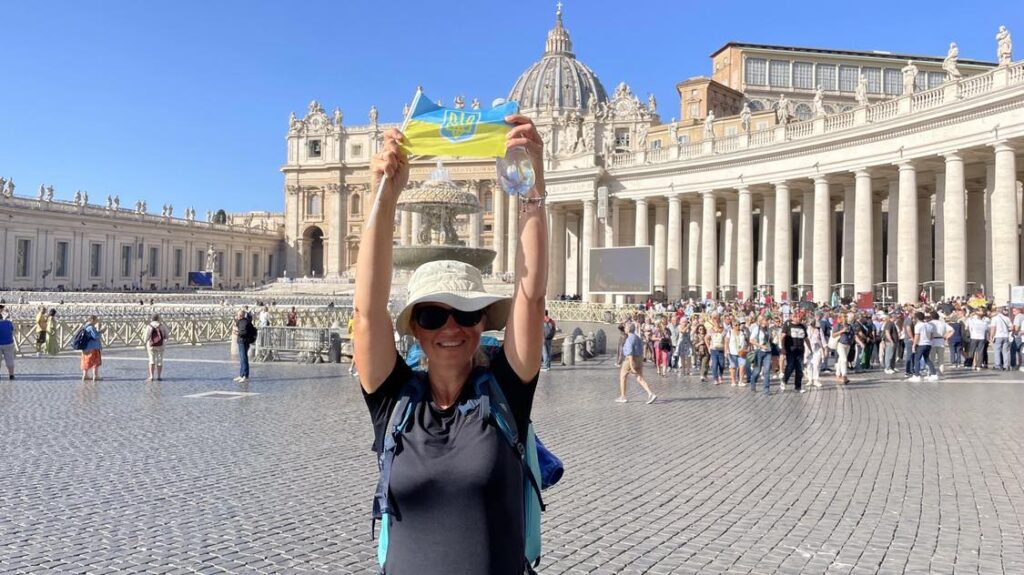
After the Basilica, we went to the Tresevere neighborhood to drink beer and celebrate the end of Francisiana. But everyone was in a hurry – Claudio hugged everyone tightly, kissed them and ran back to see the other pilgrims. Stefano was in a hurry to catch the train home to his fairy-tale Tuscan town of Montalcino. And Eveliz had another hour to walk me back to the hostel and eat delicious carbonara with me.
When I was left alone, I calmly went to stand in line for settlement. But my Norwegian fireplace companion came there, and for one more day I walked around Rome with a person who was on the same wave as me.
Where to stay in Rome:
Housing in Rome is very expensive – I tried to book a bed in a regular hostel in advance, and the price of 60 euros did not suit me. So I decided to try my luck – to go to an ostello donativo for pilgrims in the Trestevere area. And I was lucky – I was the first in line and managed to spend the night for 30 euros (the amount I left to the volunteers for the night).
I am very glad that I stayed for a night (two nights maximum) in this wonderful place. This is a traditional hostel on the St. James’ Way, run by volunteers. They meet the pilgrims, perform a foot-washing ceremony, while reading words of gratitude to the pilgrim who made this journey in their lives.
I did not expect my reaction to this rite – tears were rolling down my cheeks. And not only me – my fellow traveler from Holland, a sad donkey named Ia, was sitting next to me, swallowing his tears quietly.
These last moments on Via Franceschina will remain in my memory forever, even if I go into dementia, I will remember them. Because it’s impossible to forget the moments when I was really happy!
Useful articles and links:
- Verona – what to do in the most romantic city in Italy
- Spring in Sicily – what to see on the island on your own in a week
- Rome in winter – what to see in three days
- Venice – a small trip for three days
Find train tickets in Europe conveniently on Trainline
Green Card, CTP and Travel Medical Insurance – online on the EKTA
Booking of hotels and apartments – Booking.com


