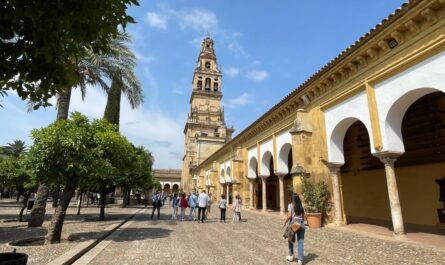

Car rental in Portugal is one of those cases where having a car gives you true freedom of travel. Ocean beaches, lighthouses, cliffs, small towns, viewpoints — many places are simply unreachable by public transport.
I have rented cars multiple times both on the mainland and on the island of Madeira, tried different vehicles, and found myself in different situations — so I have plenty to share.
Below are real tips from personal experience that will save you money, nerves, and time.
Car rental in Portugal: what you need to know
Documents for car rental
In Portugal, you will need the following standard list of documents:
- passport
- driver’s license (new model plastic licenses are accepted)
- bank credit card in the name of the driver
- driving experience usually from 1-2 years
Where to look for rental cars
I always searched via aggregators like Rentalcars or Economybookings.com — it’s convenient to compare prices and terms. Twice I found the best price at Europcar.
Renting a car at Lisbon airport is very convenient. All rental desks are in one place. But I do not recommend getting a car for the city:
- Lisbon and Porto have excellent public transport. It’s better to buy a day ticket and ride the old trams, funiculars, ferries, etc. This is a unique and interesting way to explore the city.
- Parking is difficult and expensive.
- A car in the city is more of a hindrance than a help.
I usually rented a car specifically for a route along the coast. With it, you can see beautiful beaches, small towns, castles, and other points of interest.
What kind of car to rent in mainland Portugal

In short — don’t take one that’s too weak.
My experience:
- Smart — a great option for two, economical and maneuverable, climbs hills well.
- Fiat Punto 1.2 — fine for 3-4 people with small luggage. But a bit weak for Sintra and its winding roads.
If you plan to visit Sintra, mountain roads or take long drives — get an engine from 1.4–1.6. You definitely won’t regret it.
What car is best to rent on Madeira
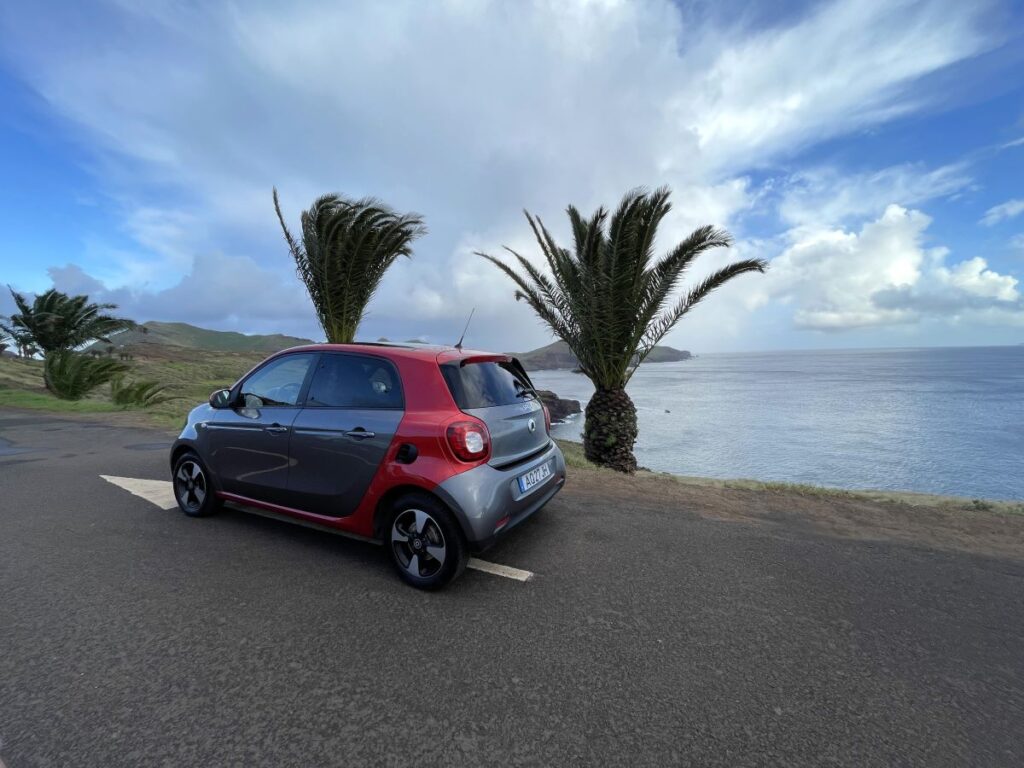
Madeira is a small mountainous island where you can’t get everywhere by bus. An automobile on Madeira is a necessity if you want to see the most beautiful places and not wait an hour for buses with confusing transfers.
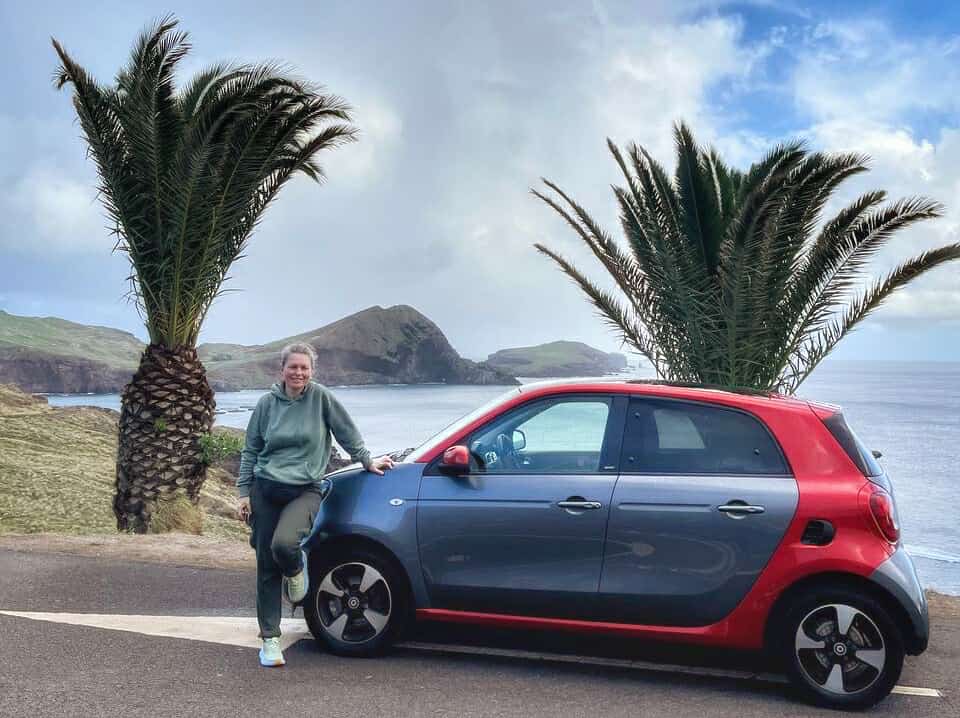
- I chose a Smart ForFour with automatic transmission – for two, it was simply perfect! Engine 0.9, but a powerful turbo that pulled well uphill. This car also has good directional stability and ABS, it handled well on wavy and morning-slick roads, no skidding.
- Pickup and drop-off at the airport – I entered my arrival time and flight number.
For 7 days in January we spent:
- €320 with full insurance – ~€45/day
- 500 km driven – ~€65 for petrol
It’s better on Madeira to:
- NOT economize on engine power – class B, engine from 1.5
- Automatic is better than manual
Why?
- steep climbs
- sharp hairpins
- wavy roads
Deposits and Insurance
Mainland Portugal:
Honestly, I don’t see much sense in paying extra for full insurance on the mainland. Why?
- Here the roads are good, there’s enough space to drive (exceptions: small villages or towns with narrow streets and slopes, but there isn’t heavy traffic there)
- You can always find a place to park if you search the map in advance.
- Drivers are reasonable, let others pass, no aggressive driving.
- Deposits (deposit) for a rental car do not exceed €300-500 from a credit card – quite reasonable money.
Madeira:
- €1100–1500 without full insurance
That’s why I took a car with full insurance coverage. I just didn’t have an extra €1500 to lock for the deposit.
Roads in Portugal
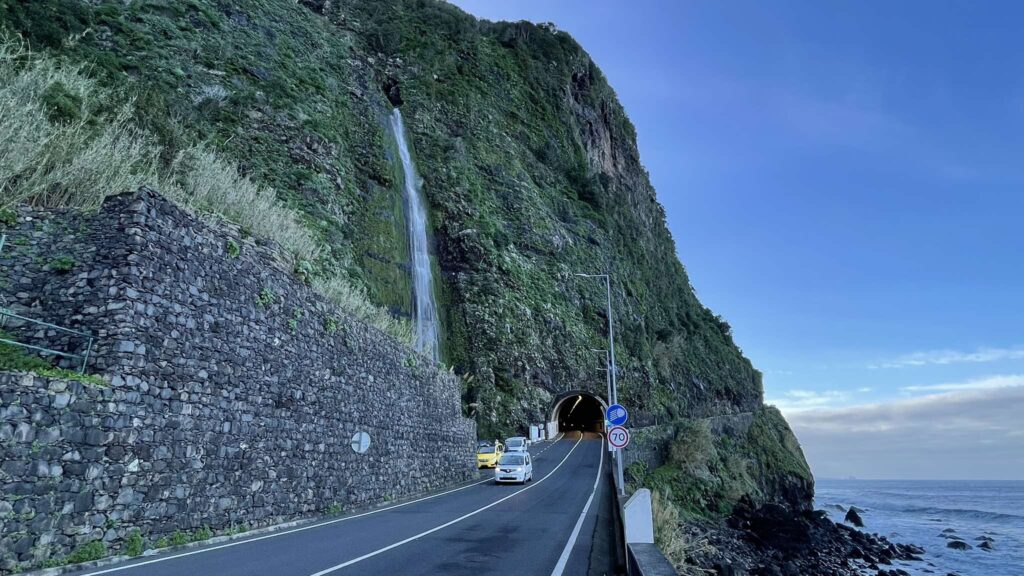
Mainland Portugal has both free and paid highways.
Portuguese roads are among the best in Europe. Driving is a pleasure.
I love exploring the country slowly, so I often choose secondary roads. But when you need to get somewhere quickly — highways save the day.
For example, you can get from Lisbon to Porto in about 4 hours.
On Madeira all roads are free.
The island is connected by a ring road with tunnels, bridges and viaducts. It’s much safer than the old roads.
Local drivers:
- experienced
- nimble
- don’t always move to the left lane to let those entering the right lane through
If you’re new, I recommend driving carefully and without rushing.
Toll roads and ViaVerde
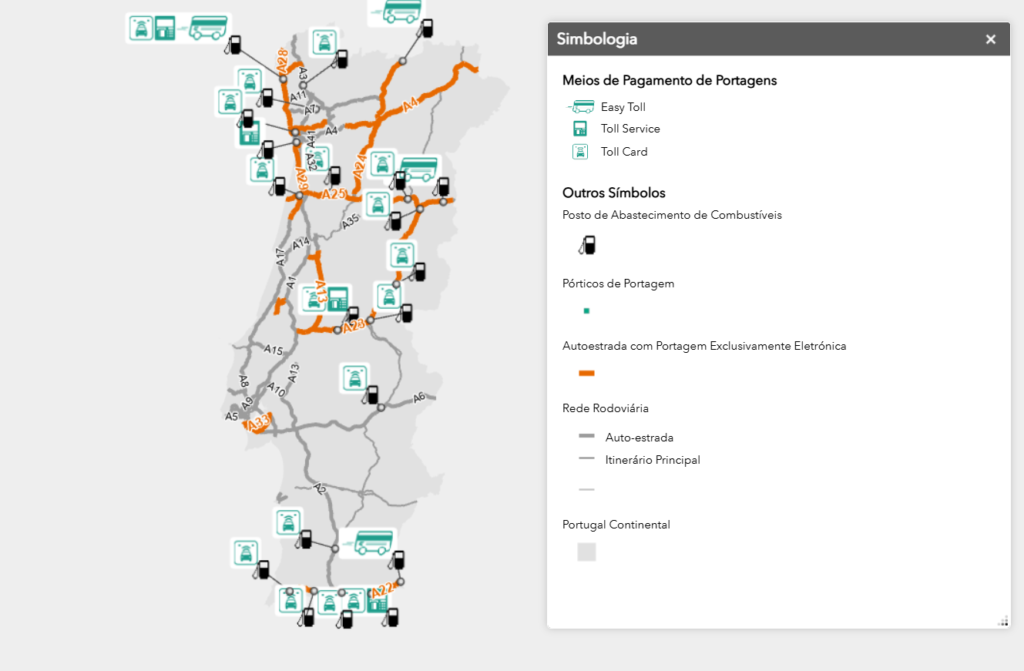
There are several road payment systems in Portugal.
- Red – toll roads that can only be paid electronically via EasyToll or TollCard (for options aside from Viaverde, read PortugalTolls).
- Grey – toll roads payable by cash or bank card + Viaverde. For cash payment it’s better to have coins or notes up to €20.
ViaVerde — the most convenient option
This is a contactless electronic payment system. You just drive through the lane without stopping.
The rental car will have a device-sensor installed below the mirror.
My experience:
- rental of the device ~€6 for the first week
- then ~€1.5/week
- sometimes it may already be included in the price
- payment is debited from your card several days after you return the car
For us, ~150 km on the motorway cost about €7.
If there is no ViaVerde
If you have passed an electronic toll road without a sensor — you can pay at a post office ctt.pt. At this link you can find a map of Portugal’s toll roads to understand where and what payment method to expect.
Important: Payment within 5 days. The countdown starts 48 hours after driving under the barrier.
Approximate costs for toll roads
| Route | Cost |
|---|---|
| Lisbon – Porto | ~€25 |
| Bridges in Lisbon (Vasco da Gama/ April 25) | 3.25 / 2.25 € per trip |
Gas stations and fuel
Everything is standard — card or cash. There are often attendants on duty.
Once I had an attendant who didn’t want to speak English. A local woman in the queue helped out )) But in general, the Portuguese either speak English or try to help.
Fuel prices (approximate)
- Gasoleo (diesel) — from €1.55
- Gasolina (petrol) — ~€1.8
Don’t mix them up!
Fines and regulations
Portugal does not like rule-breakers:
- even exceeding the speed limit by 5–10% can be expensive
- fines €150–2500
- many cameras in cities
Alcohol — up to 0.5 per mille is allowed (that’s about a glass of wine or beer).
Parking in Portugal

In big cities it’s best to look for parking right away.
This is what I do:
- I pick a spot on the map
- I look for parking nearby (free if possible, but paid is ok too!)
- I park and walk around on foot
If you paid for an hour, don’t leave the car for half a day. Fines are real.
Example of parking prices: paid parking from €0.3/hour.
Free parking
Most of them are near ocean beaches outside the cities. They are large, often unpaved. Also in small towns such as Nazaré, Peniche, at Cabo da Roca cape. On Madeira, most of the parking at natural locations or viewpoints is also free. If spaces run out – drivers park along the road, so as not to obstruct traffic for one lane.
But if there is no parking machine — it doesn’t mean it’s free. Always look at the signs.
Parking in Sintra — a story of its own
Parking near Pena Palace or Quinta da Regaleira — is quite a challenge. Too few spots, high payment. Plus, there are lots of hairpin roads in the city and around. Often there is one-way traffic: you take a wrong turn and you have to go around the city…
My advice: leave your car at the parking lot near the train station and use the tourist bus.
Parking in Funchal (Madeira)
This is a bit hard in the city:
- narrow streets
- paid parking
- few parking spots
I booked accommodation with parking – it’s important in this city.
Navigation
I used:
- Google Maps — works, but sometimes gets lost in Funchal
- Waze — a good alternative
- maps.cz — super for hiking
It’s very convenient when your rental car has a built-in navigation system. Or there’s a big screen and you can connect your phone via USB with your downloaded maps.
FAQ: car rental in Portugal and Madeira — answers to common questions
Do you need an IDP in Portugal?
International driving permit (IDP booklet) has never once been requested from me either on the mainland or in Madeira. And shouldn’t be, because there is a convention on recognition of the driver’s license between Portugal and Ukraine. But if you have an old paper license or one in non-Latin script — best to get a modern one (plastic with Latin script and a validity period).
Credit or debit card — what is needed for car rental?
Most often, rental companies want a credit card in the driver’s name, the one the rental contract is for. Debit cards are sometimes accepted, but:
- either with full insurance
- or with a larger deposit
- not all companies agree
What is an excess in insurance?
Excess — this is the amount of your liability in case the car is damaged. The excess depends on the terms of the rental company and the insurance you pay for. If you pay for full insurance – the excess is zero and you don’t have to have extra money for a deposit. But the total rental price increases by the full insurance cost, which depends on the number of rental days (~ +15-20 euros per day).
For example, if the excess is €1200:
- you scratch the car for €300 — you pay
- serious damage — you are liable for a maximum of €1200, the rest is covered by insurance.
That’s exactly why on Madeira I took a car with full coverage — the roads don’t forgive mistakes there.
Should you take full insurance?
On the mainland — if you wish.
On Madeira — highly recommended.
Reasons:
- narrow roads
- steep climbs
- hairpins
- tight parking
Full insurance = a peaceful holiday.
Are there age restrictions for drivers?
Yes, with many rental companies:
- under 25 years — surcharge for “young driver”
- over 70–75 years — there may be restrictions
This depends on the company – carefully read the rental conditions before choosing a company.
Tip: On the Rentalcars website, each company and car has a description of the terms, which will also be stated in the rental agreement.
Is an additional driver paid?
Almost always, yes.
If you plan to take turns driving — it’s better to register a second driver in the agreement right away. And you’ll have to pay for it.
Can you drive a rental car into Spain?
In most cases — yes, but:
- you must inform the rental company when signing the agreement
- sometimes this is a paid option
- insurance must cover border crossing
If you plan such a route — check in advance if the rental company agrees to this.
Is there a mileage limit?
Most companies offer unlimited mileage, but not always.
Sometimes:
- there’s a km/day limit
- or a total limit for the entire rental period
I always check this point in the contract.
Are there many cameras on Portuguese roads?
Yes, and the fines are real.
- There are stationary cameras
- And average speed control on sections
The fine goes to the rental company, and they deduct the sum + admin fee from you.
So it’s better not to “play around” with speed.
Do fuel prices vary?
Yes.
- on highways, gas stations are more expensive
- near supermarkets — cheaper
The difference can be significant.
Should you rent an electric car?
As a tourist — I wouldn’t recommend it.
Yes, there are chargers, but:
- it won’t always be convenient
- you need to plan your route around charging stations
- in the mountains the range drops quickly – there is a risk of getting stuck
Ordinary petrol/diesel is a simpler choice.
What is the fuel policy when renting?
Most often — “full-to-full”:
- you receive the car with a full tank
- you return it with a full tank
Otherwise, fuel will be charged at a premium rate.
What should you check when getting a car?
If I rent a car without full insurance, I always do the following in the presence of the company manager:
- take photos of the car from all sides
- record video
- check wheels and windows
- look for scratches
All points must be noted on a separate sheet, which is attached to the rental contract. It takes five minutes, but saves you from later disputes when returning the car.
When don’t you need a car in Portugal?
Honestly?
- In Lisbon
- In Porto
There, the public transport is excellent, Uber is very cheap, and parking — difficult and expensive.
But for the coast, villages, lighthouses, and natural sites a car is a must-have.
Conclusion: is it worth renting a car in Portugal?
- On the mainland — yes, if you plan to visit the coast, small towns, and nature. In big cities – Lisbon or Porto, it’s better to use the well-developed public transport and walk.
- On Madeira — a car is definitely necessary, otherwise you won’t see half the island.
Car rental in Portugal — it’s not about comfort, it’s about freedom. About the opportunity to stop by a lighthouse, find a cool river beach, or visit a tiny village without tourists.
And if you prepare — it will be one of the best parts of your trip.
Useful links for travelers:
Car rental– you can always find cheap options on the aggregator Rentalcars.com
Hotels– I traditionally book through Booking
Insurance can be purchased on Hotline.Finance.
- How to choose accommodation in Lisbon
- Cheap accommodation in Porto
- Lisbon – attractions and routes
- Porto – best attractions and what to do
- Best beaches of the Algarve