
Holidays on the Cote d’Azur. What sights and museums to see in Nice, features of the beaches, Provençal cuisine, beaches of Menton, and how to get around the Côte d’Azur by public transport cheaply.
A few years ago I spent a week on the Cote d’Azur. My husband was working in Monaco, and I took a real vacation: I walked along the embankments, visited museums, and enjoyed Provençal seafood on the streets of hot Nice. I also lounged on the beaches – the water in August was like steamed milk.
Itinerary in Provence – a road trip through wineries and lavender fields

In summer, there is nowhere for an apple to fall on the Cote d’Azur. Not only the rich and famous come here. Young and elderly tourists, families with children, and lovers of cultural recreation all enjoy the various resorts. And they are all united by their love for the pure turquoise color of the sea, French cuisine, vivid impressions and wonderful vacation.
When is the best time to go on vacation on the Cote d’Azur
The best time to visit is right before the hottest time of the year (summer) or right after it, but never during the summer. I was delighted with the warm sea in August, but it was so hot and stuffy that my dress stuck to my body – I was constantly sweating.
Yes, it can be very hot in Nice and the south of France in summer. It’s not much fun to explore the city while the midday sun is beating down on you relentlessly. And while the beaches offer a break from the heat, you’ll need to take plenty of sunscreen and make sure you find somewhere in the shade. Don’t underestimate the heat that stands here in the summer.
Summer is also the busiest time of the year (as it is almost everywhere else), and crowds from all over the world flock to Nice and its neighboring cities. The atmosphere is cheerful and festive, of course, but prices are high, almost all budget housing is sold out, and tourism dominates the city at this time.
I recommend coming here either right before or right after the summer. In other words, come in April, May, or September if you can.
Recommend for reading: Summer vacation on European lakes
Getting to the Cote d’Azur

The best way to get here is to fly to Nice by plane. If you are already in France, for example, in Paris, you can get to Nice by train. If you’re in Italy on the Italian side of the Riviera, you can take the train, which is quick and easy to get to.
Arrival by air
Nice has its own airport, which offers several direct daily flights to/from Paris, as well as other destinations in France and Europe. The low-cost carrier EasyJet operates many of these routes, so one-way tickets are often quite inexpensive (less than 100 euros). I flew to Nice on Ryanair from Krakow.
Alternatively, you can also fly into the airport of the much larger city of Marseille, which has many daily connections to Paris and the rest of the world. If you’re flying to Marseille, the best way to continue on to Nice is by train. All major cities on the French Riviera are connected by train. An alternative is to travel by a rental car which can be booked at the airport.
Most tourists arrive at Nice International Airport Côte d’Azur, NCE.
How do I get to Nice from the airport?

The cheapest way to get from the airport is by buses #23, 52, 59, 70, 94 – the ticket price is €1.5.
You can travel along the coast by bus or train. Buses are about the same price as trains. But the travel time is much longer – trains go through tunnels, buses weave through serpentines, and only express trains travel on highways.

If you are going to travel in the city or in the Monaco-Nice-Cannes area, you will find the website of the bus lines useful www.lignesdazur.com. Here you will learn all about the routes through different cities.
There are several night buses for those who stay late in a city. For example:
- The N100 runs from Nice Airport through Monaco to Menton,
- N200 – from Nice Airport via Antibes to Cannes,
- N600 – from Cannes to Grasse.
In general, I recommend booking public transportation tickets directly with the service provider. However, when you have a lot of options or if you are not familiar with different companies, it can be difficult to search them all to compare routes and prices.
Omio – is an aggregator that I like, it shows options for public transportation routes around the world. By searching, you will be able to see all the options for trains, buses, flights, and even ferries, as well as many different companies that provide services. Comparing prices is easy, the site has a great design, and you can keep all your bookings in one place. It costs a little more than direct booking, but it’s very convenient.
By train
The train line runs along the coast and you will have almost uninterrupted views of the Mediterranean Sea the whole time, so it’s a great way to arrive on the Riviera. Many trains run daily between Marseille and Nice, and the journey takes approximately 2.5 hours. Tickets start at around 40 euros.
The distance between the cities is short, for example, from Nice to Cannes the train takes about half an hour and costs about 7 €. Details on the schedule and timetable are on the official website of the railroad www.sncf.com. Tickets are sold at ticket offices at stations, ticket machines, or online. Before traveling, tickets must be validated at the yellow validators on the platform. The ticket is valid on all trains, and you can get off at intermediate stations, but not for more than 24 hours.
You can also rent a car at the airport in Nice or Marseille to get around the coast.
Rent a car
Booking a car in advance at the airport in Nice or Marseille is a good idea. Especially if you are planning a trip to the Côte d’Azur in the summer, because prices and the choice of cars at the last moment may not please you (from 60 euros per day).
To check prices and book, I recommend using the following car rental website:
Rentalcars.com includes offers from all major international rental companies, as well as many small local agencies that often have much better prices. You can often find favorable offers.
Coastal towns on the Cote d’Azur – big and small

First, you need to decide on a location on the Côte d’Azur and find a beach to your liking. Because some resorts have pebble beaches, while others have sandy ones.
Some places have a very vibrant nightlife, while others are calm and patriarchally quiet. When choosing a resort, do not forget about the cultural component. If you are interested in museums, there are a lot of them in Nice and most museums are free. In addition to the popular resorts, there are villages with small coves and beaches that can be the best vacation spot on the Cote d’Azur.
Recommend to read: Guide to Monaco – how not to go bankrupt and have fun
I didn’t have much choice – we stayed in one of the hotels in Monaco. I’m sorry if it sounds too pretentious and doesn’t fit in with my hiking trips. There was nothing to do there for a week, so I traveled to the Côte d’ Azur, and believe me, there is plenty to do here. The vacation and beaches on the Côte d’Azur turned out to be bright and unforgettable.
Nice is a cultural and gastronomic capital

The main city of the Côte d’Azur is Nice. It stretches along the coast of a huge embankment lined with historic Italianate buildings of the nineteenth and early twentieth centuries. There are many interesting museums here – Nice is the second city with the largest number of museums and palaces in France, which is why it is considered the cultural capital of Provence.
The old town has a wonderful atmosphere of a classic Mediterranean city. At the very peak of the siesta, Nice seems to put its head on a pillow, close the wooden shutters, and become quiet for the duration of the heat. And in the evening it comes to life with noisy voices, clinking glasses, and tourist bustle.

The Old Town with its small streets and ancient cathedrals is an ideal place for walking. You can have a great time here by creating a cultural program according to your interests. Or lie on the beach all day under an umbrella and sit in a cozy restaurant in the evening.
Despite being an expensive resort, Nice has many free beaches. You can easily come to the beach with your own bedding, eat in inexpensive bistros, and eat street food right on the street. There’s enough space for everyone, and to be honest, I had the feeling that no one cared what you were wearing, whether you were getting out of a cool car or a 1.5 euro bus. I really liked Nice for that. However, in August it is very hot there.
Where to stay in Nice?
Being a global tourist destination, Nice has an incredible number of hotels and accommodation. There are many cheap hotels near the airport that offer the best value for money, but they are more of a stopover for travelers than a place to stay for a long time.
Avoid accommodation far from the center of Nice. Because if you choose a hotel or apartment located about twenty minutes by tram from the city center, staying here will not give you a chance to get used to local life.
Also, avoid hotels located too close to the train station: as always in this type of neighborhood, it is noisy and not always pleasant.
To find the best location, you should look at the areas located between the train station and the coastline, mostly around Avenue Jean Madsen. Also, the Riquier district (behind the port) is a particularly good place to live due to its proximity to the old Palais des Congrès.
Large international hotel chains are always a safe bet, but you can also find more local, traditional hotels. Wherever you stay, don’t expect to pay less than 100 euros per night and remember that there is simply no limit when it comes to prices on the French Riviera.
Hotels in Nice:
- My Nice B&B≫ – good location in the city center. Several shops, a train station, a gym and parking are nearby. The building is brand new, the rooms are very nice, spacious and clean.
- Homelivia Av Jean Médecin≫ – The apartments are clean and have all the necessary equipment: stove, refrigerator, dishes, pots, coffee maker, air conditioning, TV, iron and board. Good location near the tram stop and the main station.
- Trocadero≫ – is a good two stars for the money. Location: in the center, close to the beach, near the train station (Monaco and Cannes are quickly and easily accessible), near the tram stop to the airport. There is air conditioning, which is very important in summer.
Explore the Old Town

In the morning, I advise you to take a walk along the narrow streets of Vieille Ville – Old Nice, painted in pastel colors. This neighborhood reminded me of something Naples and Marrakech with linen hanging over the balconies and bright canary and ochre-colored walls. Everything is mixed, but colorful, flavorful and juicy!
Even locals can’t help but visit the old town on weekends. Or the seaside Promenade des Anglais or go for a walk on Castle Hill (Colline de Château). A castle was built on its top in the XI century to protect the townspeople from pirate raids. It offers a magnificent view of Nice, the Bay of Angels, the English Embankment and the streets that run into Old Nice from the sea.
Stroll along the waterfront and then explore the historic streets that will naturally lead you to the hill. So go up and admire the views, then head back to the old town, grab some ice cream, and watch the sunset (if you’ve planned your day properly). This is a regular route for many residents of Nice.
During the walk, you will also discover the Sainte-Répartie Cathedral, the Jezu Church (one of the first Baroque churches ever built in France), the very different and very cool Russian Orthodox Cathedral of St. Nicholas in Nice, and the Basilique Notre-Dame de l’Assomption.
And then check out the Mercado Niza market. Buy some cheese and fruit and head to the beach.
The beaches of Nice

After all, this is the French Riviera, so no visit to Nice would be complete without enough time spent relaxing on the city’s fantastic beaches.
The beaches in Nice are not wide – 30-40 meters, covered mainly with large pebbles. Therefore, lying on a towel is not very comfortable, and to make it pleasant to enter the water, it is better to buy rubber slippers. If you don’t like that much, you can go to the sandy beach in Eze, a ten-minute train ride to the east.
Although there are a few private beaches, the local council had the good idea to leave the coastal area in front of the historic center almost completely open to the public. It is here that the people of Nice prefer to swim: the beach is wider and there are many bars and cafes just a few meters away. Be careful when you go swimming: it gets deep quickly!
There are 37 beaches in Nice: 22 free (municipal) and 15 paid. The beach strip stretches from the airport to the city center along Promenade des Anglais, bending around the Bay of Angels. There are no changing rooms on the municipal beaches of Nica, and toilets are often paid. Only free showers with fresh water are available. But commercial beaches have all the amenities: sun loungers and umbrellas near the surf – from 15 euros and up.
Museums of Nice

Cultural enthusiasts will enjoy a wide range of museums, many of which are free to enter. The Marc Chagall Museum is a small museum dedicated to the life and work of the famous artist, which houses the largest collection of his works (admission is free on the first Sunday of the month, on other days it costs €7.50).
By the way, the Semie district, which can be reached by bus or an hour’s walk from the old town, is the most chic area of the city. Here you can enjoy views of the entire bay from the monastery gardens, as well as visit two of the city’s best museums: The Museum of Ancient Archaeology and the Art Museum, dedicated to one of the most important impressionist painters, Henri Matisse, who lived and worked here in his last years.
Very close to the Matisse Museum is Notre Dame de Simieux, a medieval Franciscan monastery with a chapel, museum, and picturesque garden (also free of charge).
In addition to the museums and views, the neighborhood itself is beautiful and elegant, so it’s a great place to spend some time just wandering around aimlessly and enjoying the scenery.

I went to the Museum of Contemporary Art, which has about 1200 works of art (free entrance). You can visit the Archaeological Museum for free to see the ruins of the Gallo-Roman city of Cemenelum.
In the evening, when the long-awaited coolness arrives, you can take a promenade along the Promenade des Anglais, admiring the Mediterranean Palace and the Hotel Negresco, an unspoken symbol of the Côte d’Azur.
Take several day trips to other cities of the Côte d’Azur
Nice has a very convenient location and good connections to other cities along the coast. So, if you are planning to use this city as your base and want to visit some of the other attractions in the region, it is extremely easy.
You can spend the day exploring Cannes, Antibes, and Menton, all of which are accessible by train. Cannes is famous for its Belle Époque atmosphere and festival venues, while Antibes and Menton are best known for their charm and much more intimate atmosphere than Nice or other major cities.
Menton – a lemon city on the border with Italy

Those who like a secluded vacation will love Mentone, a small town located between the Italian border and the Principality of Monaco. The old town in Menton is a classic with narrow streets, parks and cathedrals, reminiscent of the atmosphere of an Italian resort. While walking around the city, take a look at the 17th-century Saint Michel Cathedral. Fans of Jean Cocteau’s work will not miss his museum.
Beaches of Mentone
The beaches of this resort are among the best on the coast: safe coastline, good sand, cleanliness and well-developed infrastructure. Most of Mentone’s beaches are municipal, which means they are free, and the showers in such places are quite simple – open watering cans, and there are no changing rooms almost anywhere. All the beaches of Menton can be divided into eastern and western. The western ones have larger pebbles; in the eastern ones, the pebbles become smaller and turn into sand.

The eastern beaches are more crowded than the western ones because of the sand and proximity to the center. But I was here in the afternoon and there were very few people. The Plage des Sablettes is a sandy, shallow coastal area – it’s good to relax with children. The coast is wide, the beach is clean, well-groomed and well-equipped. Plage Rondelli municipal beach with a wide strip of sand, calm water and a relaxed atmosphere. There is a volleyball court.

Plage du Marché is closer to the city center, so there are much more people here. Plage de Fossan – the local coast is much wider, with coarse sand instead of pebbles. The water is calm and clean, and the famous Jean Cocteau Museum and the Old Town are nearby.
The western beaches of Menton: Plage du Borrigo and Plage du Casino – there are few tourists here because of the large pebbles, so locals rest here. Clean water and showers are available, and there is a convenient parking lot nearby, where you can always find a place for your car.
Hotels in Mentone:
- Ibis Styles Menton Centre≫ – Hotel in the heart of the city, just a stone’s throw from supermarkets, bars and the beach. Rooms with a great view of the city and a balcony, cleanliness, everything you need in the room, and super comfortable beds. Centrally located, near the Plage du Borrigo beach.
- Le Vallaya Suites & Spa≫ – Excellent location near the beach Plage pour les Chiens. The room has everything you need, very new, very clean renovation. The hotel has a small pool with hot water, a very cool courtyard.
- Hôtel Vendôme Menton – Reouverture≫ – Very nice terrace, excellent location 250 meters from the beach Plage des Sablettes.
Cannes is not just about the red carpet
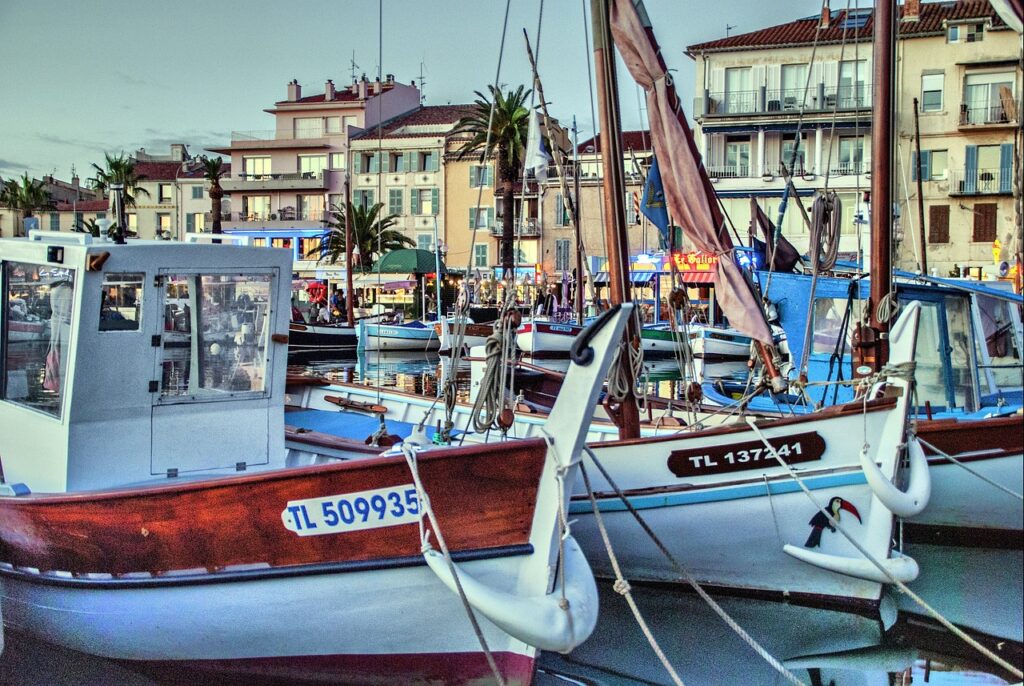
Cannes is known worldwide for its famous film festival and the Promenade de la Croisette, which stretches along the Bay of Cannes to the harbor, lined with luxury yachts, and from the Palais des Festivals to the prestigious Palm Beach Casino. Even before Cannes became popular with vacationers, there was a regular road instead of a promenade. It turned into a waterfront only in 1860, when the first villas and hotels were built here.
You can get acquainted with the culture of Provence in a small private museum – Moulin Forville (Rue Forville). It is open only on the first Saturday of every month in the afternoon. The museum, housed in a former olive oil mill, contains exhibits related to the history of Provence: old costumes, books, and various artifacts.
Go on an excursion to the Lerin Islands. The island of St. Marguerite is known for the Royal Fort and the prison of Louis XIV, where a prisoner nicknamed the Iron Mask was once imprisoned. On the island of Saint-Honoré, surrounded by beautiful gardens, there is a unique church complex. And the islands of St. Ferreol and Tradelier are completely uninhabited.
Beaches in Cannes
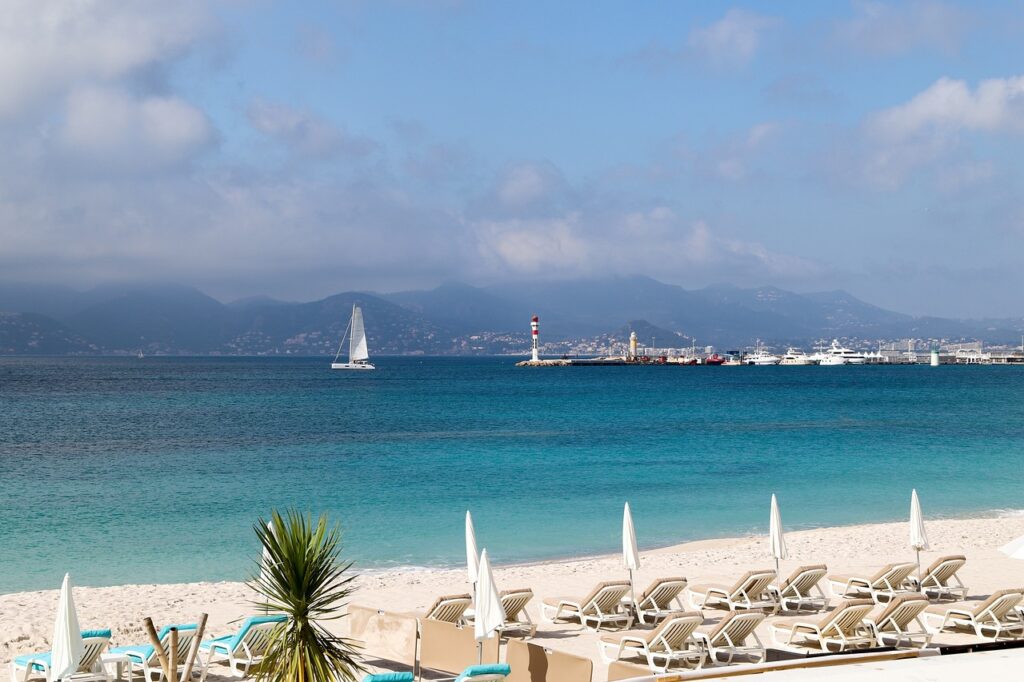
Unlike Nice, Cannes has sandy beaches with a total length of almost 8 kilometers. There are both private and municipal beaches. Private ones are owned by hotels and are most often used by their guests, who pay for entrance and services from 15 to 40 euros per day.
The best private beaches in Cannes:
- Zed (Zplage) – belongs to the Martinez Hotel,
- Plage l’Ondine is located near the Carlton Hotel,
- Festival (Plage du Festival) – next to the JW Marriott Hotel.
Entrance to the territory of municipal beaches, use of changing rooms and showers are free of charge. Municipal:
- Plage Zamenhoff is located at the end of the Croisette,
- Plage Macé is located opposite the Palais des Festivals on the Croisette,
- Casino Beach (Esplanade des Alliés) – located near the Palais des Festivals, Du Trois de Loncre Les Sables d’Or.
Hotels in Kanakh:
- Hôtel Hoche≫ – The hotel is located in the heart of the city, close to the waterfront, on a beautiful street. The room is small but cozy and clean. If you are driving, there is a large parking lot on the next street, just a 5-minute walk away. A decent hotel for little money.
- Hotel Verlaine≫ – Nice hotel, new, clean, all amenities are there. During the peak season, Cannes offers a good price-quality ratio. The beaches and promenade are a 5-minute walk away.
- Bed & Breakfast Chambres d’hôtes COTTAGE BELLEVUE≫ – Interior in Provence style, picturesque cozy courtyard with mountain views. Clean room, shower, bath, very spacious, view from the window on the orange roofs going to the sea, delicious and hearty breakfast.
Saint-Tropez – the rich and famous
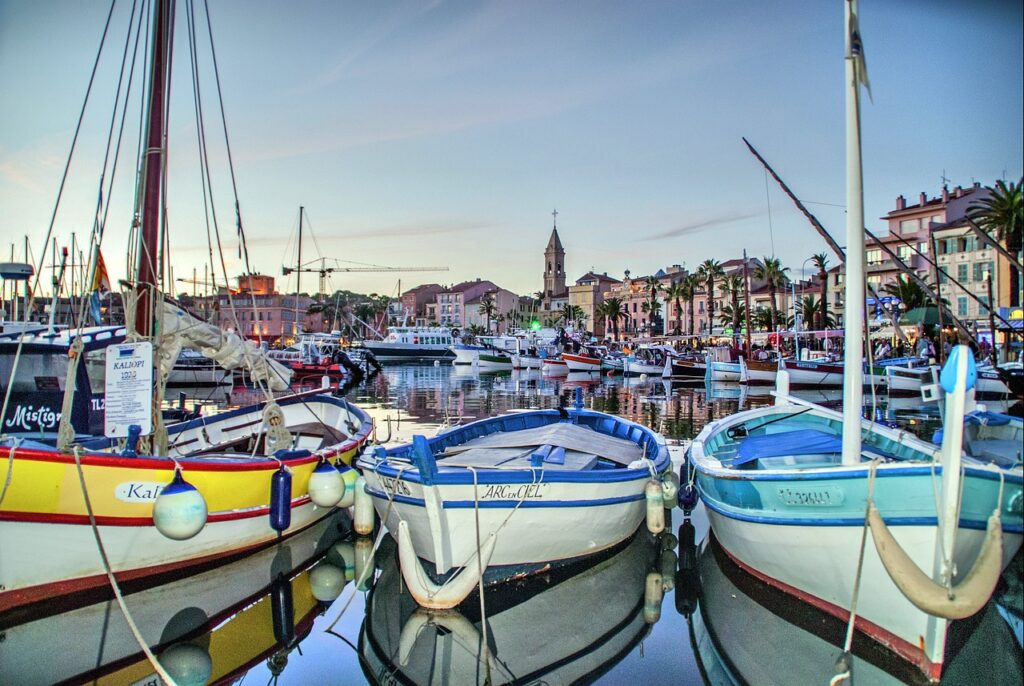
Once upon a time, representatives of the bohemian society, including directors, writers, actors, and couturiers, walked in the pine groves and along the picturesque promenades of St. Tropez. Today, this town with its old houses has become one of the most beloved corners of the Côte d’Azur.
Nightclubs host noisy parties where you’re sure to meet a few world stars and millionaires. Expensive yachts sway their masts off the coast, and it seems like you’re in a movie. In general, those who like parties and a colorful life, dining in Michelin-starred restaurants and everything that is somehow related to celebrities will like it here.
Saint-Tropez’s hallmark is the Old Port, surrounded by chic cafes and the public parading in couture outfits. A little higher is the Suffren Castle (Le Chateau de Suffren). Take a photo in front of the famous gendarmerie from the movie The Gendarme of Saint-Tropez – this is where the movie starring the great comedian Louis de Funes was filmed.
Beaches of St. Tropez

St. Tropez, like other resorts, has municipal and private beaches.
- The most famous and luxurious is the 6-kilometer-long Plage de Pampelonne, divided into private and municipal zones. In the private area, you can even meet celebrities in swimsuits from the best couturiers. And in the evening, the beach turns into a huge nightclub with loud music and dancing.
- Tahiti Beach is located north of Plage de Pampelonne. It has a more relaxed atmosphere, which is loved by families with children and elderly rich tourists.
- Plage de la Bouillabaisse – there are no large crowds of vacationers here, a calm, relaxing vacation.
- Granje Municipal Beach is located on the outskirts of the city. It can be reached on foot along a hiking trail with the romantic name Santier du Litoral. The beach is surrounded by pine groves, pine scents and cicadas.
- De Saline Beach is the most remote and secluded beach in Saint-Tropez, preferred by lovers of secluded relaxation. The best way to get here is by car or public transport going to de Salines.
Hotels in Saint-Tropez:
- La Glycine Tropézienne≫ – excellent location – 10 minutes walk to Bouillabaisse beach. Parking is available close to the apartment – you can arrive by car. The kitchenette is equipped with everything you need. Pleasant surroundings among flowers and trees.
- Un nid à Saint Trope z≫ – Very cozy, clean and well equipped kitchen. Great location – shops, restaurants and the village center are just a short walk away. Excellent value for money for Saint Tropez.
- Windward≫. – The place is beautiful and pleasant, the room is comfortable and clean. The room has a small kitchen. In the outdoor area you can enjoy the swimming pool with a relaxing toweled area.
Provencal cuisine – what to taste on the Cote d’Azur

Provencal cuisine is a mixture of Mediterranean, French and Italian culinary traditions. Provençal cuisine differs from Italian cuisine in its more sophisticated flavors and more complex recipes. If you are in Provence, be sure to try these dishes:
- Bouillabaissefish soup. It is said to have been invented by Marseille fishermen. It is based on a creamy soup made from small coastal fish with tomatoes and vegetables, seafood and noble fish species. Served with a toasted baguette and garlic roux sauce.
- Street fast food: Socca pancakes made from chickpea flour, or the French Pan-bagnat sandwich, a huge sandwich soaked in olive oil and tomato juice and filled with Nicoise salad.

- Salade Niçoise is a plate filled with various fresh vegetables (tomatoes, green beans, olives) with tuna, eggs and herbs. There are many variations of this salad, some, for example, serve it with potatoes.
- Pissaladière is a kind of Provencal pizza without tomatoes and cheese. Simply put, it’s an open pie topped with caramelized onions, olives, and anchovies.
- Ratatouille is originally from Provence. Here it is made from peppers, eggplant, and zucchini with mint and fennel. It can be served as a side dish to meat or as an independent dish.
- Tapenade is a paste of olives, capers, and anchovies spread on a toasted baguette or toast. It is used as a separate dish and served with fried vegetables or put in the filling of hamburgers.

Useful links for travelers:
Car rental – we booked a car at the Nice airport. We picked up an inexpensive option through Rentalcars.com
Hotels – I traditionally book through Booking.com
Travel Medical Insurance – online on the portal EKTA
Read also:
- Guide to the districts of Paris – where to book accommodation for tourists
- The most beautiful villages in France – a road trip through Burgundy
- Paris – a mini-guide for a romantic trip
- The best European beaches in October