
The Georgian Military Highway — the most popular route from Tbilisi: Mtskheta, Jvari, Gudauri, the Cross Pass, Stepantsminda, Kazbegi, and the Gveleti waterfalls.
This is probably the most popular route in Georgia. I’m not kidding!
- Firstly, because Kazbegi is easy to reach,
- secondly, because in one or two days you can see a multitude of interesting and diverse locations,
- thirdly – the route is very beautiful!

All the places listed below can be seen by taking a couple of days’ trip from Tbilisi. And they are well worth it! The 135-kilometre Georgian Military Road runs through mountain gorges and passes. At the same time, it can be traveled by an ordinary car—a 4×4 is not necessary. At every turn, incredible views and landmarks await you, creating memories that will last a lifetime.
I recommend reading: Three routes from Tbilisi—unusual locations that can be explored in one day.
Transport — how to travel along the Georgian Military Road
The easiest way to organize a trip along the Georgian Military Road is by renting a car. You can manage it in one or two days for $30 for the rental and $20–30 for petrol. You will not need an SUV for this trip—the road quality is excellent. Even the road to the Gergeti Trinity Church has been paved (although, admittedly, it is still falling apart).
To choose a car, the easiest option is to use an aggregator that will calculate the rental cost for the dates you specify and immediately offer several options to choose from. In Georgia, the following aggregator has proven reliable DiscoverCars. Select the dates, city, and place where it is convenient for you to rent a car; in the filters, specify what type of car you need (an SUV or a regular passenger car)—the site will show you all available options, with prices and insurance included in the rental cost.
If you do not want to drive yourself, you can hire a driver with a car. On average, you can manage it for $80–100 per day.
Minibuses to Stepantsminda depart from Tbilisi — they leave from the station Didube (the bus station and metro stop of the same name in Tbilisi). A minibus ride costs 12 lari ($4). However, to see all the places listed below, you will need to keep changing from one minibus to the next. With the transfers, it will cost two to three times more. You will also have to spend more than two days on the trip — which means accommodation and food expenses. In the end, it will cost the same as renting a car. But if you do not have a driver’s license and are on a tight budget, traveling by minibus is also an option.
Sights along the Georgian Military Road
Now, in order — here is what you can see in one or two days on the way from Tbilisi to Stepantsminda and back. The route is very diverse: gorges, a reservoir, observation decks, mineral springs, and waterfalls await you along the way.
Jvari — a monastery on a cliff

The first place we drove to from Tbilisi was Jvari Monastery. It is located 25 km from Tbilisi, on a high cliff rising above Mtskheta and the highway leading from Tbilisi toward Kazbegi. I had already visited Jvari in 2013; this place touched me deeply.

In the ancient churches of Georgia, you can truly feel the presence of a spirit—the spirit of time. These walls, with remnants of ancient frescoes untouched by modern restorers, breathe history. The monastery offers a breathtaking view of the valley, where two rivers— the Kura and the Aragvi —merge into one.

A very beautiful place; even the color of the water in the rivers is different: Kura – yellowish-brown, while Aragvi – blue.
Mtskheta is the ancient capital of the Georgian kings
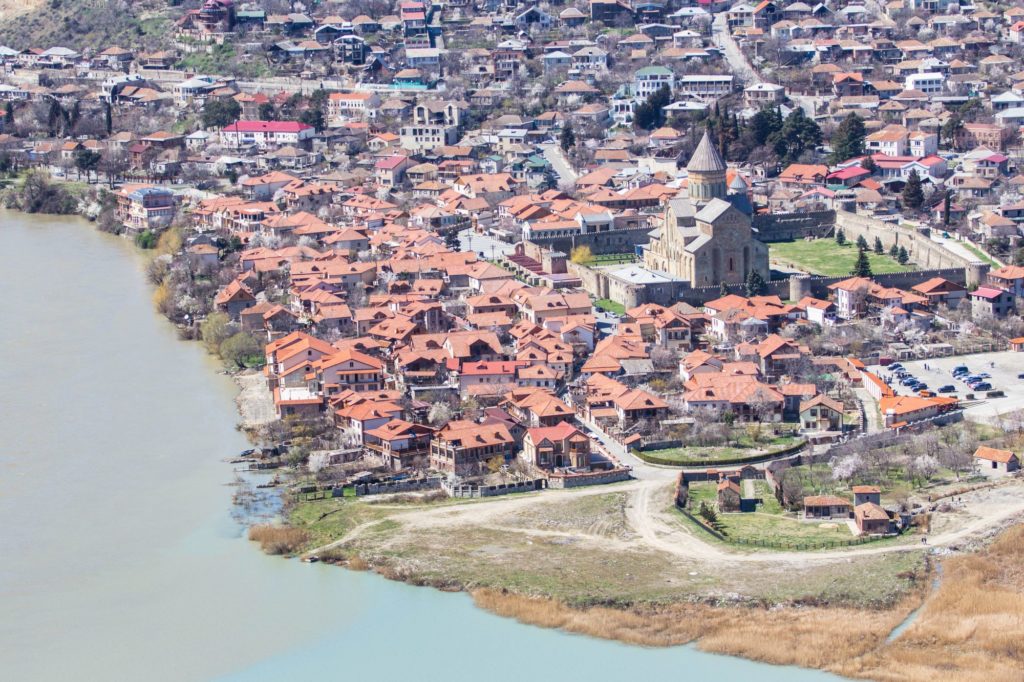
Mtskheta — a holy place for all Georgians. It was here that Saint Nino of Cappadocia brought the good news. And one of the greatest sacred relics of the Christian world is kept here — the Holy Tunic of the Lord. Mtskheta is located at the confluence of two mountain rivers — the Aragvi and the Kura.
I recommend reading: Mtskheta and the surrounding area in one day — the main sights.
The oldest churches in Georgia, included on the UNESCO World Heritage List, are located here: Svetitskhoveli — a cathedral and one of the main Georgian Orthodox churches, the Samtavro nunnery Samtavro.

I would recommend visiting Mtskheta separately and setting aside a whole day for it, so you can take your time exploring its magnificent churches, visiting viewpoints little known to tourists, and dining at one of its wonderful restaurants. Alternatively, plan to visit it on your way back.
You can read about what to do in Mtskheta here:
Ananuri Fortress and the Zhinvali Reservoir

The next attraction is – Ananuri Fortress. Located 75 km from Tbilisi in an exceptionally beautiful place — on the shore of the Zhinvali Reservoir. The walls and towers of an ancient defensive structure are reflected in its deep, clear waters.

The castle was built in the 16th–17th centuries; behind its mighty crenellated walls, two churches have been preserved — the Church of the Savior and the Dormition Church, decorated with masterful stone carvings. You can climb the tower with a pyramidal roof to see the panorama overlooking the reservoir and mountains.

Before stopping in Ananuri — make a stop at the observation deck above the Zhinvali Reservoir. The view from here is breathtaking!
The confluence of the White and Black Aragvi rivers and a mineral water spring
A short stop to see an unusual phenomenon — where two rivers meet: the Black and White Aragvi. Nearby, there is a spring of narzan mineral water. This place is located near the village of Pasanauri.

By the way, there is a legend that Georgian khinkali originate from this village — Pisanauri. There are several good restaurants along the highway that serve not only khinkali but also excellent shashlik. Here I tasted a wonderful chakapuli — my favorite hangover dish made with lamb.

After Psanauri, we stopped in Nadibani to drink some water from the spring. Mineral water flows from a tap covered in natural rust — very tasty.
Gudauri — Georgia’s most popular ski resort

The next top spot is a village and ski resort Gudauri. A rather steep series of hairpin bends leads here, and traffic jams of cars and trucks often form along it. The reason is that a large volume of cargo from Armenia and Georgia, as well as transit trucks from the port of Poti to Russia, travels along the Georgian Military Road. All this truck traffic begins to slow down considerably on the hairpin bends, causing congestion. Keep this in mind!

Gudauri itself is interesting only during the ski season—from late December to late March, when the slopes are covered in snow and skiing here is wonderful. There is nothing else to do in the village, although for a change you can visit the church in Lower Gudauri and take the gondola lift to the top of Mount Kudebi, which offers a magnificent view of the Lomisi Range.
I described my skiing experience in a separate article: in Gudauri in spring—when there is plenty of snow and few tourists.
The Arch of Friendship of the Peoples and the Cross Pass

But there are several interesting places near Gudauri. As you drive past the Gudauri ski resort, be sure to stop by Arch of Friendship of Peoples. This mosaic circular panel was created in the 1980s.

Paragliders fly over the gorge above which the arch was built—the views here are simply fantastic. The Aragvi Gorge and the neighboring mountain ranges are especially beautiful.

There is another narzan water spring at the pass, which created travertine terraces, down which mineral water flows. I saw a similar wonder in Turkish Pamukkale, but there the travertines are white, while in Georgia they are rusty-colored due to the minerals saturating the water in the spring.

The village of Stepantsminda, Kazbegi, and the Gergeti Church

The endpoint of this part of the route is the village Stepantsminda, from which a breathtaking panorama of the mountain opens up Kazbegi. Kazbegi does not always emerge from behind the clouds, so it is worth spending the night here to see the snow-capped mountain peaks bathed in sunlight in the morning.

And at the same time, drive up the neighboring hill to the Gergeti Trinity Church – an amazingly beautiful place from which you can see Kazbek on one side and, on the other, the seemingly dollhouse-like houses of Stepantsminda. A road has been built to the church, so you no longer need an off-road vehicle to get there.

Church Gergeti is located on a large hill offering beautiful views in various directions: toward Stepantsminda and Mount Kazbek. You can walk around the church on all sides or climb even higher to the moraine of the Kazbek Glacier.

To have time to see all the surrounding attractions, I recommend staying overnight in Stepantsminda. There is a huge selection of hotels and mini-hotels here—you can find budget accommodation on Booking-Stepantsminda.
Gveleti Waterfalls and the viewpoint above the Terek River

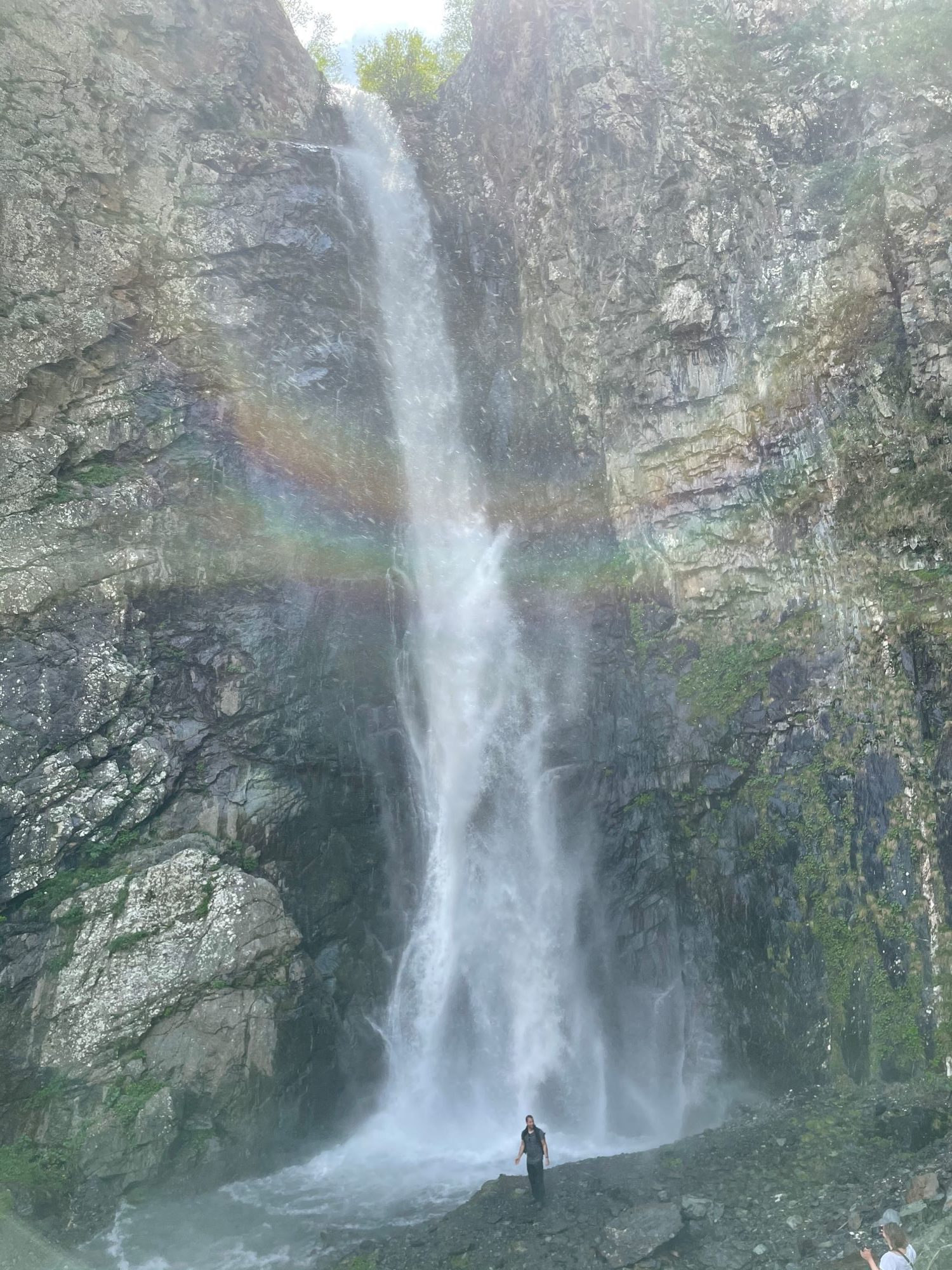
In fact, there are two Gveleti waterfalls—the lower and the upper. The lower waterfall is slightly smaller, while the upper one, located higher up in the gorge, is twice as high and especially powerful in spring.
Approaching it means getting soaked through to your underwear. And at the lower Gveleti waterfall, I managed to take a photo and remain almost completely dry.

On the way, stop at the viewpoint overlooking the Terek Valley.
How to Get to Georgia
For a trip along the Georgian Military Highway, it is best to fly to Tbilisi. Then by rental car or book a tour.
Useful links for preparing for your trip:
Insurance – you can choose an affordable option on the HotlineFinance
Booking hotels, hostels, and apartments – Booking.com
Car rental in Georgia – DiscoverCars
What else to read:
Tbilisi in three days — what to see in the capital of Georgia
A Journey to Svaneti — Highland Georgia
Racha — a Journey to the Homeland of Khvanchkara