Rota Vicentina – how I walked along the ocean in the South of Portugal
Traveling on foot gives me health, strength, and an indescribable feeling of freedom.
That’s why every year I try to go on a hiking trip to plunge into a pleasant fatigue, become stronger and slimmer, and see new horizons.

Instead of a preface
This year, I exchanged the Camino de Santiago for an alternative route, the Rota Vicentina. After three years of hiking in Spain, the Camino has become understandable and accessible. I already knew the rules of the game: where to get information, where I would spend the night and what I would eat during the trip, and even what kind of conversations we would have in the evenings in the albergue.
I wanted something new. It is important that it is warm and beautiful, and that there are as few people as possible on the way – to be alone with yourself and the stunningly beautiful nature.
The universe accepted my well-articulated request and sent information about Rota Vicentina, a relatively new hiking route in southwestern Portugal.
I bought tickets to Lisbon and flew to meet the new trails, which I walked 225 kilometers. The results of the trip exceeded all expectations, and so I would like to share useful information about the route of Rota Vicentina.
Lyrics – why to go to Rota Vicenina?

Seven years ago, I discovered a new kind of travel – walking alone in warm and delicious European countries. Women’s solo travel is no longer a novelty. Many books have been written about it and no fewer films have been made. But every time I pack my backpack and set off, my heart sinks in anticipation of a new adventure.
Why do I need it? Being alone with yourself is a special pleasure to be yourself, to see new horizons, to meet interesting people along the way.
When we travel in a company, the chance to meet someone interesting is reduced by several times. When we have someone else to blame for our problems when traveling, we can’t find out what our minds and bodies are capable of. And so every year I discover my own personal facets of the possible.
And I’m not bored at all, after all, there is always a fellow traveler with whom you can exchange a few words, and share bread and a glass of wine. And fatigue? Of course, walking a couple hundred kilometers is not the same as lying on the beach. But a pleasant fatigue, a cleansed mind, and the opportunity to lose a few pounds against the backdrop of the endless expanse of the ocean is the perfect fitness for a hiker.
The safety on the Rota Vicentina
The safety of such trips is my responsibility. Of course, I ask myself questions: how to get off the route if, God forbid, something happens to my health, or I run out of water and get dehydrated, or suddenly I get lost and lose the trail or wipe out my feet. But I have been walking for years and know how to prepare for such a trip.
- First, I always have mobile Internet to stay in touch.
- Secondly, I leave the route plan to my family and keep in touch with them every day, periodically sending them the coordinates of my location.
- Thirdly, I always stock up on water and food before the next stage.
- Fourth, I always have insurance that covers hospitalization, and if I want, I can pay a little extra for emergency evacuation.
And most importantly, I am confident that no one will offend me, because there are many more good people on Earth, and bad people do not walk so far.
Practical information – when to go?

In summer, southern Portugal is quite hot – the temperature rises to 40℃. Therefore, from late May to mid-September, you can forget about such a trip.
In October and May, it’s time to get ready to travel. November, March, and April are borderline months when it is already/still warm, but the probability of precipitation is high. In the spring, the probability of rain is slightly higher than in the fall.
I walked along the Rota Vicentina from November 4 to 15, it was great weather for a walk +15-20℃. Twice on the road I was caught by short-term rains. It rained more often at night, and in the morning the sun came out from behind the textured clouds.
Route – marking and length

The Rota Vicentina (St. Vincent’s Way) is divided into the Fishermen’s Path and the Historic Path.
The Historic Path
The Historic Route (Caminho Nistorico) leads from Santiago do Caxem to Cape São Vicente. Its length is 262 kilometers. The route is divided into 13 stages – from 12 to 33 km long.
The historical path goes through fields and hills, passing through towns and villages. You can get to know the culture and life of the south of Portugal. The route is not difficult, there is practically no elevation difference.

The Fishermen’s Path
The Fishermen’s Trail (Trilho dos Pescadores) runs mostly near the ocean. From Porto Covo to Lagos. Its length is 226 kilometers, the route is divided into 13 stages, with distances ranging from 10 to 22 km per day. This route is perfect for those who like to be alone and quiet. However, it is a bit more difficult than the Historical one because of the sand dunes and elevation difference.

Sometimes the routes merge, and there are also many radial branches – in case you find it too short and want to make a few more laps. You can go from north to south, or vice versa, as your heart desires.

The routes are well marked – the main thing is not to get confused in the designation. The coastal path is characterized by blue and green markings that are visible everywhere: on wooden posts, stones, trees, and anything else that can be used to mark the way so that travelers do not go astray.
It is not difficult to navigate – if you walk south from the north, the ocean is always on your right hand, and vice versa. You can start your journey from the south, from Lagos, and arrive in Porto Covo in 12 days.
I chose the coastal route along the ocean and completed it in 11 days. She walked from north to south, from Porto Covo to Lagos, so that it would not get colder as winter approached.
You can download maps of the routes on the official website – https://rotavicentina.com.
How to get on the route?
To get to Porto Covo you need to take a bus Rede Express. Buses to this destination run daily from the Lisbon Sete Rios bus station. The fare is about 20 euros. The bus takes 3 hours. Tickets can be purchased in advance on the carrier’s website or at the ticket office. I still recommend doing this in advance, as sometimes the system at bus stations glitches, computers freeze, and a long queue forms (I experienced this on my way back).
How difficult is Rota Vicentina?
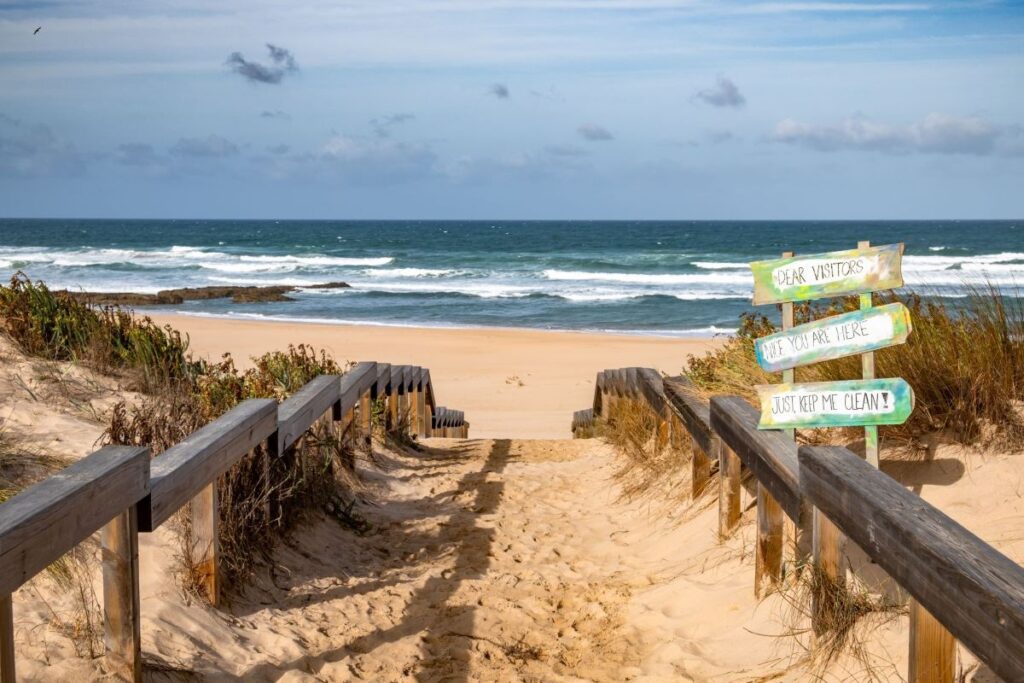
The Rota Vicentina is a fairly easy route for those who have already walked the Camino de Santiago, such as the French Way. For those who have walked only the Portuguese route from Porto, this route will seem more difficult, but not so much that you groan all the way.
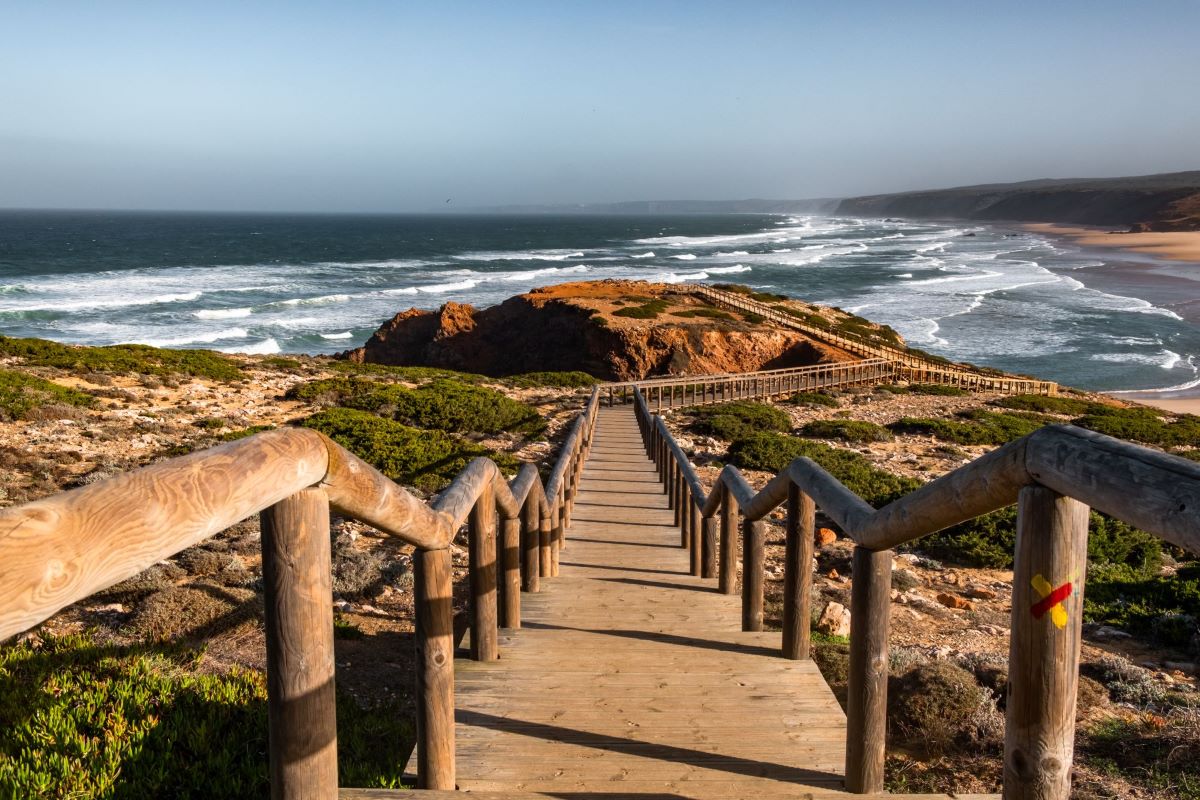
The Fisherman’s Trail has a small elevation difference – from 30 to 80 meters. Often the trail leads along the same plane – over the ocean. There are areas where it is really difficult, and this is what you need to be prepared for some challenges.
What to prepare for?
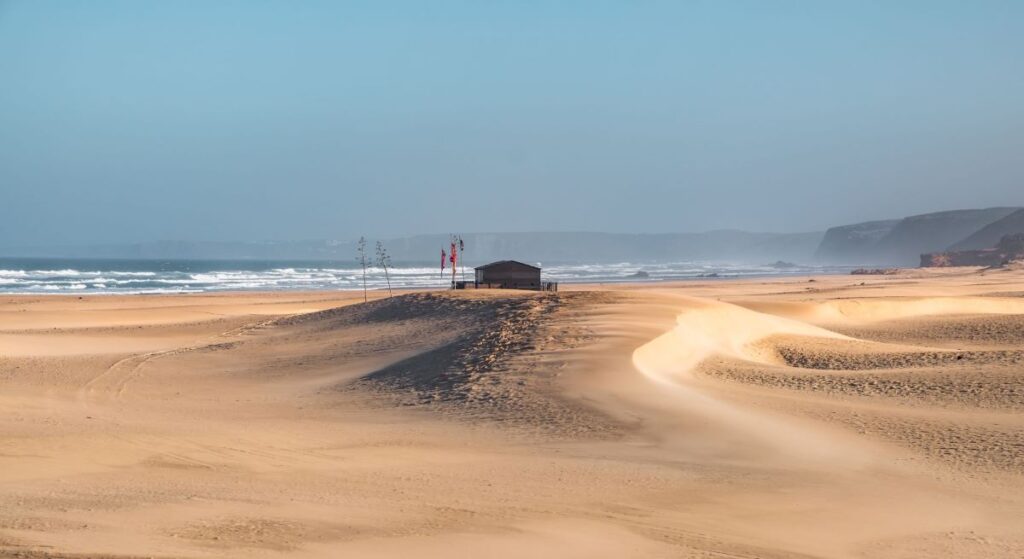
- You will be walking on sand for most of the way. The entire coast, despite the cliffs rising above the ocean, is covered with sand dunes. Sometimes my feet fall ankle-deep into the sand and get stuck in it. Sometimes you can go down to sandy beaches and walk on wet sand, which is a little easier. Part of the way leads along rural roads, which is easier but not as beautiful.
- From Cape San Vincente to Lagos, you need to be prepared for a constant drop in altitude. There is a real “comb” of constant descents and ascents. The terrain is like this because of the many rivers and streams that flow into the ocean. This is much less common on the western side of the route.
- There are several sections along the highway – there are not many of them, no more than 10 km in total, but they are not interesting, you just have to walk to the settlement.
- The main difficulty of the route is that there is practically no civilization on the way. During the day, you can see one coffee shop that will be open at best. We’ll have to carry water and food on our backs.
- If you are afraid of heights, be prepared to feel dizzy – part of the way passes over high cliffs – beautiful! but some people can’t stand such beauty.
What are the other nuances of the route?

Otherwise, the route is not very difficult. In dangerous places of descent from the rocks, there are often ladders or ropes. Where the slopes are not too steep, you just need to keep your balance. For those who are not friends with their bodies, trekking poles may be useful on such stretches.
Footwear: I walked the whole way in Merrell sneakers. Sand practically never got into them, although I was predicted to have problems with such shoes. I met an Austrian man wearing trekking boots on the way – his feet were sweating in them, and he still managed to get sand in them, which made his feet look like a bloody mess.
Even though I did rub my calluses, they were not the result of sand. These are my standard blisters on the soles that accompany me in any shoe on all hiking routes. There was a minimum of sand in the sneakers – my feet breathed, and it was very comfortable. Important! for the shoes to breathe, but sandals and sneakers with mesh should not be worn in this case.
Every day you need to walk 15-20 km – a comfortable distance to walk at a relaxed pace and admire the beauty. The route is laid out in such a way that it seems to me that it is impossible to shorten it without losing the opportunity to see the ocean.
Transportation there is difficult – there are no buses, you have to call a taxi in the towns along the way. To do this, you need to stock up on the phone numbers of the taxi service – you can find them on the official website of Rota Vicentina.
Accommodation and meals on the route
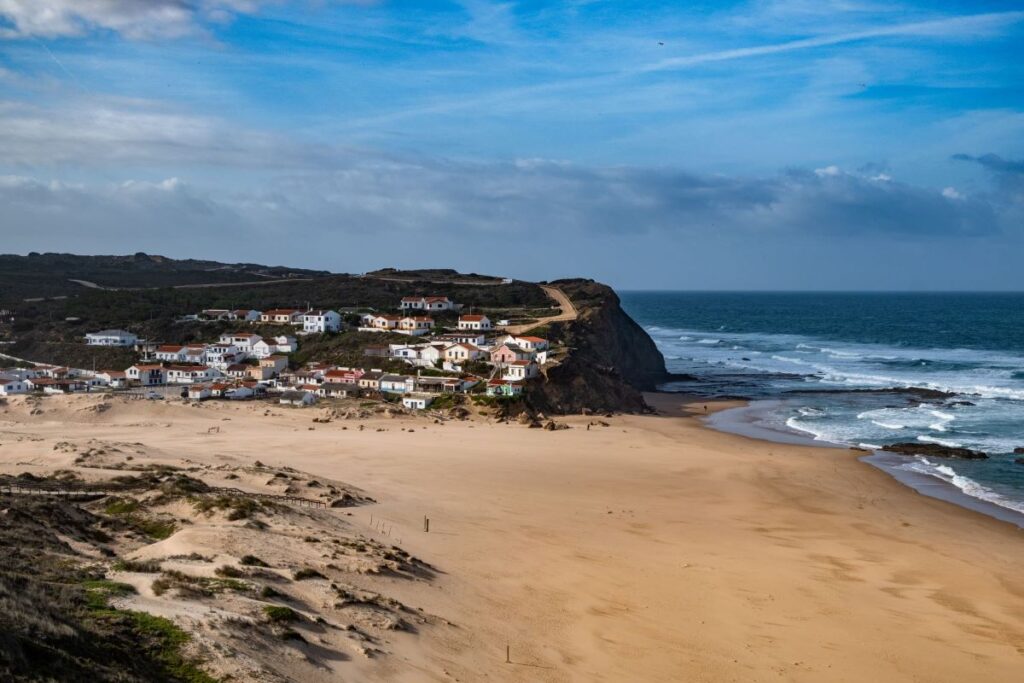
The route is divided into comfortable stages, with a small village or town at the end of each stage. At any time of the year, you can find accommodation and a couple of cafes and restaurants, where you can always get something delicious from Portuguese cuisine for a little money.
There are also shops where you can buy simple food and cook your own meals. If the average price tag for a dinner in a restaurant is 15 euros, then the food for dinner and breakfast cost me 5-7 euros.
In November, you don’t have to book your accommodation in advance. Everything happened for me in the “today for tomorrow” mode. But this is only possible due to the low season – in other more active months, it is better to book your accommodation in advance, as there are many more pedestrians and tourists.
I lived mostly in hostels – a bed costs from 13 to 25 euros per day. In some villages, there are no hostels, so I had to rent a room in an apartment, which cost 40 euros.
If you are planning to go together, the accommodation will be a little cheaper. If you’re traveling with a group, you shouldn’t focus on hostels at all, as apartments will cost less per person.
In general, for the most part, I liked the accommodation on the way – it was clean, cozy, clean bedding, amenities and kitchen. Compared to the Camino, the Fishermen’s Trail has completely different living conditions.
I recommend the hostels I like on the way:
- Hostel in Porto Cova – Ahoy Porto Ahoy Porto Covo Hostel: very cozy and clean, 4 people in a room, there is a kitchen, towels are not included in the price. The owner of the hostel, Nikalaush, will tell you everything about the route, show you on the map all the points where you can buy water and food along the way, where it is better to go to the beach, and many more different nuances.
- Hostel in Vila Nova de Milfontes Hike & Surf Lodge: very clean, huge kitchen with everything you need for cooking, 6 people in a room, but very spacious, towels are included in the price.
- Hostel in Almograve – Almograve Beach Hostel: Very cozy and clean, 4 people in a room, excellent kitchen, towels included in the price.
- Hostel in Zambujeira do Mar – Hostel Nature: This is probably one of the best hostels I’ve ever stayed at. It has only three rooms – a 2-, 3- and 4-seater dormitory. I booked the last bed, but I didn’t regret it. The kitchen is excellent, there is a washer and dryer – use is included in the price. They treat you to wine and fruit, very clean, towels are also included in the price. In the morning, they treat you to fresh boiled eggs from their own chickens.
- Hostel in Sagres – The Lighthouse Hostel The Lighthouse Hostel: a little off the beaten track from the central part of town, but the hostel is great. You can stay here for a few days if you wish, there is a beautiful garden, a cozy living room, a kitchen – the price includes simple breakfasts. Towels for an additional fee. There is a surf school at the hostel.
What to take with you on the Rota Vicentina

For those who have already been hiking, I will not discover “America” with my camping kit of a pilgrim and part-time journalist. You probably won’t need a camera and a laptop – these are my working tools (I worked in the evenings and took pictures on the road).
Here is my list of things I took to Rota Vicentina (with some comments):
1 – a buff around the neck or as a hat on the head
2 – windbreaker jacket
3 – waist bag for money, documents, phone
4 – waterproof case for the camera
5 – shower slippers
6 – laptop (working tool)
7 – long-sleeved T-shirts – 3 pcs.
8 – T-shirts – 2 pcs.
9 – second pants
10 – microfiber towel
11 – a down vest (I wore it when I left the house, complete with a windbreaker)
12 – medicines (ibuprofen, plasters, nifurixazide, paracetamol, bipanthene ointment for sunburn – very necessary, etc.)
13 – soap and water (dry shampoo, Lush hair cream and balm, soap and toothpaste, body cream, sunscreen – take SPF 50, a washcloth, toothbrush and all kinds of hygiene items)
14 – a sleeping mask (I use it in hostels and airplanes)
15 – underwear
16 – Teva sandals (as a change of shoes for evening walks)
17 – a hat (needed to get from winter to summer)
18 – a 30-liter backpack
19 – passport and money
20 – raincoat (needed 2 times)
21 – leggings – clothes for hostel and sleeping
22 – gloves (needed to get from winter to summer)
23 – a case with wires, chargers and all sorts of technical stuff
24 – camera
25 – super light backpack for city walks and grocery shopping
26 – a headlamp (never came in handy!!!)
27 – spider tripod (for photos)
28 – powerbank (a very useful thing – the batteries of our phones were always running out)
29 – phones (I have two, as both batteries are running low)
30 – memory card adapter, camera charger, comb, 5 pairs of socks, sunglasses, hostel lock, charging tee.
You don’t need a sleeping bag on this route! This makes your backpack much lighter and simplifies your life – you don’t have to pack it every morning.
What else to read:
- Via Francigena – Italian Camino, route details from Lucca to Rome
- Trekking to Everest – how to prepare to hike in the Himalayas
- Best time to go on a trip to Portugal
- 10 tips for those traveling to Portugal for the first time
- Camino de Santiago – how to prepare for the pilgrimage?
Booking of hotels and apartments – Booking.com
Rent a car – on DiscoverCars