
What to see in Prague in two or three days? Where to go to drink Czech beer, eat dumplings, duck and boar’s knee? Where are the free observation decks in Prague? What are the requirements for tourists to get to the Czech Republic? How to get to Prague and how to get around the city.
This article is for those who have never been to Prague but have long wanted to visit it.
If you’ve already been to the city of red roofs, I recommend reading this: Where to go if it’s not your first time in Prague.
When is the best time to go to Prague

I’ve been to Prague in all seasons – each season has its pros and cons.
Summer in Prague – if the temperature rises above +30 degrees, the city turns into a stone bag. Hot is not the right word. But numerous parks, especially those on the banks of the Vltava, are saving the day. Here you can survive the heat of the day by lying on the lawn with a cool glass of beer or lemonade.
Winter in Prague means that fog often falls on the city. They make it much colder than in frost. Terrible winds are blowing on the outskirts of Prague. But every year the winter in Prague is different, so it depends on your luck. There may be frosts, possibly above freezing temperatures. A big advantage of Prague winter (not during the holidays) is that there are few tourists after the New Year’s holidays. An ideal time for those who do not like crowds of tourists.
I think the ideal time to go to Prague is late spring and early fall. In spring, the city blooms, thawing out from the winter cold. In the fall, the heat subsides and Prague is gradually covered with autumn leaves – the most romantic time to travel. Don’t forget to take an umbrella – it rains often.
How do I get to the center of Prague from the airport?

If you arrive in Prague by plane, you can get to the city in the following ways.
- There is a direct shuttle bus from the airport to the Praha hl.n . railway station, which costs 100 CZK (€4).
- You can save money by traveling 2 times cheaper with a transfer. From the airport, there is a bus #100 that goes to the nearest metro station Zličín. Then you need to take the subway and follow the yellow line to the center. A ticket for such a trip costs 40 CZK (€1.57) and you can travel with it by different types of transport for 1.5 hours. There is a cheaper ticket (30 CZK – 0.5 hours), but it won’t work because you won’t have time to get to the center in that time.
- Taxis are more comfortable transportation, especially if you have children and suitcases. You can book a taxi in advance on Kiwitaxi – This is convenient if you arrive at night and don’t want to wait for an Uber. Or use the Uber or Bolt app.
Where to stay in Prague
Prague is divided into 22 administrative districts, which are numbered from 1 to 22. Hotels and hostels are scattered throughout the city. However, you should limit your search for housing to the first ten districts, as they are closer to the center.
- When I’m coming to Prague for a few days – looking for accommodation options on Booking.com Booking.com Booking.com – hotels and apartments in Prague. The price for a double room starts from €50.
- If you want to live in the city center, choose Prague 1 and 2 districts: Old Town, Mala Strana, Vysehrad.
- If you want to live a little away from the tourist anthill, Prague 3, 5 is a great choice: Letná, Žižkov, Vinohrady. The price for a double room starts from €35 for two people.
Where is the best place to stay in Prague for a week or more – it is better to read a separate article: Where to stay in Prague – the best neighborhoods for tourists.
We lived for more than a month in the area Smichov – near the center, but in a convenient place to live, with inexpensive restaurants, a large selection of supermarkets and good transportation. Two-room apartments with kitchen and washing machine cost from €40 per night, including underground parking.
Tip: If you plan to stay far from the center, choose hotels near the metro. And remember – Prague is located on the hills, a short distance on the map may turn out to be a long hill climb on foot.
Transportation – how to get around Prague

Prague is a city of trams, as well as subways, funiculars, and buses. It’s convenient that there is a single ticket(Jizdenka) for all types of public transportation in Prague. The ticket price depends on the validity period:
- 30 minutes – 30 CZK (€1.2) – not valid for the funicular to Petršín Hill
- 90 minutes – 40 CZK (€1.65) – not valid for the funicular to Petršín
- 1 night – 120 CZK (4.7 €)
- 3 nights – 330 CZK (13 €)
You can transfer from one type of transport to another (tram, subway, buses) within the time for which the ticket is valid.
Where to buy a ticket for public transport in Prague?
- In the PID Lítáčka mobile application (all individual e-tickets must be activated in the application before boarding the vehicle for the first time).
- In a contactless terminal located inside each tram (the ticket indicates the time of sale from which the trip starts).
- In ticket machines (depending on the type of machine, paper tickets must be validated when boarding a vehicle or at the entrance to the subway).
- At information centers or DP Praha sales outlets at metro stations (paper tickets must be validated when boarding a vehicle or at the entrance to the metro station ).
- At newsstands and some shops (paper tickets must be validated when boarding a vehicle or at the entrance to the subway).
- Drivers of PID suburban buses of the 300-410 and 951-960 series (all paper tickets are valid here, a paper ticket printed by the driver with the time of sale on it, from which the ticket validity period begins).
- By SMS (SMS tickets issued to SMS Jizdenka. Available only with SIM cards of Czech operators, confirmation of the ticket purchase must be received before the first boarding of the vehicle).
Tip: there are no turnstiles in the Prague metro, and before entering a metro station, tram or bus, you must validate your ticket with a validator (it displays the date and time of boarding on the ticket), otherwise, even if you have a ticket without validation, the trip will be considered a “hare”. The fine is 800 CZK (€31).
What to eat and drink in Prague
Prague is the center of Europe, so you can find restaurants for every taste. I’m not particularly fond of Czech cuisine. But whenever I’m in Prague, I go to a trusted place at least once. Here are some tips on beer, food, and sweets in Prague.
Beer in Prague

Real Czech beer is brewed from malt wort with hops grown exclusively in the Czech Republic. The high-quality drink is sold under the brand nameČeské pivo. So far, only Velkopopovický Kozel, Radegast, Pilsner Urquell and Gambrinus have been awarded this honorary title. You can tell the difference between quality Czech beer by looking at the foam. It should be a homogeneous white color, thick as sour cream, and take up about one-sixth of the glass. A glass of beer in pubs and restaurants costs from 50CZK(€2).
If you not only want to drink beer, but also taste great snacks, go to Pivovarsky Klub (Karolíny Světlé 26, Praha 1). This pub sells 240 varieties of beer, including 8 varieties brewed in house. All dishes are cooked according to old Czech recipes.
In the restaurant Zubaty Pes restaurant restaurant, each glass of beer comes with instructions on how to drink it properly and what to eat.
The history of the monastery brewery Klášterní Pivovar Strahov goes back to the 13th century. It offers not only traditional Czech beer tasting, but also brewing courses, live music, folk dancing, and a tour of the brewery.
Czech cuisine in Prague
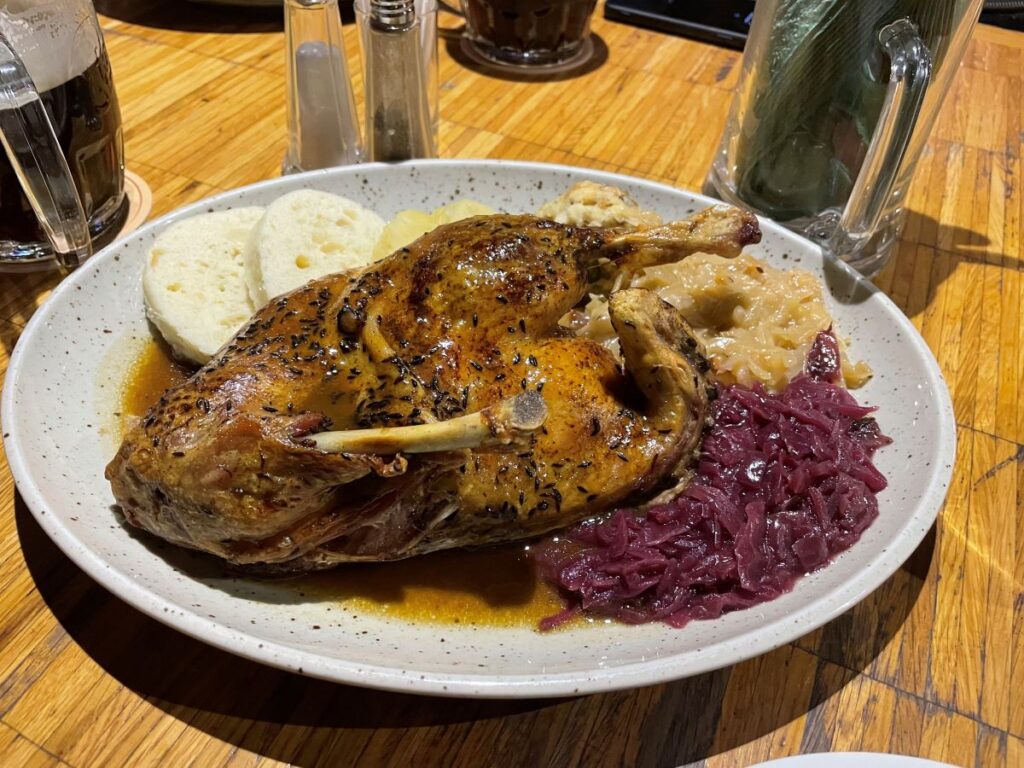
I cannot call Czech cuisine healthy. But given that it’s rarely hot here in winter, pork and potato dishes with dumplings are simply necessary for the body to keep warm. Be sure to try the well-known Veprshevo knee – a pork leg, first boiled and then baked in the oven.
It is served with a traditional side dish of Zele – stewed sauerkraut – and Knedliki – slices of bread or circles of boiled dough in gravy (from 350CZK – €11.26). You can try all this to the accompaniment of Czech folk songs with an accordion at the tourist restaurant U Fleků (Křemencova 11, Praha 1).
Czechs also cook delicious roast rabbit and duck in honey sauce. Various soups – garlic soup in bread is especially tasty, you can taste it in the Polévkárna v Plavecké cafe (Plavecká 4) – prices for soups are 40-100CZK (€1.45 – €3.88).
For inexpensive restaurants, I recommend Restaurace U Kristiána (Vltavská 787/8, 150 00 Praha 5-Smíchov), a great restaurant where locals often come for delicious food and beer.
If you are walking around the Old Town, be sure to visit Hlávkov dvor (Vodičkova 17, 110 00 Nové Mesto). Czech cuisine is really delicious here.
Tip: Gratuities are often already included in the bill, but they are often not mentioned. Therefore, read the receipt carefully to see if it contains the words “služby“, “service“, “přirážka“, “přirážka k ceně“, “10%“.
Prague and Czech sweets

It is believed that the main street food in Prague is trdelník, a famous pastry that is grilled over charcoal, spiraling the dough onto a thick skewer and sprinkling it with sugar and cinnamon. The inside is hollow, you can eat it just like that, but it tastes better if you put a few scoops of ice cream or a filling of berries and cream inside. The idea for the filling was recently invented at the Good Food Coffee and Bakery bistro (Karlova 160/8, 110 00 Staré Město) – here you can choose any of the 10 varieties of fillings presented. The cost of a classic 60 CZK trader is €2.33, with a filling from 70 CZK – €2.7.
In fact, a trunk show is a tourist attraction. You simply won’t find it in non-touristy areas. The locals prefer to buy completely different pastries. Czechs love, for example, ordinary donuts – koblížky. They are sold in all bakeries, candy shops, and supermarkets. The price per piece is 10 kronor, compared to 50-60 kronor per trdl.
Prague has its own special dessert, the Cubic vieneczok, which can be tasted in the old Oriental coffee shop located on the second floor of the Black Mother of God House. Vienechok is a bagel made of custard dough and filled with delicate cream. Vienets are sold everywhere, but they are usually round, and only Oriental offers square ones. Because the building where the cafe is located houses the Museum of Cubism, and the architecture of the building is a typical example of Cubism in the very center of Prague.
Entertainment and excursions in Prague
Prague and its ancient streets, castles, and churches still retain the medieval spirit of history. You can spend hours walking through the narrow streets and huge squares here, with stunning architecture and city views around every door and corner.
Tip: To pay for tickets, groceries in most stores, and food in restaurants in Prague, you just need a bank card. The exception is street food and products at street markets. It is most profitable to withdraw CZK from a Ukrainian hryvnia card at ČSOB ATMs.
Be careful: most exchange offices charge a large commission. If you do need to change currency, the best rate is at Change Mango exchange offices on the corner of Wenceslas Square (Jindřišská, Nové Město, 110 00 Praha 1).
Malaya Strana

Prague Castle
All tourists start their Prague itineraries from Prague Castle, the former residence of Czech kings and the largest castle complex in Europe. It is open daily from 6:00 to 22:00. You can walk around the courtyards of Prague Castle for free. If you want to go inside for a guided tour, it is better to buy a season ticket – 250 CZK-€9.7. The price includes all major attractions: The old royal palace, the Basilica of St. John the Baptist, and the Church of St. George. Giri, St. Vitus Cathedral, Zlatna Street. At Christmas, Hrad decorates a Christmas tree and organizes a festive fair.

It’s interesting to watch the changing of the guard at Prague Castle – it’s an old tradition and a kind of Prague landmark. The ceremonial changing of the guard is held daily at 12:00. The standard change is every hour. In summer from 7:00 to 20:00, in winter from 7:00 to 18:00. The guard stands in three places: near the Black Tower, near the Old Royal Palace, and at the entrance to the second courtyard (from the royal garden).

Visit St. Vitus Cathedral – it used to be completely free for visitors, except for a paid observation deck on one of the towers. Now it’s only partially free – you have to pay to go to the altar. Those who climb the 287 steps will have a panoramic view of the roofs of Mala Krajina, Old and New Prague. On the way up, visitors can take a break by examining the mechanism of an old clock.
Open: Monday – Saturday from 9:00 – 17:00, Sunday from 12:00 – 17:00. (The cost is 150 CZK-€5.8).
Petrshin hill
From Kampa Island, a funicular leads to the top of Petršin Hill (the ascent is included in the price of a 24-hour public transport ticket – 150 CZK-€4.7). On the hill, Prague residents built a smaller copy of the Eiffel Tower, the Petřínská rozhledna (Petřín Tower), which has become an integral part of the Prague landscape (Petřín Gardens n. 663 118 00 Prague 1). There is an observation deck at the top, from which you can see the city at a glance.
The Petrshyn Observation Tower has two observation decks located one above the other. You can get to them by elevator or on foot using the stairs located along the outer perimeter of the elevator shaft.
Open from 10:00 to 22:00, ticket price 150 CZK – €5.9.

On the way down from Petřín Hill, you can visit the free observation deck in front of the eastern wing of the Strahov Monastery (Strahovské nádvoří 1/132, Prague 1). There is a garden and vineyards under the monastery, and below it you can see a wonderful view of the city, which is beautifully framed: the towers of Prague Castle on the left and Pershing Hill itself on the right.
Be sure to go on a tour of the Strahov Monastery Library: the halls, decorated with paintings and frescoes, are lined to the ceiling with ancient tomes that are more than a hundred years old. It is open daily from 09:00 to 17:00 (price 120 CZK – €4.66). Please note that you can’t take photos for free here – the fee for taking photos is 20 CZK (€0.8).
Old Town – Stare Mnesto

Old Town Square
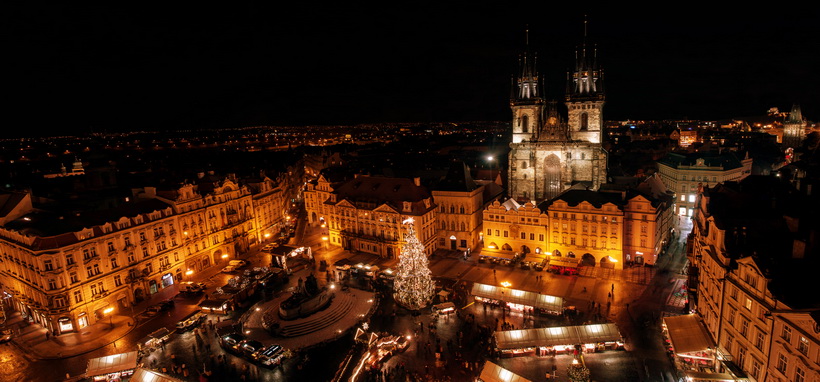
First of all, you should go to the Old Town Square and see the world-famous Orloi clock located on the Town Hall Tower. Every hour, tourists gather here for a mini-performance. When the big hand hits twelve, figures of the 12 apostles appear in the windows above the clock. In addition, the skeleton rings a bell, and the end of the performance is marked by the crowing of a golden rooster. At this point, you need to make a wish and drink a glass of Czech beer – they say it will definitely come true.
An iconic and postcard view of Prague’s most beautiful square opens from the tower of the Old Town Hall. The observation gallery is accessed by sloping slabs rather than steps, but there is a high-speed elevator for those who are tired of wandering around the city. The cost of the lift is 130 CZK – €5. The square also houses the Tyn Church, the Cathedral of St. Mikulas, and the Kinski Palace, forming a single ensemble.
Charles Bridge
You should definitely come to the Charles Bridge – preferably at dawn when there are no tourists, but only single runners. Charles Bridge is framed by statues of saints, one of them – the statue of St. John of Nepomucky – makes cherished dreams come true. It is enough to touch the bas-relief of the sculpture and think about what you want. To make the dream come true, you have to perform a special ritual: stand on a golden nail on the pavement, touch the cross on the parapet with your left hand, and touch the five stars on the bronze figure of the saint near the statue with your right hand.

Alfons Mucha Museum
The Alfons Mucha Museum is for those who love the Art Nouveau style and want to get acquainted with the work of the most famous Czech artist, illustrator, jewelry and furniture designer, creator of posters and posters, and even the designer of the first Czech money. I adore Art Nouveau. And Prague literally breathes this style, there are so many buildings and interiors where you can still see Art Nouveau in all its splendor.
Dancing Houses – Ginger and Fred, two houses that stand on the Vltava embankment near the Jiraskuva Bridge. In the evening, the buildings are illuminated in different colors, giving the impression that they are really dancing with each other.

Visegrad Fortress is located on the hill of the same name. There is a very nice park here and a great view of the Vltava River. Be sure to visit here in the fall to rustle the leaves and go down into the dungeon. An atmospheric place.

The Clementinum is a complex of Jesuit collegiate buildings that houses the National Library of the Czech Republic, the Mirror Tower, the Astronomical Observatory, and the first weather station in Europe. The place is interesting for those who are fond of history and love old libraries. Bonus – the tower offers a non-standard view of Prague. The ticket costs 300 CZK (€12).
Prague with children

For those planning a trip to Prague with children – be sure to visit the Prague Zoo (U Trojského zámku 3/120, 171 00 Praha 7). You need to set aside a whole day for it – a huge zoo with hundreds of species of animals, birds and amphibians.
The animals live in open enclosures, and pools with transparent glass have been built for polar bears, penguins, and seals, so you can watch the animals in their natural environment. The park has playgrounds for children, cafes and places for adults to relax. It is open daily from 9:00 to 19:00, adult ticket: 200 CZK-€7.8, children’s ticket: 150 CZK-€5.8.
The Lego Museum is located on Narodna Street in the city center. The museum features 20 expositions (3,000 models) on three floors, making it one of the largest Lego museums in Europe. It took more than one million parts to create a huge and complex world based on simple parts of a familiar construction set. The ticket costs 270 kroons (€11).
Tip: do not buy food before going to the Prague Zoo. The prices for all food in the cafes located on the territory of the zoo are much lower than in the city center – the food is tasty, fresh and will surprise you with a relatively low price.
Free entertainment in Prague

You can spend several days in Prague without paying a single penny for excursions. Of course, it’s worth preparing for such a budget-friendly, yet interesting pastime. Mala Strana is home to many beautiful corners and buildings.
- Check out the Waldstein Garden (Valdštejnská zahrada), decorated with sculptures of ancient gods and a wall with artificial stalagmites.
- Take a walk among the gingerbread houses on Nerudova Street. They often do not have numbers, but have their own names: the house “Three Violins” – belonged to a family of violin makers in the 18th century (Nerudova, 12), the former property of a jeweler is the House at the Golden Bowl (Nerudova, 16), and the house “At the Two Suns” was home to Jan Neruda, a great Czech poet (Nerudova, 47).
- One of the most romantic places in Prague is Kampa Island, surrounded by the Vltava River and the small Chortovka River. Houses descending to the canal, stairs, a river tram, terraces and cafes hanging over the water – all this creates a cozy atmosphere on the island. It’s a great place to spend time and even have a picnic. The island of Kampa was once home to mills, and several mills have been preserved to this day. The big wheel of the Devil’s Mill is still in operation, and a water tram runs past it. Take a walk along the Chortivka River, over which hangs the

Walks and the unusual streets in Prague
Nearby is the John Lennon wall, covered with lyrics from his songs and declarations of love for the legendary foursome. Street musicians play Beatles songs, and around the corner is the John Lennon Pub (Hroznova 495/6, Prague), where all the walls are covered with portraits of the Beatles.
Take a look at the narrowest street in Prague (only 70 cm wide) – Vinarna Chertovka (U Lužíčného semináře, 118 00 Prague 1-Malá Strana-Malá Strana). Only one person can walk through it at a time. Therefore, a traffic light with a button was installed to warn oncoming pedestrians with a signal.
If you walk just one block towards the Kafka Museum and go down to the river, you can get to the kingdom of swans and ducks. This place is loved by Prague residents, who come here in couples and with children to feed and admire the beautiful birds, bridges, and boats that sail along the river. A boat ride on the Vltava River will cost from 250 CZK-€9.7 for an hour-long trip.
Free observation decks in Prague

Prague is located on the hills and there are many free viewpoints in the city. Here are the best of them:
- Letna – from this hill, in good weather, you can see up to seven or eight bridges in the Vltava River – is a favorite place for photographers and artists. In bad weather, you can warm up with a cup of coffee in the Hanavský Pavilon restaurant, located in the Hanavský Pavilion, built in 1891 to showcase the exposition of a metallurgical plant during the Zemstvo Industrial Exhibition.
- Visegrad Hill. It has a fortress, a beautiful park over the Vltava River, and few excursions. The Vyshehradsky Hill offers an unusual view of the Vltava River and Petrshin Hill.
- Near the walls of Prague Castle is the most visited observation deck in Prague. The Old Castle Staircase, 183 meters long and with exactly 209 steps, leads to it. The climb is quite steep, and at the end of it you will be rewarded with one of the best views of Golden Prague.
- Khotkovy gardens. After a noisy, crowded Hrad, it’s good to take a break on a bench overlooking the Old Town. Vineyards grow on the outskirts of the gardens on the hillside, and there is a Panorama Express Cafe near them. Coffee or a glass of wine with a view of Prague – this combination is worth a lot!
Free route in Prague – find all the statues of David Cerny

Another option for a free route is to walk around Prague and see all the statues and installations of the scandalous sculptor David Cerny, who became famous for his non-standard installations and sculptures that made him famous all over the world. Here is a route through some of them:
- Giant babies crawling on the island of Campa.
- The steel and moving Kafka’s Head is located in the courtyard of the Quadrio shopping center (Spálena 2121/22, Prague 1).
- Men writing – they are doing it in the courtyard of the Franz Kafka Museum (Cihelná 2b, Praha 1).
- The sculpture of St. Wenceslas on a dead horse is located near Wenceslas Square in the Lucerne Passage (Štěpánská 61, Prague 1).
- A suspended man, who simultaneously resembles Lenin and Sigmund Freud, hangs between the roofs of Jilská 1, Praha 1.
- Trabant’s car with human legs is called “Where You’re Going” and is Cerny’s first sculpture (Vlašská 19, Praha 1).
Useful articles and links:
Booking of hotels and apartments – Booking.com
Car rental – I am looking for inexpensive options on Rentalcars.com
- Prague for Christmas
- Where to go from Prague for one day – castles, rocks, mineral SPA
- Thermal spas in the Czech Republic – where to relax with your family
- Czech beer included in the list of intangible heritage