TOP 10 things to see in Porto: free places and attractions, where to go, what to eat, beaches for relaxation, observation decks in Porto.
Porto is the second largest city in Portugal and the most important municipality in Northern Portugal. Once a Celtic-Roman town, it has since grown into a large city with many services, tourist attractions and millions of tourists visiting each year.
Porto is a place that needs to be experienced, not just seen. Yes, there are sights to see and some things you really have to do. But the real joy of Porto is enjoying life in this beautiful city.
To experience and enjoy – here are my TOP 10 things to do in Porto.
1. Take a picture near the Don Luis I Bridge

I remember how stunned I was when I first saw the famous bridge of Don Luis I. The bridge was built according to the Eiffel project. And in style it is very similar to the legs of the Paris tower.
If you walk to the top of it (where the tram runs), you’ll have a stunning view of the Douro River and the cityscape. You can see mass of buildings and red roofs that run down to the Ribeira riverfront. Along the Vila Nova embankment, rubber boats sway, on which barrels of port wine used to be transported. Take this opportunity to take some memorable photos.
I think it’s worth visiting the bridge during the day and then again at sunset to see two similar but completely different views. The view from the top flight over Porto is worth the effort of going up and down the stairs.
2. Walk and port wine tasting in Vila Nova de Gaia

After crossing the bridge over the Doro River, you will reach the nearby town of Vila Nova de Gaia. Porto and Vila Nova de Gaia are two different cities separated by the Douro River. But it would be a mistake to visit Porto and ignore Gaia. All you have to do to get there is cross the D. Luis I Bridge.
A funicular runs from the top of the Don Luis I bridge . This attraction for tourists and those who don’t like going down and climbing stairs. The cost is €6 for a regular one-way ticket. The ticket includes a coupon for a free “tasting” of port wine in one of the cellars of Vila Nova de Gaia. Tasting is in quotation marks, because only 50 grams are poured in exchange for a coupon.
Vila Nova de Gaia

But if you like it, you can buy a real tasting and compare the tastes of 5-10-20-year-old port wines. In Vila Nova de Gaia, wineries and warehouses of the most famous port wine producers are spread along the river. There are Sandeman, Grahams, Ferreira, Kopka, etc. in which countless treasures are stored – vats of port wine. Price from 15 € for a set of 5-7 types of port wine. Plus stories about the origin of this wine and the winemaking intricacies of the Douro River region.
Once you’re in town, you’ll have plenty to do, from world-class wine cellars to amazing traditional restaurants with stunning views. It is also always worth taking a walk along the promenade of Gaia near the Douro River. If you have enough time, you should walk along the river until you reach the charming village of Afurada. It is a fishing town with lots of great seafood restaurants.
3.Visit the fabulous bookstore Livraria Lello
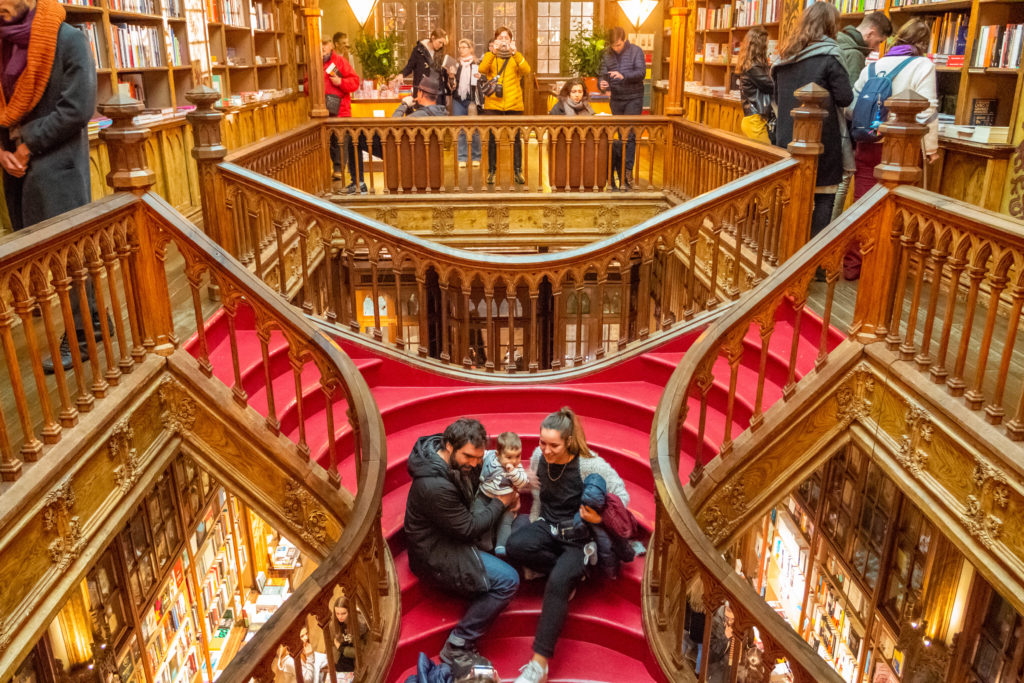
Located in the heart of Porto, Livraria Lello is considered one of the most beautiful bookstores in the world. JK Rowling, the author of the famous Harry Potter series, was inspired by it when writing her novels. She regularly visited the bookstore in the 1990s.
Founded in 1906 by the Lello brothers, Livraria Lello is today one of the most famous landmarks in Portugal. It is attracting many tourists thanks to its amazing design. Even in front of the entrance to the bookstore, the white facade, which combines modern and neo-gothic styles, is impressive.
The exterior is certainly an eye-catcher, but Livraria Lello owes its fame to the store’s stunning interior: walls lined with large floor-to-ceiling bookcases overflowing with volumes in all languages. The highlight is definitely the iconic red spiral staircase.
Tip: in any case, it is better to buy tickets in advance – otherwise you will have to stand in line twice: first to the ticket office, and then again to enter the bookstore. Try to visit in the morning to avoid the crowds on the stairs.
This bookshop is so popular that there is now an entrance fee (it costs €5, but the ticket price is the same if you buy something inside).
4. Go to the ocean on a vintage tram

Take the historic tram number 1 – for 3.5 euros it will take you to the lighthouse and the promenade. Along the promenade, locals walk, ride bicycles, rollerblade and breathe the ocean air while sitting in cafes. It is possible to walk to Matuzinhos beach.
There are two more routes of old trams – No. 18 and No. 22. Line 18 – runs in a loop from the Porto Tram Museum (Museu do Carro Eléctrico) in Massarelos in the west of Porto to Carmo and back with stops at Hospital de Santo António, Viriato and Entre Quintas.
The fare is €3.50 for one trip or €6 for 2 trips. A two-day pass costs 10 euros and can be purchased on board or at the tram museum.
5. Looking for Azulejos

The beautiful Azulejo tiles – The word “azulejo” comes from the Arabic al zellige, meaning “polished stone.” You’ll see these glazed ceramic tiles almost everywhere in Porto – from churches to train stations, fountains and benches. Azulejos are a very important part of Portugal’s cultural heritage.
King Manuel I of Portugal brought this art form to this country in the 15th century from Sevillia, Spain. Initially, the tiles used simple geometric patterns, but over time they evolved into a more complex and decorative art form depicting religious motifs and the nation’s history. These tiles are mainly blue and white in color. Shades of yellow and green are also common.

You can easily explore azulejos in Porto on your own. For example, you can see the monumental panels at the São Bento train station, where almost 20,000 azulejo tiles depict Portuguese history and rural scenes. This colossal work took almost 11 years!
Other outstanding azulejos can be found in the Cathedral of Porto-Se, the churches of Igreja do Carmo, Capella das Almas, Igreja de Santo Ildefonso and the Casa da Musica museum.
6. Go grocery shopping at the Mercado do Bolhão
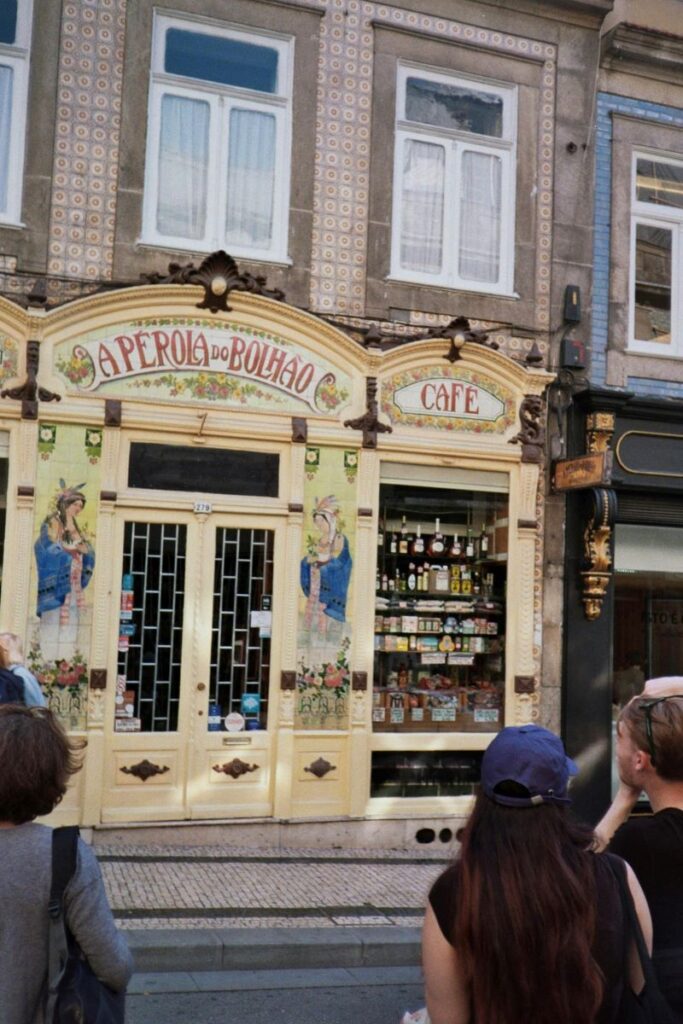
Recently renovated, the new Mercado do Bolhão is a refined version of the old market of the same name, which used to be a loud, busy and rather smelly place.
Now cleaner and prettier than ever, the new market has somehow managed to retain its folkloric charm and still offers an endless array of traditional dishes and delicacies. Despite the fact that it was radically restored to fit the needs of tourists coming to Porto.
7. Visit the historical sights of Porto

Historical sites are something people usually look for in big cities, but I almost didn’t mention Porto. Is it because they are bad? Absolutely not! Although historical sites are not the first thing I would recommend seeing in Porto, there are plenty of interesting sights for anyone interested in history, architecture and religion.
To prove your point, here’s a quick overview of the most famous attractions in the area:
- Avenida dos Aliados is built in the Parisian style and is the transport hub of the city, with a magnificent train station in São Bento and various bus stations located around the boulevard.
- Sé do Porto: One of the city’s oldest and most important monuments, this Romanesque cathedral dates back to the 12th century and is characterized by a mix of architectural styles. This is where the route starts Camino Portuges da Costal pilgrims on walking to Santiago de Compostela in Spain.
- Palácio da Bolsa: an old stock exchange, this 19th-century neoclassical building has sumptuous rooms, including a breathtaking Arab room decorated with intricate Moorish designs.
8. Look at the city from the observation decks

Climb the observation decks for a panoramic view of Porto.
- Clerigos Tower: An iconic symbol of Porto, this baroque bell tower offers panoramic views of the city from the top after climbing 240 steps.
- One of the most photogenic Miradouro da Vitoria is an observation deck on Rua da Vitória, near the small church – Nossa Senhora da Vitória. It is fashionable to get here for free at any time of the day or night.
- The observation deck Miradouro da Serra do Pilar near the monastery is located above the Ponti di Don Luis I bridge. It offers a breathtaking view of the river, Ribeira and the bridge.
9. Surf or swim on the beaches of Porto

The ocean and several city beaches are easily accessible from the center of Porto.Located at the mouth of the Douro River, Foz do Douro is easily accessible by bus #500 or tram #1.
The promenade along Avenida do Brasil and Avenida do Montevideo is full of bars, restaurants and cafes between Castelo de San Juan and Castelo do Quejo (Cheese Castle). From here you can take bus #502 along Avenida da Boavista back into the city.
Further north, Matozinius can be reached by metro Porto (line A). It has some good seafood restaurants and some of the best clubs in town.
If you are into surfing, riding the waves in Matozinius is a must. You might find me having a beer in the sand while you do the hard work. If you’ve never surfed before but would like to try, there are plenty of new surf schools in the area: check out Fish Surf School and Matosinhos Surf Camp to get started.
More information: The best beaches near Porto
10. Take a walk through the historic quarter of Ribeira

Ribeira is a historic quarter in Porto, included in the UNESCO World Heritage List.
Take a walk along the Ribeira embankment – the Doro River flows through the city. Along its winding and high banks are scattered the colorful houses of the old town – Ribeira, with shabby tiled roofs and small balconies.

The main attractions here in Ribeira are the Casa de Infantes, the Church of St. Francis (tel: 222 062 100) with its austere Gothic exterior and the stunning Baroque interior with its catacombs, which contain an ossuary containing human bones. As well as the neoclassical Palacio de Bolsa, once the city’s stock exchange, and the riverside Plaza Ribeira.
It is here that the symbol of Porto is located – the two-story Ponte de Dom Luis I of the 19th century, which crosses the Duoro River to Vila Nova de Gaia.
Along the Duoro from Ribeira to Ponta da Arrabida, you can take a pleasant 2 km walk along the river.
Summary
- Porto, the second largest city in Portugal, offers numerous attractions and experiences beyond sightseeing.
- Top highlights include taking pictures near the Don Luis I Bridge and tasting port wine in Vila Nova de Gaia.
- Visitors should explore the stunning Livraria Lello bookstore and ride vintage trams to the ocean.
- Don’t miss the chance to see beautiful Azulejos tiles, shop at Mercado do Bolhão, and visit historical sights like Sé do Porto.
- Experience panoramic views from observation decks and enjoy the beaches of Porto, as well as the historic Ribeira quarter.
Useful articles and links:
- Algarve – the best beaches in Portugal
- Nazare – the biggest waves and beaches in Portugal
- Sintra – a great guide to the city and beaches
- Beaches near Lisbon – where to relax, walk and play sports
- Cascais – a beach resort near Lisbon
Find train tickets in Europe conveniently on Trainline
Rent a car – Rentalcars.com
Booking of hotels and apartments – Booking.com