

Naples and the surrounding area in four days – what we managed to see and try in Naples, how to climb Vesuvius, the surrounding area – Amalfi, Positano.
If you’ve already been to Rome, Venice, or Milan, I recommend you look towards Naples. It’s very different from the northern cities listed, but has its own unique atmosphere.
Naples is the best cure for boredom. It has a special cuisine, an original culture and stunning nature at the junction of the sea and the mountains. It is worth coming here to bask in the sun in the spring, eat the most delicious pizza in Italy, see the lemon harvest in the winter, climb Vesuvius – this is the minimum that can be done in a few days in this bright and chaotic city.
When is the best time to go to Naples?

Anytime! Naples is a great destination all year round. So come whenever you feel like it and you will find it beautiful and thriving all year round.
It can be very hot in the summer, so if you can’t stand the heat, I would advise you to avoid this peak season.
The winter in southern Italy is not like that of northern Europe, so it is a great place for a winter holiday. Although it can be almost as crowded in winter as in summer.
The best time, in my opinion, to visit Naples is spring and autumn. This is from October to November, and from February to May.
During this time, the weather is pleasant and usually warm, there are few crowds, prices are lower, and the queues are noticeable. This is the perfect time to enjoy Naples in a relaxed atmosphere. You will also see a lot more locals enjoying the Italian life – Dolce Vita.
We were in Naples in mid-November. At this time, the air temperature on the Neapolitan coast in the middle of the day rises to 23℃. The same is true in spring – in March and April: the sea is still cold, but you can sunbathe without problems
Keep in mind that the weather is often changeable – winds can come and bring clouds with them. You can take an umbrella with you, there are short-term rains.
How to get to Naples
You can get to Naples by various transport options:
by train from Rome, by plane from various cities and countries in Europe, low-cost and other airlines fly here.
Where to stay in Naples

Naples is a fairly compact city with many of the key attractions all located in one area. So choosing where to stay in Naples is easy, as it is best to stay somewhere in the center and on the coast.
Most of Naples’ districts are suburbs, stretching far from the city center. You can find cheap hotels in these areas, but this will increase your travel time. And the outskirts of the city are not as pretty as its interesting and colorful center.
The best area of Naples is in the Chiaia district. Staying in this part of the city will put you in the middle of the action. This is the shopping center of Naples, but it is also right on the coast and within walking distance of many attractions.
Hotels and apartments in the center of Naples:
I traditionally booked accommodation on Booking-Napoli. Here you can find a hotel or apartment in the very center of the city at the best price.
- Mia Suites Beverello≫ – The apartment is beautiful, clean and elegantly furnished, located in the Central district near the port. It is convenient that there are means of transport nearby and you can even walk around the city well.
- il Salotto di Chiaia≫ – The apartment is located in the very center of Naples, literally a stone’s throw from Piazza Plebiscito. Friendly and extremely helpful owner. New clean apartment with good beds, kitchenette and everything you need for a comfortable stay.
- Dadalu’ Toledo≫ – Brand new apartments, tastefully furnished, with all amenities, clean and welcoming. Great common areas and a very well-organized kitchen with coffee machine, capsules, microwave, juicer, toaster. Great location, in the center directly on Via Toledo (close to Toledo metro), but at the same time well insulated from noise.
How to get around Naples

Naples has excellent public transport. Metro stations are located in every part of the city, making it easy to get from one area to another. The stations are also incredibly beautiful.
They are called “artistic stations” – a city initiative aimed at beautifying the more modern elements of the city. Toledo station is often considered the most beautiful in the world, designed to look like an intricate underwater grotto.
Buses are also a great option and run every few minutes. From the airport, you can take a bus or train and use them to get around Naples. Transport is not something you should worry about here. Although I think that the main way to get around Naples should be with your feet. On foot – to walk around the city, as it is quite compact in the center and worth exploring.
Tip: The only thing I would sincerely not advise you to do in this city is to rent a car! I really like traveling by car: a rented or your own car. But here in the south of Italy there is a very specific driving style – all the cars I saw in Naples were beat up or worn out. There is some chaos at intersections without traffic lights. Honestly, you don’t need a car in the city. But if you book a car to go out of town – take full insurance!
You can choose the optimal car on the aggregator – Rentalcars.com.
Day 1 – historic center of Naples

Naples is primarily a colorful city of worn streets. In the old town, clotheslines are stretched between the houses. Everywhere you can hear the cries of quite expressive locals who are simply used to showing their emotions for show.
What is worth seeing in Naples and not to be missed?
Royal Palace of Naples

Go to Piazza del Plebiscito. The huge square on a sunny day will give the feeling that Naples is at least the navel of Italy – behind you will be the columns of the Royal Palace, and in front of you the waters of the Gulf of Naples.
The Royal Palace of Naples, located in the very center of the city on Piazza del Plebiscito, is one of the former residences of the Bourbon kings. It was designed and built by the Spanish court. The Royal Palace of Naples dates back to the early 17th century, and was originally intended to accommodate King Philip III of Spain.
Over the years, the palace has been reconstructed and restored, especially after World War II, when it was badly damaged by bombing. It now houses the National Library of Vittorio Emanuele III, the Teatro San Carlo and various administrative offices.
Castel dell’Ovo
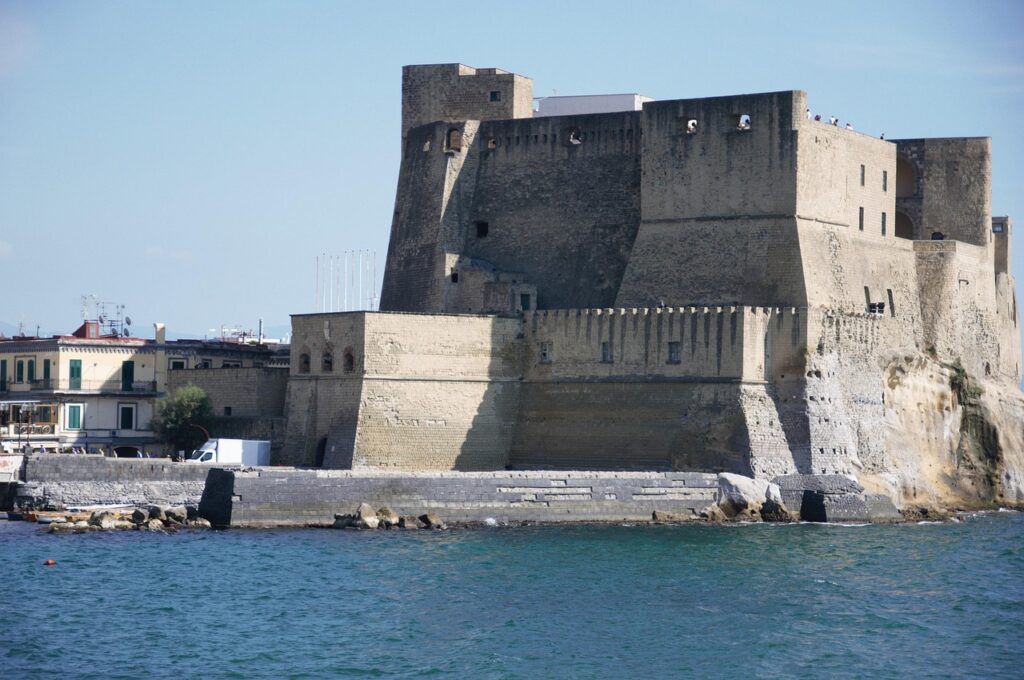
Castel dell’Ovo or Egg Castle, is the oldest fortification in Naples. Its location on the seafront is visible from most of the city. The castle is built on the foundations of a Roman villa, on an islet in the harbor of Naples. On this islet, called Megarida (now connected to the mainland by a causeway), legend has it that the siren Parthenope came ashore after failing to lure Ulysses.
The castle takes its name from the Roman poet Virgil. Legend has it that Virgil placed an enchanted egg in the castle’s foundation as protection. If the egg breaks, it means disaster for the city and its inhabitants.
Castel dell’Ovo was once a royal residence, but was later used as a prison. In the 15th century, the fortress was heavily modified by the Aragonese, and its current appearance dates from this era. Recent underwater archaeologists have discovered the original port of Naples, as well as the original Greek settlement of Paleopolis.
Castel Nuovo
Then go to Castel Nuovo – a magnificently preserved castle, which today houses the city museum. Yachts sway under the castle walls, seagulls fly above them, and the port bustles nearby – complete immersion in the atmosphere of a large seaside city.

Castel Nuovo, or New Castle, was named to distinguish it from Castel dell’Ovo, which is only a few hundred years older than the castle. It was modified from the original Franciscan monastery by Charles I of Anjou, who ruled the Kingdom of Sicily in the 13th century.
The castle, known locally as Maschio Angioino or Angevin Castle, is still in use today. Visitors can see the Arch of Triumph, the Palatine Chapel, the Barons’ Hall, and the Roman ruins beneath the Armory.
The Cappella Palatina is the only part of the original building that remains; like Castel dell’Ovo, Castel Nuovo was altered by the Aragonese. The nobility patronized the arts and hosted many famous artists; frescoes by Giotto decorate much of the interior.
Naples Cathedral

Naples Cathedral is the most important Roman Catholic church in southern Italy and has outstanding frescoes dating back to the 14th century. Visitors can also see Greco-Roman ruins, as well as two Paleo-Christian churches dating back to the 4th century. Much of the modern church is Gothic with later Renaissance and Baroque additions/modifications. It was also damaged by bombs during the war and has since been restored.
Twice a year, the cathedral will bring out the chalice of Saint Januarius, or San Gennaro, the patron saint of Naples. The blood is usually thinned, and if it does not, legend has it that disaster will befall the city.
Funicular in Naples
It is worth taking a funicular to one of the hills of Naples to see the clouds swirling over the cap of Vesuvius. The funicular to Vomero Hill is suitable for this: the starting station of Augusteo is opposite the Galleria Umberto I on the outskirts of via Toledo and not far from Piazza Plebiscito. The cost of a one-way ticket is €1.3. If you plan to use public transport a lot, it is worth buying a day pass for €3.5.
Catacombs and dungeons of Naples

The opposite of a city tour from above is a tour of the dungeons and catacombs of Naples. The network of catacombs of San Gaudioso, San Gennaro, San Severo is located under the city at a depth of up to 40 meters. The tour costs €10.
A great alternative can be an independent underground tour of the Neapolitan metro. Yes, this is not a joke – Naples has one of the most beautiful metros in the world, you will rarely see such stations – real masterpieces! By the way, the Toledo and Dante stations are recognized as the most beautiful in the world. Such an independent tour will cost only €1.3.

Lines 1 and 6 of the Naples Metro can be called underground art galleries. Each station, featuring contemporary art, is unique and accessible to all who travel on the metro. Both lines feature over 180 different works of contemporary art, and several other stations are planned to be transformed into art stations.
Christmas Road


San Gregorio Armeno, or Christmas Road, is a small street in Spaccanapoli where Christmas is celebrated all year round. Here you can buy a crib called a presepe, the nativity scene so famous in Naples, or any other Christmas item that will complement your nativity scene. What’s so cool about San Gregorio Armeno is that it’s not just traditional nativity scenes, but every scene you can think of. And some of them are quite creative. When exploring the old town, don’t miss this world-famous spot.
What to see in the vicinity of Naples

Do you know why Naples is the way it is? Noisy, dirty, irreverent and sometimes dangerous, with all this laundry on the lines, peeling walls, incredibly delicious pizza, wine and sweets, noisy men and women, drivers who do not recognize traffic rules, the most delicious ice cream, mothers with a bunch of children who are born into the world, disorder, eternal garbage on the roadsides and omnipresent motorcyclists.
Vesuvius is to blame for everything. Yes, yes, the reason for all of the above is precisely this mountain, which has killed more than one thousand people. It has been puffing for hundreds of years, releasing toxic gas fumes. It was Vesuvius that made the Neapolitans who they are.
They have joy and love for life, they catch every second and do not pay attention to conventions. They eat divine and unhealthy pizza, the best gelato in the world, shout curses at each other, and within a minute, hug like the closest people in the world.
Climb Vesuvius
So – Vesuvius, don’t miss the opportunity to climb the volcano – in quiet times it is open to tourists.

To do this, you need to get to the nearest town of Pompeii – you can get there by car, or you can take the train for €3. Train tickets in Italy can be purchased on the websiteTrainline.
Then the bus will take you to the foot of the volcano and back – for €4. You must purchase online tickets to access the volcano in advance – on the website of the Natura park of volcano.

To see the crater, you need to climb another couple of hundred meters up, walk for about 30 minutes. But at the top you can look into the heart of the volcano: it is still dormant, but sensors are installed on it that record volcanic activity. The volcano offers a stunning panorama of the entire Gulf of Naples, and in good weather you can see its neighbor Etna in Sicily, the islands of Ischia and Capri.

Amalfi – lemon city
Another option to complement your vacation in Naples is to visit the nearby resorts of Positano, Amalfi and Sorrento, whose numerous bays and rocky shores are planted with lemon groves. To do this, you can use the bus departing from the ferry. The cost from Naples to Amalfi is €8, a full circle through all cities is €20.
Amalfi

Amalfi has beautiful slopes and sea, and very cozy cafes. Order a cup of coffee with a glass of limoncello at a seaside cafe, put your face in the sun and forget that autumn has already arrived.

Coffee in Naples is one of the most delicious in Italy. In general, this land was very lucky – the best products were brought to the local port and the demanding attitude to the quality of ingredients has been preserved to this day. Coffee in Neapolitan coffee houses starts from 1.5€ for a cup of espresso, cappuccino – from 2.5€. Delicious – the wrong word! In a pasticceria (bakery) buy rum baba – this is a local delight, invented in Naples (2€).
Positano

A wonderfully beautiful town on the mountain slopes, from which stairs run straight down to the sea. I fell in love with this place, I want to come back again and again.
What and where to eat in Naples


Neapolitan cuisine is primarily pizza. Yes, it is, because pizza is not made tastier than in Naples anywhere in all of Italy.
Classic pizza is pizza margherita (named after Margherita of Savoy) and pizza marinara. The first consists of dough that stretches and melts in your mouth, the filling is mozzarella cheese, grated tomatoes and basil. Pizza marinara – tomatoes, dough, tomatoes, garlic and oregano. This is a classic, the rest are a dozen names and variations for those who like with additives: meat, mushrooms, anchovies, etc.

The most delicious pizza can be tasted in any pizzeria, but my favorite is Pizzeria Antonio e Gigi Sorbillo (Via Dei Tribunali 38). Keep in mind that there may be queues here – the tables are constantly packed with visitors. The price for a margherita with a double portion of mozzarella is €6.
Please note that most establishments charge a coperto – a fee for service and changing plates and tablecloths – €2 per person.
Street food is another heavenly delight of the flavors of Naples. Ice cream – gelato, from €2 per ball. Arancini – rice balls with filling, originally from neighboring Sicily – from €1.5 per piece. A street version of a closed pizza is pizza fritte or fried pizza. This is a piece of yeast dough fried in oil, with a filling of cheese, ham and tomatoes. Deep-fried seafood – you can buy them on every corner: shrimp, squid, bambini octopus – fried and packed in a regular paper ball, often served on skewers – a portion from €4.
I sincerely recommend Naples, although it may not be to everyone’s taste. The city is not polished to a shine – it has its own character. It is often dirty and very noisy here. But I like such cities.
Useful links for travelers:
Car rental – cheap car rental options in Ukraine Rentalcars.com
Hotels – traditionally booked through Booking
Insurance can be purchased on the website Hotline.Finance
Train tickets in Europe – on Trainline
Velvet season – the best places to relax at sea in September
Tropea – complete guide about the rest on the best beaches of Calabria, Italy
Cinque Terre – how to visit, where to stay, what to see