
After returning from my trip to Portugal, I gathered useful information about hotels and neighborhoods in this city where it is best to look for accommodation when traveling.
I tell you how to choose housing, in which neighborhood to settle, how close to the historical center and main attractions, metro stations, and depending on the city’s landscape. I hope my experience will be useful to you.

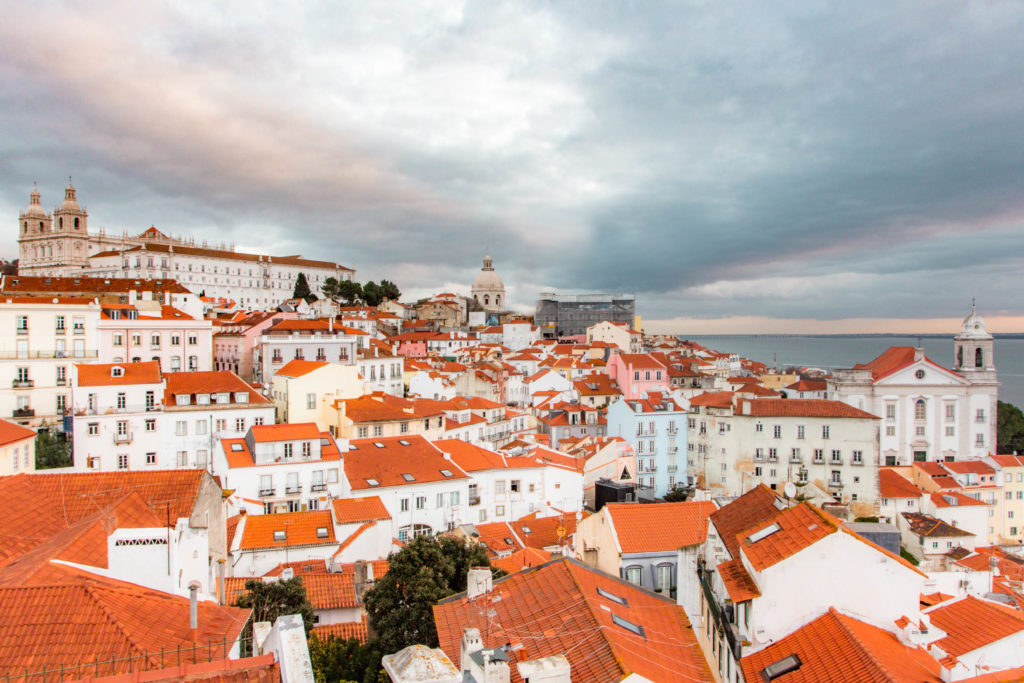
Lisbon is a vibrant and colorful city located on the hills by the Tagus River. Because of this, to get to some hotels and apartments, you will have to overcome stairs, descents and ascents. Plus, the price of hotels does not always correspond to their quality.
In February 2020, I was in Lisbon with my mother. It is difficult for her to climb up a hill, to the upper floors without an elevator, and to walk for a long time. I had to think through all the routes and look for accommodation in Lisbon with attention to its capabilities.
To find something suitable for our needs and not for all the money in the world, we had to search for offers on Booking.com.
What to know when choosing an apartment in Lisbon
When I went to Lisbon for the first time it was quite difficult to decide which neighborhood to settle in with my housing requirements. But it was the third trip with my mom and I managed to find suitable options.
To do this, I used the following life hacks:
- The easiest way is to carefully read the reviews of previous guests Booking.com – there is an option for automatic translation from any language.
- Sort all offers with a score of 8 or higher on Booking.com. All the hotels and apartments in Lisbon that are rated lower are really not worthy of attention. Either it will be a microscopic apartment on the ground floor, or an unsympathetic neighborhood, or dirty housing with broken plumbing.
- After finding a suitable option for the price, copy the address and look at Google Maps – to see on which street the hotel is located. There’s a simple function to launch the little man to see a panoramic image of the neighborhood.
- The same function will help you see how steeply uphill your street leads. This will especially help those who find it difficult to walk up hills, either because of age or because they use a wheelchair.
- If you are traveling to Lisbon with children or with the elderly, choose a hotel near a metro station or public transportation stop. You’ll need the metro or trams to get around most of Lisbon’s attractions. It is better to buy a daily pass to use all types of transportation: old trams, funiculars, subways, and buses.
- Also check for an elevator in the hotel or in the building where the apartment is located. Most housing is in old houses with steep, narrow staircases. If you have large suitcases, consider this as well.
- Remember that in Lisbon you need to pay a tourist tax of 4 euros per day. Carefully read the price of accommodation on Booking, as the tax is often not included in the total amount of accommodation and is paid separately.
- If you arrive in Lisbon by car, ask your apartment owners about parking in advance, or write a request to the hotel. Parking can be either free (such housing options are very rare in the city center) or paid. The price depends on the city district and can reach up to 25 euros per day for storing a car in an underground parking lot.
Accommodation in the historic center of Lisbon

Lisbon is a fairly large city by European standards. Traditionally, the main tourist attractions are concentrated in its historic center. The historical part of the city is located on numerous hills and hills above the Tagus River.
It is optimal to settle in one of the districts of the Historical Center so as not to spend 30-40 minutes a day on transport logistics. Also, do not choose housing on the opposite bank – in the Almada district. It takes a long time to get there, and the fare is more expensive. It is best to choose a hotel or apartment in one of the central districts.
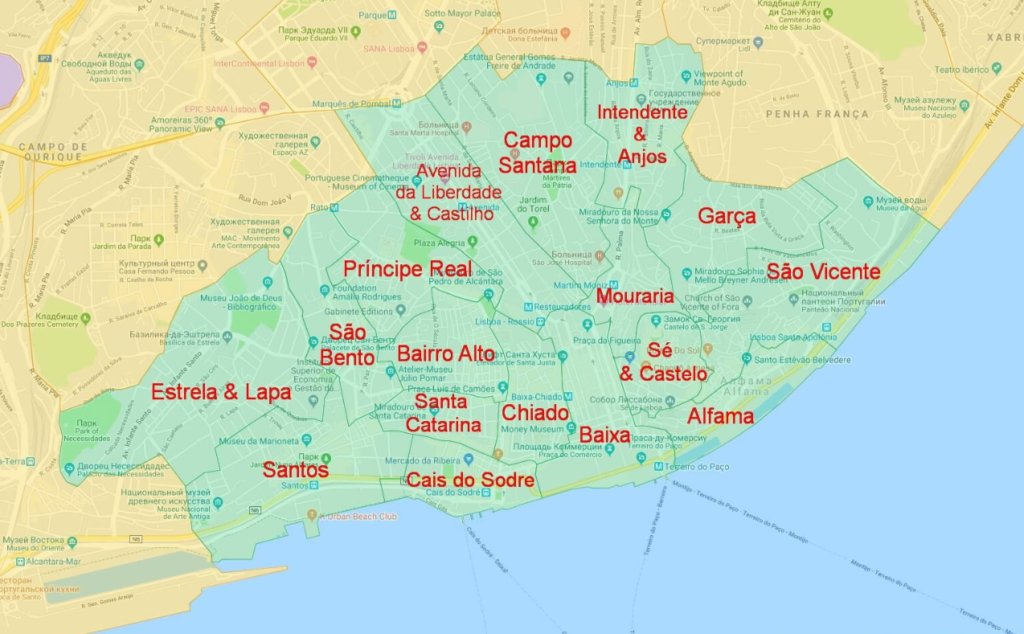
Each of the districts has its own peculiarities, pros and cons. Depending on the requirements and desires of tourists. Let’s take a closer look at each of them.
Baixa – the center and main attractions

Baixa is the center of Lisbon, it doesn’t get much more central than that. Several parallel streets stretch from Praça da Figueira towards the Tagus River, where tourist restaurants and souvenir shops are located. The main one is Rua Augusta, a promenade street that borders the Arc de Triomphe and the Plaza de Commerce.
Everything here is flat and there are no slides. You can walk for a long time on foot to the embankment of the Tagus River, walk along it towards the April 25th bridge, and eat roasted chestnuts from a tray(3 euros bag) – delicious!!!
Pros:
– Close to metro stations: Rossio and Terreiro do Paço – blue line.
– In Baixa, on R. Conceição street, the old tram No. 28 runs. In the morning and evening hours, you can catch a ride at the bus stop(38°42’35.3 “N 9°08’13.5 “W) if you don’t have a seat. Remember that if the tram is overcrowded, it stops only at the request of passengers inside.
Cons:
– There is a large selection of hotels and hostels in the Baixa area. But they are all located in old buildings with narrow stairwells and no elevator.
– If the hotel windows overlook Praça da Figueira Square or busy streets, you will hear the noise and chatter of trams until late at night.
Nearby attractions:
- The Cathedral of Lisbon (entrance fee 4 Euro)
- Commerce Square
- Praça Dom Pedro IV and Rossio Station
- Santa Justa elevator (5 euros and a long queue)
- Museums of Lisbon history

Accommodation options in Baisha:
- B in B Lisbon Downtown Suites – is a cozy hotel in the heart of Lisbon.
- Lisbon Downtown – is a small guest house with simple but clean rooms for undemanding tourists who do not spend time in a hotel.
- Rossio Apartments – tiny but cozy apartments overlooking Rossio Square.
- Be Poet Baixa Hotel – is a wonderful hotel on the pedestrian street of Rua Augusta.
Alfama – old Lisbon

The Alfama neighborhood is very atmospheric, reminiscent of Odesa’s Moldovanka. Narrow streets and staircases run down from the Miradouro de Santa Luzia hill to the new passenger terminal, located at the foot of Alfama on the Tagus River.
It is one of the best preserved old neighborhoods with an authentic Lisbon atmosphere. There are small cafes around where you can listen to fado in the evenings, clothes are drying on ropes, and old ladies sell chocolate shots with zinjinha on the stairs and in the doorways of their apartments.
Pros:
– The authentic space of the neighborhood, many nice cafes where Fado – traditional Portuguese songs – are played in the evenings.
– The stairs are not an obstacle for young people – they can sit on them in the evenings, listening to the sounds of Alphabet.
Cons:
– Most houses have quite a bit of space inside. There are few hotels, a small selection of hostels and apartments. Apartments are often small, with windows facing the walls of neighboring buildings.
– To get here by transport, you will need either the old tram No. 28, which takes you to the top of the Miradouro de Santa Luzia, or you can walk up steep stairs. There is an elevator that can take you down to several levels, but it doesn’t always work. Or take the subway to the cruise terminal, and from there up the same winding steep stairs.
Nearby attractions:
- Fado Museum
- Viewpoint Miradouro das Portas do Sol
- Miradouro de Santa Luzia observation deck
- St. George’s Castle (a little higher on the hill)

Accommodation options in Alfama:
- My Alfama Apartment – is a nice, albeit very small apartment with windows overlooking a small area.
- Lisbon Best Choice Apartments – spacious apartments with views of the Tagus River
- Memmo Alfama – Design Hotels – A boutique hotel, one of the few in the area, has rooms with a terrace offering stunning views of the river.
Chiado – shopping and restaurants

If you are interested in shopping, bars and cool restaurants, look for accommodation in the Shiadou district. During the day, the city is bustling with life, and in the evening, numerous restaurants are open late. Zara and H&M are located in the area, so you can spend a few hours looking for new clothes.
The nearest metro station is Baixa-Chiado (two stations on the blue and green lines), and the old tram #28 also runs here.
Pros:
– A large selection of cafes and bars, ranging from simple tassas to local cafes where you can have a quick and inexpensive bite to eat.
– Excellent shopping – the largest clothing retailers are within two to three blocks
Cons:
– It’s almost always crowded, although if you want, you can walk a few blocks away from Praça Luís de Camões and sit in quiet squares or walk along deserted streets.
Nearby attractions:
- The destroyed Carmo monastery
- Church of Sao Roque
- Free observation deck of the Santa Justa elevator
Accommodation options in Shiadu:
- Loving Chiado – is a rather spacious apartment located on several floors of the building, with a loft for a large family upstairs.
- Flores 105 Guesthouse – A nice and fairly inexpensive hotel with breakfast included.
- Poets Privates – family rooms in a large apartment with shared facilities.
Bairro Alto – partying until the morning

Bairro AltoAccording to a good friend of mine who rented a tiny room there for 25 euros a night, it’s “the most out-of-the-way neighborhood for those interested in tiny noisy bars, music until 4 a.m., weird but totally harmless guys selling everything from weed to cocaine at all hours of the day, and the whole underground vibe.” Overall, it’s atmospheric and noisy, but definitely not boring.
Nearest metro station: Restauradores (blue line), from which you will have to walk uphill or take the Elevador da Glória funicular.
Pros:
– The area has great food in nondescript cafes, with menus and dishes cheaper than in Alfama or Baixa.
Cons:
– Some streets can be noisy until the morning.
– You’ll have to change trains or walk with a suitcase from the metro station.
Nearby attractions:
- Miradouro de São Pedro de Alcantara
- Church of St. Roch

Accommodation options in Bairu Alta:
- Selina Secret Garden Lisbon – is a stylish hipster hotel with a rooftop bar and patio.
- Le Flat | Bairro Alto Studio – apartments with a kitchen and a bathroom.
- Inn Bairro Alto B&B / B.A Sweet – is a cool bed and breakfast.
- Bairro Alto Hotel – a five-star hotel at a great price.
Mouraria is an international neighborhood with great cafes

Mauraria is an international neighborhood with many Nepalese, Indian, Peruvian, and Chinese cafes and shops. A very colorful international, sometimes dirty neighborhood. But it is located near the terminus of the old tram 28 (on Martim Moniz Square), from where it heads up into the hills on the way to Alfama. I lived in this neighborhood twice in a very clean apartment.
Nearest metro station: Martim Moniz and Intendente (green line).
Pros:
– Often inexpensive, albeit tired, housing. Convenient transportation.
– There are supermarkets, also located within walking distance to many attractions and the center of Lisbon.
– If you like kebab and hookah, this is the place for you. Many inexpensive international cafes and restaurants.
Cons:
– If you settle in the depths of the neighborhood, get ready to storm the hills with a suitcase.
– Not very clean, although Lisbon is not a particularly clean city by and large, but you can stumble upon a mini-dump in an inconspicuous corner.
Nearby attractions:
- Praça da Figueira Square
- Miradouro do Recolhimento observation deck
- Viewpoint Miradouro da Graça
- Miradouro da Senhora do Monte observation deck
- The final stop of tram #28 is Martim Moniz Square

Accommodation options in Mouraria:
- Hostel Charme da Graça – is a wonderful hostel with private rooms.
- Castle Boutique Apartments – apartments for two, I would have stayed there, but there were no vacancies for my dates.
- Casas da Baixa-Vila is a wonderful hotel, with well-trained staff, nice step balconies in the rooms, and breakfasts are beyond praise.
- LARGO Residencias – I lived here for a few days in the winter, simple, inexpensive, and cozy, close to the metro.
Santa Catarina (Bica) – narrow streets and stairs and cool apartments

Bica is a nice neighborhood in the heart of Lisbon. Located in close proximity to Baish, most of the streets are steep hills and staircases. Hotels, hostels and apartments in old buildings without elevators. But there are also some gems – apartments with an attic and views of the Tagus River. I stayed here for a few days in a wonderful hostel and I will stay here next time because of the cool atmosphere.
The nearest metro station: Cais do Sodré (green line)
Pros:
– Cool locations for beautiful photos, lots of hidden cafes with small terraces.
– The Miradouro de Santa Catarina observation deck offers a magnificent view of the river.
Cons:
– Get ready to stomp up and down the hill in a hug with your suitcase. It’s pretty cool here!
Nearby attractions:
- Miradouro de Santa Catarina observation deck
- Ancient funicular Elevador da Bica (Bica)
- Time Out Market food market
- The Pink Street with lots of bars

Accommodation options in Santa Catarina:
- Cais do Sodré Guest House – economy class apartments
- Lisbon Five Stars Apartments – is a fantastically beautiful huge loft at a great price.
- Lisbon Five Stars Apartments – very stylish apartments overlooking Dom Luiz Park.
- Sunset Destination Hostel – is one of the coolest hostels in Lisbon with a rooftop pool and bar overlooking the Tagus River. Cool atmosphere, super kitchen and lobby, friendly staff.
Av. da Liberdade / Avenida da Liberdade – prestigious and close to the center

Wide avenue Avendida da Liberdade with a lot of shops – Armani, Gucci and Dolce Gabbana, theaters and a beautiful plane tree alley on the sides. There are many good hotels and apartments here.
Housing prices here are slightly higher, but everything is respectable and spacious. It’s nice to walk around, and it’s also interesting to look into the neighboring alleys and streets. On the quiet parallel street R. São José has a lot of cool, inexpensive restaurants, pâtisserie cafes, and my favorite coffee shop, Fábrica Coffee Roasters, with the best cappuccino in Lisbon.
Nearest metro stations: Avenida (blue line), Restauradores (blue line), Rossio (green line).
Pros:
– A large selection of good hotels, apartments and hostels.
– There are many restaurants and cafes with great menus and no tourist attractions, convenient transportation, close to the center.
Cons:
– More expensive than in other neighborhoods, but the cost is justified by the comfort and pleasant neighborhood.
Nearby attractions:
- Praça Dom Pedro IV and Rossio Station
- The ancient Largo da Anunciada funicular leads to the hill in the Graça district, with observation decks offering stunning views of Lisbon.
- Shop A Ginjinha (Largo São Domingos 8), where you can buy a bottle of Ginjinha or a glass of liqueur for 2 euros
- Sao Dominguez Church – was destroyed during the earthquake of 1755. and restored with the preservation of the surviving columns and altar (visit – you won’t regret it).
- Tivoli Theater – here you can listen to the performances of stars performing Fado

Accommodation options for Avenida de Liberdade:
- TURIM Restauradores Hotel – an inexpensive but nice option within 70 euros per night.
- Hotel Expo Astoria – is a sure three stars for 90 euros.
- Bluesock Hostels Lisboa – is an excellent modern hostel, there are double rooms with shared facilities. I lived here for 14 euros a day in a dormitory.
- Charm Flats – are wonderful apartments with a kitchen for those who like to prepare breakfast in the morning.
Belem – museums and the Tagus River embankment

The Belem neighborhood is quite remote from the center, adjacent to the waterfront near the Tagus River. You will have to make transfers from the airport and take at least half an hour by tram #15 from the center. The neighborhood will appeal to those who are not new to Lisbon and want to enjoy morning jogs along the waterfront and sunsets near the Torre de Belém tower.
Nearest metro station: there is no metro to this part of Lisbon, so you need to change to tram #15 at the final station of the green line Cais do Sodré.
Pros:
– Inexpensive housing, few tourists, lots of air on the waterfront.
Cons:
– It takes a long time to get from the airport and to the center.
Nearby attractions:
- Torre de Belém Tower
- Vasco da Gama Aquarium
- LxMarket at the former factory under the bridge on April 25
- Bridge on April 25
- Museum of Art and Architecture MAAT
- Museum of Popular Art
- Gothic monastery of Jeronimus
- Pastéis de Belém confectionery

Accommodation options in Belem:
- Cosy Bedrooms Guest House – cool apartments near the Torri de Belem tower.
- Famous Crows Lisbon Suites – apartments with a kitchen to prepare breakfast after a run.
- LxRoller Orange Tree House – Belém – apartment with a terrace near the MAAT Museum.
Príncipe Real is a bohemian neighborhood

Finally, I left my favorite neighborhood to live in Lisbon – Principal Real. I discovered it at the end of my last trip – it’s a diamond hidden from many tourists. And I kind of regret that I didn’t pay attention to him before.
We lived near Estrella Park on Av. Alvarez Cabral. Despite its remoteness from the center, it is easy to get here by metro or bus. Quiet streets, greenery, parks with ducks and exotic plants. Within walking distance of the famous Basilica of Estrella, a good selection of hotels. There are many coffee shops and nice restaurants with cheap and tasty food. I highly recommend it!
The nearest metro station: Rato (yellow line terminus)
Pros:
– It’s nice and respectable, with supermarkets and cafes. There are few tourists in the area, but there is plenty to see.
Cons:
– Some streets are very steeply downhill. When choosing a place to live, I used Google maps and launched a little man to see the slope of the streets.
Nearby attractions:
- Basilica da Estrella
- Estrella Park (garden)
- Lisbon Botanical Garden
- Viewpoint Miradouro de São Pedro de Alcântara

Accommodation options in Principale Real:
- Dany Lisbon House – two-bedroom apartments at a nice price.
- Dom Dinis Studios – apartment with a nice balcony and breakfast. We lived here for two days with my mother.
- Casa do Leão 1 – authenticity of an old house, apartments on the ground floor.
What else to read
- Cheap accommodation in Porto – how to choose a neighborhood and hotel
- In Porto in winter – what to see and do
- Lisbon – sights and routes
- Car route from Lisbon to Porto
Useful links to prepare for your trip:
Car rental – cheap car rental options in Ukraine Rentalcars.com
If you are planning to visit Lisbon for a couple of days, it is ideal to book accommodation on Booking.com