Why Mallorca? A few years ago, I decided to explore the European islands. Before that, my travel collection only included Sicily, to which Malta and Madeira have already been added. And here is the third “Ma” – Mallorca, a very popular holiday destination. But I chose the shoulder season (or “velvet season”) to enjoy the warm sea and the absence of summer crowds.
Although this largest Balearic island of Spain is mostly associated with beaches and a vibrant, albeit noisy, party atmosphere, it offers much more for the discerning traveler.
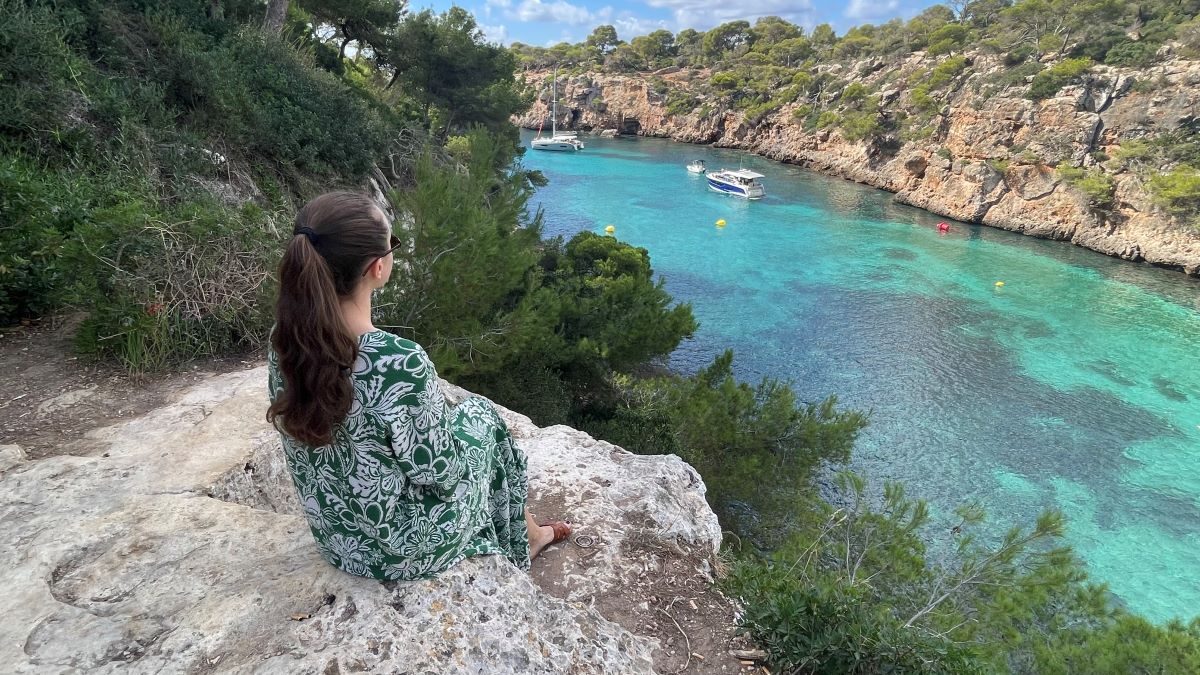
Mallorca is an island of coves (Cala), framed by pines, sandy beaches, terraced olive groves, and winding mountain roads. Mallorca’s charm lies in its fabulous sunny landscapes, charming honey-colored villages, and stylish hotels.
Traveling the island by car is, in my opinion, the best way to see as much as possible. And also to be free in terms of time and chosen directions. I’ve been traveling this way for a long time and I highly recommend it to everyone: learn to drive a rental car, get a driver’s license to feel that thrill – I go wherever I want!
Seasons in Mallorca
In fact, you can visit this island all year round – just like Barcelona, where it’s warm and pleasant to walk even in winter. And Mallorca has mountains for winter hiking and wonderful cities – Palma de Mallorca is very crowded in summer, but winter is the perfect time to explore it properly.
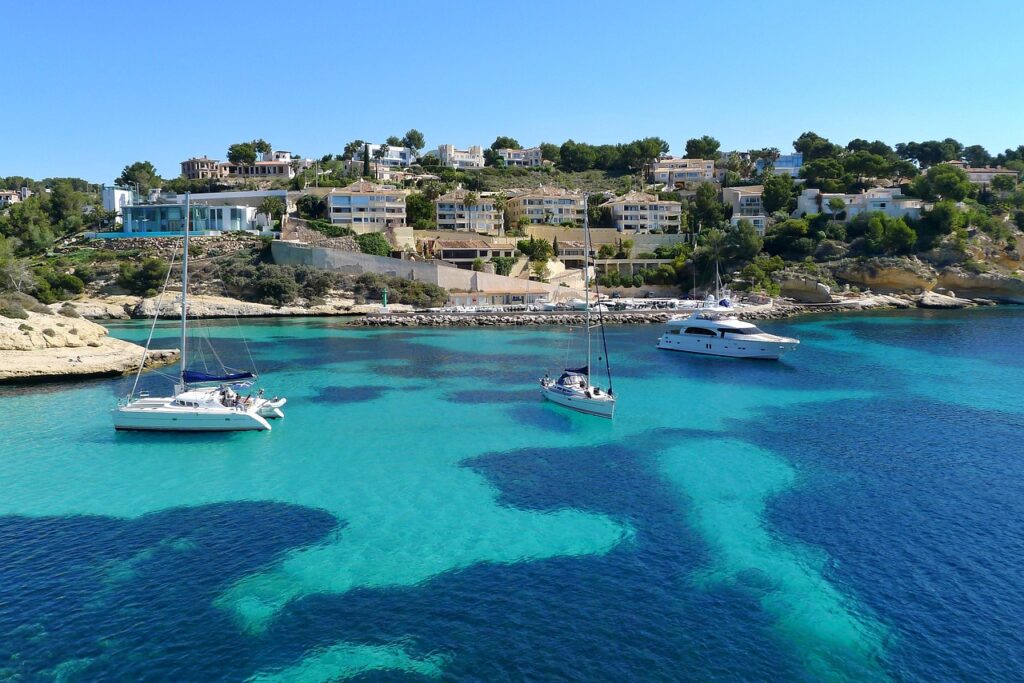
Summer – all the beaches here are filled with vacationers, because this is the time when the sea water is the warmest and the most beautiful color. It is an incredible emerald and blue color. You won’t see this color everywhere, so summer for a beach holiday is a great time in Mallorca. Although the prices are much higher than in winter and during the low season.
In winter, Mallorca is more or less empty. Many hotels and restaurants close for the season. The island can feel deserted.
But if you are interested in the sea, as well as an active road trip to explore the island – the ideal time is spring and autumn. Specifically, May or September are the ideal times for a calm and more budget-friendly holiday in Mallorca.
These are the two periods when:
- the sea is already (or still) warm
- there are significantly fewer tourists than in summer
- accommodation and car rental are 20–40% cheaper
- the light is soft, the sky is clear, and the colors are incredible for photos
Spring – May
- Air temperature: +23…25 °C
- Sea: ~18–20 °C — refreshing, but already pleasant for swimming.
- Landscapes: everything is green, the Serra de Tramuntana mountains are blooming, ideal for trekking.
- Pros: clean beaches, peace, lower prices.
- Cons: the water is not yet as warm as in August.
Autumn – September – Early October
Cons: in the second half of September and early October, short thunderstorms are possible (the start of the “rainy season”).
- Air temperature: +25…27 °C
- Sea: ~23-25 °C — ideal for swimming.
- Tourists: already fewer after August, beaches are quieter.
- Pros: warm sea, wonderful evenings, beautiful light at sunset.
How to get to Mallorca
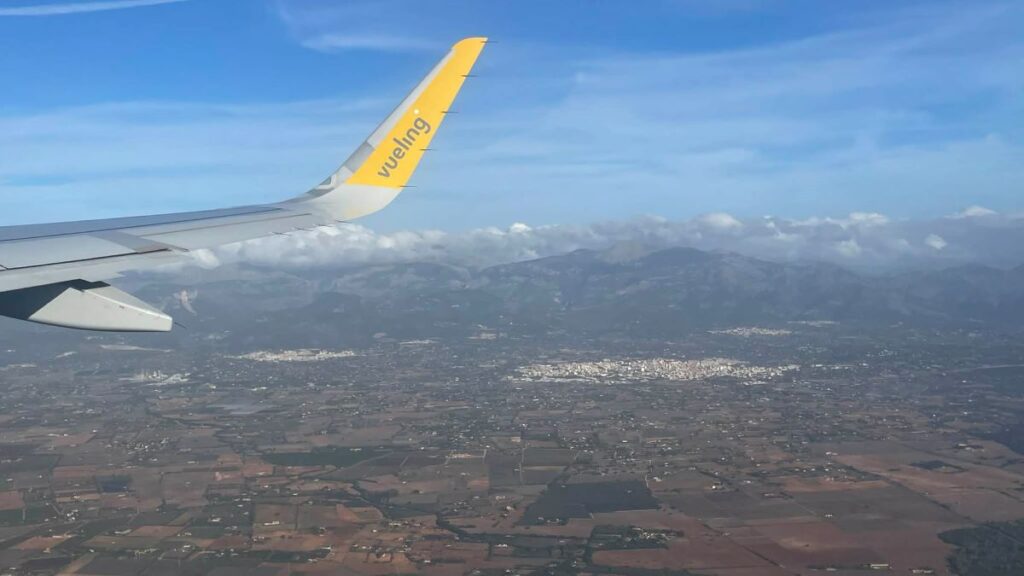
In my opinion, it’s very simple – many airlines fly to Mallorca, including low-cost carriers. Tickets are inexpensive if you buy them in advance. My daughter and I flew from different European cities – she from Prague, I from Chisinau – the round-trip tickets cost approximately the same money, about 120 euros round trip.
Look for flights with Ryanair, EasyJet, SkyUp, Vueling – if flying from mainland Spain, and other air carriers. For some, they are slightly more expensive, for others, on the contrary. The price also depends on the season – summer is the most expensive, especially if you buy at the last minute.
The bus from the airport costs 5 euros one way, 8 euros round trip. Keep in mind that these buses have a break at night – you will have to call a taxi. We spent the last night in Arenal – closer to the airport, because we had a very early departure (we returned the car in advance because it’s impossible at night) – Kiwitaxi cost 22 euros.
- Alternative option for those living in Europe: their own car + ferry from Barcelona or Valencia.
How to travel around Mallorca
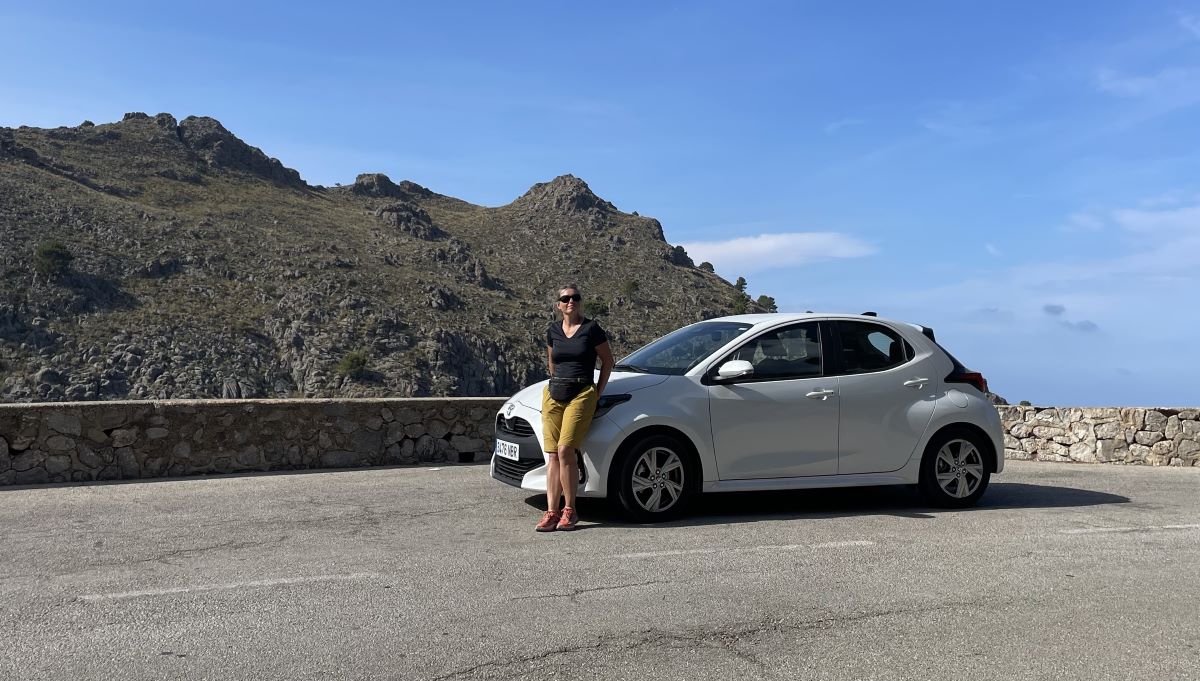
Without a car, you will hardly be able to visit all the beautiful places that Mallorca is rightly proud of. If you do not have a license, you will have to explore the surroundings on local buses (price 2-10 euros), and this task is a bit of an asterisk. Please note that some places are simply not accessible by public transport, and there are not many alternatives: sightseeing buses or taxis.
Renting a car in Mallorca
We used the DiscoverCars service. We paid 200 euros for 7 days with full insurance. An absolute bargain for the low season! I repeat – I highly recommend choosing the low season for travel. You can find cheaper ones, but the deposit is very inhumane – from 1200 euros for a car of the lowest class.
With the help of the car, we were able to include even the most remote corners of the island in our travel plan and did not regret it once. The flexibility of trips, especially depending on the weather (we were in Mallorca in October), allowed us to avoid rain as much as possible, moving from one part of the island to another.
Roads in Mallorca

All roads in Mallorca are free – even the expressways, unlike mainland Spain. There are many motorways near Palma, in other parts of the island – two-lane roads. In the mountains they can be very narrow, so if you see a 30 km per hour sign, it is because of the steep serpentines.
The roads are generally safe and in excellent condition. The serpentine mountain road down to Sa Calobra is a bit difficult, narrow, and requires special care. Especially if large excursion buses are coming towards you, which are not used to driving slowly, it is better to slow down and let them pass. There are also narrow paths in villages or on the approaches to wild beaches. Therefore, if you are an insecure driver, take full insurance and a car with an automatic transmission. Then you will not be nervous again.
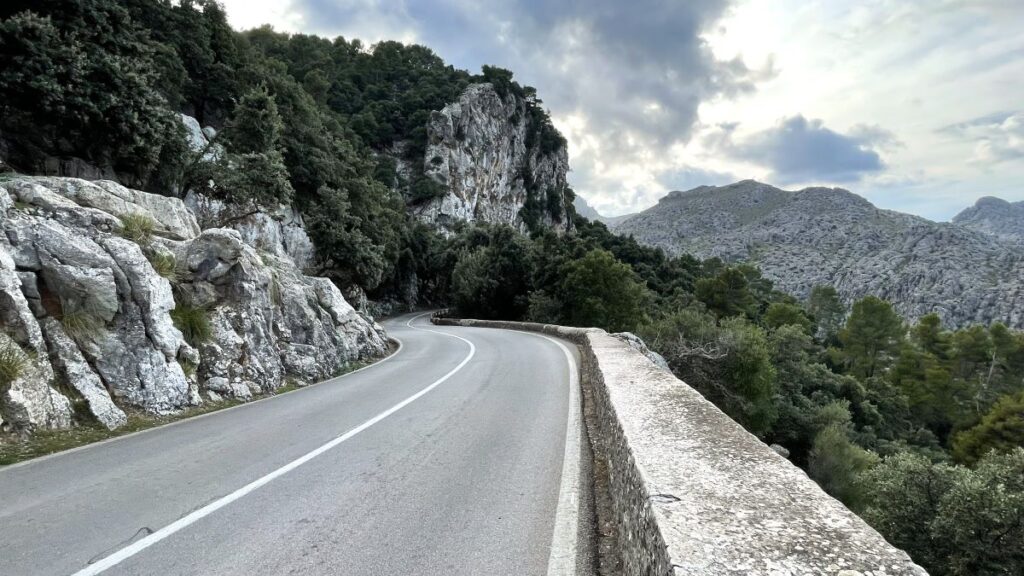
But compared to the roads in Madeira, Mallorca is quite easy to drive. I’ve already compared it – take my word for it!
The only source of annoyance is the huge number of cyclists on the mountain roads. Overtaking large groups of cyclists on winding roads can be difficult, so patience is a key factor when driving in the mountains of Mallorca. And an automatic transmission will come to the rescue at such moments.
Parking on Mallorca
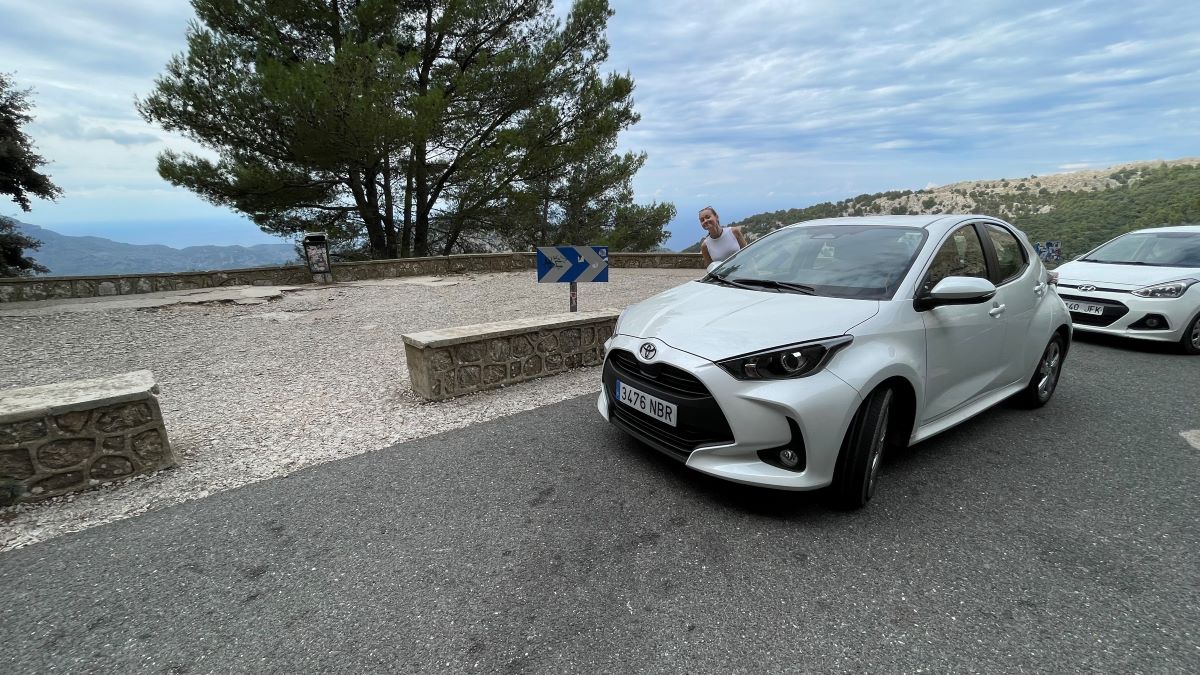
This is a separate topic: parking is paid, but you can find free ones. Most hotels do not have their own parking (I studied this topic when I was looking for accommodation), but in small towns there are always municipal parking lots, where we always found free parking.
Or hotels and guesthouses reserve parking spaces for their guests in the nearest parking lot. The cost of parking varies (0-15 euros / day).
Parking lots near beaches, tourist attractions or in remote lagoons – from free municipal ones, to 8 euros per day near Ul-Trnas beach. I will tell you about each parking lot – geolocation and prices that we used below in the description of the places where we managed to visit by car.
Top tip: before you go anywhere on the island, search Google Maps for parking in that location (paid or free). You can’t park your car just anywhere!
Public transport in Mallorca
To follow the schedule and plan routes, you will have to make friends with the bus carrier’s website TIB. The transport system in general works with varying success: for example, be prepared that the last bus may leave at 7 pm, and on weekends it may not go at all.
The universal transport hub in Palma is the Estacion Intermodal train station, located on Plaza de España, or rather on its minus first level – underground. All intercity routes depart from here.
Intercity buses connect Palma with most towns on the island. TIB is a bus company that operates intercity bus services. The cost depends on the distance – from 1.8 to 6€. You can buy a round trip ticket at once – the price is simply added up, discounts are not available in this case. Please note that the schedule on weekdays, weekends and holidays varies.
Our route around Mallorca
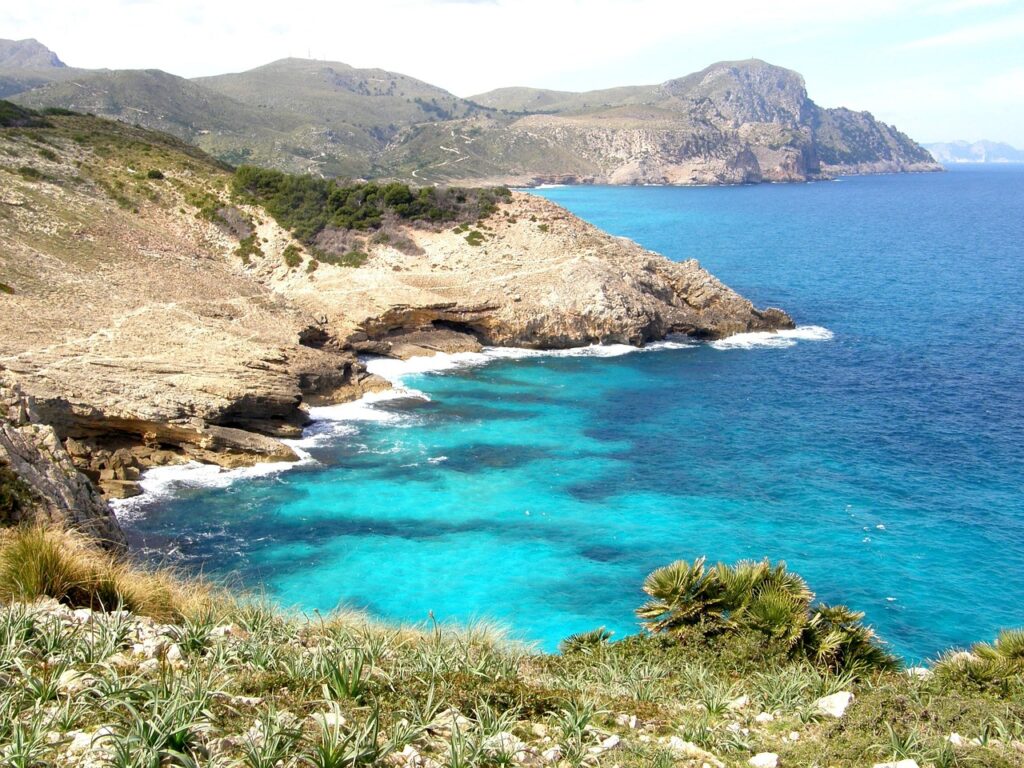
The plan was to see as many interesting places on the island as possible in a week. So we decided not to stay in just one place, but to travel around the islands by car. In my opinion, this is an ideal solution for those who are interested in more than just beaches. Mallorca is diverse and worth seeing from its native side. Mountains, lagoons, rocky capes, lighthouses, wild and equipped beaches, bays – Cala, salt lakes with flamingos, mountain reservoirs, cozy (and not so) cities and towns. And this is not a complete list of what awaits you in Mallorca.
Day 1: Mallorca Airport – Santa Ponsa
We pick up the car from the rental office and rush to check into a hotel in the town of Santa Ponsa. Santa Ponsa is a resort in the southwest of Mallorca, approximately 20 km from Palma, in the municipality of Calvia.
Accommodation in Santa Ponsa
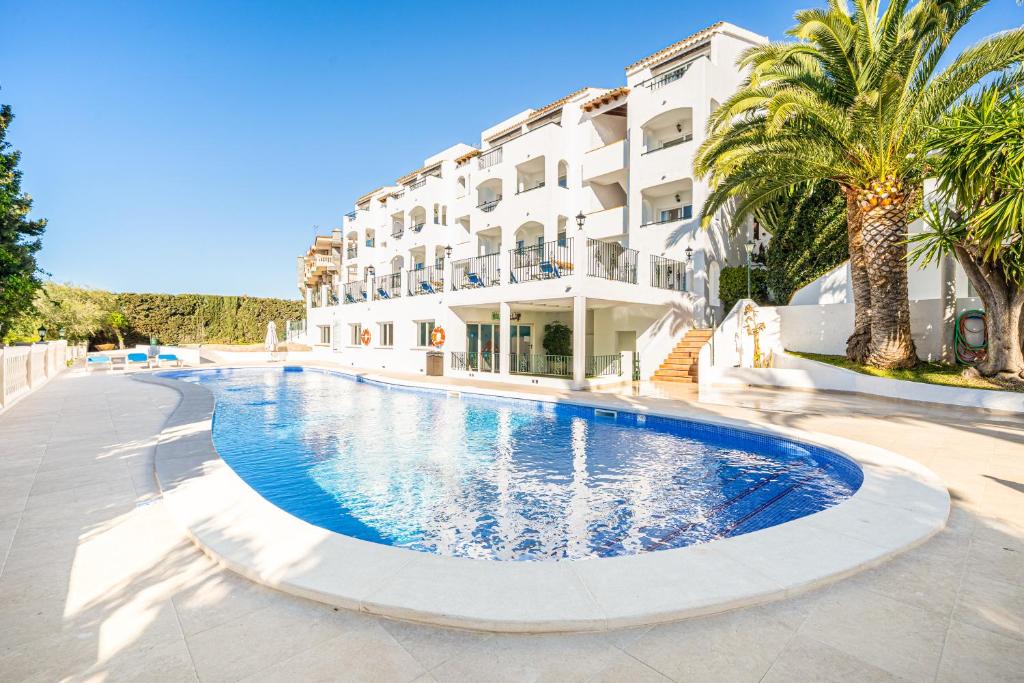
We chose a family recreation complex for our stay Aparthotel Holiday Center – mostly British families with children relax here. There are several swimming pools, a restaurant, a bar with evening karaoke (for amateurs). The prices are quite adequate compared to the level of service. We chose an apartment with a separate bedroom, balcony, kitchen to cook our own breakfasts and dinners. The complex is located 5 minutes walk from the beach.
There is no parking at the hotel, but there is also a large municipal one 5 minutes away, where you can find a free space if you wish. We found a parking space (here) – very convenient.
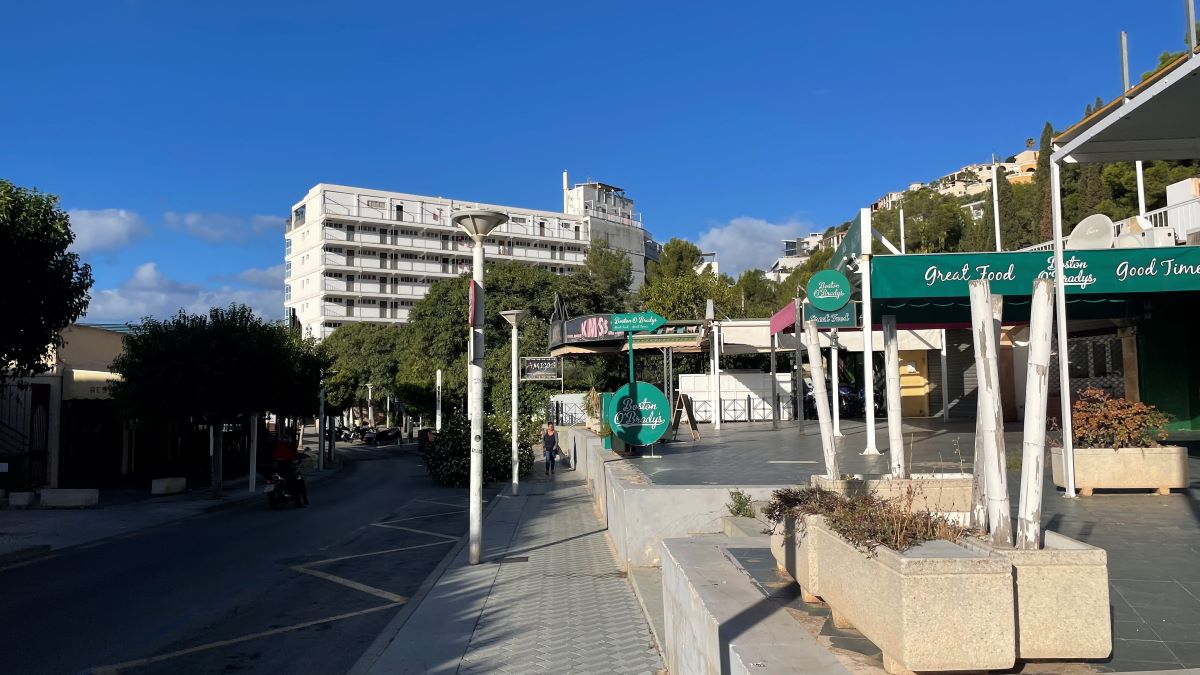
There is a small but well-stocked Spar supermarket near the apartments – you will find all the necessary products for cooking there.
We were tired from the morning flights and wanted to throw our clothes in the laundry (4 euros for using the shared washing machine) and go to the beach – the forecast shows two more warm sunny days, which we should take full advantage of.
Beaches in Santa Ponsa
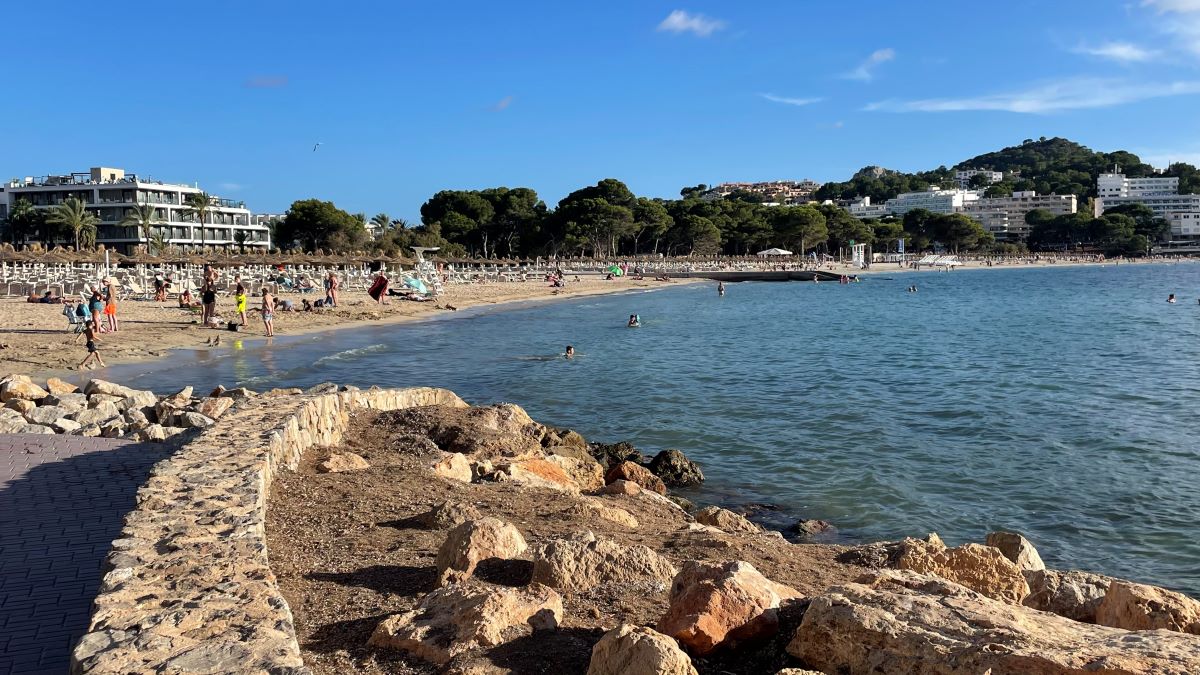
Santa Ponsa has both a large main beach and a smaller cove (Caló d’en Pellicer / Caló d’en Pallisser) nearby, for those looking for a quieter place. Large with beautiful white sand, divided into two parts by a river flowing into it.
In general, all beaches have either a stream or a river that formed them in one place or another on the island. Here you need to choose in advance which part of the beach you want to stay in, because you can’t get around the river by water, there are concrete barriers. In general, they are the same – choose the one that is closer to your home.
- Playa de Santa Ponsa — A large sandy beach, with a gentle entrance to the water, without strong waves – very suitable for families with children.
- The length of the beach is approximately 500-900 meters, the width is enough to find a place to relax
- The infrastructure on the beach is good: sun loungers, umbrellas, showers, lifeguards in season, cafes/restaurants nearby.
Pros
- Convenient location – close to Palma, easy to get to (city + airport).
- Comfortable for families – beach without strong waves, with a gentle entrance, many amenities, night noise is less intense than in neighboring “party” resorts.
- Many options for entertainment and sports – not only the beach, but also golf courses, tennis, yachting, small bays for snorkeling, boat trips to neighboring islands or bays.
- More calm than in Magaluf or Palma Nova – in Santa Ponsa the atmosphere is “less violent”, more options for a quiet holiday, family or mixed tourist.
Cons
- Nightlife/Drinking – Although not as intense as Magaluf, due to the large number of Irish and British tourists there are many bars and parties which can be a nuisance if you are looking for peace and quiet.
- Less authentic/local character in the resort centre – partly a “tourist town”, with many international tourists, cafes and restaurants geared towards nightlife.
Day 2. Santa Ponsa – Cala Pi – Es Trenc beach – Valldemossa
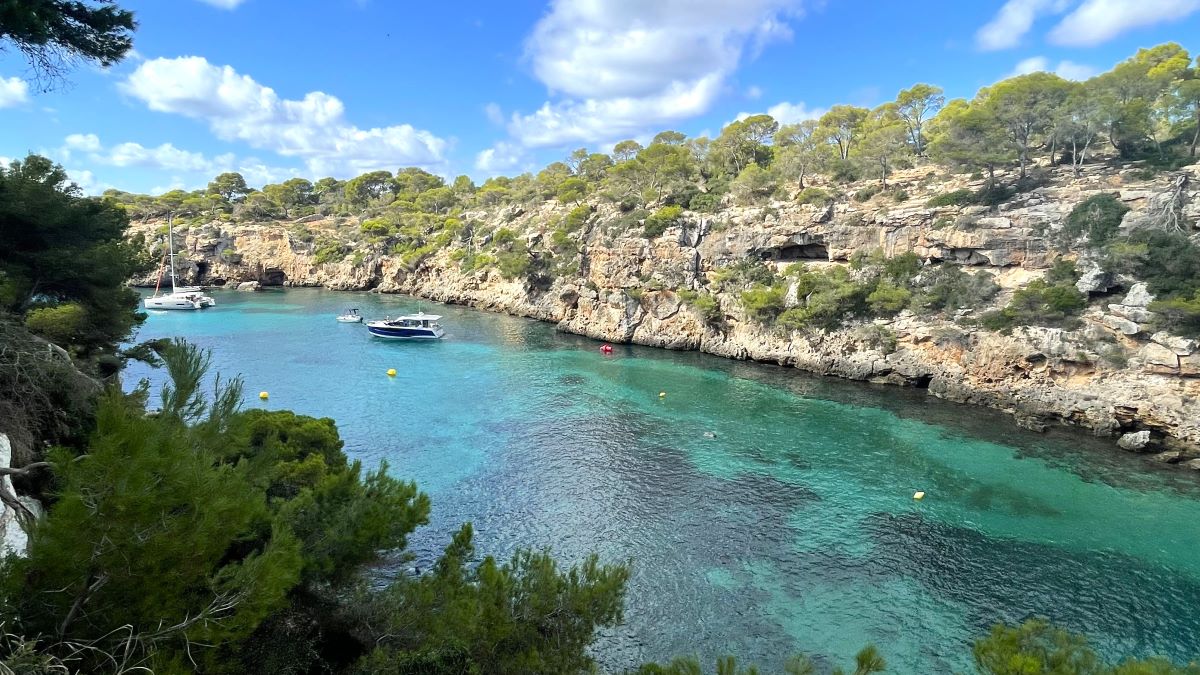
Actually, I didn’t plan to drive to the southeastern beach that day. But the sun and sunny day changed our plans. We looked at the forecast and understood that a couple of days and sunny days would end. And we really wanted to go to a large sandy beach with white-white sand like in the Maldives.
We have a car, the extra 100 km is not a problem – an hour and we are almost there. Again, the advantage of a road trip is the flexibility of plans. And it’s so cool!
We had breakfast on our balcony and rushed to the wonderful bay of Cala Pi – to look at the beautiful water and swim in it. The bay in October is not as crowded as others (for example, Cala D’Or), so I advise you to consider it for a vacation if you plan to stay in such places. And 25 minutes from it is the beach Es-Trenc, known to everyone for its incredible photos.
Es Trenc Beach
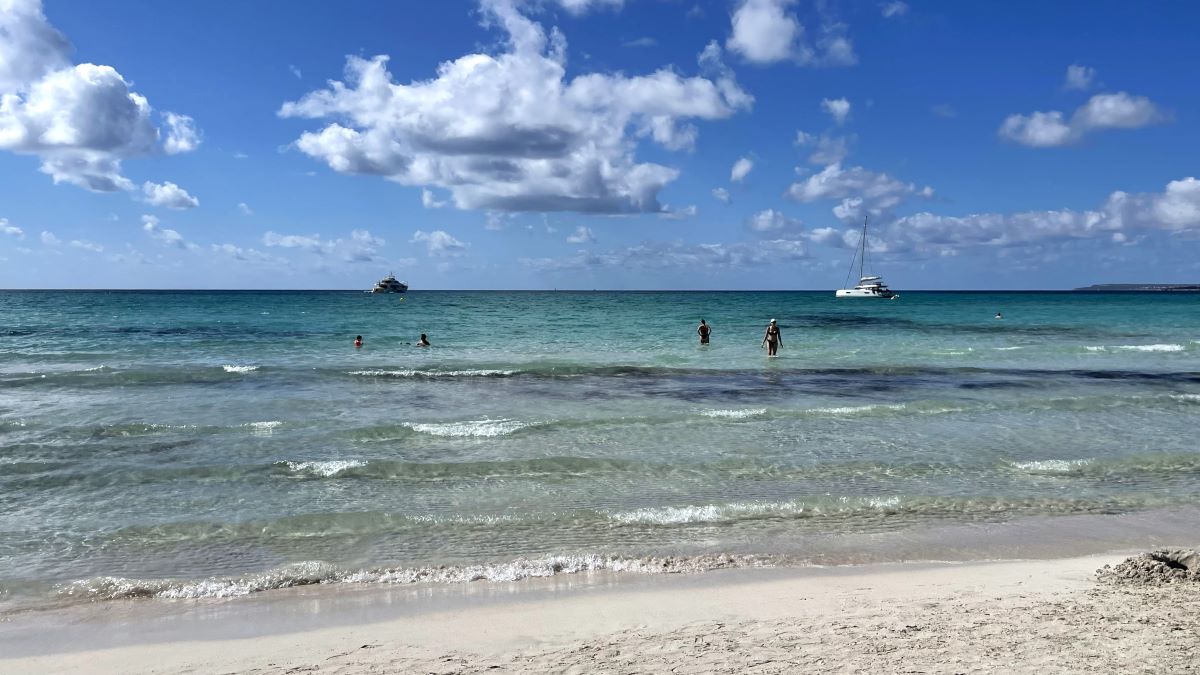
Es Trenc is the longest and most famous wild beach in Mallorca, located on the south coast of the island, between the resorts of Colònia de Sant Jordi and Ses Covetes. This place is often called the “Caribbean of the Balearics” for its white sand and turquoise water that shines even on a cloudy day.
Features of Es-Trenc beach
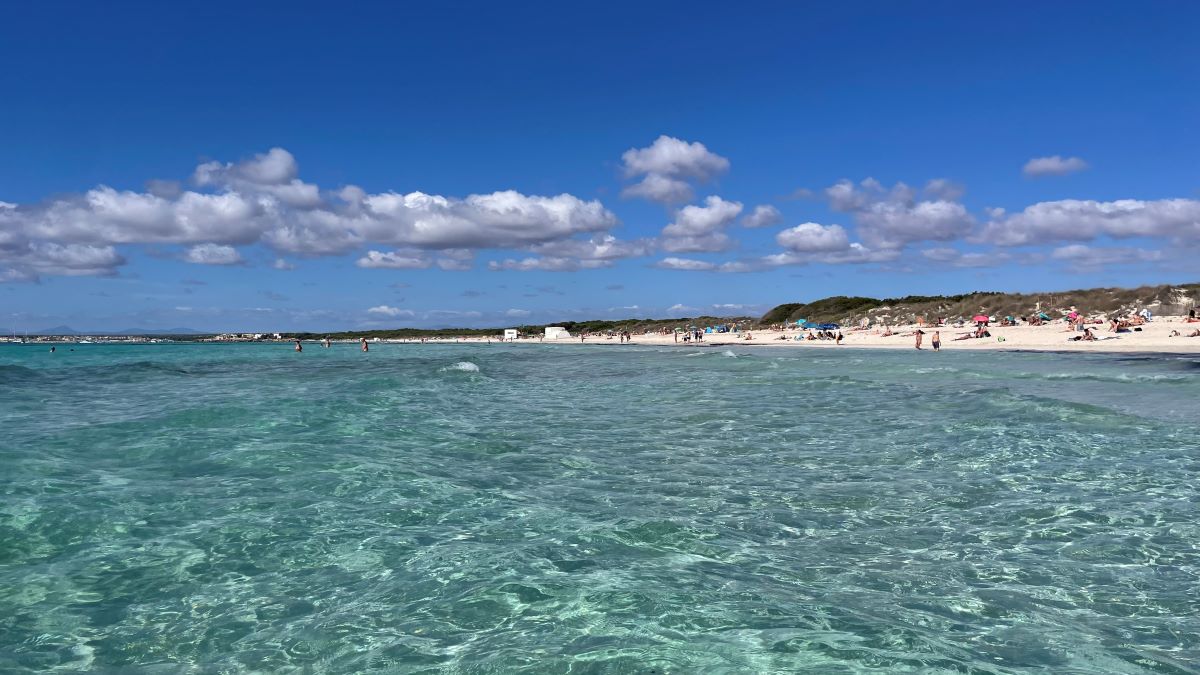
- Length: about 2.5–3 km
- Beach type: natural, undeveloped, protected area of the Es Trenc–Salobrar de Campos National Park
- Sand: soft, white, fine-grained
- Sea: crystal clear, with a very gentle entrance – ideal for swimming and long walks in the water
- Depth: shallow a few hundred meters from the shore – the sea is calm and safe
- There are no large hotels, roads or noise – just dunes, waves and the smell of the sea.
- Es Trenc retains a sense of wilderness that you won’t find on most wonderful beaches in Mallorca.
This is a truly incredible beach, although it can also be very crowded. The part adjacent to the parking lot near the salt lakes ensures the arrival of many vacationers to the beach. They (and us) were not stopped by the price of parking – 8 euros per day!
But if you walk to the western part of the beach, where mostly nudists rest, you can get a quiet vacation. And if you want, you can sunbathe and swim naked.
The water on the beach

The water on the beach is an incredible color, the sunset is gentle, the sand is white and very fine. The beach is surrounded by sand dunes, entry to which is prohibited. I really liked it there, although the first part of the beach was completely clogged with tourists even in October. We went to the nudist area and felt very free and comfortable there. In fact, 50% of people there relax in swimsuits.
On the way to the beach you will see salt lakes, large piles of salt and pink flamingos that feed on plankton from the salt lakes. The path is narrow and in some places you have to be very careful with oncoming cars.
Keep in mind: if you plan to visit this beach in the summer, bring umbrellas with you, because there is no shade here.
How to get there
- From Palma ~45–50 min by car.
- From Colònia de Sant Jordi чи Campos — bus or taxi.
- Parking— near Ses Covetes or Es Trenc Parking Area (8 euro by day or even 1 hours), then walking about 5 min.
Valldemossa and sunset at Mirador de sa Foradada
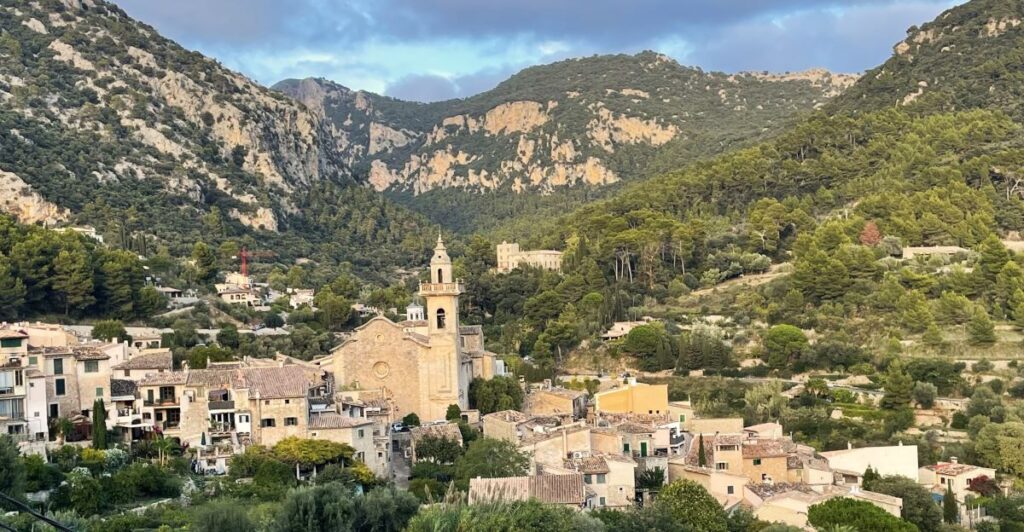
After swimming on the beach, we decided to get to Valldemossa, a popular mountain village 17 km north of Palma, before heading to the hotel. It became famous thanks to a beautiful romantic story: the lovers, composer Chopin and writer George Sand, once fled here. They hid for two months in the local monastery Real Cartuja de Valldemossa (Plaça Cartoixa0) – this is how the book Winter in Mallorca was born.
The city center consists of stone buildings accented with green shutters and narrow cobblestone streets lined with potted plants. Almost every house is decorated with colorful tiles depicting life Santa Catalina Thomas(Catherine of Palma), a canonized saint who was born in Valldemossa in 1533.
The monastery itself was conceived as a royal residence and was built at the end of the 14th century. Today you can go inside, read the love notes and climb to the observation deck (tickets online here).
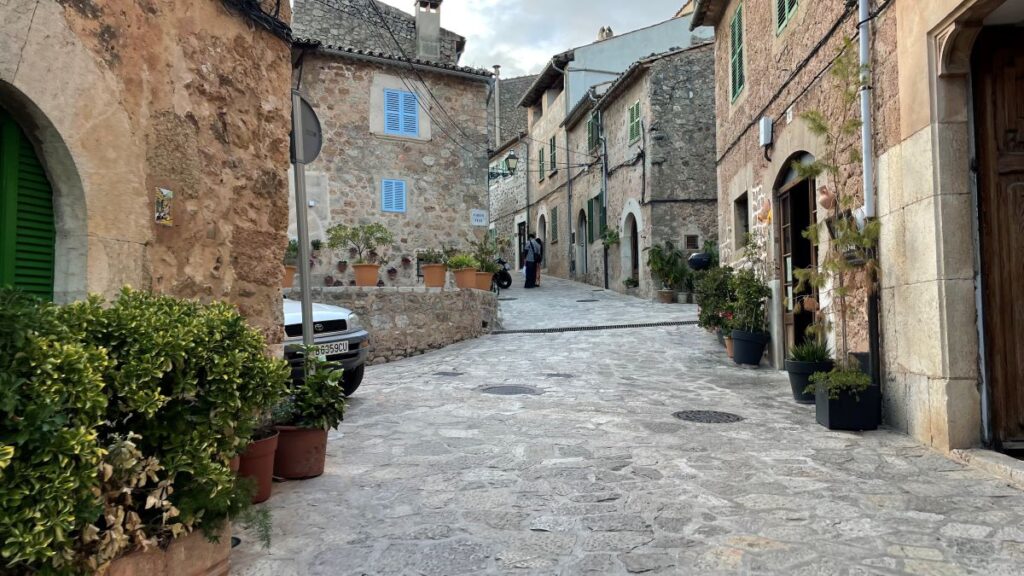
If you have time, head to the nearby village of Deia, which is very similar in style to Valldemossa but less touristy. With its seafront location, excellent restaurants and walking trails, Deia is a great place to stop for a few hours. From the village, you can walk down to the blue waters of the bay Cala Deia – a great, quiet place to go snorkeling.
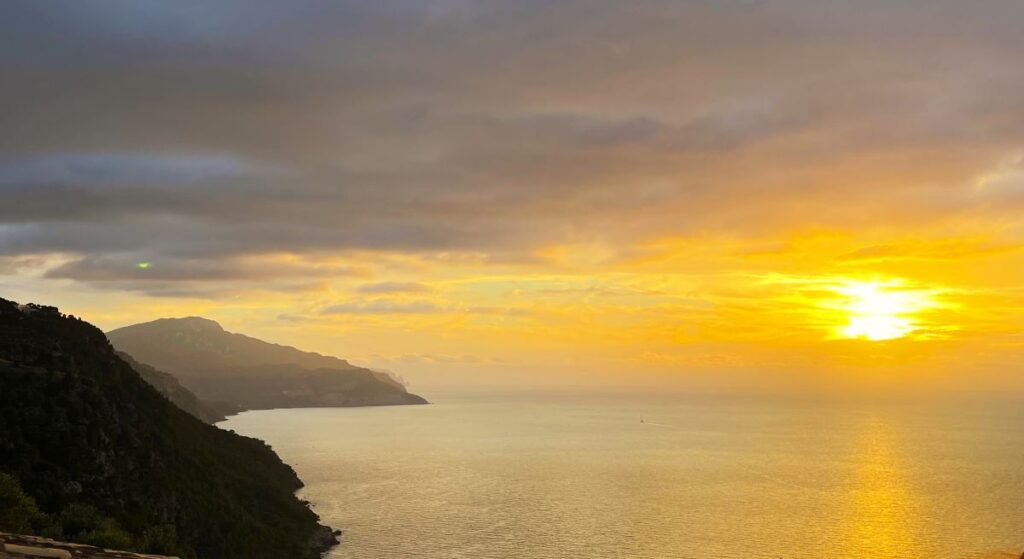
We went to one of the most beautiful viewing platforms in the mountains, towering above the sea – Mirador de sa Foradada. Not many people came for the sunset – we found a place in a paid parking lot (here, 1.2 euros per hour). Wonderful view of the sea and rocks. In the restaurant located nearby, they also played “Time To Say Goodbye” by Andrea Bocelli – I cried from the music, the beauty of the sea, and the sun.
Day 3: Soller – Serra de Tramuntana mountains – Cala Sa Calobra – Port de Pollensa
I booked the next two nights in the town of Port Pollensa, which is located in the northeastern part of the island, near Cape Formentor. But we didn’t plan to go there right away, because that day we wanted to see several locations in the mountainous part of Mallorca.
Soller
First, we went to the town of Sóller – a town and municipality in the Tramuntana mountains, located on the northwestern coast of the island, surrounded by orange groves.
It was isolated from other areas until the local narrow-gauge railway began operating in 1912. It connected Sóller with Palma, and today it has become the main attraction of the city. The old tram goes on narrow rails (only 914 mm wide) through picturesque mountain ranges, bridges and tunnels.
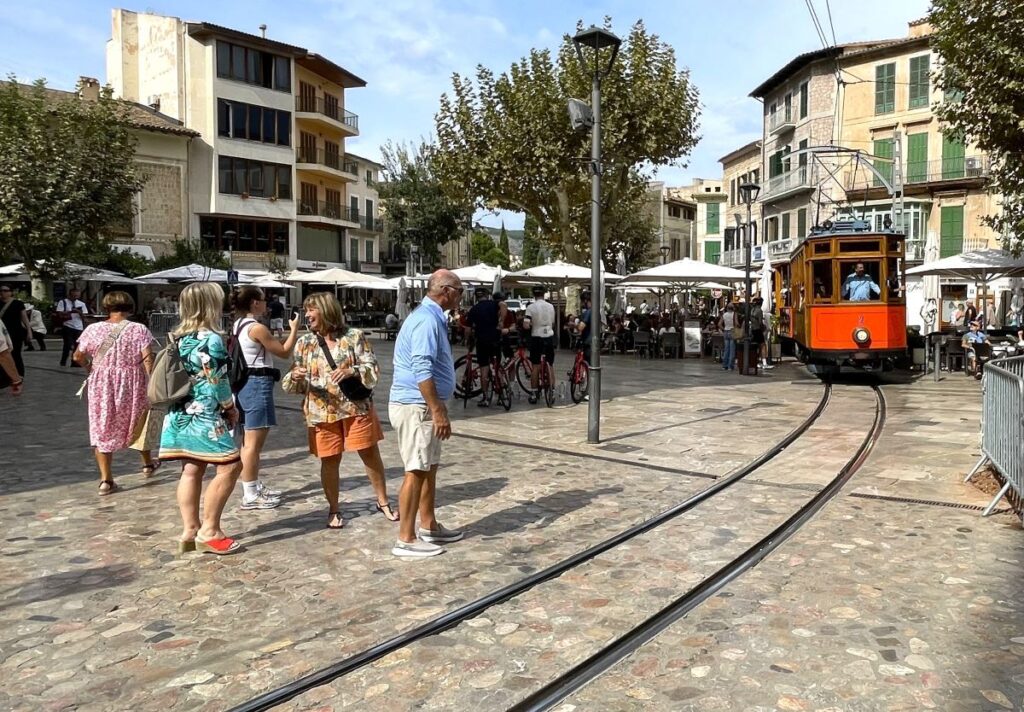
Port de Soller is the picturesque port village of Soller. It boasts a sheltered harbour, a long crescent-shaped beach and a host of restaurants and hotels on the seafront.
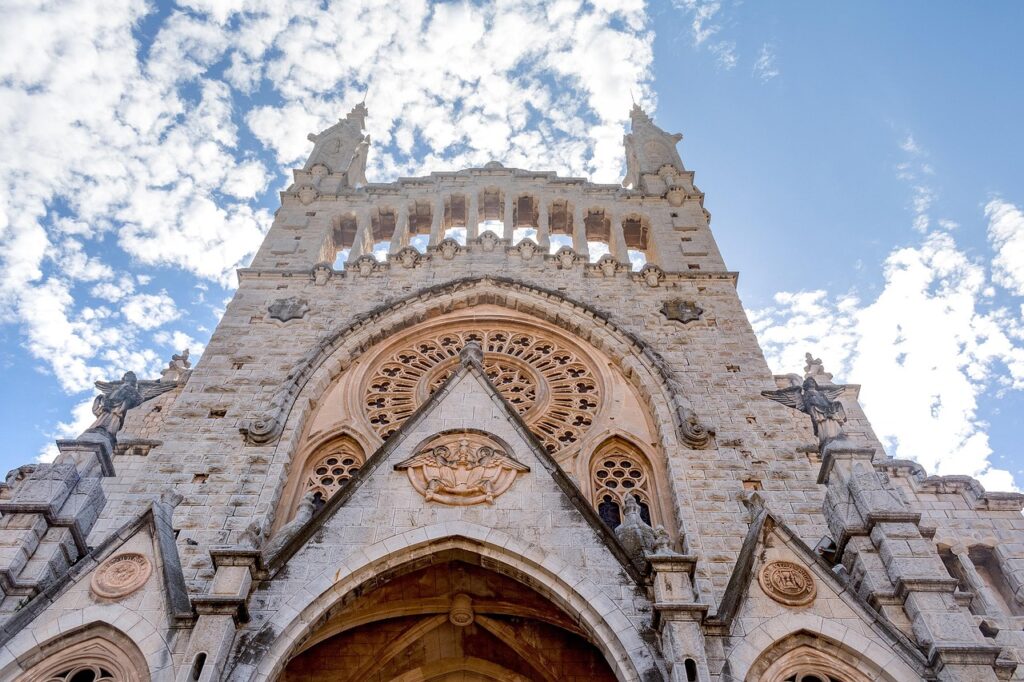
In addition to its fantastic location, Soller is a delightful and lively town with a wealth of cafes, gelaterias, restaurants, bars and shops. The atmospheric main square, Plaza de la Constitución, next to the church of Sant Bartomeu, is the heart of the town. Soller boasts a range of excellent boutique hotels, finca estates and traditional guesthouses.
What to do in Soller:
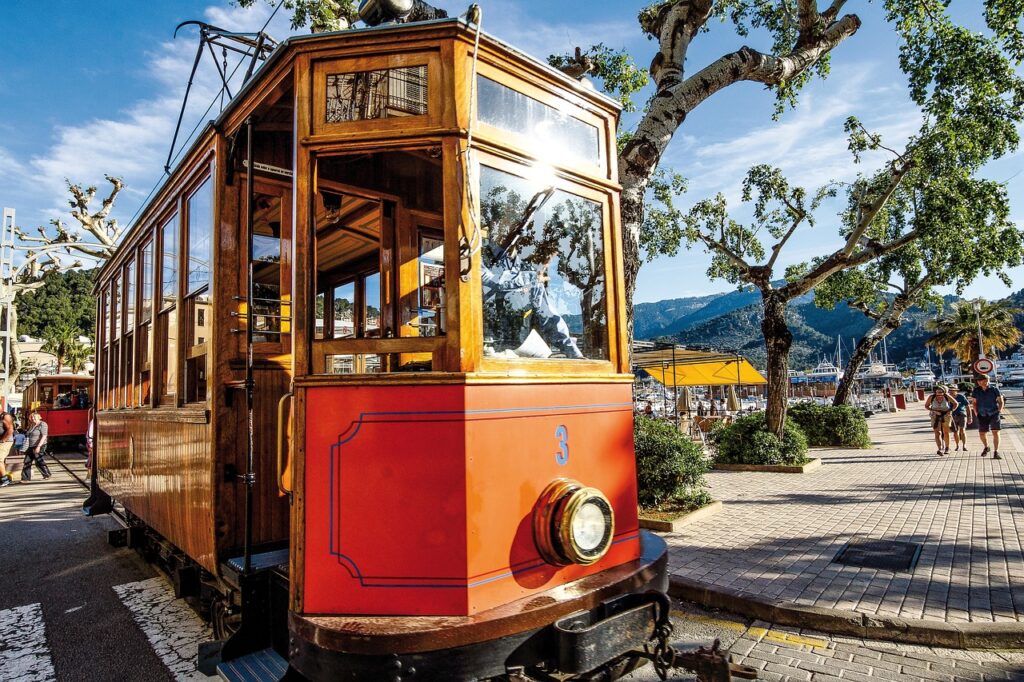
- Take a nostalgic ride on the historic Ferrocarril de Sóller train (the “Orange Express”) from Palma to Sóller – a scenic route through the mountains.
- Stroll through the central square of Plaça Constitució, home to the beautiful Església de Sant Bartomeu church and the Art Nouveau Banco de Sóller bank building.
- Visit the surrounding fruit valleys – especially orange groves (e.g. Ecovinyassa) – taste fresh juice, enjoy nature.
- Hike or bike to the Serra de Tramuntana mountains: wonderful routes with panoramic views start right in Sóller.
- On Saturdays – the local market in Sóller: produce, crafts, the atmosphere of local life.
- Relax on the beach in Port de Sóller – a beach area of the bay with palm trees, gentle water.
- Walk along the promenade in Port de Sóller: cafes, restaurants, views of the sea and mountains at the same time.
- Nature outings from Port de Soller: for example, hiking trails to the lighthouse or around the coast.
- Savor seafood: fresh catch in restaurants by the water.
Sa Calobra, Cala de Sa Calobra and Torrent de Parei
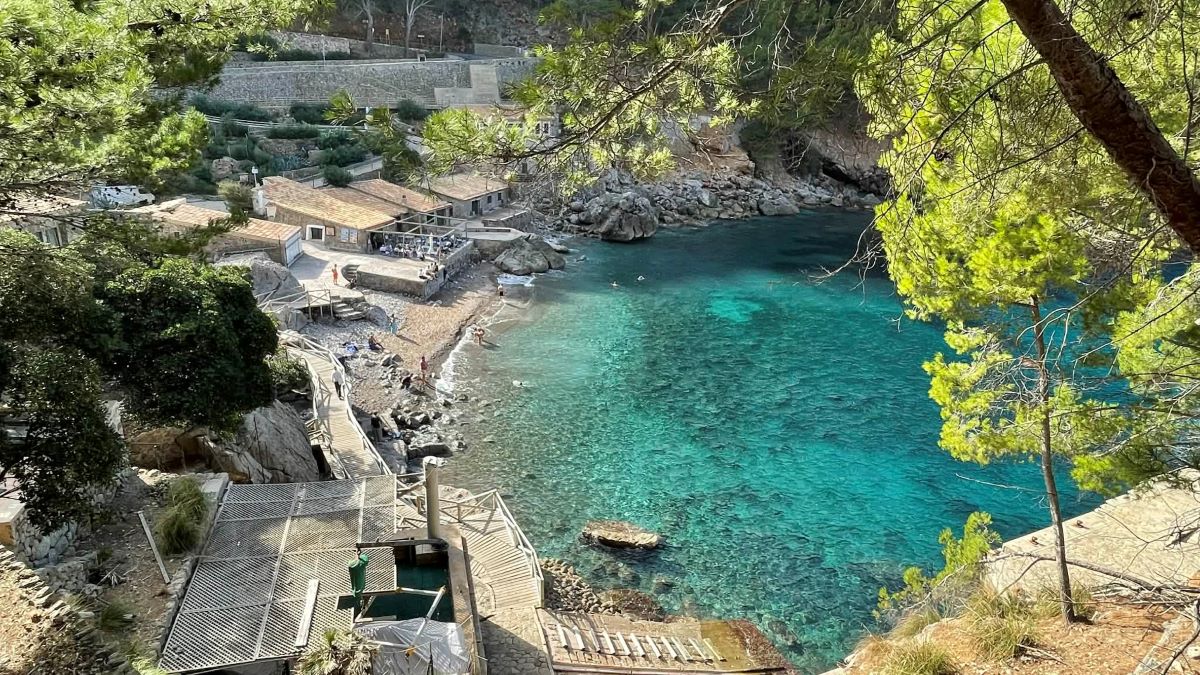
Sa Calobra is a small village on the northwest coast of Mallorca. It is the gateway to the Torrent de Pareis canyon.
Park at the paid parking lot Sa Calobra. Exact location on Google. We paid about 3 euros for two hours.
After parking, take the paved road to Sa Calobra. Several restaurants and bars surround the rocky cove of Playa de Sa Calobra, a popular beach for swimming. The restaurants here are not worth your attention in my opinion, as we did not find any interesting menus or good reviews about these establishments. They are purely tourist hangouts.

To reach the famous canyon beach, follow the signs for Torrent de Pareis Canyon. The walking path follows the coast and then through two tunnels.
The second tunnel takes you to a beach called Playa de Torrent de Pareis, surrounded by high cliffs and bisected by the Torrent de Pareis stream.
How to get to Sa Calobra:

By car, because regular buses don’t go there. I saw a lot of excursionists driving towards me – this made me realize that it’s better to go to this place in the afternoon, so as not to crowd together with a bunch of tourist excursionists.
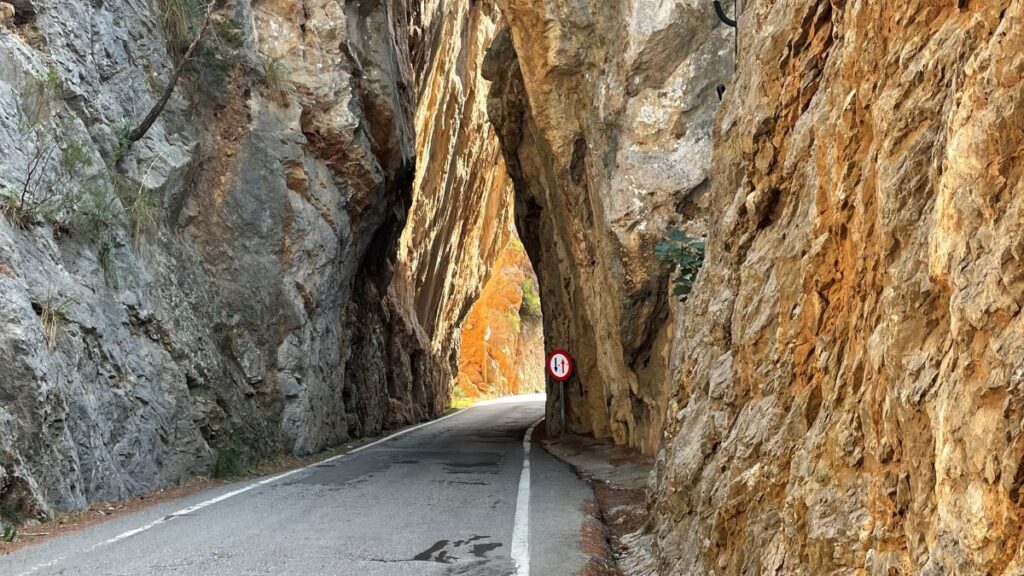
The Ma-10 goes through the Tramuntana mountains. Shortly after passing the Couber and Gorg Blau reservoirs, there is a turnoff to Sa Calobra (Ma-214). This spectacular mountain road winds its way down the mountains to the coast. The road is narrow and requires great care.
There is a cool place where only one car passes – between the rocks that formed a natural arch. And on this road there is a strange U-turn, which passes over a stone arch bridge, near which there is a viewing platform for the wavy serpentines of the entire path. The road itself is a very impressive sight, awesomely beautiful and not difficult if you choose a car with an automatic transmission.
Puerto de Pollensa

Puerto de Pollensa is a quiet seaside town located on the shores of Pollensa Bay in the north of Mallorca. It is one of the best places to stay in Mallorca, as it has access to both the sea and the mountains.
We stayed at the Taiko apartment hotel so that we could make breakfast. But to be honest, there are so many good cafes and restaurants in the city that we hardly use the opportunity to cook for ourselves. But if we are going to Port de Pollensa for a long time, the apartments will be a very convenient place to stay for the night.
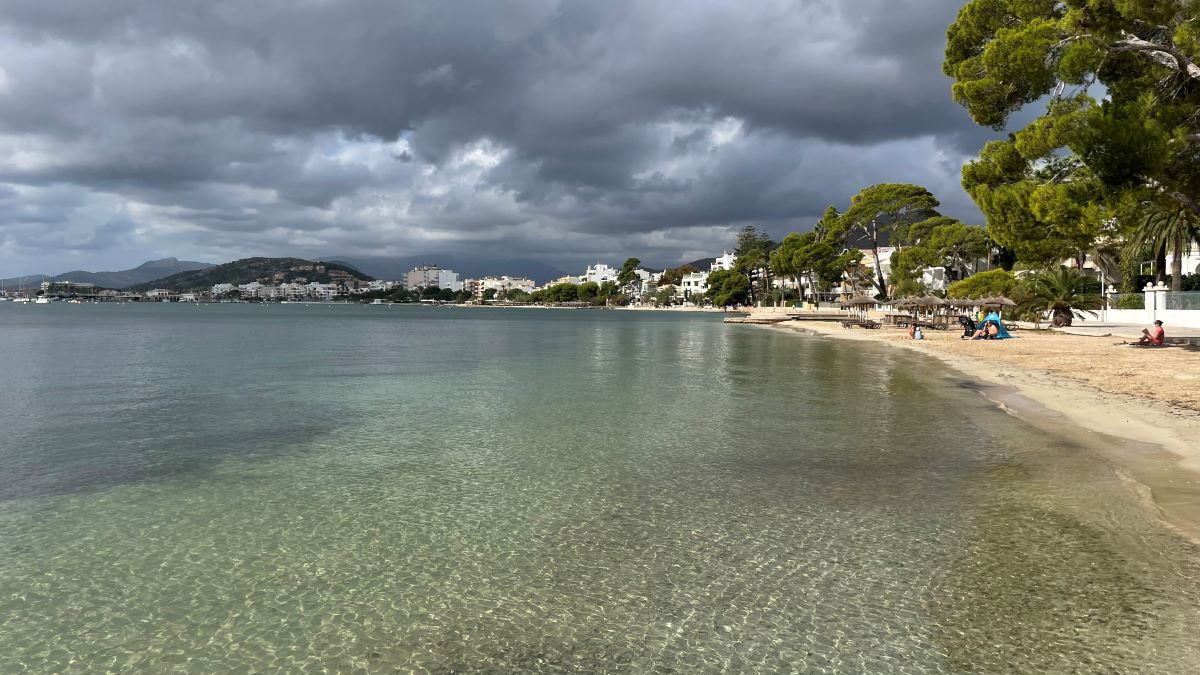
During our stay, we enjoyed the sandy beach under the pine trees – Playa del Port de Pollensa. It reminded us very much of the beaches in Croatia, but here, unlike it, there is fine white sand and the same clear water. It is also nice to walk along the promenade with pine trees growing there is a large selection of boutique hotels and good restaurants.
Here you will not see crowds of drunken tourists who do not leave the pool for several days, most likely there are more people who like to actively move around the mountains during the day – on foot, by bike or by car, and in the evening choose delicious cuisine in a pleasant establishment and enjoy the peaceful atmosphere.
What the resort offers
- A huge beach with golden sand, stretching along the bay. The water is calm, gentle, which makes it attractive for families with children.
- The promenade “Pine Walk” (pine tree alley along the water), which creates a pleasant atmosphere for evening walks, contemplation of the sea and dinner on the terrace of the cafe.
- Marina and yacht port: here you can see the yachts and boats moored, and even choose a sea excursion.
- Natural surroundings: the Serra de Tramuntana mountains are nearby, beautiful panoramas and rich opportunities for active recreation.
Day 4: Pollensa Beach – Alcudia – Cape Formentor
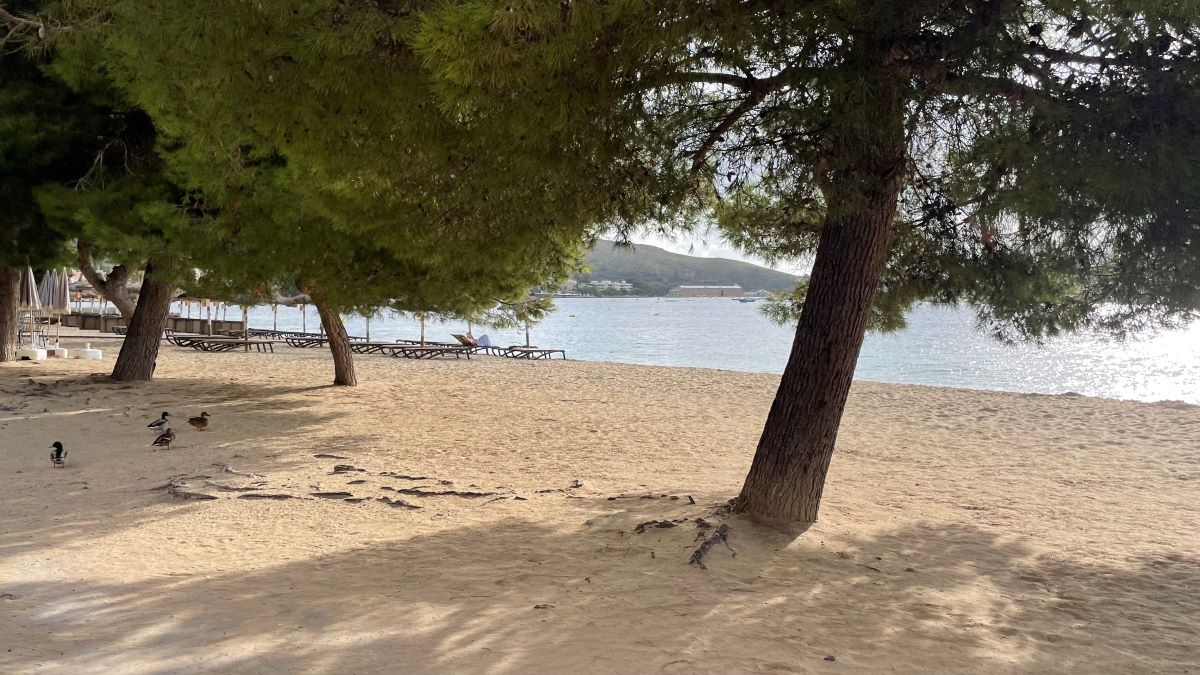
On this day, the weather finally started to deteriorate, but in the morning the sun was still shining. So first we went to the beach and took a short walk along the Pollensa promenade. And only then we went to see Alcudia and Cape Formentor. Spoiler: it didn’t rain until the very night – so we were lucky to see everything, but we couldn’t swim in Alcudia due to the strong wind.
On the 5th day of the Mallorca route, there is an opportunity to explore the Alcudia peninsula, which is a 20-minute drive from Port de Pollensa. The Alcudia peninsula separates the bays of Pollensa and Alcudia in the north of Mallorca.
Port de Pollensa in Mallorca: a resort for those who love the sea, beauty and tranquility
There are several wonderful places on the peninsula, including the historic fortress town of Alcudia, Platja des Col Bach beach and the Mirador de Peña des Migdia viewpoint.
Hence my observation: the bay of Port de Pollensa is more protected from the winds than the vast beaches of Alcudia. If you are planning a holiday at the end of the season (like we were in October), it is better to choose Port de Pollensa.
Alcudia

Alcudia is one of the most popular resorts in northern Mallorca, which successfully combines an ancient medieval city and a long beach resort – Port d’Alcúdia.
Old Alcudia
- Inside the medieval walls – narrow streets, stone houses, markets, cafes, the atmosphere of antiquity.
- It is worth visiting the Roman ruins of Pollença, the city walls and observation towers.
- Every Wednesday and Sunday– a market where locals sell fresh fruit, cheeses, olive oil, and handmade products.
Port d’Alcúdia Beach
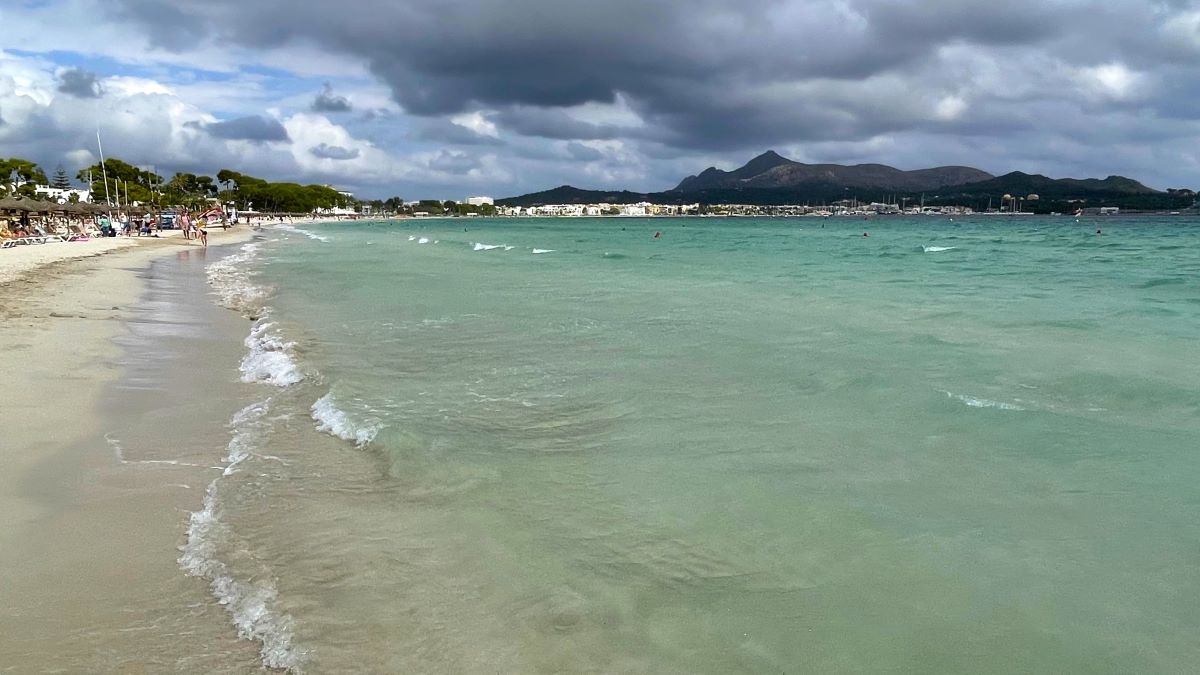
- One of the longest beaches in Mallorca – over 7 km of fine white sand.
- The water is clear and blue, shallow, calm – ideal for families with children.
- Along the coast – a promenade with restaurants, bars, shops and a marina.
- Popular water sports, boat tours, trips to the bays of Coll Baix or Cala Poncet.
- A wide selection of accommodation – from budget to premium.
Formentor Peninsula
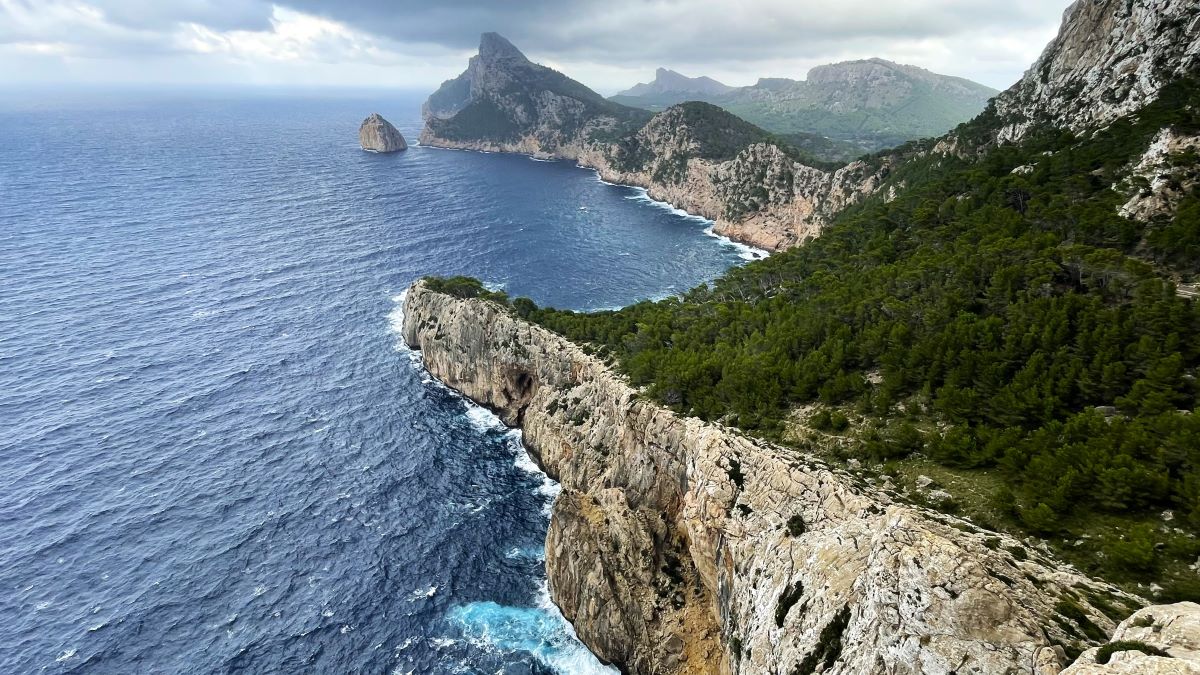
Next we headed to the Formentor Peninsula, a narrow, mountainous peninsula known for its stunning views, huge lighthouse and hidden coves.
The hiking trails on Formentor are uneven and mostly unmarked. One of the best places to watch the sunset is from Mirador Es Colomer(Google Maps).
How to get there:
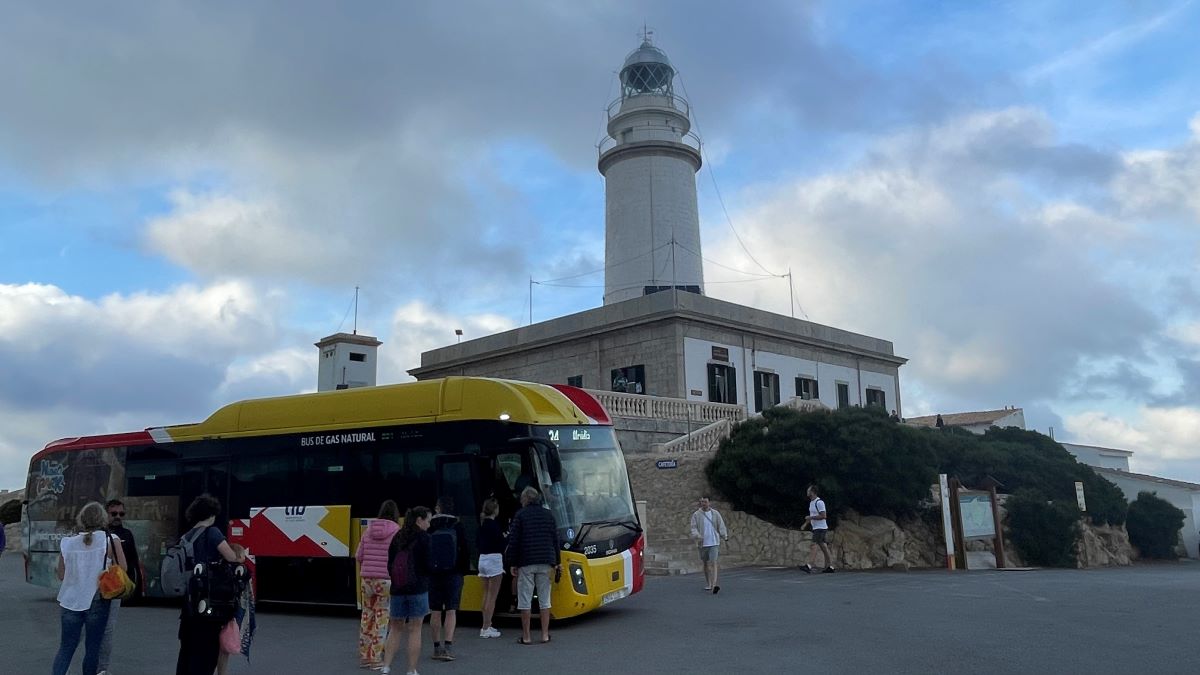
The Ma-2210 road connects Port de Pollensa with Cap de Formentor. However, seasonal traffic restrictions apply during high season. From June 1 to October 31, traffic on the Ma-2210 motorway is restricted to private vehicles from 10:00 to 22:00. During this time, the cape where the lighthouse is located can only be reached by bus from Port de Pollensa or Alcudia.
The current timetable for bus 334 can be found on the website tib.org. The cost of a bus ticket depends on the departure: from 4 euros from Port de Pollensa, to 1.8 euros from the parking lot near Formentor beach.
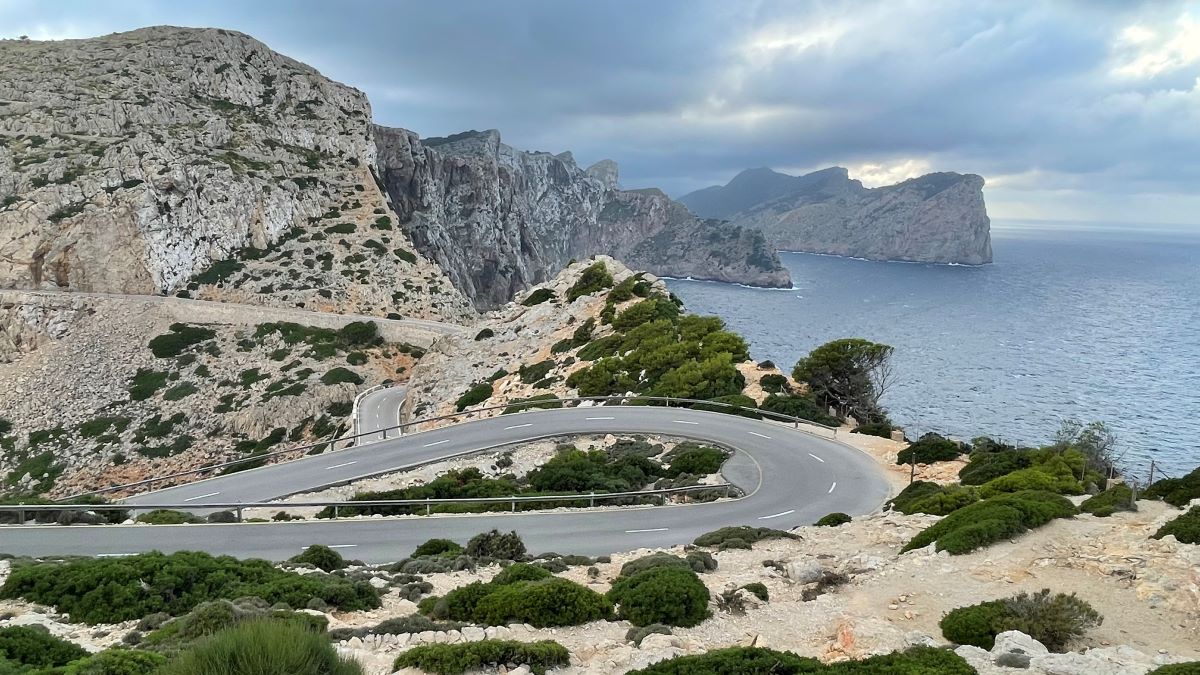
Or drive to Formentor Beach, where there is free parking, leave your car there and take the bus to the lighthouse. You can use this parking lot if there are free parking spaces. Parking on the side of the road is prohibited. There is a barrier here that will close when the parking lot is full. There are also electronic signs that provide information about the availability of parking spaces. The Formentor Beach parking lot has a maximum capacity of 300 cars and usually fills up very quickly.
If you decide to go to Cape Formentor in the morning, you need to leave the peninsula by 10 am to avoid fines.
Day 5: Dragon Cave (Drach Caves) – Cala d’Or
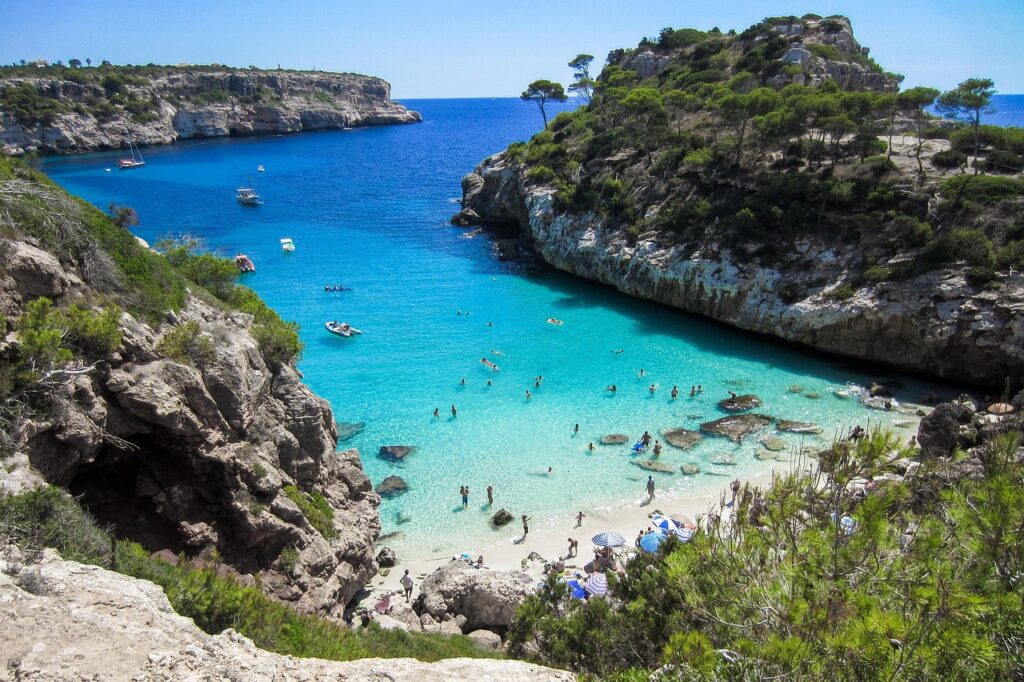
Today we are heading to our next overnight stop – the town of Cala d’Or, which has several bays with sandy beaches. Why did I choose it? I looked at many descriptions and photos and just settled on it, because the bays (Cala) are mostly similar to each other and have high rocky shores and wonderful sandy beaches.
The most magnificent bays and beaches of Mallorca are concentrated in the southeast of the island. These are the “screensaver” photos of Mallorca: images that promise a blissful escape from everyday life.
But on the way we planned to visit one of the famous tourist attractions – Drach Caves (or Dragon’s Cave), which, despite its huge popularity, I still advise you to visit and see with your own eyes.
It rained in the morning, so the cave tour doesn’t depend on the rain outside – it’s a great idea to go there during a downpour.
We bought tickets a day in advance on the cave website, but they were also sold at the box office. So, in high season (summer) it’s better to buy tickets in advance. In mid-October, it was sold out – you might not get on the tour if you arrive and decide to buy tickets at the box office.
Cuevas del Drach
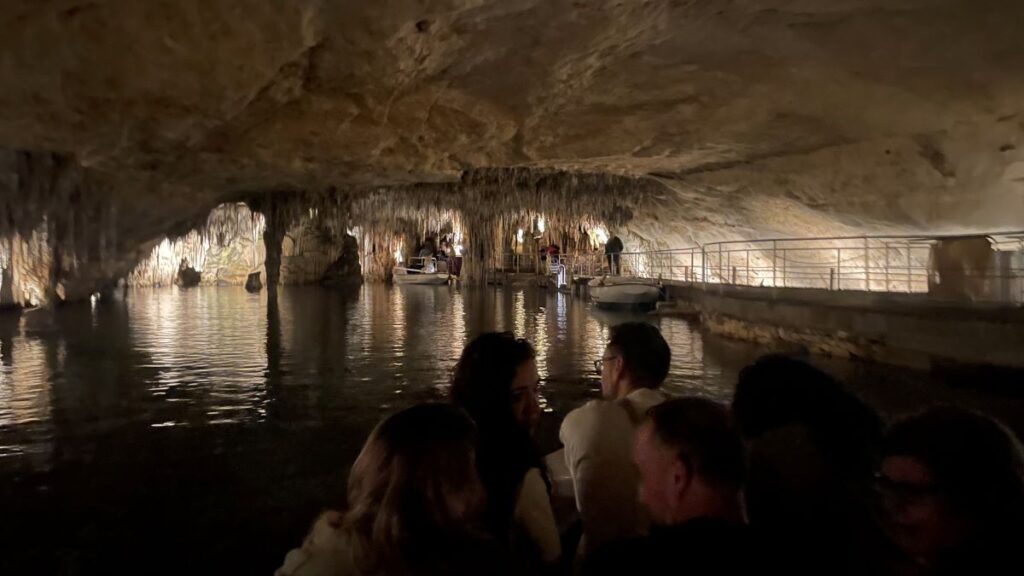
Drach Caves is one of the most famous natural wonders of Mallorca, located near the town of Porto Cristo on the east coast.
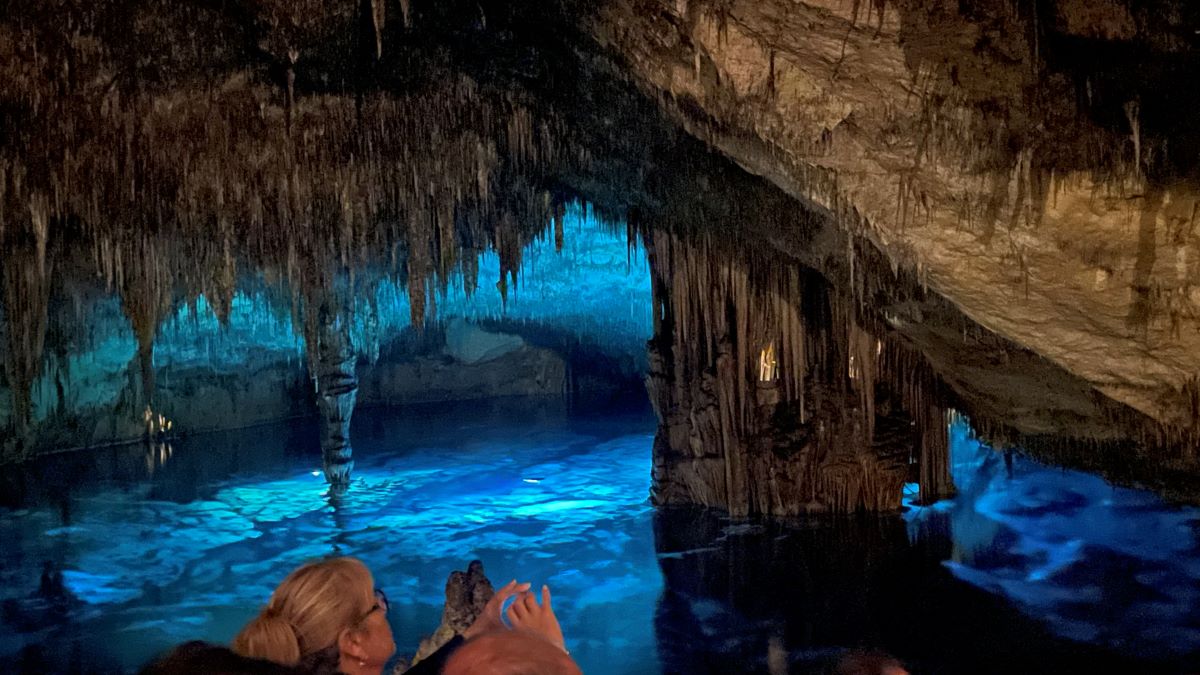
Inside there are four large caves, stretching for more than 1.2 km, with fantastic stalactites and stalagmites, illuminated by warm light. I have been to different caves, for example, the Caves of Nerja were very impressive last year – they are incredibly huge. But in this cave, what impressed me more was not the scale, but the incredible number of tiny stalactites, which cover the entire surface of the ceiling like needles. And of course, the underground lake, on which boats float.
The main highlight is the underground lake Martel (Lago Martel), one of the largest in the world. During the excursion, a short concert of classical music is held here, performed live by musicians on boats – a magical spectacle! First, all visitors are seated on benches in the underground amphitheater, and then the lights are turned off and boats with musicians sail onto the lake stage. It is very impressive!
After the concert, everyone is taken on a boat ride – you have to stand in line, but it is not long and this is also a pleasant part of the underground tour.
Buy tickets in advance on the Dragon’s Cave website, or on third-party websites if you didn’t have time to do it on time and the official tickets are already sold out.
Good to know
- The temperature inside is around +21 °C all year round.
- Entrance is only with a guided tour, lasts ~1 hour.
- It is better to buy tickets in advance (especially in summer).
- Location: Porto Cristo, eastern Mallorca
- Main feature: underground concert on the lake
Cala d’Оr
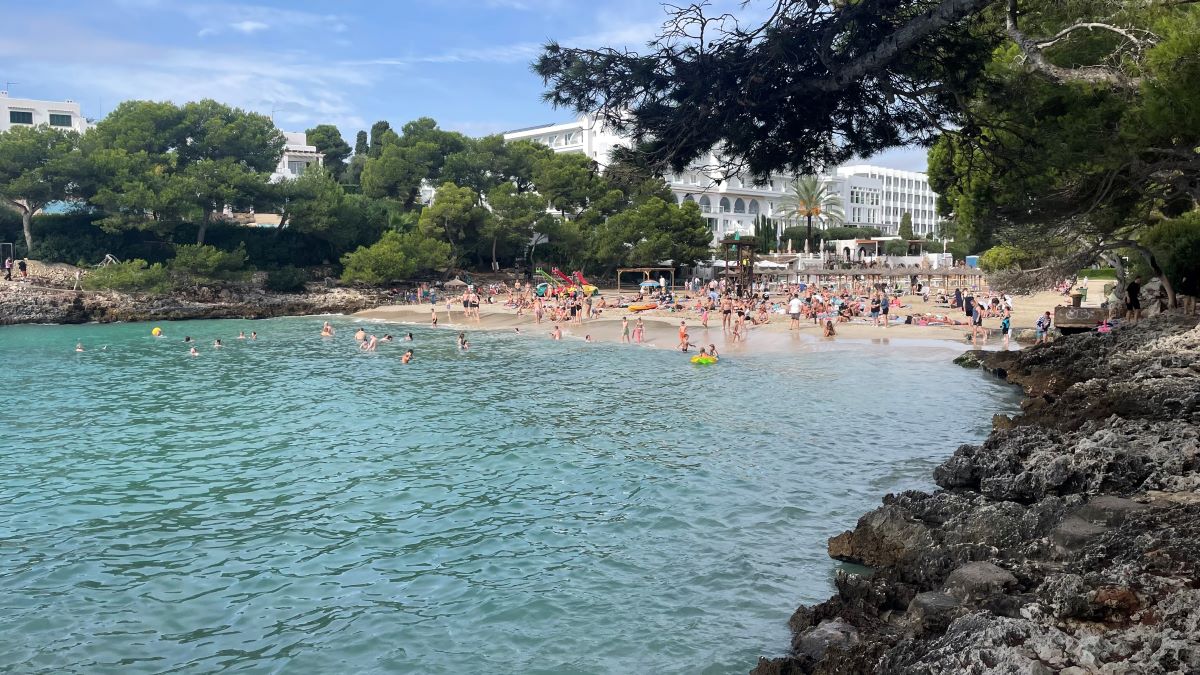
Cala d’Or (translated as “golden bay”) is a stylish, well-groomed resort with white houses and hotels in the Mediterranean style, picturesque small bays with turquoise water and a cozy atmosphere.
This is an ideal place for those looking for a quiet family vacation, beauty and comfort without excessive noise.
We stayed in apartments Sol Cala d´Or Apartamentos, which are located two minutes from the beach, but a little away from the noisy bars and restaurants. There is a private pool if not
Cala d’Or Beaches
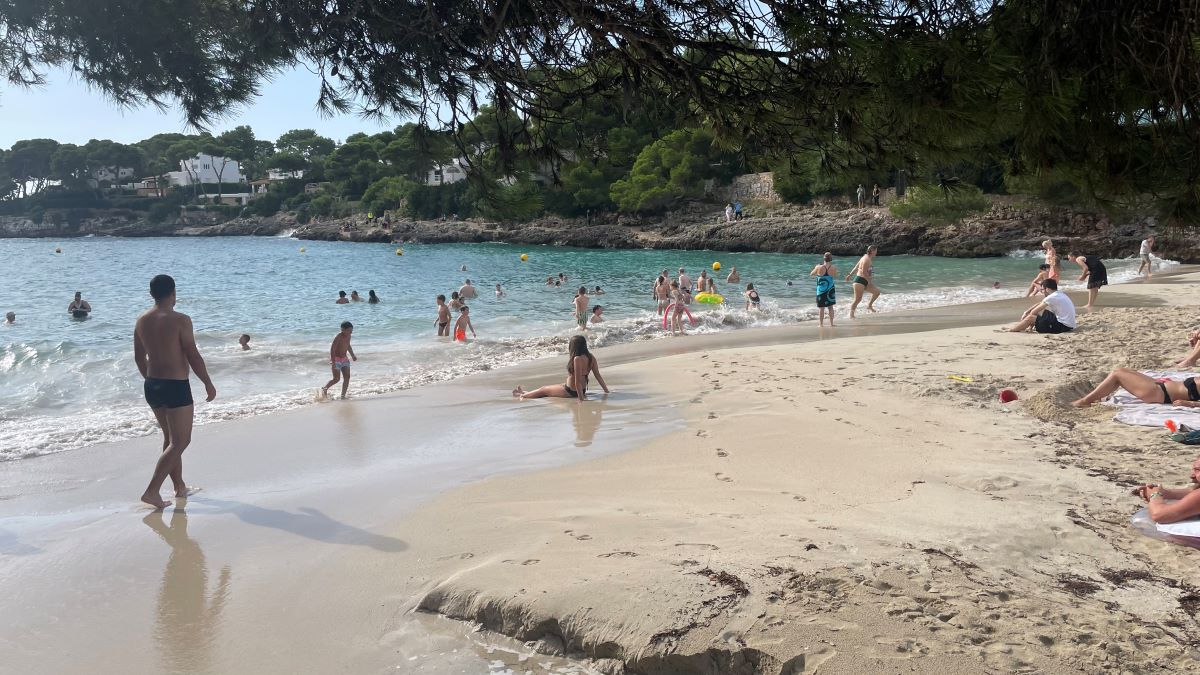
- The resort consists of several small bays: Cala Gran, Cala Esmeralda, Cala Ferrera, Cala Serena.
- The water is very clean, turquoise, with a gentle entrance.
- The sandy beaches are small, surrounded by rocks and pine trees.
- The bays often have bars, sunbeds and boat rentals.
- The beaches are small – in the middle of summer they can be crowded.
Atmosphere and entertainment
- The small port and marina is one of the most beautiful in Mallorca, with yachts, restaurants and nightlife without excessive noise.
- Many restaurants, cafes, boutiques in the center of the resort.
- Nearby is the Mondragó Natural Park with wild beaches and hiking trails.
- The resort is convenient for walks, cycling routes and boat excursions.
Day 6: Caló del Moro and El Caragol Beaches, Lighthouse Far del cap de ses salines
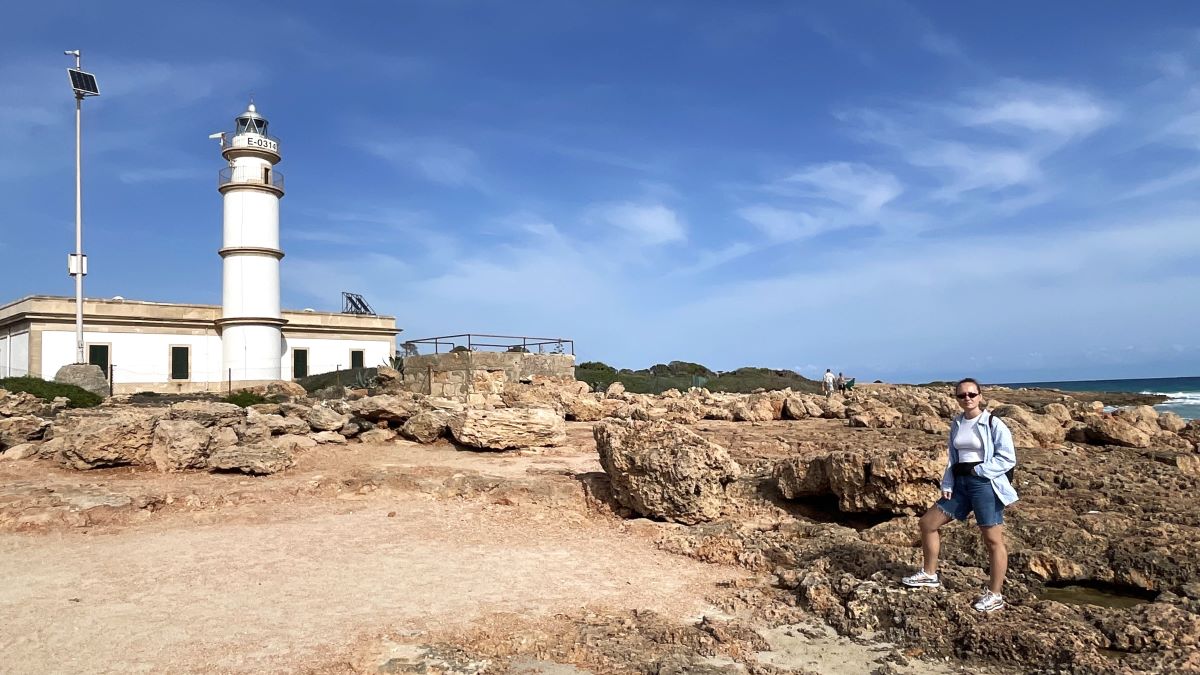
The penultimate day on the island we devoted to different beaches. After a heavy rain in the morning on the beaches of Cala d’Or it was very crowded and the water was very mixed with sand and water that went into the sea from the rivers. So we tried to swim in the bays of Cala Gran and Cala Esmeralda – strong waves, there was very little space on the beaches (everyone wanted to enjoy the sun). So we decided to go to the remote beach of El Caragol.
Playa El Caragol (often written “Es Caragol” or “Playa d’Es Caragol”) is one of the most natural and “wild” beach places on the island. It is a very intimate, cozy and incredibly beautiful place. When we arrived there, there were a maximum of 10 people on the beach. This is all because you need to walk along the seashore for about 25 minutes (1.5 km from the parking lot near the Cap de ses Salines lighthouse) along the stones and sand – many people are too lazy to do this. Well, it is wonderful!
El Caragol
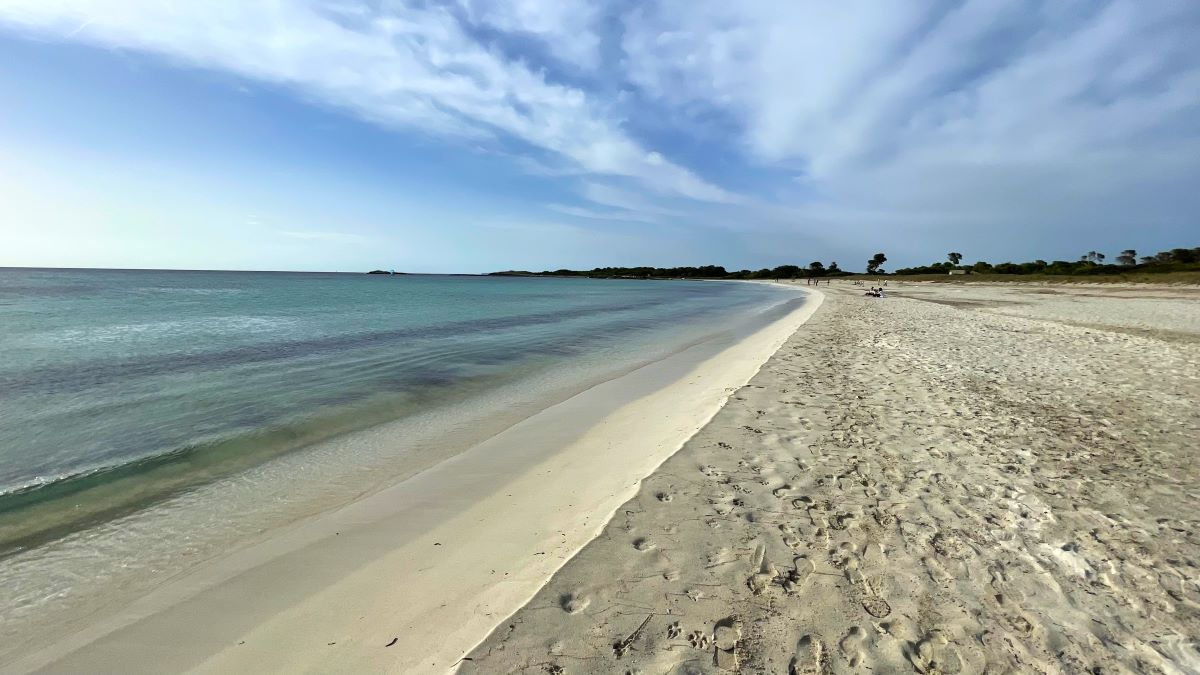
- The beach is located in the municipality of Santanyí on the southeast coast of Mallorca, near the Cape of Cap de ses Salines – it is one of the southernmost beaches of the island.
- The beach has natural status: it is “wild”, remote, with little infrastructure – ideal for those who want to get away from the typical resort noise.
- Dimensions: approximately 500 m long and about 60 m wide on average.
- The sand is white and fine-grained.
- The water is very clear, turquoise, with a gentle entrance in many areas.
- Coast and sea: there is a significant area with very low water (a coastal “platform” with sand), which makes it convenient for a long stay in the water.
- Swimming conditions: the waves are usually small, but it is worth considering that due to the openness of the coast there may sometimes be wind or small waves.
- There is seaweed gathering in one part of the beach, but it is large and only in one corner.
After swimming on this beach, we went to the nearby Caló del Moro – to have dinner and at the same time to see the sunset at the nearby observation deck – Mirador del Pontàs. A beautiful place – in the sea there is a huge rock in the form of a natural arch or bridge, such places attract because they are naturally beautiful.
Day 7: Palma – S’Arenal
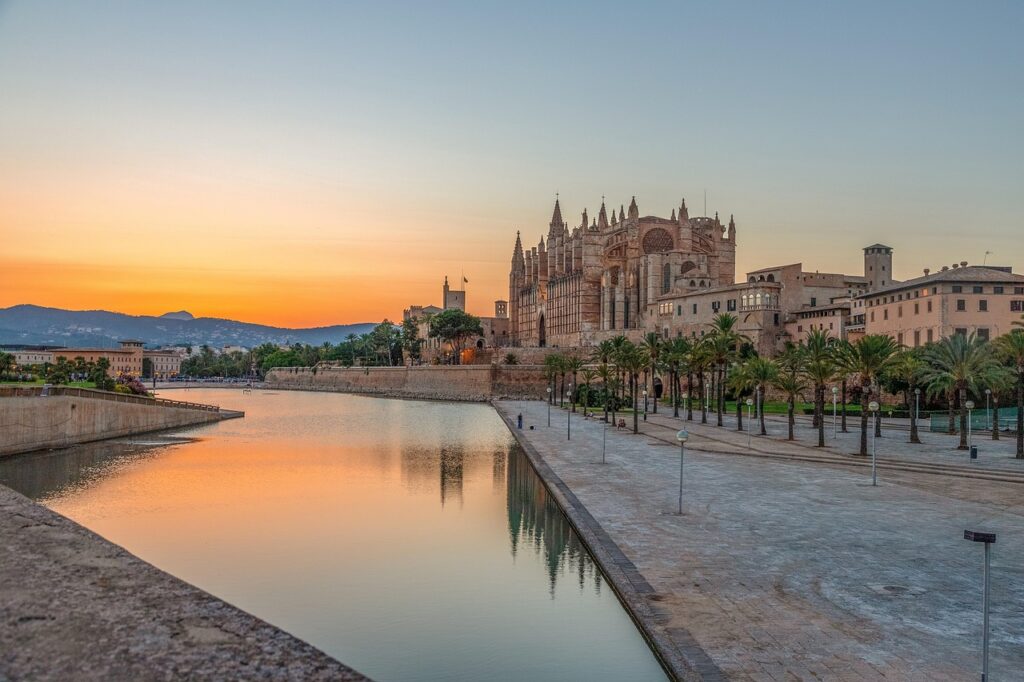
Today we rent a car to visit the capital of Mallorca – the city of Palma. Then spend the night near the airport (morning flight at 6:00 – taxi cost 22 euros).
So, Palma is a big city that has its own charm and color. I don’t really understand why I would spend a long time here, because I’m more interested in nature than cities. But there is something to see here.
TOP places in Palma in 1 day
- La Seu Cathedral (Catedral de Palma) is the main attraction of Mallorca, a Gothic cathedral with Gaudi stained glass windows and a view of the sea.
- Palau de l’Almudaina Royal Palace (Palau de l’Almudaina) is a former Moorish palace next to the cathedral.
- Old Town (Casco Antiguo) is narrow streets, flower-filled balconies, old houses and atmospheric cafes.
- Plaça Major is a central square for a quick stop, photos and coffee.
- Passeig del Born is the main elegant street with boutiques, restaurants and fashionable terraces.
- Es Baluard Museum is modern art and a wonderful panorama of the port and the sea.
- Paseo Marítimo is a walk along the promenade with views of yachts and the sunset.
- Bellver Castle (Castell de Bellver) is a round fortress from the 14th century with the best viewing platform over the city.
- Mercat de l’Olivar or Mercat de Santa Catalina – local produce, fruit, ham, seafood.
- Try ensaimada – a traditional Mallorcan pastry with coffee.
We stayed for one night in the hotel Planet Hotels ONE – close to the bus stop from the airport (A2), near the beach in the suburb of Palma – S’Arenal.
Conclusions after the trip
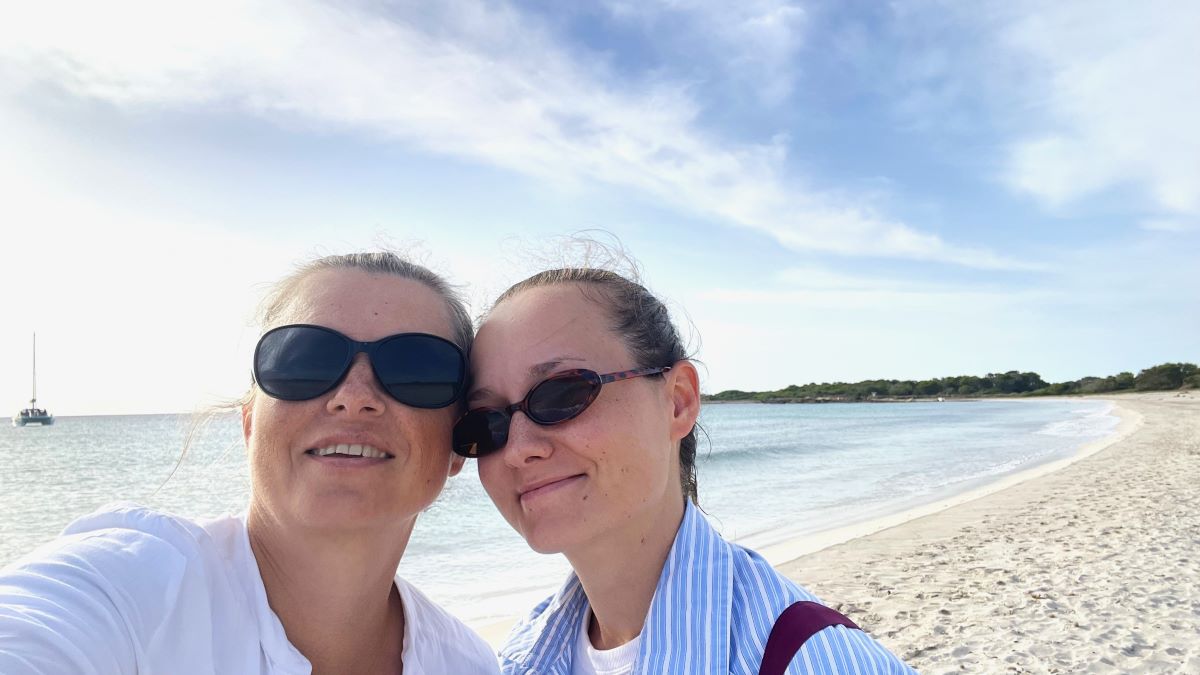
If you have a week in Mallorca and you like variety – don’t stay in just one city. Or choose a resort very carefully so as not to end up in a place where you will be uncomfortable because of a special contingent (like in the south of the island – young people are drunk and have fun very brightly.
The weather in October still allows for swimming, and the rains add drama to the sky – so it won’t be hot, and the water is still warm from the summer, great for a relaxing holiday.
Rent a car and drive around the island – we managed to see the main places, but there is still a lot left that can be included in the next trip. Mallorca is a diverse island, there are various interesting attractions for any request: whether for a quiet holiday for adults, or for a holiday with children, active hiking and cycling.
Useful articles and links:
- Top 7 cities worth visiting in Spain
- Mallorca beaches – the most beautiful bays and beaches with blue water
- Madeira VS Mallorca – which island to choose for your next trip
- Seven districts of Rome – where it is best for tourists to stay
Travel medical insurance with discounts can be purchased from HotlineFinance
Hotel and apartment bookings – Booking.com
Timetable and train tickets in Europe – Trainline
Rent a car – DiscoverCars