Madeira Itinerary – how we traveled and what we managed to see in a week on the island. Honestly, after such a trip, you need a vacation to recover because everything turned out to be very intense. But the mountains, waterfalls, and viewpoints won’t explore themselves. So, how to fit the unfit, or how we traveled around Madeira!
In reality, instead of a full week, we only had six days because on the first day, our plane couldn’t land at Funchal Airport due to strong winds. We spent the night on Tenerife, where the plane landed on the first day. However, the airline provided us with a hotel, transfer, and meals. And despite having to fit everything into the remaining days and constantly adjusting plans due to the weather – we managed to see it all!
Almost – we left a little for the next time because Madeira is a place worth visiting more than once.
So, I’m sharing my personal experience of traveling around Madeira, the itinerary, what we managed to see, how we traveled, and where we stayed during the trip.
I recommend you to read: Where to stay in Madeira – places and vacation style, advice from personal experience
How to travel around Madeira
When I was considering transportation options, I had a choice: either buses or renting a car. After reading numerous reviews, I realized that seeing all the places I wanted to visit on the island in a week would be nearly impossible using public transport.
Still, many tourists choose to travel around Madeira by bus. Some don’t have a driver’s license, while others prefer to save money on car rental. A bus ride costs around 2 euros on average, whereas renting a car for a day costs at least 30 euros. For a solo traveler, buses are certainly more cost-effective than a car.
There are several reasons for this:
- First, buses in Madeira are quite slow because, when traveling from point “A” to point “B,” they make numerous stops along the way. They enter many small villages and make frequent stops, following their route. Where a car would take 30-40 minutes, a bus could take 2 hours.
- Second, there are four different bus companies on the island, often with separate stops and schedules that don’t always align. If you need to transfer between buses, it can take a lot of time. Each bus company has its own stops, even within the same town, so you need to look for their branded logos to find the right one.
- Third, to travel around the island efficiently, you need to plan everything very carefully to see as much as possible. With a car, this isn’t a problem—you can quickly adjust plans if, for example, the weather changes or you decide not to visit a place on a particular day. Additionally, on weekends and holidays, many bus routes may not operate.
- Fourth, buses don’t always reach remote areas or scenic viewpoints. Check the notes in the schedule for a specific route—intermediate stops are usually listed, and some locations are only served by certain trips.
Traveling Around Madeira by Car
We traveled by rental car—following tradition, I searched for the best deal on DiscoverCars, but I carefully read reviews for different companies. The reason? Rental prices are quite high, and deposits are even higher if you don’t purchase full insurance (deposits in Madeira range from €1100-1500 depending on the car class).
I immediately ruled out cars with manual transmission and weak engines. Why? Because Madeira has extremely steep roads and winding mountain passes. A weak car with a manual gearbox is not a joy to drive here—it’s pure struggle.
So my strong advice: do not save money on a car!
Madeira by car – car rental and driving nuances you need to know
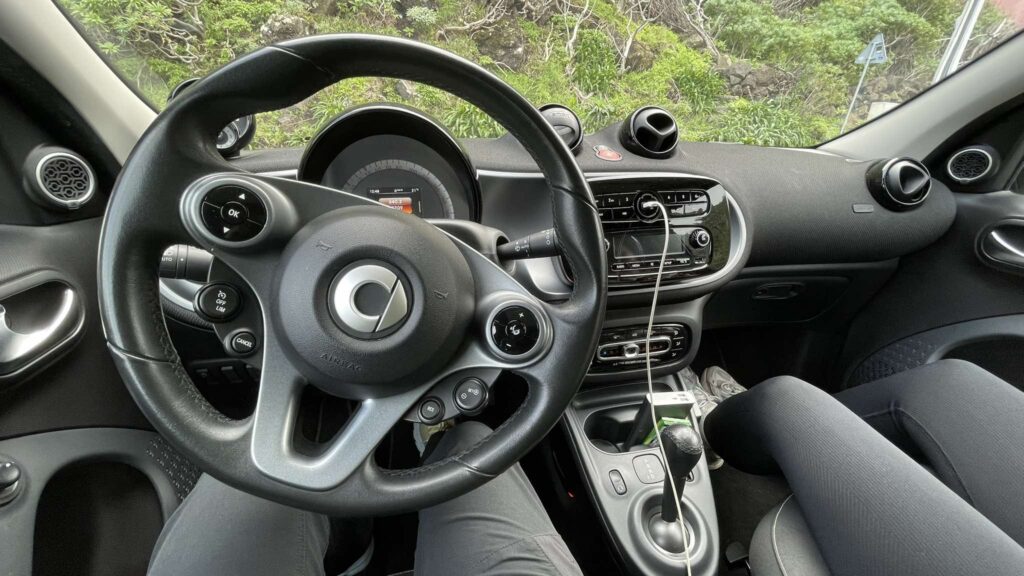
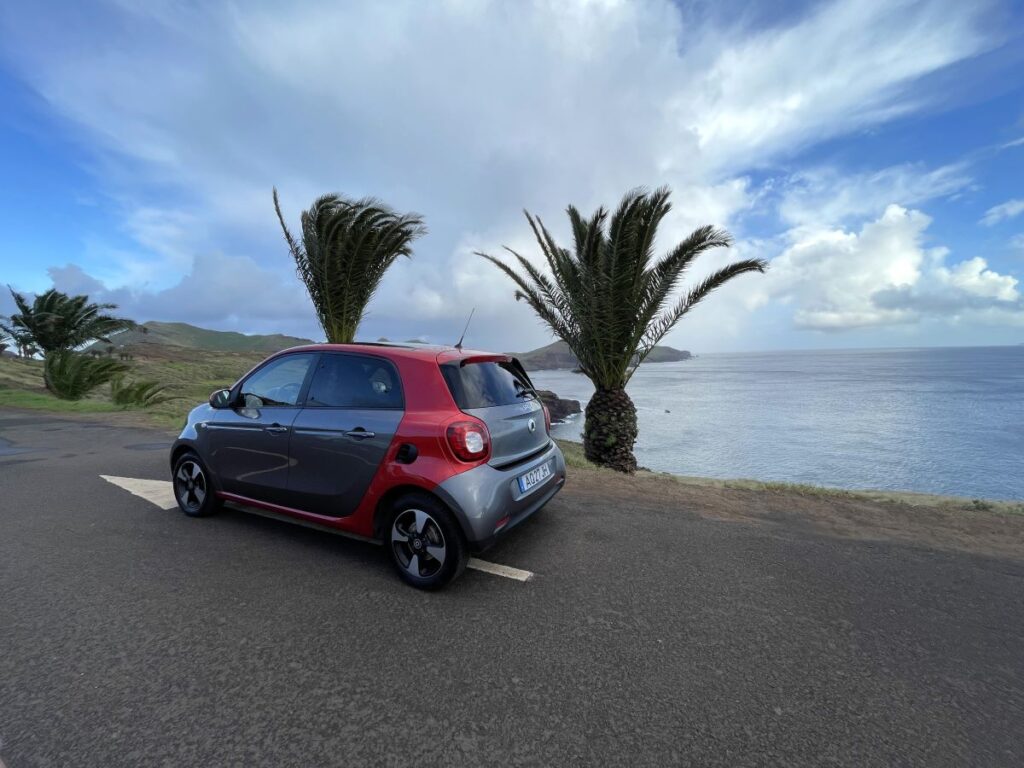
If you’re traveling as a couple, feel free to rent a Smart ForFour. This compact car has just a 0.9L engine, but the turbo pulls it up any hill. In six days, we managed to drive 500 km on this small island, and I spent only about €65 on fuel.
However, the rental cost us €320 in January, including full insurance for 7 days (€45 per day).
If you’re traveling with a group of 4-5 people and have suitcases, it’s better to rent a Class B car with at least a 1.5L engine. And, of course, an automatic transmission. It will be larger, but you’ll still find parking everywhere except in the center of Funchal. Plus, such a car will have no problem carrying your entire group up the steep hills.
Roads in Madeira

The cities and small towns on the main island of Madeira are connected by one major road that circles the entire island. This main road is the best alternative to the older city roads, which are steeper and narrower.
Fortunately, the new main road is relatively safer. It is known for its numerous tunnels that cut through mountains and other natural obstacles, such as gorges, as well as many bridges and viaducts. The main road connects not only the cities and small towns of the island but also its main natural attractions.
Locals in Madeira are generally skilled drivers due to the island’s unique geography, but they also have a habit of exceeding speed limits in some areas. They are also not particularly inclined to move to the left lane to let drivers merge from the right.
If you are new to driving on the island, I recommend being cautious — even on the main road.
Parking in Madeira
The busiest traffic is in the center of Funchal, where the streets are narrow, parking is paid everywhere, and it is generally difficult to find a spot. That’s why we booked an apartment with its own parking there.
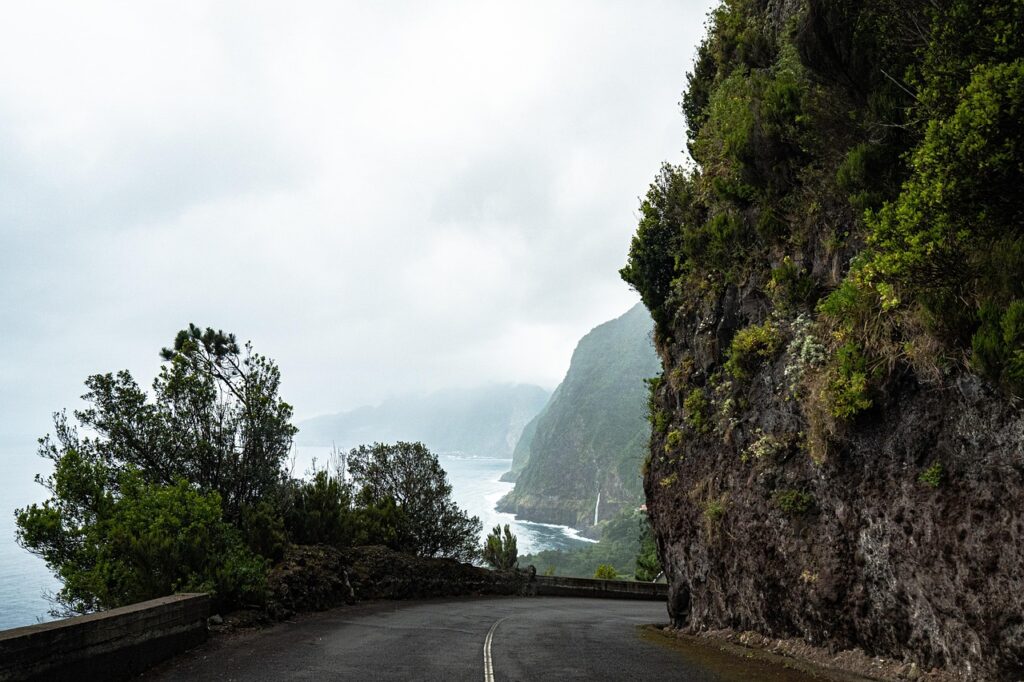
In other towns, parking is easier—you can almost always find a spot to park for free along the road. Near natural landmarks, levadas/trails, and viewpoints, parking is free everywhere. The only exception is the parking lot at Pico do Arieiro (4 euros per hour). However, since there are very few spaces, on good weather days, cars park along the road, which is completely free.
Wherever we parked, the prices were quite reasonable. For example, in the town of Ribeira Brava, we left the car in a covered parking lot—the price was 0.3 euros per hour. Payment by card.
Navigation
For driving, I used Google Maps. It worked well for the most part, except in the narrow, winding streets of Funchal, where Google got a bit confused. Otherwise, it was fine. You can also use the Waze app.
For trekking/hiking, I used maps.me.
Parts of the Island: Differences and What to See
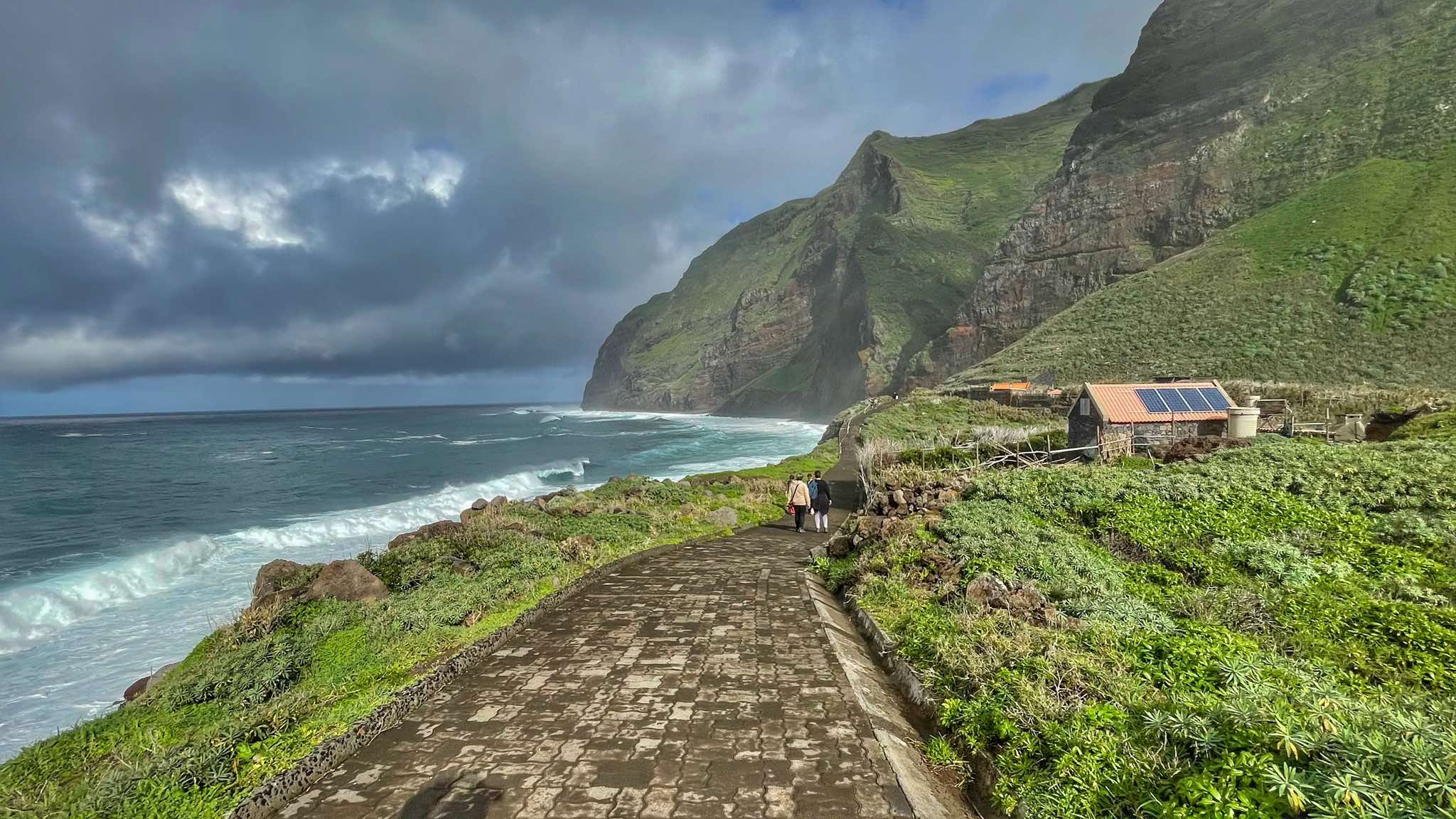
We traveled around the entire island along the coast, through tunnels and mountain serpentines. We also visited the center of Madeira and even spent a night in the mountainous region of São Vicente.
So, each part of Madeira differs slightly in terms of weather and locations. Understanding where everything is located will help you plan your route. Or, if the weather suddenly changes in one area, you can adjust your plans and head in the opposite direction.
Southern Part of the Island

- 1. This area has the highest concentration of settlements, including the capital city, Funchal.
- 2. Most hotels and apartments are also located in the south. That’s why the tourist infrastructure is more developed here, with cafés, restaurants, and Funchal’s port, where cruise ships arrive.
- 3. The sunnier and warmer side of the island. It’s believed that the most sunny days occur in the south, particularly in the Ponta do Sol and Madalena do Mar area.
- 4. Bananas are grown on the mountain slopes. It’s amazing to see them on terraced hillsides and even in private gardens along the streets of small towns.
- 5. Waterfalls cascade down the mountain slopes, such as those in Madalena do Mar and along the old road between Madalena do Mar and Ponta do Sol—like the Cascata dos Anjos waterfall. Similar waterfalls can also be seen while hiking along levadas, such as Levada Nova, and in other parts of the island.
- 6. One of Europe’s highest cliffs, Cabo Girão, stands here at 580 meters. At the top, there is a glass-floored observation deck. Entry costs 3 euros.
Northern Part of the Island

- 1. Honestly, the north impressed me even more than the south. The landscapes are wilder, and the cliffs are steeper and more striking.
- 2. There are fewer buildings outside settlements and not as many supermarkets. The north is much less inhabited than the south.
- 3. The north is cooler, but not cold. We actually swam in winter on the black volcanic beach in Seixal. You can also swim in the natural lava pools in Porto Moniz—both free and paid ones with facilities.
- 4. The north is less sunny than the south, but the dramatic scenery and the deep blue ocean make up for it.
- 5. One of the world’s most scenic coastal roads runs along the ocean in the north.
- 6. The lush, mountainous region of São Vicente is located here. Locals grow vineyards on the mountain slopes.
- 7. The north is home to many waterfalls visible along the roads, with small parking areas where you can stop and admire them. One example is Água d’Alto Waterfall, located near São Vicente.
Western Part of the Island
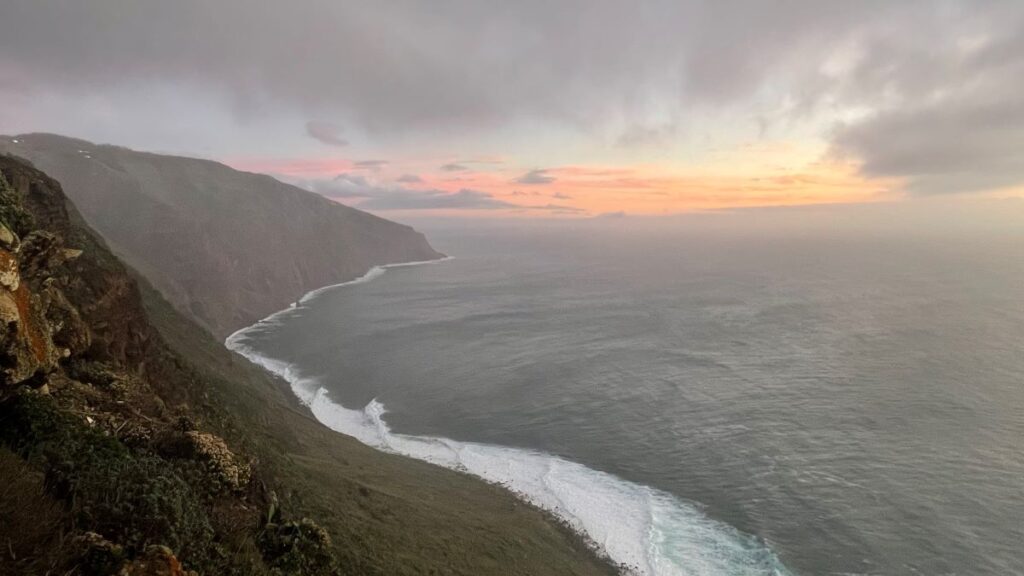
- 1. The west is less touristy and quite empty, especially after the 2024 wildfires. The villages here are more neglected, with very narrow roads.
- 2. Three key attractions in this area include the lighthouse at Ponta do Pargo (considered the best sunset spot on the island) and the viewpoint with a funicular at Calhau das Achadas, which overlooks a small fishing village and old gardens. Both offer breathtaking views of the ocean and cliffs from great heights.
- 3. A lesser-known waterfall can be admired from the Miradouro da Garganta Funda viewpoint.
- 4. We also discovered a fantastic viewpoint near the Capela de Nossa Senhora da Boa Morte church – Miradouro da Boa Morte.
Eastern Part of the Island
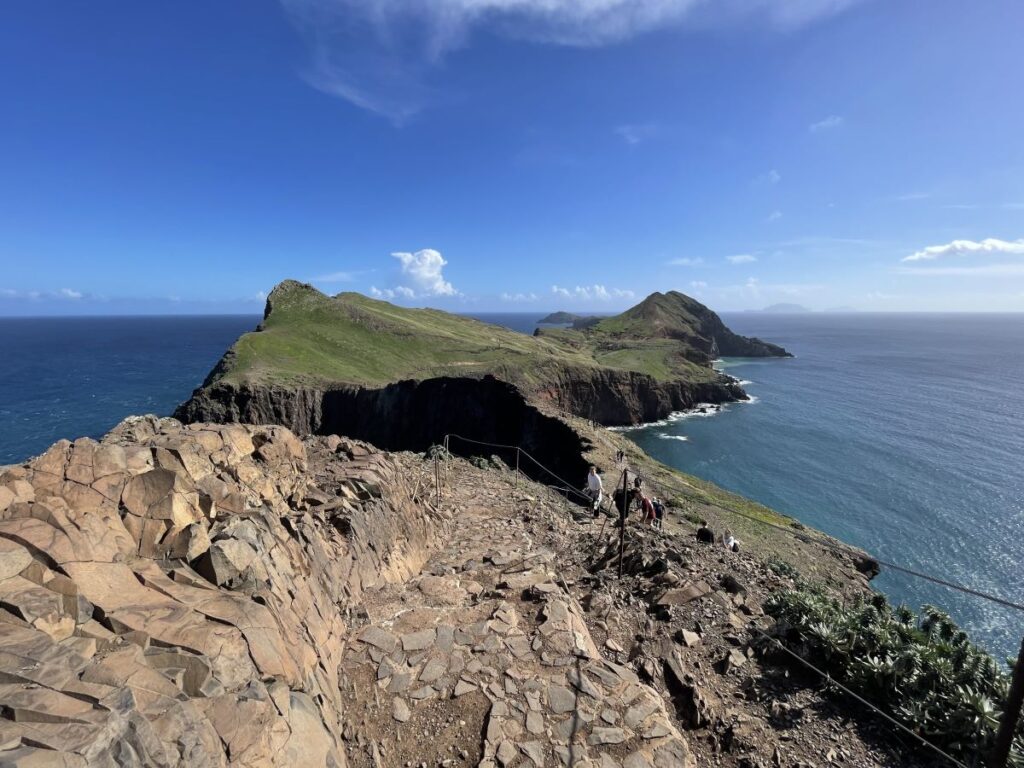
- 1. The east is home to stunning green mountains with winding roads offering breathtaking views. A particularly scenic stretch runs from Porto da Cruz to Santana.
- 2. Near the coast, you’ll find the uniquely shaped mountain Penha de Águia, surrounded by spectacular coastal landscapes.
- 3. The incredibly beautiful Ponta de São Lourenço headland is accessible via the fantastic PR8 hiking trail, which I highly recommend. In winter, the cape is an emerald green, while in other seasons, it takes on a brick-red hue. That’s why I suggest doing this trek in winter.
- 4. In Machico, you’ll find a sandy beach with imported yellow sand – Praia de Machico, as well as a beautiful natural beach with black volcanic sand, Prainha Beach.
- 5. The eastern part of the island features several stunning levadas. The easiest and most scenic is Levada dos Balcões, which ends at a balcony-like viewpoint offering spectacular mountain and ocean views.
- 6. The east also offers plenty of accommodation options. The best place to stay is Santana, which has numerous hotels and shops. It’s also a convenient base for accessing the hiking route to Pico Ruivo, just a 15-minute drive away.
Central Part of the Island
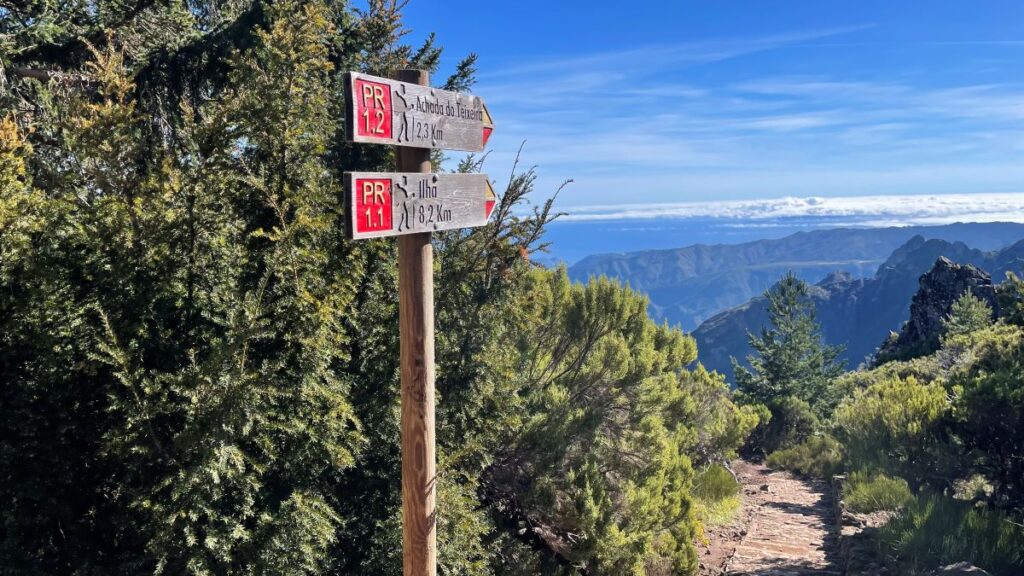
- 1. The central part of the island is home to the highest mountains, including Pico Ruivo (1,861 meters), offering breathtaking views and challenging ascents and descents.
- 2. Clouds often settle in the valleys like a bowl, attempting to spill over to the coast, while you stand above them.
- 3. It is noticeably cooler here than on the coast.
- 4. A breathtaking viewpoint, Curral das Freiras, overlooks the Valley of the Nuns, where a once-isolated village is now accessible by road and bus, or via a trekking route.
- 5. This region is home to the island’s iconic PR1 Pico do Areeiro – Pico Ruivo hiking trail.
- 6. The ancient laurel forest of Fanal is also located here, featuring mystical, twisted trees.
Our Madeira Itinerary by Days
We split our stays across different locations to avoid returning to Funchal every day and to experience different scenic routes. Driving in Madeira is a pleasure, offering stunning views along the way.
Here are our overnight stops for a week in Madeira:
- Days 1-3 – Funchal (We unexpectedly spent a day in Tenerife due to strong winds preventing our landing in Madeira).
- Day 4 – São Vicente (to explore the northern region).
- Day 5 – Santana (for more northern sights and the Pico Ruivo hike).
- Days 6-7 – Funchal (a different location, closer to the center, to explore the city).
Of course, you can stay in Funchal for the entire trip without moving to different towns. For us, it wasn’t an issue since we had a car. Plus, we only had small carry-on luggage, making it easy to pack up in the morning and quickly hit the road.
Day 1 – Unplanned Landing in Tenerife

This day was packed with emotions—a strong wind prevented us from landing in Madeira’s airport. First, we experienced intense turbulence as the pilots attempted to land, followed by 1.5 hours of circling over the island before finally diverting to Tenerife.
Madeira’s airport is ranked among the top ten most dangerous airports in the world. The reason? A short, narrow runway extending over the ocean, built on a viaduct supported by 180 three-meter-wide reinforced concrete pillars. On one side, the cliffs press in, while on the other, waves crash beneath. Landing a plane here in windy or challenging weather requires exceptional pilot skills. Even in good weather, the landing can be bumpy—so be prepared!
In bad weather, planes don’t land at all. In our case, there were wind gusts of 80 km/h and a thunderstorm in Funchal, so we were rerouted to Tenerife.
Everything ended well—Wizz Air accommodated us in a 5-star hotel near Tenerife South Airport. They provided a transfer and dinner. We took a short walk by the ocean and went to bed, exhausted from the emotional day.
I recommend you to read: Madeira in Winter: Complete Travel Guide
Day 2 – Madeira and Ponta de São Lourenço
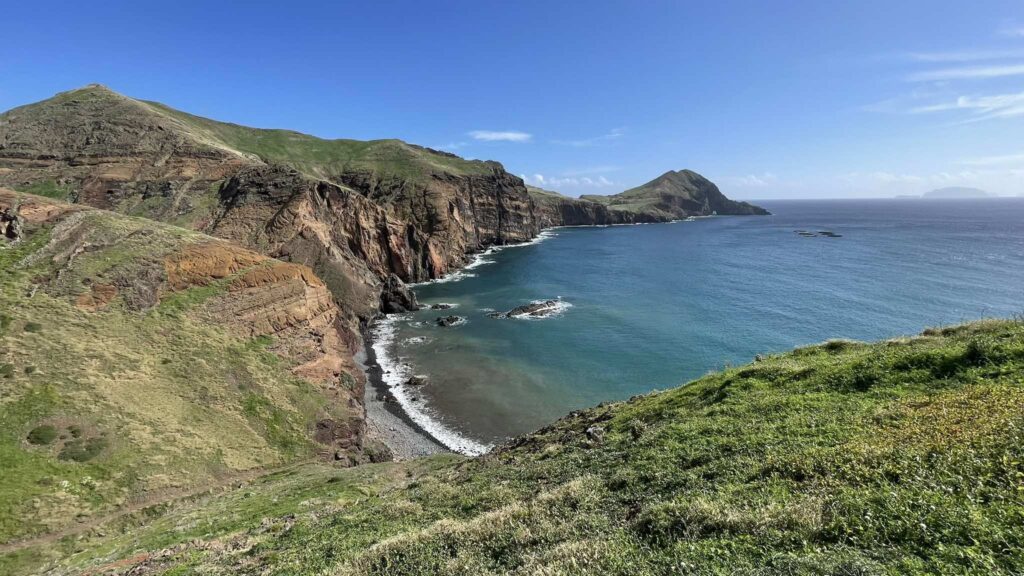
Our plane landed around 11 AM. The island was covered in clouds, and it was raining over most of Madeira. The only sunny spot was Ponta de São Lourenço, located at the island’s easternmost point.
We picked up our rental car at the airport, checked the weather, and decided to head straight to the island’s east to hike trail PR8 to the farthest eastern point of Madeira—Ponta de São Lourenço.
Martian-like landscapes with bright brown soil in summer, and an emerald-green peninsula in winter. A complete absence of trees, except for a few palms near an oasis by Cafetaria Sardine House café & snacks, which is located midway through the trail. A piercing wind overpowering the roar of the turbulent ocean, trying to push you off the path. And stunningly beautiful views—all of this awaits you at Ponta de São Lourenço.
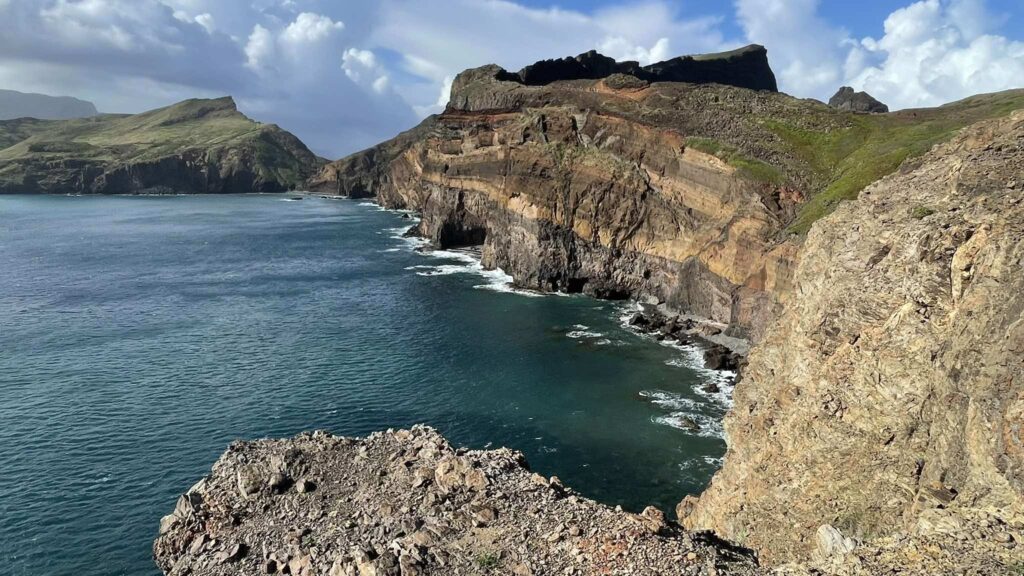
You can fully experience this landscape by hiking the PR8 Vereda da Ponta de São Lourenço trail—four kilometers each way. The trail may seem easy at first, but towards the end, you’ll face a steep ascent to a panoramic viewpoint, requiring some effort to reach the top.
Keep in mind: if you get caught in the rain on this route, it can be dangerous because the paths here are made of clay. The clay quickly turns soggy and becomes very slippery. Even in trekking shoes, it was difficult to descend when a cloud came in the last meters and poured rain on us. Be careful, take a raincoat with you, wear shoes with good tread.
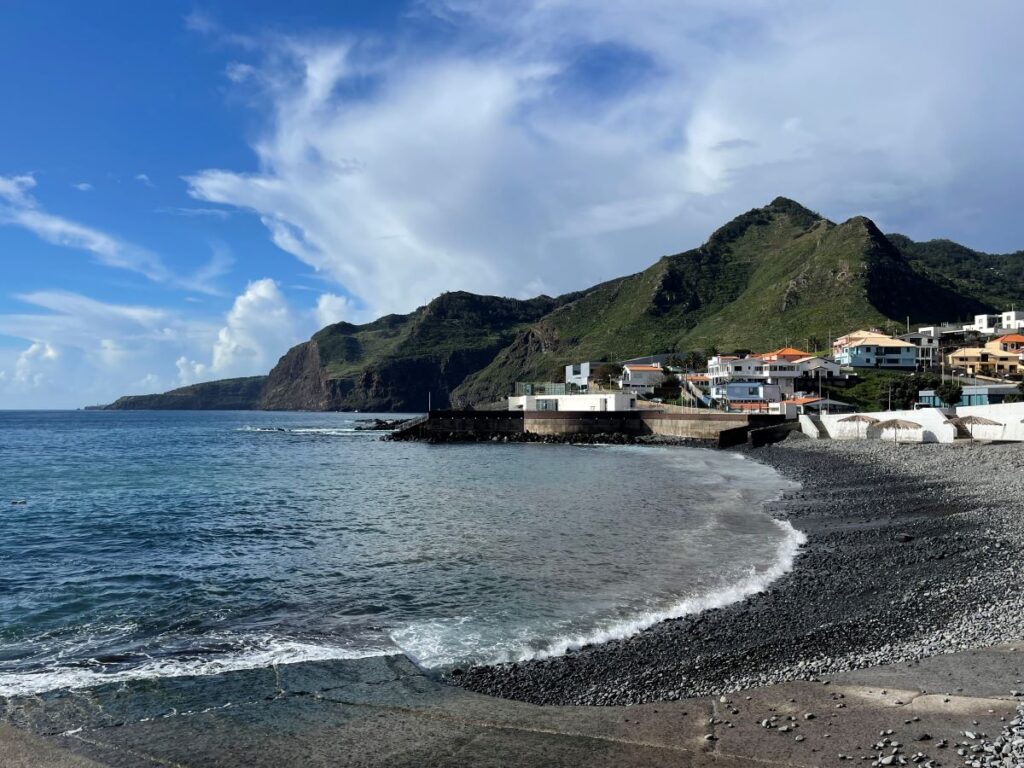
After completing the hike, we stopped by the nearby town of Caniçal, known for its fishing industry and seafood restaurants. We had lunch with local dishes —Tuna and Octopus Madeira-style. However, we didn’t enjoy it much as the preparation method was quite heavy and greasy, with everything fried.
How to Get There
- By Car: You can drive to the start of the trail, where there is a free parking lot (32°44’35.8″N 16°42’05.6″W). However, parking spots are often scarce, so it’s common for cars to be parked along the roadside—this is normal across the island.
- You can also reach the trailhead by bus SAM №113. Make sure to take the one that goes to the final stop, Baia D’Abra.
Where to Stay in Funchal:
For the night, we headed to Funchal, where we had missed a night due to our unexpected stop in Tenerife. Our apartment-hotel, Travellers Pearl by Storytellers, offered self-check-in, and they were expecting us despite our Tenerife detour (we had informed them in advance). I chose this accommodation for its private parking, as well as the ability to prepare breakfast or dinner — there’s a kitchen with all necessary utensils, plus a washing machine.
Day 3 – Cabo Girão and Angels Waterfall
In the morning, we checked the weather across the island and decided to stay on the southern coast, as this was where the sun was expected.
If you’re visiting Madeira outside of summer, I highly recommend checking the weather forecast for different parts of the island before planning your itinerary. The best website for this is IPMA-Madeira.
Additionally, I suggest checking real-time weather conditions and cloud coverage using the numerous live webcams available across the island. You can find them on this website.
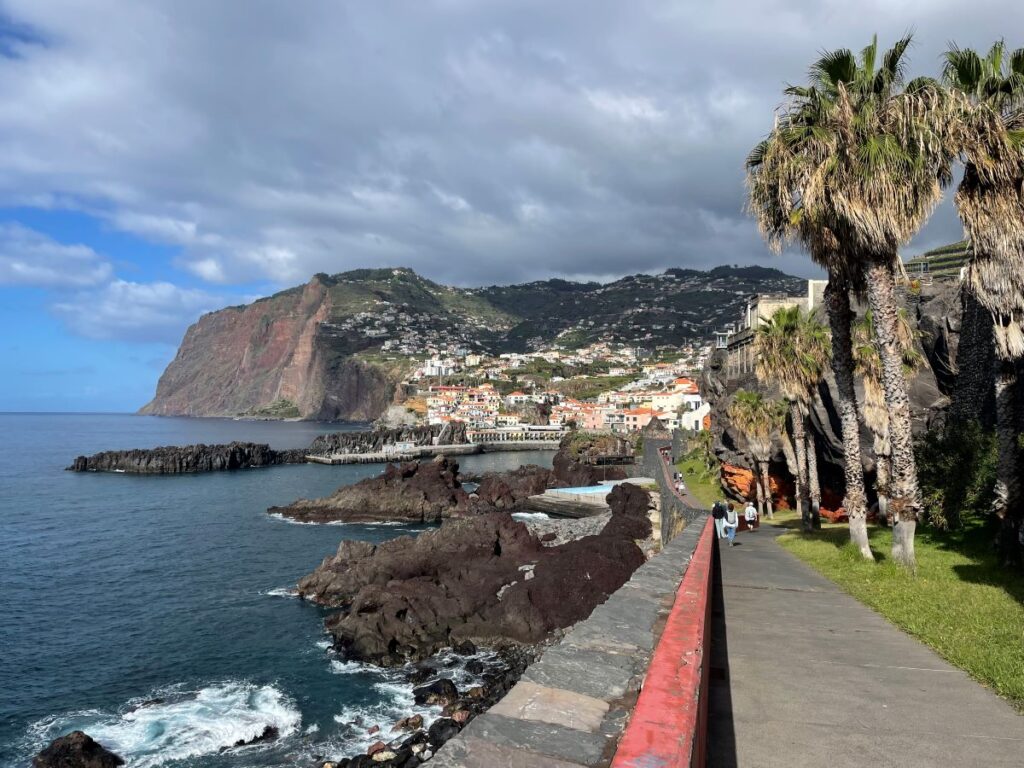
Our first stop was the charming and slightly touristy town of Câmara de Lobos, a favorite holiday spot of Winston Churchill, where he used to paint by the shore of its cozy little bay. It’s a truly picturesque town with a beautiful promenade and scenic views of Cabo Girão cliffs. We took a walk and enjoyed a delightful coffee at Restaurante Coral.
How to Get to Câmara de Lobos:
- From Funchal, take bus #7.
- By car – we parked on one of the streets in Câmara de Lobos, where there was a free spot (32°38’51.6″N 16°58’13.4″W). There is also a paid parking lot on the promenade.

Next, we headed to Cabo Girão—a cape that is considered the highest sea cliff in Europe and the second highest in the world. Its visible height is nearly 580 meters, but that’s only what we can see. No one knows for sure how many hundreds of meters it extends beneath the Atlantic Ocean and deep into the earth. The slopes of Cabo Girão are actually the exposed peak of an underwater volcano, and on one of its ledges, a glass-floored viewpoint has been built.
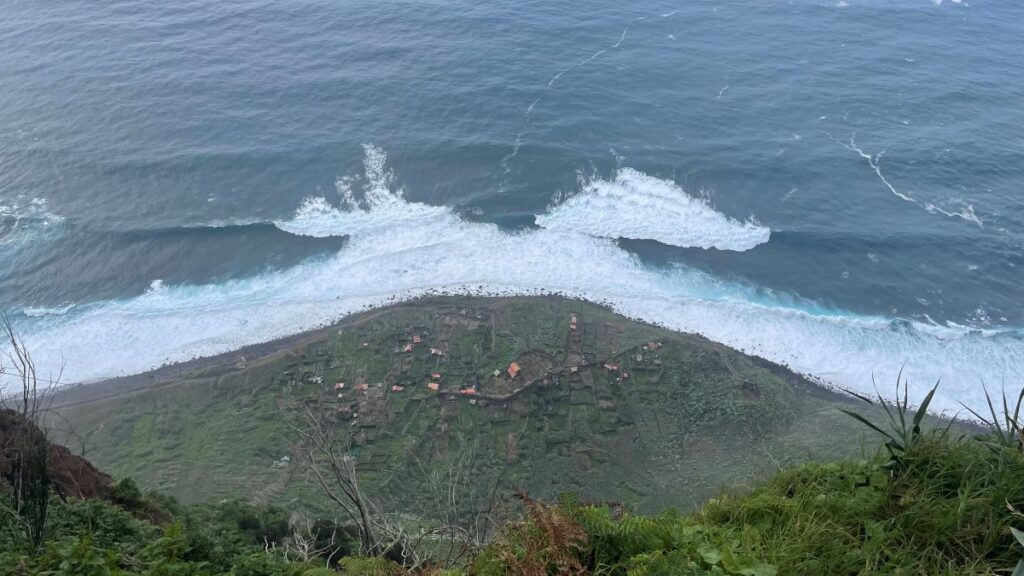
The breathtaking views of the ocean and the tiny gardens below are guaranteed. If you’re feeling adventurous and want to descend to a small secluded village by the ocean, you can take the Teleférico do Rancho. This cable car was originally built for farmers who rely on it to reach their plantations below. However, it’s open to all visitors for a fee of 10 Euros round trip (cash only). We didn’t go down as maintenance work was being carried out in late January, so be sure to check the schedule in advance.
How to Get to Cabo Girão
- From Funchal, take bus #142.
- By car – free parking is available here: (32°39’26.6″N 17°00’18.6″W).
Ribeira Brava
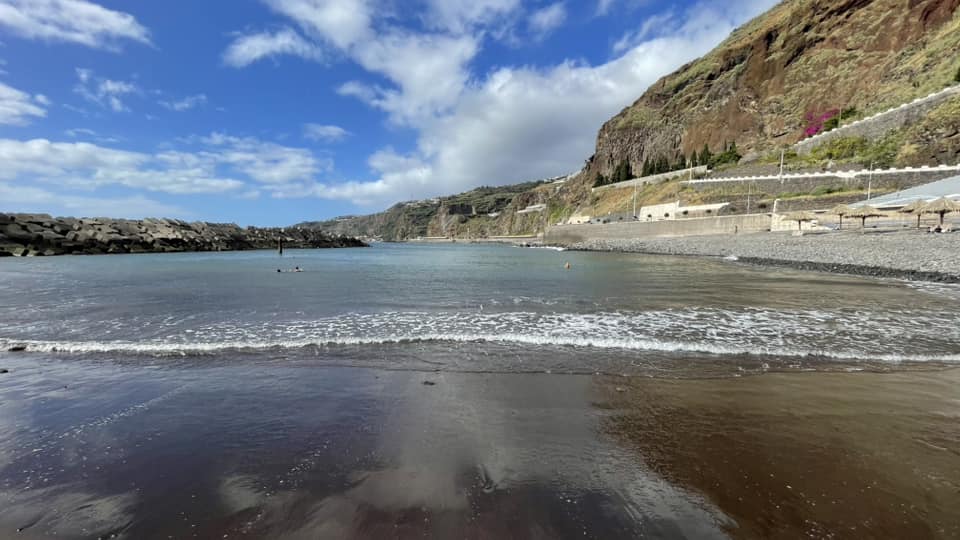
The next place that caught our interest was the town of Ribeira Brava. We were looking for a sandy beach to swim and have lunch at a local café. This charming town is located in a gorge that leads to the northern part of the island, towards São Vicente. It has a small beach with black volcanic sand, protected by a large breakwater that shields it from high waves. If you’re looking for a beach getaway, this is a great spot.
After a stroll along the beach, we realized we were more hungry than eager to swim. We found a cozy little spot, Café do Grilo, popular with locals. We enjoyed delicious regional dishes: bacalhau (codfish) with grated potatoes, stewed lamb tongue, and octopus salad. With non-alcoholic beer, the total for both of us was 25 Euros. Highly recommend such places if you want to try authentic, homemade-style food without overpaying for tourist dining.
Angels’ Waterfall
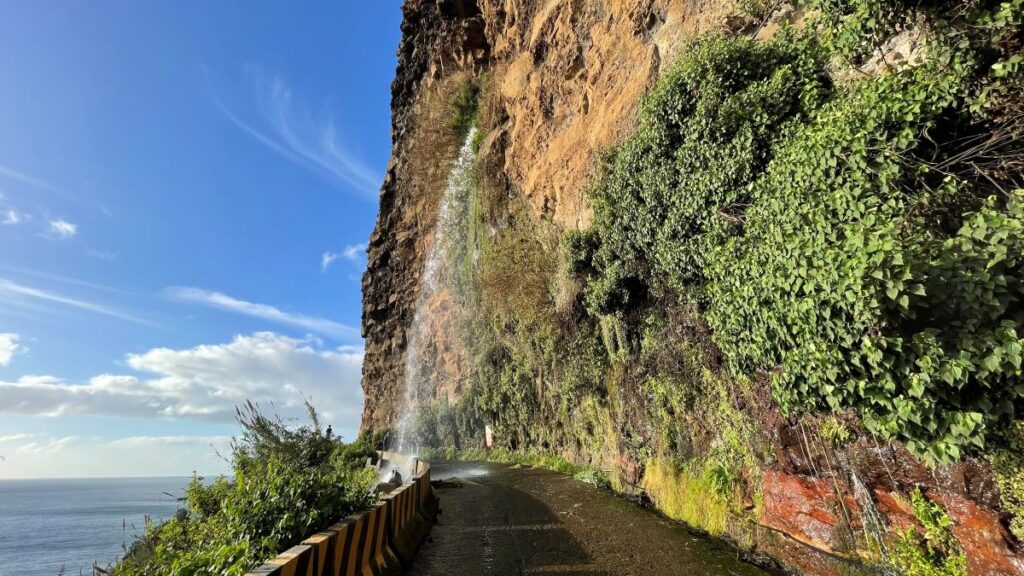
Next on our journey was one of Madeira’s most unique sights—the Angels’ Waterfall (Cascata dos Anjos), which cascades down a cliff directly onto the road. Unfortunately, in 2025, the ER101 road is closed to traffic due to landslides. However, you can park nearby and walk just 100 meters to reach the waterfall.
Coordinates for the waterfall and nearby parking: (32°41’20.4″N 17°06’51.6″W).
In the evening, we returned to Funchal, stopping by a large supermarket to stock up on supplies for the next two days. Since we planned to head north, where shops are scarce, we bought fruits, ham, yogurt, and other essentials.
Day 4 – Nuns’ Valley and Pico do Arieiro
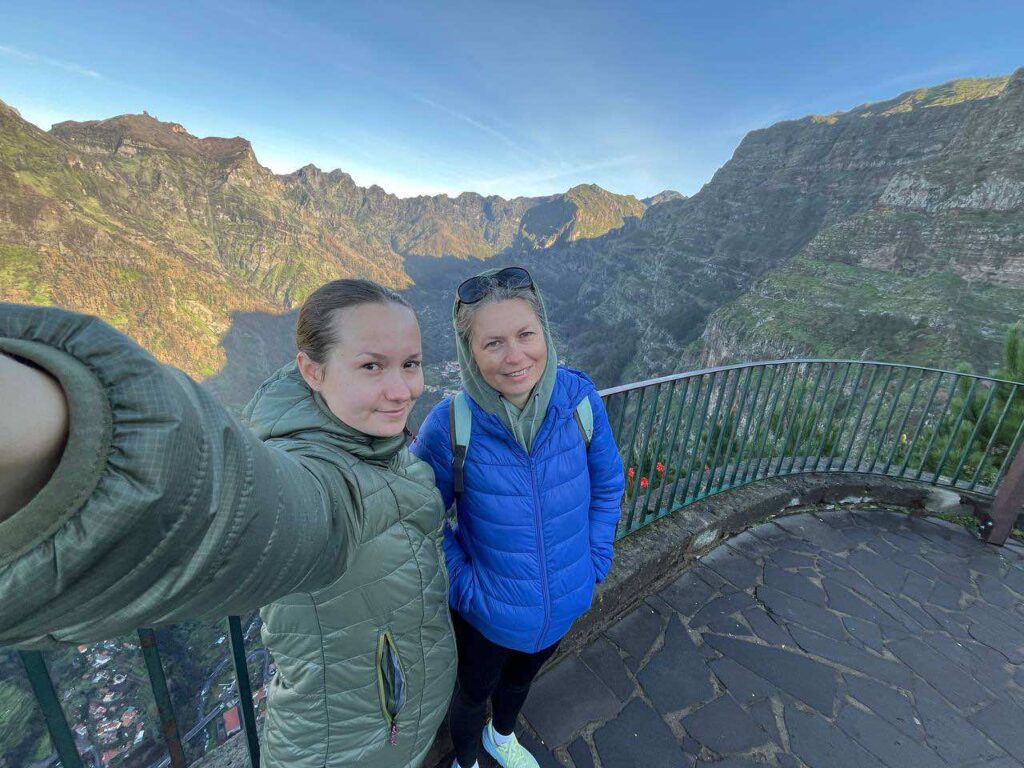
Our original plan was to visit Nuns’ Valley in the morning, then head to Porto Moniz and drive from there to São Vicente, where we had an apartment booked. However, the weather changed our plans—there were no clouds over the mountains. So, we quickly adjusted our itinerary and added Pico do Arieiro to the day’s route.
We left at 8 AM to witness the sunrise gradually illuminating the valley of Curral das Freiras. This stunning location comes with a legend: nuns from a Funchal monastery supposedly fled here to escape pirates. While the story isn’t true, it adds charm to the already picturesque village nestled in the valley below.
Near the viewpoint, you’ll find the Eira do Serrado – Hotel & Spa, which offers panoramic views and a pool overlooking the valley. You can stay overnight and admire the scenery from the pool or simply stop by for a coffee at the hotel’s café.
Tip: come here in the morning before 10 am – after that you will find yourself in a crowd of tourists arriving in large tour buses.
How to Get to Curral das Freiras:
- From Funchal, take bus No. 81, which goes to the village of Curral das Freiras. However, do not ride all the way to the final stop. Get off at Ribeira da Lapa-Zona 13 (here). From there, you’ll need to walk about 1 km to the Boca da Corrida viewpoint.
- If driving, follow the winding mountain roads to the parking area near the viewpoint. Parking is free.
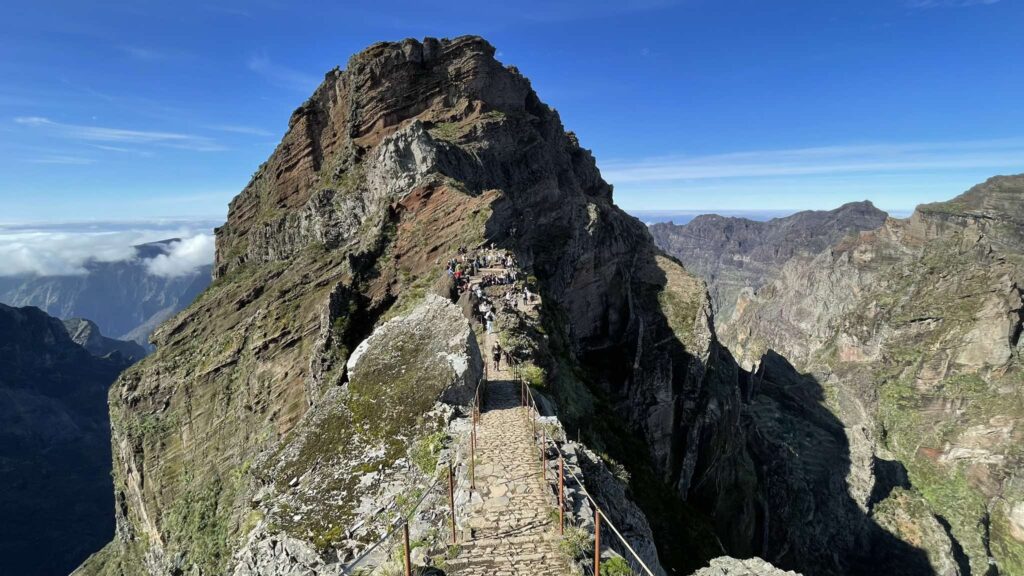
Next, we headed to one of the most breathtaking hiking trails on Madeira, starting at Pico do Arieiro. The unique thing about this peak is that you can only reach the summit by car. You drive up to a viewpoint with a parking lot right nearby, and just like that—you’re in the mountains! From the Pico do Arieiro viewpoint, the stunning PR1 Pico do Areeiro – Pico Ruivo trail begins.

This trail was my dream hiking experience on Madeira. Unfortunately, in January 2025, it was closed due to the wildfires that occurred in autumn. Only the first 1.2 km were accessible, but even that short section was epic and breathtaking. I highly recommend visiting—preferably on a sunny day, as thick clouds can obscure the views and make hiking unsafe.
This viewpoint is also popular for watching the sunrise in the morning and the sunset in the evening. It’s an incredibly beautiful place where you can stand above the clouds.
As of January 1, 2025, this trail (like all hiking trails on Madeira) requires an entrance fee of €3 per person.
How to Get to Pico do Areeiro:
- By car – It takes about 1 hour from Funchal. If coming from other cities, the route still passes through Funchal, so plan this visit while staying on the southern coast.
- Some travelers have reached Pico do Areeiro partially by bus. They took a bus to the Paso do Poiso mountain pass, where many cars head uphill. From there, they easily hitched a ride to Pico do Areeiro.
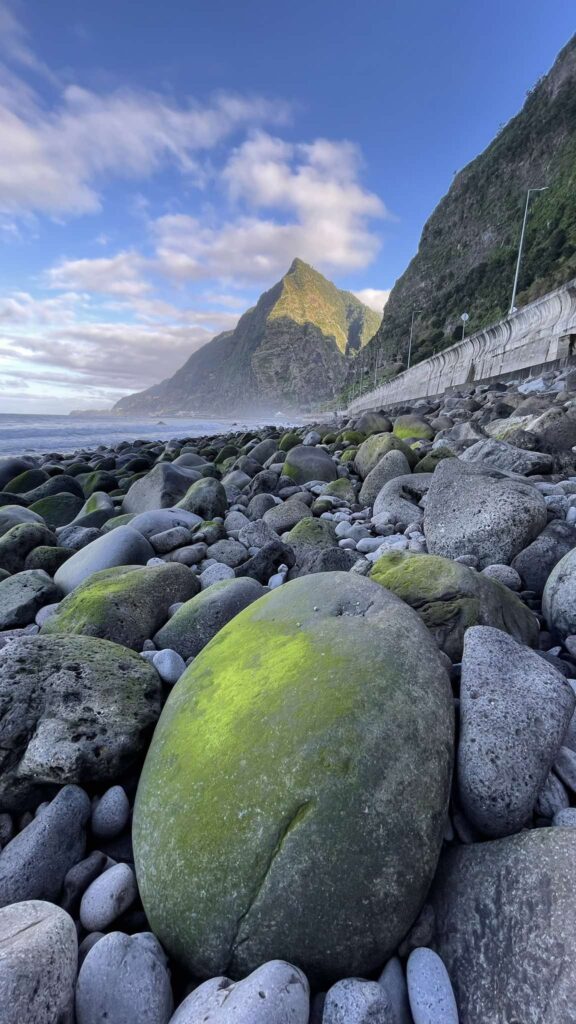
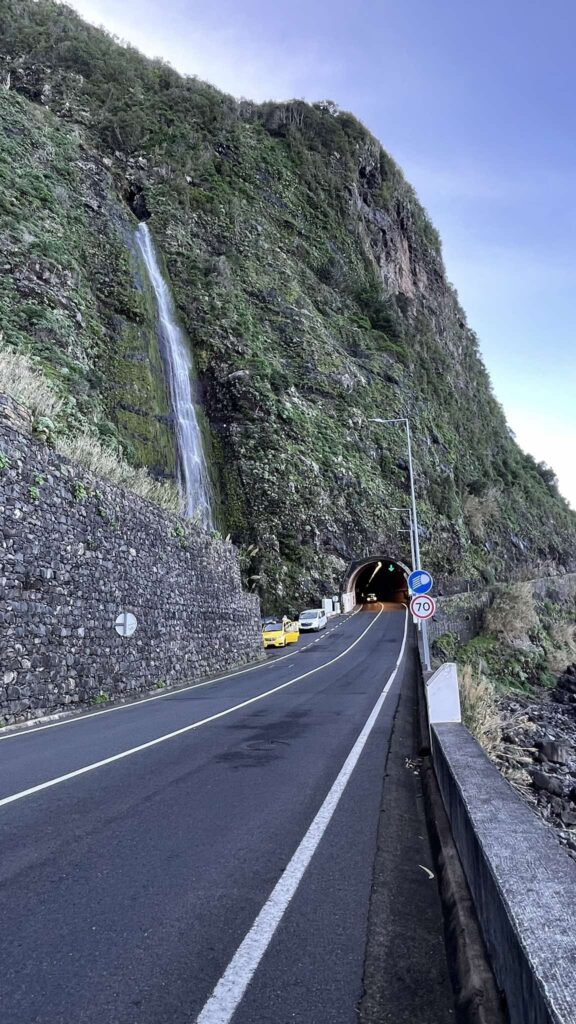
After our mountain hike, we headed toward São Vicente, where we planned to stay for the night. We booked a fantastic room in a spacious two-story apartment at Refugio das Fontes. In reality, we had the entire huge house to ourselves, complete with a kitchen, washing machine, and dryer. There’s plenty of parking space near the accommodation, and self-check-in is easy.
What to see in São Vicente? First, there’s the chapel on the hill, Capela de Nossa Senhora de Fátima, which looks stunning during the day and appears to float in the air at night due to its lighting. Another attraction is the water caves, Grutas de São Vicente, but they were closed during our visit.
Along the oceanfront, there’s an entire street lined with restaurants serving local and seafood dishes. You can get there by car or on foot if your accommodation is near the coast. At Restaurante Caravela, you’ll find delicious and generously portioned meals.
Day 5 – Porto Moniz, Waterfalls, and Fanal Forest
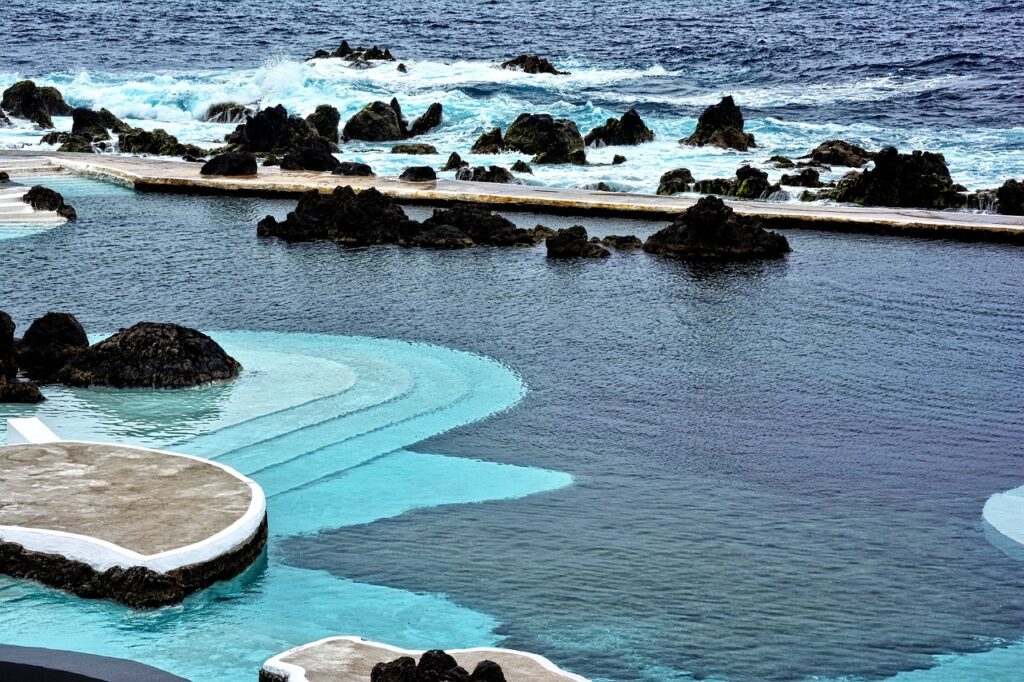
In the morning, we packed our bags and set off toward Porto Moniz, a town located on the northwestern tip of Madeira Island. What is it famous for? Primarily, its large natural lava pools filled with ocean water, both paid and free.
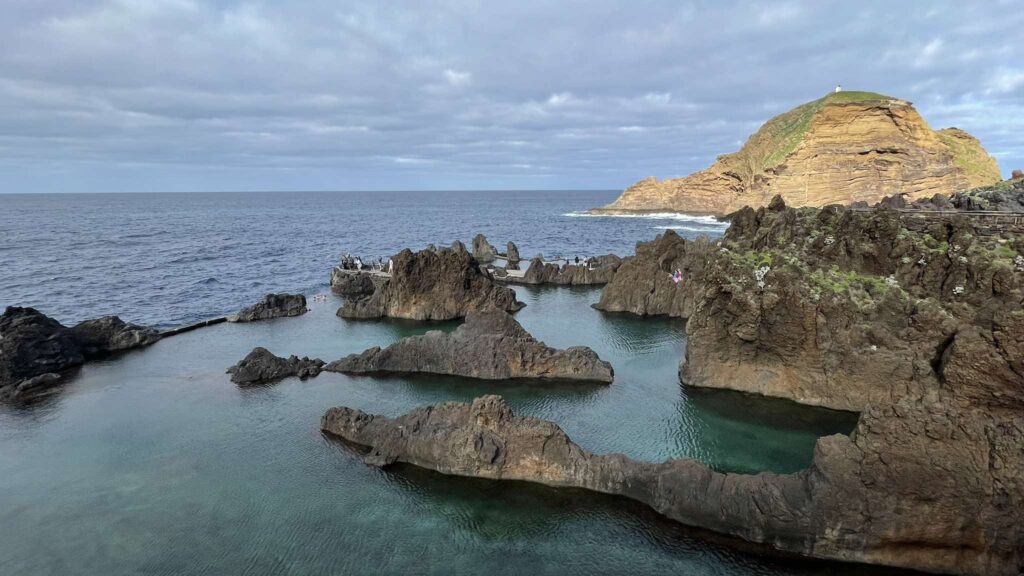
We brought our swimsuits, and the sun even came out. However, at the cape where the pools are located, there was a strong and not-so-warm wind. We didn’t really feel like undressing and jumping into the water. But some people were swimming and said the water was refreshingly invigorating.
Note that there are two swimming pool locations in Porto Moniz, close to each other. The first is the Aquarium pools and they are free, but a bit basic and there is no infrastructure. The second is the paid pools (cost 3 euros per adult) with nice stairs, sun loungers, etc.
How to Get to the Lava Pools:
Bus No. 80 is an option, but traveling by car is much more convenient. There are both free and paid parking areas near the lava pools.

Next, we headed into the mountains to Fanal Forest, located between Seixal and Ribeira da Janela. Fanal is a vast, ancient Til Forest (Ocotea foetens), with trees dating back to pre-discovery times of the archipelago. This forest is part of the local Laurissilva Forest, also known as the Laurissilva Forest (“Laurel Forest”). In 1999, it was designated a UNESCO World Heritage Site. Laurissilva forests have also been preserved in Cape Verde, the Azores, and the Canary Islands.
The forest is magnificent, with twisted old trees emerging through the mist. I highly recommend visiting this place—it’s incredibly atmospheric. Take a short circular hiking route to fully immerse yourself in the magical surroundings. The walk takes about 1 to 1.5 hours, and it’s absolutely worth it!
How to Get to Fanal Forest:
- You can drive there in a rental car—there is a free parking area here.
- Alternatively, you can book a guided tour by bus or in a small group by jeep, which usually includes other northern island highlights.
On the way back from Fanal, we made a stop at the Miradouro da Eira da Achada (here)—a great viewpoint offering stunning views of the northern coastline. There’s also a small free parking area available.
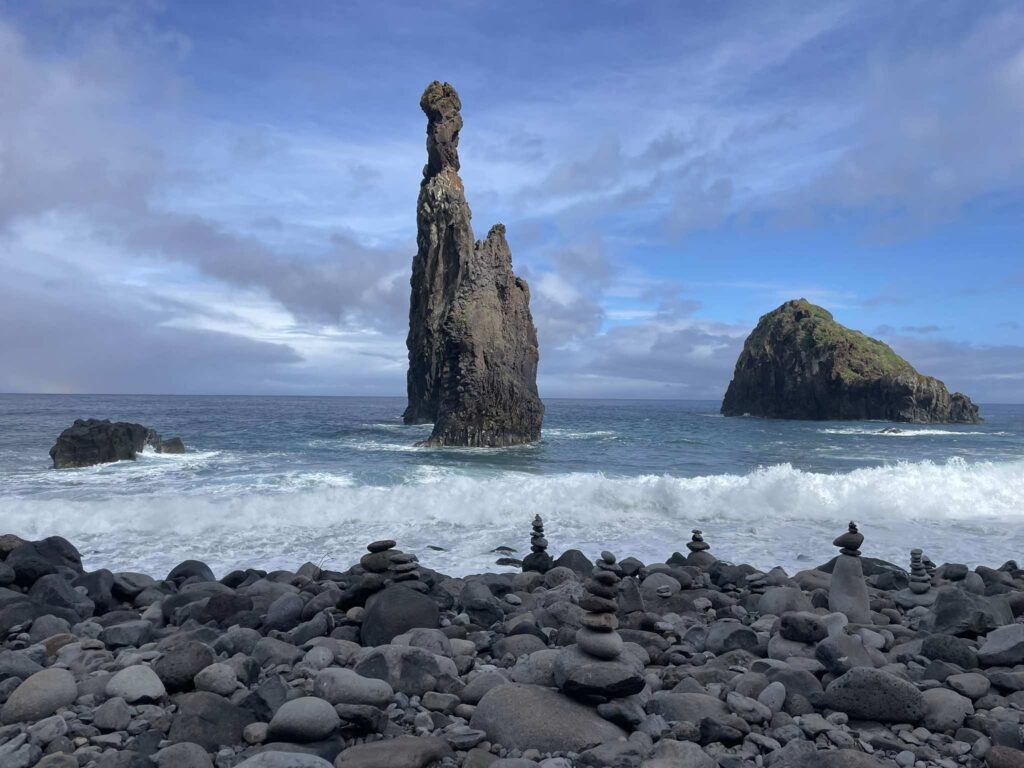
Our next stop was Ribeira Da Janela, home to the striking sea rock formations also known as Neptune’s Fingers. This spot features a beautiful pebble beach and a small viewing platform with a tunnel. The scenery is mesmerizing—you could sit for an hour just watching the waves crash against the rocks. Interestingly, the “Neptune Fingers” look different depending on the angle from which you view them.
How to Get to the Rocks at Ribeira Da Janela
You can get there by turning toward the shore at the tunnel exit between Seixal and Porto Moniz. Alternatively, you can descend from Fanal Forest through the village of Ribeira Da Janela.

Seixal
Our next stop was the town of Seixal, home to a large beach with natural black volcanic sand. We decided to swim here since the water was relatively warm (19°C in January). The air temperature was the same, and the beach was sheltered from the wind—so why not start the swimming season on January 25? And we did! It felt unusual to swim in water with black sand, as it made the water appear darker and less transparent due to the waves, which was a little eerie. But there were many people, even families with kids, enjoying the water, which reassured us.
The beach has free changing rooms, restrooms, and showers—very useful since the fine black volcanic sand gets everywhere. We parked our car for free near the beach here.
By the way, Seixal also has natural lava pools located near the beach. However, they were on the other side of the slope, where the wind was quite strong and unpleasant.
São Vicente
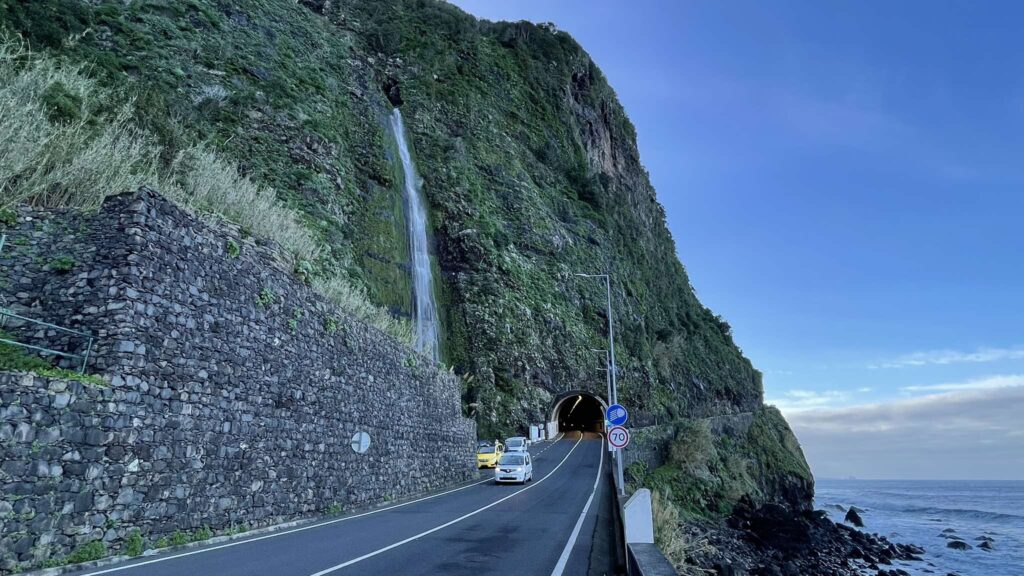
Next, we headed back toward São Vicente to see several waterfalls along the scenic ER101 road. It’s breathtaking to drive and witness massive streams of water cascading down cliffs. There is even a small parking area near the Cascata Água d’Alto waterfall—perfect for stopping to admire the view. We also walked down to a nearby rocky beach to see the scenery from a different perspective—it was stunning, absolutely stunning!
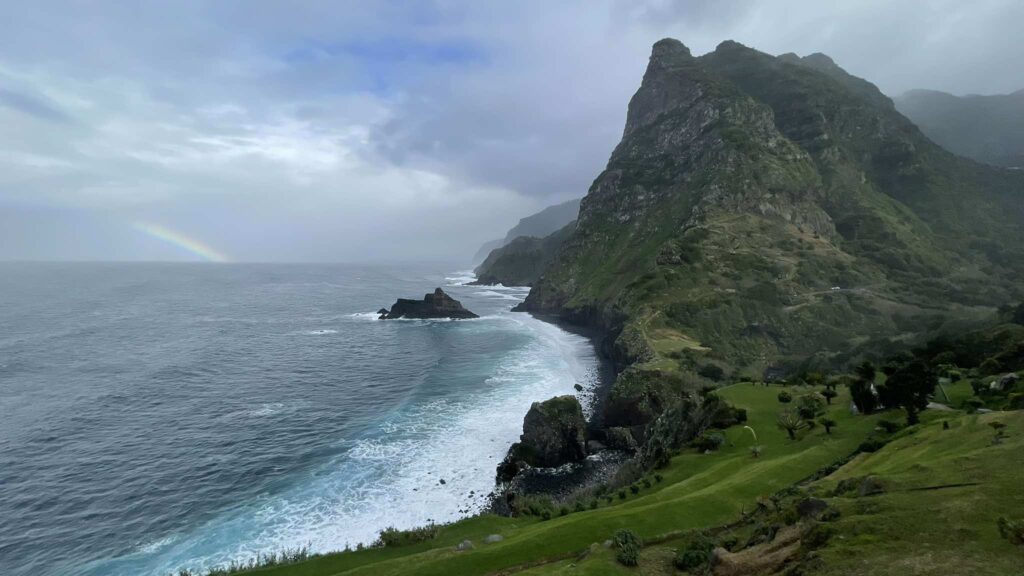
After leaving São Vicente, we decided to have lunch at Restaurant São Cristóvão, which boasts a stunning viewpoint overlooking Madeira’s northern mountain slopes as they descend into the ocean. The view is breathtaking! Even if you don’t plan to eat, it’s worth stopping by for a coffee or some photos. However, I highly recommend dining here — the octopus and fish dishes were absolutely delicious!
Accommodation in Santana

We then headed toward Santana, where we had booked a stay at Casas de Campo do Pomar B&B. This charming property offers cozy mini-apartments with a terrace and a beautiful valley view. The stay includes breakfast, and parking is available right at the entrance. Though it’s a roadside parking spot, the street isn’t a busy thoroughfare, so there’s plenty of space for cars.
Keep in mind that the most expensive stretch of road on the island is in the north, from Ponta Delgada to São Jorge. There is a long drive around a gorge and many switchbacks. But if you are lucky with the weather, you will see wonderful views!
Day 6 – Santana – Pico Ruivo – Levada dos Balcões – Funchal

After such an eventful previous day, I thought we wouldn’t have the energy for much. It had rained overnight, leaving behind only dew on the trees and flowers in the morning. The island seemed freshly washed and glowed under the sun—the mountains were clear once again.
We had breakfast and set off for the mountains, but first, we stopped to see Madeira’s traditional houses. One of the island’s iconic symbols is the brightly colored Palheiros houses with their distinctive triangular thatched roofs. You can find them for free in the very center of Santana, near the local town hall.
If you want to fully immerse yourself in the island’s traditional lifestyle, consider visiting the Madeira Theme Park (Parque Temático da Madeira). For just €3, you can stroll through the park, which features historic buildings, sculptures, and picturesque landscapes. You can also watch artisans at work on themed streets and browse numerous stalls selling handcrafted items. However, if you’re just looking for some nice photos and a short walk, the free traditional houses mentioned above will be enough.

Pico Ruivo
Just a 15-minute drive from Santana lies the highest mountain in Madeira – Pico Ruivo. You can drive up to the free parking lot located at the start of the PR1.2 hiking trail. The standard entrance fee for the trail is €3, payable via QR code or in cash if a ticket seller is present.
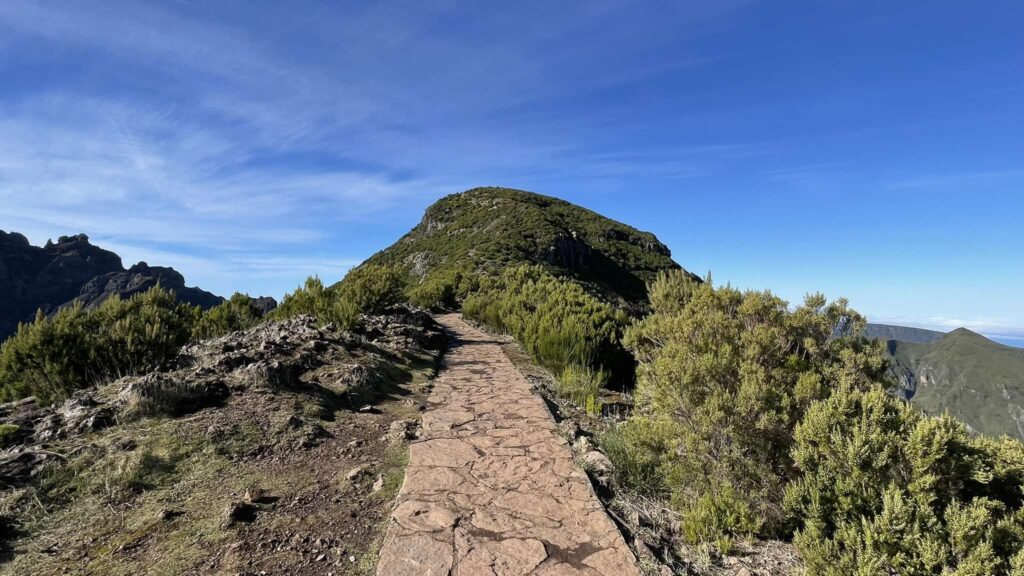
The hike is not too difficult; you just need to walk uphill along a well-maintained stone path with railings. The views along the way are breathtaking! Midway, there is a mountain shelter where you can grab a coffee or use the restroom. The trail is about 2.8 km one way, and we completed the round trip in about 1.5 hours. We also spent another 30 minutes enjoying coffee at Achada do Teixeira – Mountain Spot Café, located near the parking area. The pastries were delicious, though a bit pricey.
How to Get to Pico Ruivo:
- No buses go there – you will need a taxi if you don’t have a rental car. A taxi from Santana costs around €30 per vehicle.
- By car – from Santana, take a narrow but scenic road to the parking lot near Achada do Teixeira. From Funchal, follow the ER103 road via Santana.
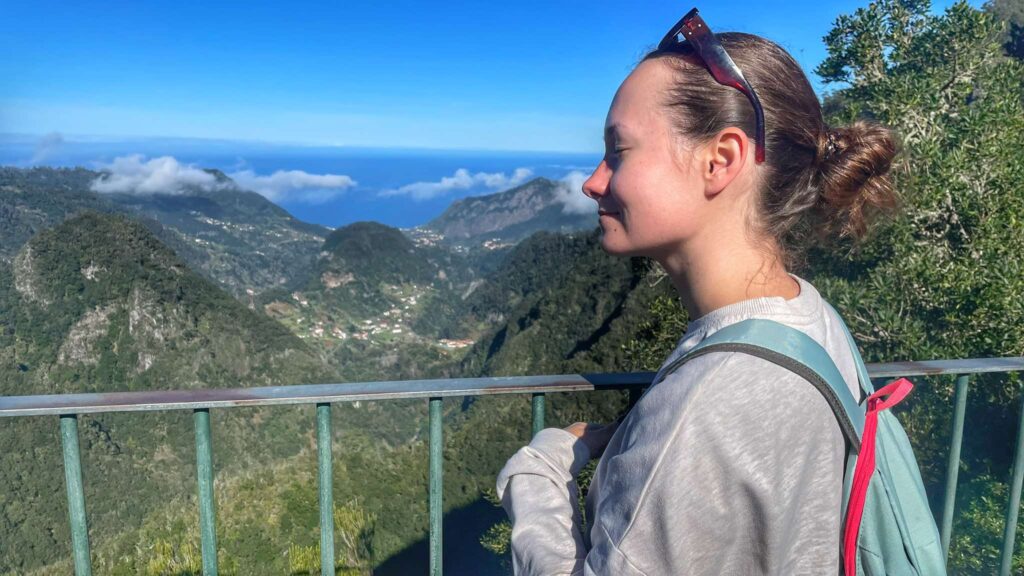
Next, we headed to another short but incredibly scenic hike – PR 11 Vereda dos Balcões. Conveniently, it was on our way to Funchal. This is a fantastic walk that leads to a stunning mountain panorama at the viewpoint. The starting point is located here. Parking is limited, but most people park along the roadside.
We then continued along the ER103 road to Funchal, where we stayed in the same central apartments as before. Having a parking space is essential in this city.
Funchal – What to See in One Day
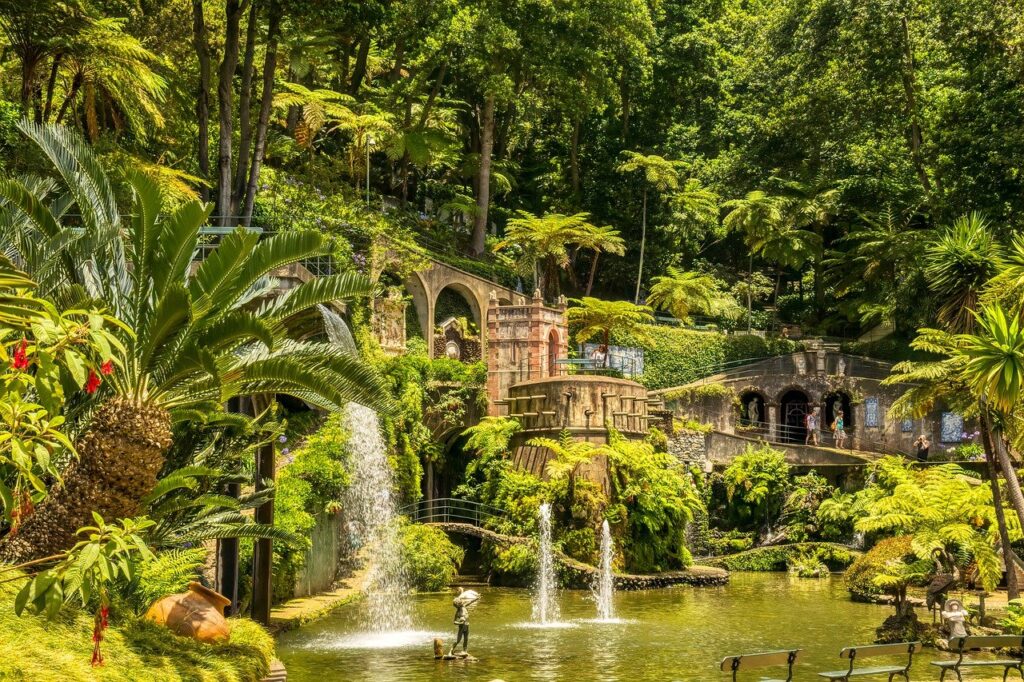
The main city of Madeira is Funchal, where almost all tourists from the “mainland” stay. Upon arriving at the airport, named after Cristiano Ronaldo, don’t be surprised that the young Portuguese footballer became a living legend on the island. He was born here, and every boy proudly wears a jersey with his name while playing football on local fields.
In the old town center, you’ll find Santa Maria Street, a must-visit for those who love graffiti and street cafés. Almost every door and wall is covered in colorful artwork—an artistic expression by local painters who have turned the timeworn buildings into a charming bohemian atmosphere.
If you enjoy vibrant market scenes, be sure to visit the Mercado dos Lavradores. Every Saturday, vendors from across the island offer a variety of goods, from fresh produce grown on mountain terraces to handmade crafts and freshly caught seafood. The island’s signature fruit is passion fruit, and from its juice and local rum, they make the warming drink Poncha, which you can try at the market or in any bar on the island.
Monte Palace Garden
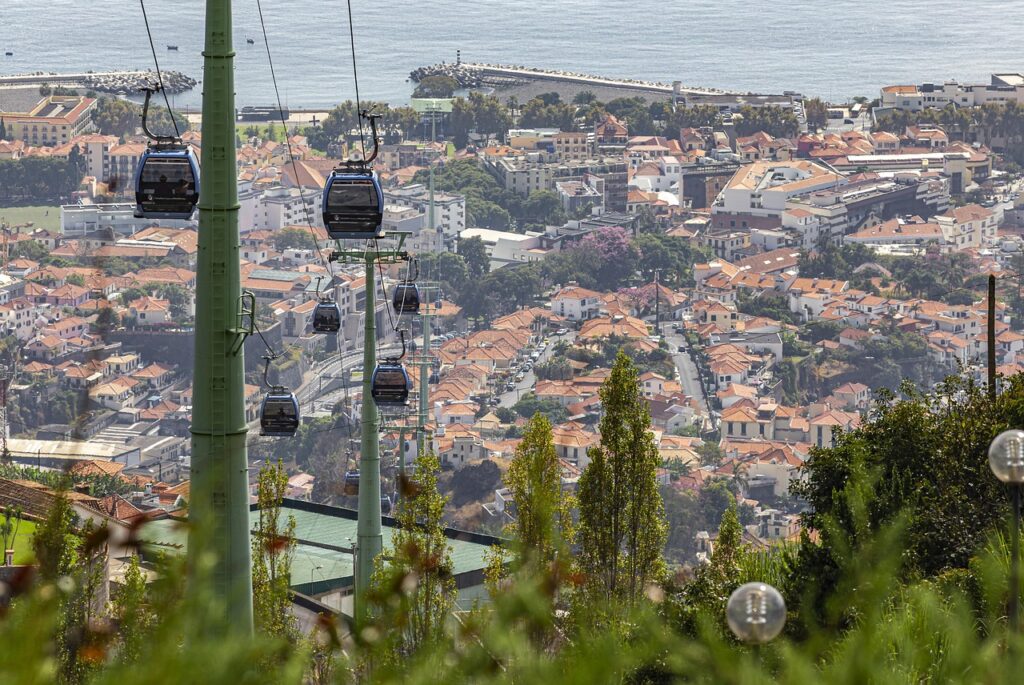
To get a panoramic view of Funchal, head to the Monte Palace Gardens, where you’ll find stunning landscape designs and elegant park architecture. This vast garden, once part of a grand estate, is perched on a hill accessible by a cable car from Funchal’s waterfront (€14 one way, €20 round trip). The gardens are filled with exotic plants from around the world, charming bridges, fountains, colonnades, and unique sculptures. If you have a car, it’s more budget-friendly to drive up and park on a nearby street.
For the descent back into the city, you can follow one of Madeira’s famous levadas, such as Levada da Serra do Faial. This scenic route offers some of the best panoramic views over Funchal and the vast Atlantic Ocean.
Day 7 – Viewpoints and Waterfalls on the Western Side of the Island
It’s the last day in Madeira. How should you spend it—relaxing on the beach or exploring the places you haven’t visited yet? The choice is yours. We decided to take one of the easier yet stunning levada walks and visit some of the most breathtaking viewpoints on the island’s western side.
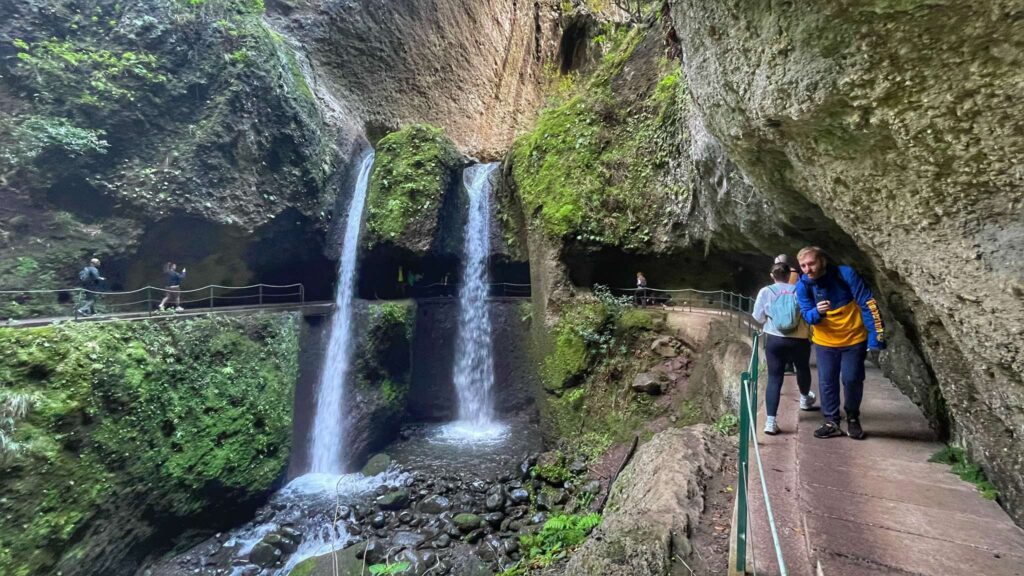
Levada Nova starts in the town of Lombada and stretches just 3 km in one direction, but the views along the way are truly spectacular. At the end of the trail, after passing through a long dark tunnel (bring a flashlight!), you’ll find a stunning two-tiered waterfall. The path actually passes beneath this waterfall, making for an unforgettable experience!
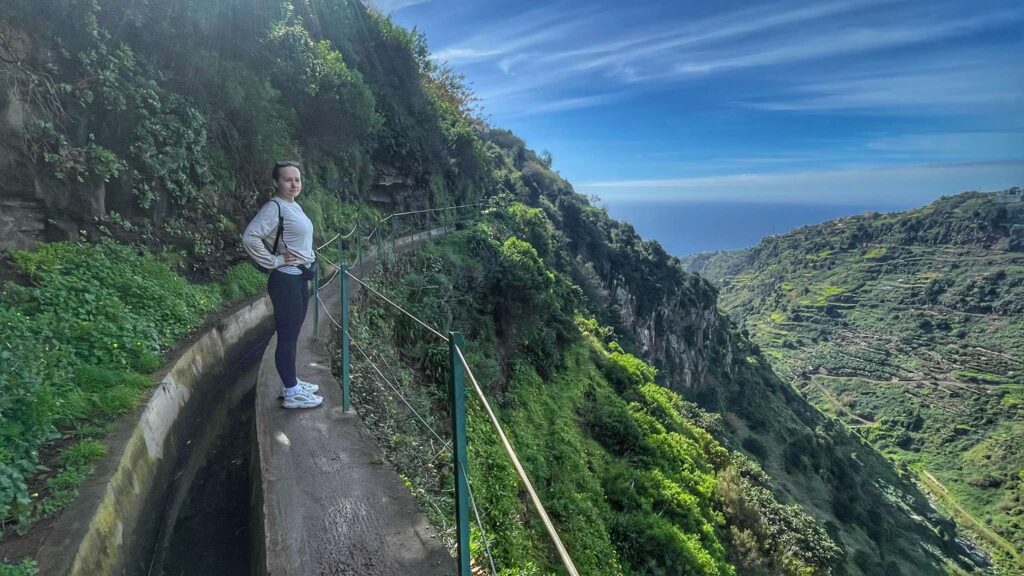
If you don’t want to return the same way, you can descend and take a different path on the way back via the nearby levada – Levada do Moinho (not to be confused with PR7, which is located in a different part of the island and was closed at the time).
The total distance is 6 km, taking a maximum of 2 hours. The views and waterfalls along the way are stunning!
How to Get to Levada do Nova
The trail starts near the church Igreja da Lombada, where there is a small parking area. You can leave your car there or park further up the road. We started the hike from the opposite side – here, where more parking spots are available. We first walked along the upper section before descending towards the church.

Next, we headed to a truly atmospheric and remote location that can only be reached by cable car – Achadas da Cruz. This hidden gem on the oceanfront feels like a lost world. Here, you’ll find small agricultural plots, tiny holiday cottages belonging to local residents, and a beautiful stone path that runs along the coastline and massive cliffs.

The cable car was not built for tourism but for farmers, as it is the only way they can reach their plantations below. However, visitors are welcome to use it. The system consists of just two cabins—one going up and one going down. Be sure to check the operating hours in advance, as there are no staff members at the bottom, no call buttons, and no way to summon the cabin if you get stuck. What awaits you below is a secluded beach, powerful waves, and the serenity of solitude.
Price and timetable:
The funicular costs 5 euros for a round trip. At the top, an operator manages payments (cash only) and ensures the cabin does not exceed its limit of 6 people. At the bottom, passengers board independently as the system is fully automated. In winter, the last descent is at 16:30, but everyone who has already gone down will, of course, be gradually brought back up.
How to Get to the Achadas da Cruz Cable Car
You can only reach this location by car – parking near the cable car is available here.
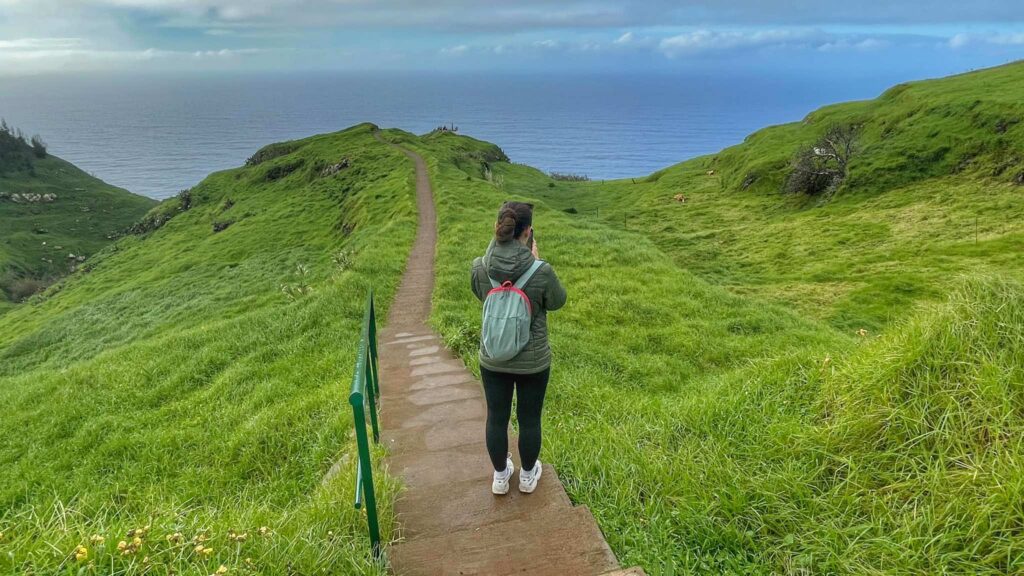
The next viewpoint is located near the church Capela de Nossa Senhora da Boa Morte. This is a lesser-known but truly impressive spot. There is free parking available next to the church.

Next, we visited the “Devil’s Throat” waterfall, which can be seen from the Miradouro da Garganta Funda viewpoint. Parking here is very limited, accommodating only 4-5 cars. From there, a short walk leads to the breathtaking sight of a 200-meter-high waterfall carving its way through a circular rock wall.
We ended the day at the Farol da Ponta do Pargo lighthouse, a popular spot for photographers and sunset lovers (weather permitting). This location is stunning: a lighthouse, towering cliffs in every direction, and the vast ocean — it’s truly mesmerizing.
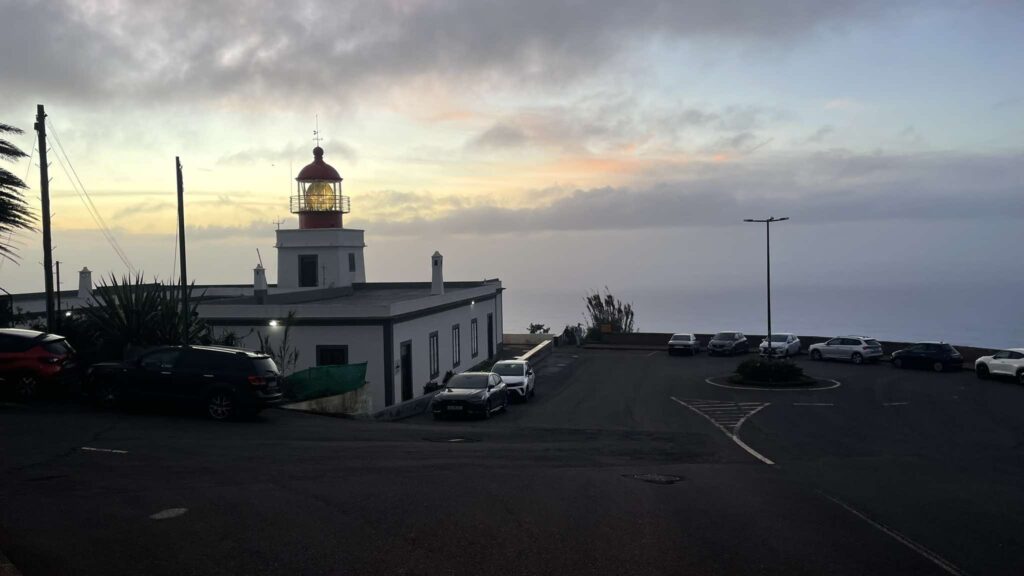
By the way, nearby is a great restaurant, O Farolim, where we enjoyed a delicious meal of Espetada — Madeiran-style beef skewers on a stick.
In the evening, we returned to Funchal, packed our things, and in the morning, we headed to the airport, where we returned the car and flew home.
This trip was one of the most memorable in recent years. Incredible Madeira, a magnificent blooming island — I hope to return someday.
Useful Articles and Links:
- Alentejo Coast – Where to Find Portugal’s Most Beautiful Wild Beaches
- Beaches near Lisbon – where to relax, walk and surfing
- Rota Vicentina – Hiking Along the Ocean
Car Rental – Affordable options are always available on the aggregator DiscoverCars
Green Card and travel medical insurance – available online at HotlineFinance
Hotel and apartment bookings – Booking.com